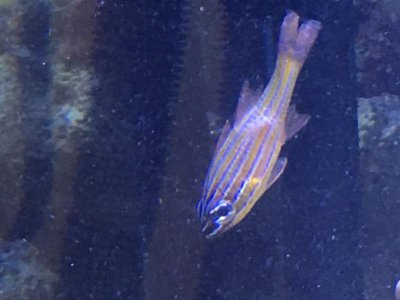
Is this ICH? Ruby Reef to treat if no QT?

It hasn't claimed a single fish in my tank I have 70 Fish in 5 tanks. I have lost more fish jumping out then I did to ich. Just wish they did more research on it. I know a lot of hobbiest have something happen to them once and then they spread it around like it a fact. 20 years ago when I used to keep marine fish ich was a killer. Last 5 years I haven't really worried too much about it


Sent from my iPhone using Tapatalk Pro
 
Also how many post on here go like this
Bought a new fish. Blame the lfs because it got ich and it dies. Must be lfs fault no other fish got ich.

Maybe that fish was ill for something else. Just saying wish people a lot smarter than me would do some research on this


Sent from my iPhone using Tapatalk Pro
 
Don’t understand why online everyone says ich is a killer. My hippo and powder blue but had ich. 3 years later and 1 year later they are still growing and happy. Why is it such a killer is all these cases and mine it’s no big deal. Not here debating you shouldn’t qt or anything like that but I simple by Fish that been at my lfs for 2 weeks. He treats with Cooper. Then I put fish in my sump for a week or frag tank and then add to my main tank. Nothing special and in 3 years besides losing a few wrasses. My tank has been dead free. But with 15 wrasses then do fight a lot. After 18 months together my female melanarus finally decided she didn’t want to live with the male anymore.


Sent from my iPhone using Tapatalk Pro

IMO ich is not capable of killing a fish that is otherwise healthy and is living under ideal conditions. However, I am very wary about making statements like these since these would still be case sensitive and people often prefer comforting examples over their hars reality. Everybody likes to think they are keeping their fish under ideal conditions. But not everybody is and "ideal" , to most parts, is a vague concept for an aquarium. But overall, I agree with your statement. Dangers of ich is sometimes overstated, there are pathogens that are almost 100% death sentence to all the fish within the tank, ich is not one of them.


That being said, not everybody has tank that are "ideal" accept having ich. There is so many unseen event happening in our tank that we cant see or control. There is a whole micro ecosystem of protozoans, bacteria, fungi algae, viruses... where each inhabitant have certain roles. Same way ich prey on fish, there are protozoan predators and pathogens that prey on ich. I think this is one of the reasons why people who have new tanks are more inclined to lose fish to ich while fish usually do not die of ich in mature systems.

For fish to die of ich, it needs to reach plague levels and "puncture" the host fish so much that it loses the ability to regulate water within its body or get secondary infections. In mature systems, ich simply cannot reach plague levels. When ichs number increase, numbers of its predators and pathogens also increase, keeping the numbers in check. On top of that, there is a barrage of filter feeds and sand grazers that can passively consume ich at different stages of its life cycle. Again these guys are only found in large numbers in mature tanks. When ich cannot reach plague levels, host fish has the chance to develop immunity against the infection. So fish become asymptomatic to ich.

Overall, does this mean ich is cured? Most likely not, it is most likely still within the system and is still infecting fish at a low level. Ich is also present in natural environments of all these fish we keep and they all most likely get infected with ich. But they dont die since it doesn't reach plague levels in a healthy ecosystem. Remember, ich is a parasite, if it kills all available hosts, it will die as well. Ina healthy ecosystem, parasites do not kill healthy individuals.

There is also some anecdotall evidence that it might eventually disappear due to extensive inbreeding if no new ich strains are added for a long period of time. But I dont think anyone made a conclusive study on this.
 
IMO ich is not capable of killing a fish that is otherwise healthy and is living under ideal conditions. However, I am very wary about making statements like these since these would still be case sensitive and people often prefer comforting examples over their hars reality. Everybody likes to think they are keeping their fish under ideal conditions. But not everybody is and "ideal" , to most parts, is a vague concept for an aquarium. But overall, I agree with your statement. Dangers of ich is sometimes overstated, there are pathogens that are almost 100% death sentence to all the fish within the tank, ich is not one of them.


That being said, not everybody has tank that are "ideal" accept having ich. There is so many unseen event happening in our tank that we cant see or control. There is a whole micro ecosystem of protozoans, bacteria, fungi algae, viruses... where each inhabitant have certain roles. Same way ich prey on fish, there are protozoan predators and pathogens that prey on ich. I think this is one of the reasons why people who have new tanks are more inclined to lose fish to ich while fish usually do not die of ich in mature systems.

For fish to die of ich, it needs to reach plague levels and "puncture" the host fish so much that it loses the ability to regulate water within its body or get secondary infections. In mature systems, ich simply cannot reach plague levels. When ichs number increase, numbers of its predators and pathogens also increase, keeping the numbers in check. On top of that, there is a barrage of filter feeds and sand grazers that can passively consume ich at different stages of its life cycle. Again these guys are only found in large numbers in mature tanks. When ich cannot reach plague levels, host fish has the chance to develop immunity against the infection. So fish become asymptomatic to ich.

Overall, does this mean ich is cured? Most likely not, it is most likely still within the system and is still infecting fish at a low level. Ich is also present in natural environments of all these fish we keep and they all most likely get infected with ich. But they dont die since it doesn't reach plague levels in a healthy ecosystem. Remember, ich is a parasite, if it kills all available hosts, it will die as well. Ina healthy ecosystem, parasites do not kill healthy individuals.

There is also some anecdotall evidence that it might eventually disappear due to extensive inbreeding if no new ich strains are added for a long period of time. But I dont think anyone made a conclusive study on this.


Very insightful. Thank you. Helps me understand a little better without knowing for sure. Well spoken and said


Sent from my iPhone using Tapatalk Pro
 
There will always be contradictions with ich, as IME very few people actually QT and tons of people have successful tanks using fish that are certain to carry it (as it is natural).


  • [1]People have acknowledged that ich is generally present on wild fish populations, but not fatal due to not reaching plauge levels that can occur in aquariums.

    [2]It is well known to become fatal in aquariums, given the right conditions. The assumption is that those conditions are simply being a closed environment (i.e. Aquarium), but [3] below contradicts that.

    [3]It is also known that seemingly many aquariums/fish become resistant and/or immune to ich.

The question for me is I have no idea how people differentiate between [1] and [3], other than perception. The assumption that just being in a closed environment will lead to ich fatalities seems false since there are plenty of examples that defy this (some openly brag about it), and it seems that some aquariums can exist as if ich would in its natural state (or even dissapear?).

People will also often speak of "it being hidden in the gills!" in any aquarium that may have had signs of ich but never treated it, but IMO that is simply perception with no direct evidence. The implication is that the fish are still being "hurt" somehow but that you just can't see it. It's a weird assumption, because if you think closed systems are the source the problem, arguing it is in some quasi state of being a "problem" but also not a problem... is kind of weird. Semi-plague? Mini persistent plague? Hmmmm....

I understand the drive to QT and employ methods to ensure [2] never happens, but there seems to be some real resistance from people to accept that [3] can and does happen frequently. Furthermore It often seems like the catastrophic [2] situation is often in tanks that employ the QT, but something "slips through the cracks". Makes me wonder is some tanks just become more prone to the severe issues when they are actually in an unnatural state (i.e. unlike [1]) of being completely ich free using strict QT procedures.

Anyway, I am in no way advocating not using QT as there is far more than ich to worry about, I just find ich to be in interesting as you have some people going to extremes (that frankly many people will never do for an average aquarium), and others who do nothing (and know its there) and both can be successful.

As for the OP, that looks like a serious case of ich and not good for those fish, I would at a minimum treat them.

 
Last edited:
There will always be contradictions with ich, as IME very few people actually QT and tons of people have successful tanks using fish that are certain to carry it (as it is natural).


  • [1]People have acknowledged that ich is generally present on wild fish populations, but not fatal due to not reaching plauge levels that can occur in aquariums.

    [2]It is well known to become fatal in aquariums, given the right conditions. The assumption is that those conditions are simply being a closed environment (i.e. Aquarium), but [3] below contradicts that.

    [3]It is also known that seemingly many aquariums/fish become resistant and/or immune to ich.

The question for me is I have no idea how people differentiate between [1] and [3], other than perception. The assumption that just being in a closed environment will lead to ich fatalities seems false since there are plenty of examples that defy this (some openly brag about it), and it seems that some aquariums can exist as if ich would in its natural state (or even dissapear?).

People will also often speak of "it being hidden in the gills!" in any aquarium that may have had signs of ich but never treated it, but IMO that is simply perception with no direct evidence. The implication is that the fish are still being "hurt" somehow but that you just can't see it. It's a weird assumption, because if you think closed systems are the source the problem, arguing it is in some quasi state of being a "problem" but also not a problem... is kind of weird. Semi-plague? Mini persistent plague? Hmmmm....

I understand the drive to QT and employ methods to ensure [2] never happens, but there seems to be some real resistance from people to accept that [3] can and does happen frequently. Furthermore It often seems like the catastrophic [2] situation is often in tanks that employ the QT, but something "slips through the cracks". Makes me wonder is some tanks just become more prone to the severe issues when they are actually in an unnatural state (i.e. unlike [1]) of being completely ich free using strict QT procedures.

Anyway, I am in no way advocating not using QT as there is far more than ich to worry about, I just find ich to be in interesting as you have some people going to extremes (that frankly many people will never do for an average aquarium), and others who do nothing (and know its there) and both can be successful.

As for the OP, that looks like a serious case of ich and not good for those fish, I would at a minimum treat them.


IMO another factor that makes ich more dangerous in closed systems is higher amount of nutrients within the water. I dont know if there are any studies that show much nitrate and phosphate ich can absorb from the water, or how much it changes the growth rate, but every single celled organisms (and most marine multicellular organisms) can absorb nutrients from the water. There are also some evidence from the hobby suggesting ich is more prolific in aquariums with high nitrate (a common advise for living with ich; "keep nitrate levels low").

Higher nutrients is also a bigger problem for younger tanks and less of a problem for mature tanks. So younger tanks have more nutrients for ich to grow on and less micro-fauna and filter feeders to keep its population in check . If you add fish to that mix (as a dded bonus for ich, these conditions will also stress fish), ich can reach plague levels very fast before fish have time to develop immunity.

In mature tanks, nutrients are low and there is predator pressure on ich population. So population cannot reach plague levels. Fish have the chance to develop acquired immunity against ich. So the ich infection levels drop to the basal rate found in the wild.
 
Yes I never believed the theory of it living in its gills Yes we know Fish carry ich in there gills in the wild, but if this disease is so deadly and dangerous how on earth are my fish still living after 3 years living with it. You would think their gills would be devastated by now. Yes I argee in the op case that looks like a bad case. My tangs usually have s few spots on them and are still swimming and eating like pigs


Sent from my iPhone using Tapatalk Pro
 
Does the QT need:

Substrate?
Live Rock?
Is a canister filter ok? What type of filtration is needed in a QT?
Need a protein skimmer?

My current setup is a 54 gal DT, fluval 306, eshops PSK-75, 30 pounds live rock, 25 dead rock, 2 orbit IC bars, live sand bottom

For QT, a fish tank, or a bucket, or trash can, something size appropriate to hold the fish.
A heater to keep it warm.
A filter for water quality

No substrate needed
No live rocks needed
A piece or two of PVC pipe, elbow or something washable for a shelter
A canister filter or hang on is fine.
 
Hey gang...love all the participation on the thread...thank you...update, 1 of the cardinals perished. His fins seemed to melt away..i tried to catch him and take him to the lfs for treatment but was unable to catch him. So went to the shop, came home, did a major water change (40%) and he did not do well with that...started having buoyancy problems and just didn't make it...That said, the other cardinal who had ich seems to be doing just fine. I guess this whole episode has taught me a few things. A - it seems that fish can live with ich. It's a roll of the dice, but true nonetheless. B - i think I way overreacted to the presence of ich in the tank. In attempting to solve this with Ruby Reef Kick Ich, I was told to raise the temp of my tank to 86 degrees, turn off my skimmer and remove the carbon from my canister filter. All of this resulted in my royal gramma dying (most likely from the heat), killing a decent amount of the coraline algae on my live rock and jacking my water chemistry up in the process. I actually spoke to the Ruby Reef people about their product and told them I was advised to raise tempt to 86 degrees. To be fair to them, they disavowed this and suggested i got bad advice from the lfs that suggested I do that. Still, if I had to do this over, I probably would have just not done anything and let the ich take its course since in the end the lfs advised against sacrificing water chemistry for ich treatment. Mind the corals which I've spent more money on than fish...

Anyway, I could spend about $300 - 400 to set up a decent QT and then let my DT go fallow for 3 months. I could also just take my fish to the lfs and let my DT go fallow for 3 months. If I wanted to eradicate ich, I'd do one of those, and 3 months seems to be what most agree upon for a good fallow period. However, my wife thinks that we shouldn't be trading in our "pets." Now, I'm inclined to save the $300 -400 for a QT setup and just buy new fish when and if the current inhabitants die from ich. Maybe they won't...?
 
Sometimes when you do less, you actually do more.
It is always preferable to not use meds on our fish, fighting it on their own can bring better results and a more immune fish.
My QT was $50 bucks, $25 for a glass 20g, $15 for a small heater, $10 for sponge filter.
Used a desk lamp for light.
72 days is the very safe standard for DT fallow, some do it in less.
 
Uncle...I would intend to keep my fish in the QT for 3 months as well - hence the need for something larger than a 20g...do you agree?
 
I would just leave those fish alone. I am not a fan of leaving your tab fallow for 72 days. Every coral or frag you put into your tank also would have to be in a fish less system for 72 days or all your work would be for not. Keep your water clean. Feed your fish well and try to only buy fish that been at lfs a couple week or qt new arrivals


Sent from my iPhone using Tapatalk Pro
 
I'm guessing the other cardinal is about to succumb?

I'm guessing the other cardinal is about to succumb?

So one of the cardinals died the other day. I thought the second might make it but then I notice this lesion developing today. Bizarre. Never seen a lesion like this on a fish. Spots, yes. Lesion, no. Anything special or what you might expect from ich?
card.jpg
 
I have not seen that in ich, actually, I had not seen a strain of Ick that looked so big on a fish, but pictures can be deceiving...learn something new everyday
 
Think I spent like 100$ total on my 40 breeder QT. Plenty big enough for all 10 of my fish for the 72 days.

A QT doesn't have to be an elaborate setup. A tank of some sort that will hold water, heater, and air stone is all thats needed.

When I first started I kept my clowns in a 5 gallon bucket for 72 days, changing water every couple days with 0 problems.

FWIW, I just lost all my fish due to ich. It came in on a snail shell from a CUC replenishment. Wiped out my entire livestock in 4 days.
 
So one of the cardinals died the other day. I thought the second might make it but then I notice this lesion developing today. Bizarre. Never seen a lesion like this on a fish. Spots, yes. Lesion, no. Anything special or what you might expect from ich?
View attachment 388859

You might have ich and uronema together. That lesion looks very much like uronema. Or it might be a bacterial infection and ich. But uronema is also known to cause swim bladder issues, which kinda fits in with your description.

When ich parasites leave the host fish, they puncture the skin. This makes them susceptible to pathogens that attack open wounds (such as uronema or certain bacteria).
 
Thanks all...I lost one of my clowns...went from 8 fish down to 4 in like a week. I think I'm going to set up a QT though will try to do as cheap as possible....buy a 40-50g tank off craigslist then filter and heater new.

I was thinking about trying a 20-30 g QT set up by my LFS said that for more than 4 fish (where I will be in the future), that would be too small for an extended isolation period...

Many thanks again to all for the feedback!
 
Thanks all...I lost one of my clowns...went from 8 fish down to 4 in like a week. I think I'm going to set up a QT though will try to do as cheap as possible....buy a 40-50g tank off craigslist then filter and heater new.

I was thinking about trying a 20-30 g QT set up by my LFS said that for more than 4 fish (where I will be in the future), that would be too small for an extended isolation period...

Many thanks again to all for the feedback!

Do a leak test on the tank you got from CL. Fill it up with water outside.
 
Back
Top