LED Troubleshooting

In my case V(f) was substantially different.. (different colors w/ much diff V(f) but equal chip count)
IF my thinking is correct.. a higher mA driver would solve that problem since those chip differentials would not be as extreme as in my case.. and the voltage "boost" @ higher mA would overcome it .. ;)

As to my understanding trying to run a red and a blue in parallel wouldn't work since the voltage @ mA "latch" wouldn't permit a v(f) high enough to light a blue (say the driver is 250mA constant current) @ 25C .. ;)
and of course the lower the mA the duller.. ;) I assume you could extrapolate to close to zero???

sorry, just babbling..

.....babble, babble........that's kind of what I figured, though with a current mirror (just a pair of transistors) you could! Why, I don't know, but you could......

Usually parallel arrays are using the same chips(or combination of chips) in each parallel string, as should be the case using two of the OP's multichips. Though it is possible that they do not both use the same RB diodes (possibly from two different production runs). Otherwise they should be very close in Vf.

Though essentially two of the 50 watt multichips in parallel is really 10 strings of 10 LEDs all wired in parallel so the odds of imbalance get high pretty fast........... :)
 
you can do it w/ resistors.. at constant voltage..so to speak
0J3106.350.jpg


Just grabbed this for fun.......

but now you went way beyond me..
http://en.wikipedia.org/wiki/Current_mirror

but I don't think you can get a mirror if one LED hasn't "fired" w/ the lack of V(f)

Until the LED "lights" the current is unimportant. Not sure a "mirror" would fix this..
Take a 3V LED and hook it to a 10A 1V PS and nothing will happen.........
 
but I don't think you can get a mirror if one LED hasn't "fired" w/ the lack of V(f)

Until the LED "lights" the current is unimportant. Not sure a "mirror" would fix this..
Take a 3V LED and hook it to a 10A 1V PS and nothing will happen.........

It does work. Rather fun to play with. Any old NPN transistors will work as long as they are thermally connected and electrically isolated from one another. Ideally they sequentially numbered off the same production run, but, that's just a technicality....

The two transistors equalize the voltage drop on the two or more parallel strings. The transistor(s) connected to the string(s) with the lower Vf increases it's voltage drop to even out two strings. There is a point at which this doesn't work if too much power is being dissipated by one of the transistors it may burn out (or more likely reach thermal shut down point), In which case you should probably reconsider running them in parallel :) or get larger transistors and a bigger heatsink for them:lolspin:
 
got to think about that in relation to this:
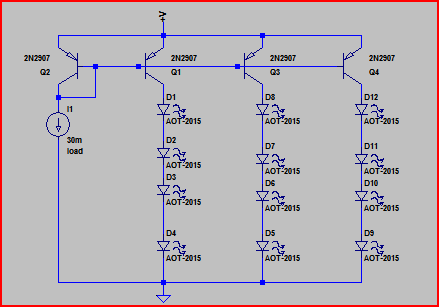
I1 represents the open drain output of your LM3916 set to 30mA. Q2 forms the reference for Q1, Q3 and Q4 (all bases tied together) so the same current that flows through Q2 will also flow through Q1, Q3, Q4. So you can say Q2s collector-emitter current "sets" the current for the rest of the transistors.
30mA will flow through each series chain of LEDs, as long as the supply voltage is high enough for the diode drops + a bit for transistor (say at least 0.5V)
Note that the transistor shown is not a "recommendation", rather the first I clicked on in LTSPICE - any typical small PNP should be suitable though. Same with the LEDs.
Also note that you cannot vary the current linearly by altering supply voltage as it's a constant current setup. To do this you would need to vary the LM3916 current setting.
http://electronics.stackexchange.com/questions/25206/switching-3-different-voltages-with-one-input

too......much........thinking... Time to eat.. ;)

2lofZ.png
 
Back
Top