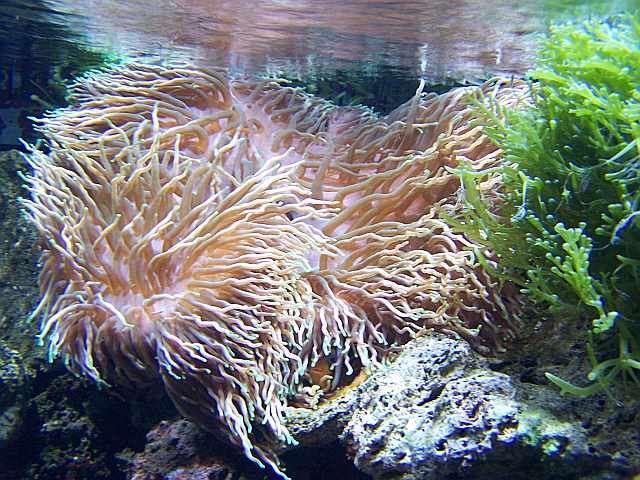
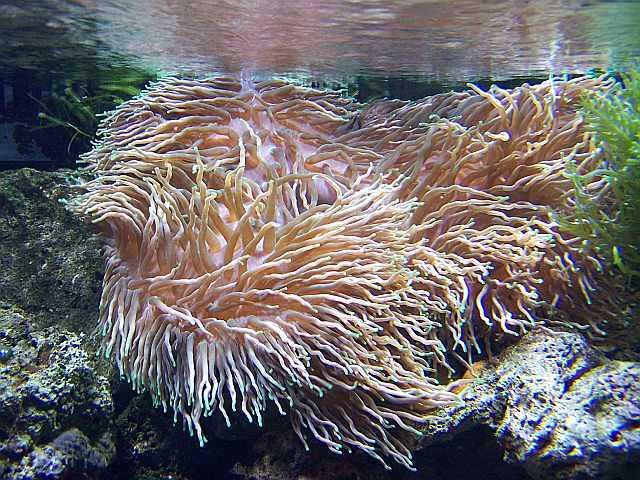
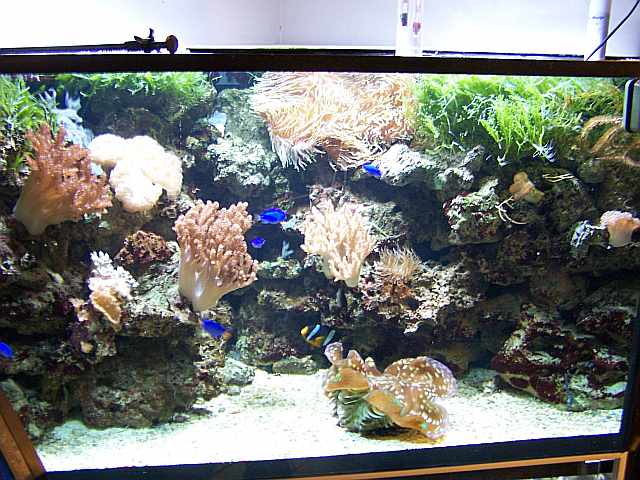
Re: Let's have some fun. Who on RC has the 'oldest' nem?
<a href=showthread.php?s=&postid=8568610#post8568610 target=_blank>Originally posted</a> by sonofgaladriel
Also, let us in on what you believe to be the 'key' to keeping that particular variety healthy for so long.
My thinking on this:
- Each anemone species has its own preferences as to where it will want to live on the reef, and how it will want to attach to the substrata. Paying attention to the needs of the species and modeling what they need as best you can is key. Some prefer to protect their pedal disks, some will prefer to be out in the open.
- Water movement and types of water movement is key. Again, depends on the species, so paying attention to where the anemones live on the real reef will offer up clues to what they're looking for. Anemones that reside near the waterline will appreciate wave like flow conditions and high light intensity, for example.
- Trying not to overdo it, is important. Pick your favourite things and try to restrict yourself to that. Again, look to the real reef as an example. If an anemone is part of a colony, or solitary .. If solitary, how large is the area that it inhabits before you see another anemone? Multiple anemones in one tank may sound desirable, but may have unintended consequences. Hypocrite alert: I'm really bad at following this particular piece of advice myself. I have two strains of BTA and two S. gigantea carpets in the same tank water (now actually in the same tank now that I moved one of my carpets over). I do notice odd behaviours at times that could be attributed to a form of territorialism/diffuse competition. In general it is far better, in my opinion, to avoid "multi species assemblages". I think the effect is worse with newly collected specimens .. ie. I think it is better to carry them over that initial period of acclimizing to captive life if isolated from other anemones. (Exceptions may exist.)
- And unfortunately, there is an element of luck. Some specimens just don't make it into captive life, for whatever reasons. This makes it a hard call, I assume the overall statistics on this are still as grim today as they were 5 or 10 years ago. It is, therefore, imperative upon us as hobbyists to make careful, informed, measured choices. It seems to me that those specimens that do "make it" tend to be very hardy, undemanding creatures. It's just that "first little while" that is so tricky. There must be something in the collection/importation/shipping/retail/etc cycle that is just too hard on them. Whether it's sharing the same water as other stressed anemones, being in darkness for extended periods of time, oxygen, temperature, .. etc. etc. .. who knows. The real trick is learning to recognize a "good bet" versus a "not so good bet." There is a question of ethics, I would have to say, about those that don't make it. Is it worth importing 10 anemones for the 1 of that 10 that won't die? .... I really kinda have a hard time wrestling with that question myself. Hopefully we will see the day that we see more species available from captive rearing sources as opposed to wild-collected, since the cost seems to be very high.
Sorry I didn't mean to turn this into a soapbox thing. Hopefully some of these thoughts prove helpful.


 [/IMG]


 The colours in there are amazing and one day I hope I can have a tank half as nice as that.


 ).
).