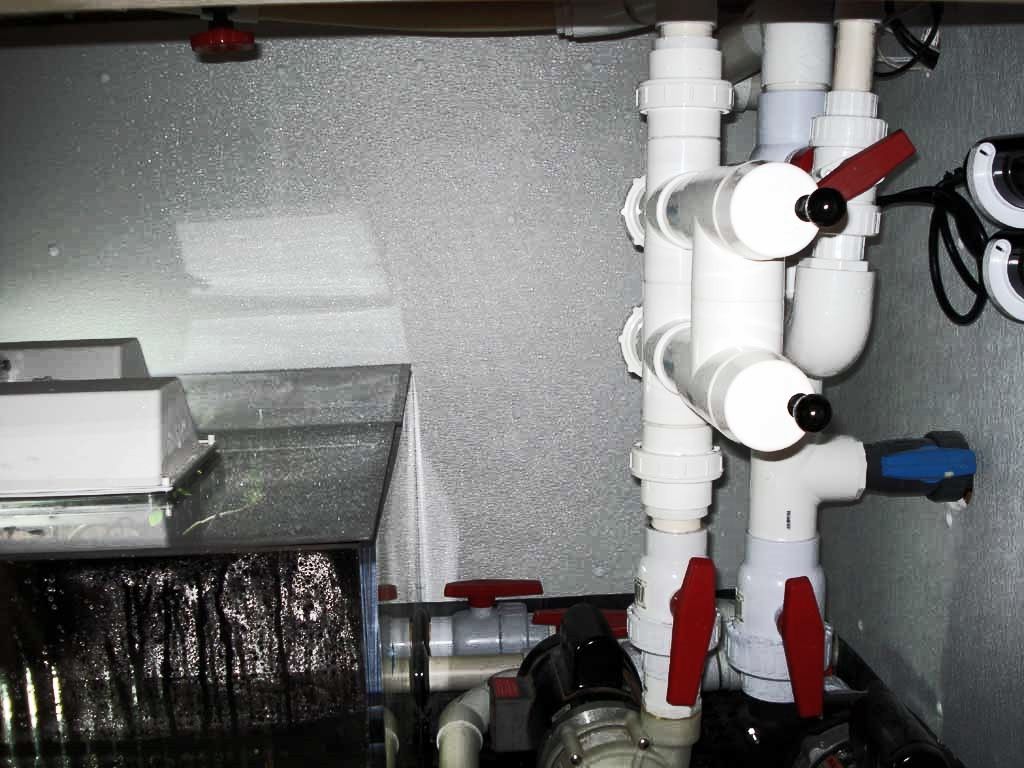
Manifold 'Domino' Affect?

TheFishTeen

New member
While designing my manifold for my upcoming system, I thought of something and it's really starting to make me curious. So say you have the average manifold: Pump feeds a whole bunch of ball valves (or gate's if your feeding a skimmer or such), and you've got your reactors, refugium etc. When you close the first ball valve, you are removing the feed to whatever is connected to it.

But, wouldn't the next valve (and all the proceeding one's) receive more water now that there is one less thing to feed?

An example would be if you have a return pump that does 2000GPH, and you have 4 returns, your getting about ~500GPH from each outlet. In the case of the manifold, you are closing one of those outlets therefore the water that would have exited that first outlet is now continuing and exiting the next ones over. If that is true, then that means you have to adjust all the other valves too, now that more flow is being forced into them.

In other words, closing one manifold outlet is creating a domino affect. Every other outlet is affected by the other.

Is this correct? If so, how could I prevent this, while still only using one pump?
 
You're probably right in that one valve's state will affect all of them but I think the effect is a little more limited having the return which is essentially open. On my manifold it seems that the flow coming out of the valves are less affected than the return which in my case is the only part that is essentially open completely. My return is really all the flow that is left over after getting by the manifold so maybe that's why in my case it seems the reactors and things running off my manifold don't really change that much when one of the others are shut off. I think the pumps we run on aquariums are relatively low pressure devices to begin with so what you are worried about isn't that big a deal. I could be completely wrong as I'm no expert in hydrodynamics etc. though.
 
It can create a domino effect like you mentioned. A way to prevent any changes is to use pressure regulators, too expensive and complicated for most hobbyists. I would say to minimize this effect, have the last outlet completely open (most people do and use it for the return feed) and use the outlets in ascending order according to the flow needed so when closing them the effect on the others will be minimized. In other words use the first outlet for something that needs little flow, the next one for a higher flow feed, and so on. The way I see it if you have the first outlet completely open or with high flow when you close it the effect on the others will be greater than if it was the last one.
This order can also be according to flow stability, the first outlet should have the most stability so you would use for something that requires that, and so on.
Just an idea to not get too complicated with calculations.

Also make sure to use a pump that will give you enough GPH for your application, that should help too.
 
Last edited:
My manifold T's off of my return line. If I close a valve on the manifold, the volume will increase to the tank which is the point of least resistance. Any increased pressure within the manifold will be negligable since all the valves on the manifold are gated way down. Carbon or GFO for instance require very little flow and as such, those valves are already closed "pretty much" all the way but not quite. I personally would not run the manifold in line with the return but instead using a T in line so that the manifold is essentially a dead end with some valves in it. I also have a gate valve after the T leading to the manifold to further further restrict flow into the manifold.

Here is an older picture of my manifold.
reactors4.jpg


In this picture, the Valve at the upper right just above the elbow and the T is the line that runs to my manifold off of the return line. The Blue valve below runs to my chiller and the plumbing behind the manifold line goes back to the tank. Closing the chiller line or one of the 3 manifold valves results in very little if any impact on the flow through the manifold itself.
Aqua-UV2.jpg


Aqua-UV3.jpg
 
Last edited:
While designing my manifold for my upcoming system, I thought of something and it's really starting to make me curious. So say you have the average manifold: Pump feeds a whole bunch of ball valves (or gate's if your feeding a skimmer or such), and you've got your reactors, refugium etc. When you close the first ball valve, you are removing the feed to whatever is connected to it.

But, wouldn't the next valve (and all the proceeding one's) receive more water now that there is one less thing to feed?

An example would be if you have a return pump that does 2000GPH, and you have 4 returns, your getting about ~500GPH from each outlet. In the case of the manifold, you are closing one of those outlets therefore the water that would have exited that first outlet is now continuing and exiting the next ones over. If that is true, then that means you have to adjust all the other valves too, now that more flow is being forced into them.

In other words, closing one manifold outlet is creating a domino affect. Every other outlet is affected by the other.

Is this correct? If so, how could I prevent this, while still only using one pump?

It should not be enough to make a difference, unless you are running all 4 feeds off the manifold wide open, which will not happen. Return pumps are not highly pressurized, and you can only get so much water through whatever opening you have with each ball valve on each feed.

I use a dedicated Blueline 40 feeding a 4 valve manifold (2 BRS reactors, Ca reactor, sulfur denitrator). For example, if I close off the two BRS reactors, I don't see a jump in my calcium reactor effluent rate or my denitrator rate. If I close of one of the BRS reactors, I don't see a rise in the other BRS reactor flow rate. One reactor is GFO, the other is carbon. close of the carbon reactor, and the GFO does not rise in the other from increased flow shunting to it. They all stay steady.

Non-issue, IMO. Nothing to be concerned about.
 
Thank you all for your comments.

The reason I bring up this topic is because I will be running a Deltec external skimmer (might add another one later) on my upcoming build and I am making it a priority to have as much control over the unit as I can.

I am not as worried about the reactors and refugium feed as much as I am for the skimmer.

Here's the current design:

Screen-Shot-2011-11-11-at-12.43.30-PM.png


This design would be susceptible to the 'domio' affect, according to most of you.

I may just end up adding a second pump dedicated just for the skimmer feed(s).
 
You will see an increase in flow,but you need to factor in fluid dynamics and Bernoulli's eq. Once you hit the limit for a certain pipe dia only the pressure of the system inc. which drives the increased flow. Too much theory to get into on rc, but I note about a rise of about 1/4" in water height in my rubbermaid lagoon after shutting my 1" return valve. The return can flow about 600gph, so my lagoon is likely getting an additional X00gph.

The only way to combat this is with a valve post-pump that can be adjusted when you change another valve setting. IMO it would be overkill and not worth the extra effort.
 
Wouldn't it be better to have a loop instead of two dead end branches? It would help eliminate the issue you might face of low flow to a specific valve as it technically places them all in the middle, 1st valve gets water 1st and 8th, 2nd gets 2nd and 7th, 4th gets 4th and 5th, etc...

I know this is done in some home plumbing, i don't see why it wouldn't work just as well here.
 
I love manifolds, have ran them for years not only in the marine world. I have designed many of them for the military and private sector. The biggest problem I see with your design is you are feeding a skimmer, some skimmers are very open to a flow change while others will overflow with the smallest change. If you are running something that is open to small changes then go for it. A lot of factors will weigh into how much more water you will get when closing or opening a valve on a manifold and as stated previous RC isnt the place to get into that because of the factors taken into account and the math to figure flow rates, ect. My last system I had a Mag 18 feeding a manifold that was feeding 2 reactors, ASM-G4, and 1 piped to my house drain for water changes. With the ASM if I changed flow on all valves at the same time it would overflow but if I took my time and change one at a time and gave it a couple mins to settle out then it was fine. Good luck to ya and hope you get it worked out.

PS use one of your extra lines for water pump out to your sewer system, you will love water changes.
 
As most have said, The difference is fairly negligible. I have a flow valve on my UV, and I keep it at ~220GPH, If I close another manifold position, it rises to about 240GPH and if I open one it will drop to ~200gph. This varies with which position I open or close (what the flow was to begin with, before being opened or closed). My manifold is Teed off the return much like your design.

Flow meters are relatively inexpensive ( I think it was $20 - $30). With one you'd be able to monitor the flow to the skimmer, and dial it down if needed.

FYI
When you say you're not worried about the fuge or reactors, you're missing the point. The point is, those flow so low to begin with, closing them won't change the rest of the system pressure very much.
 
Wouldn't it be better to have a loop instead of two dead end branches? It would help eliminate the issue you might face of low flow to a specific valve as it technically places them all in the middle, 1st valve gets water 1st and 8th, 2nd gets 2nd and 7th, 4th gets 4th and 5th, etc...

I know this is done in some home plumbing, i don't see why it wouldn't work just as well here.

Yes, that was my original plan.

Screen-Shot-2011-11-13-at-4.37.38-PM.png


I love manifolds, have ran them for years not only in the marine world. I have designed many of them for the military and private sector. The biggest problem I see with your design is you are feeding a skimmer, some skimmers are very open to a flow change while others will overflow with the smallest change. If you are running something that is open to small changes then go for it. A lot of factors will weigh into how much more water you will get when closing or opening a valve on a manifold and as stated previous RC isnt the place to get into that because of the factors taken into account and the math to figure flow rates, ect. My last system I had a Mag 18 feeding a manifold that was feeding 2 reactors, ASM-G4, and 1 piped to my house drain for water changes. With the ASM if I changed flow on all valves at the same time it would overflow but if I took my time and change one at a time and gave it a couple mins to settle out then it was fine. Good luck to ya and hope you get it worked out.

The primary intention of implementing the gate valve is for precise skimmer adjustments. Another note to make is that the skimmer feed is the first outlet, so there is no potential 'domino' affect. The second skimmer feed is for a future skimmer addition.

PS use one of your extra lines for water pump out to your sewer system, you will love water changes.

Thanks, but my automatic water change system is a little more automated than that. Reefkeeper, cheers :)
 
As most have said, The difference is fairly negligible. I have a flow valve on my UV, and I keep it at ~220GPH, If I close another manifold position, it rises to about 240GPH and if I open one it will drop to ~200gph. This varies with which position I open or close (what the flow was to begin with, before being opened or closed). My manifold is Teed off the return much like your design.

Flow meters are relatively inexpensive ( I think it was $20 - $30). With one you'd be able to monitor the flow to the skimmer, and dial it down if needed.

FYI
When you say you're not worried about the fuge or reactors, you're missing the point. The point is, those flow so low to begin with, closing them won't change the rest of the system pressure very much.

Good point on the flow meters. I think AquaCave has a few of them, I'll go check it out.
 
Not quite what i meant; i meant a full loop, like the first picture with 2 90s and a connection piece at the ends of the branches. With a longer single branch you really could starve that last valve.

Image6.gif


That is the same idea, except for a closed loop return... But just think of that loop as the manifold, and a tee instead of the 90 feeding it.

Overall it might not make much difference in the end, but in theory (at least in my head), it balances all the valves. Plus the cost of replacing 2 end caps (last valve on a tee) with 90s and a piece of pipe is negligible; alternatively replacing 2 90s with 2 Ts (for the last valves) is also pretty insignificant.
 
Not quite what i meant; i meant a full loop, like the first picture with 2 90s and a connection piece at the ends of the branches. With a longer single branch you really could starve that last valve.

Image6.gif


That is the same idea, except for a closed loop return... But just think of that loop as the manifold, and a tee instead of the 90 feeding it.

Overall it might not make much difference in the end, but in theory (at least in my head), it balances all the valves. Plus the cost of replacing 2 end caps (last valve on a tee) with 90s and a piece of pipe is negligible; alternatively replacing 2 90s with 2 Ts (for the last valves) is also pretty insignificant.

Ok, great. If you reckon this is the best design, that this is what I will go with.

Thank you.
 
Not quite what i meant; i meant a full loop, like the first picture with 2 90s and a connection piece at the ends of the branches. With a longer single branch you really could starve that last valve.

Image6.gif


That is the same idea, except for a closed loop return... But just think of that loop as the manifold, and a tee instead of the 90 feeding it.

Overall it might not make much difference in the end, but in theory (at least in my head), it balances all the valves. Plus the cost of replacing 2 end caps (last valve on a tee) with 90s and a piece of pipe is negligible; alternatively replacing 2 90s with 2 Ts (for the last valves) is also pretty insignificant.

It may sound good, but a circular loop only adds more resistance which would eat gph from your master pump. A 'T' manifold will not 'starve' any port so long as you have significant flow from the master pump that supports all the outputs. Your water is not going to start racing around the loop as it is looking for one thing, the path of least resistance. In a application for supply flow in a tank this is likely better for a more gentle flow, but serves to add only complication for an aurium application.
 
Back
Top