Melanarus Wrasse question???

el aguila

Member
I have had a 2" juvi or possibly female melanarus wrasse for about a month now. Healthy/eats good, and was waiting for it to change into a male with no visible change yet. The LFS that I purchased it from had it for about 3 weeks.

A local LFS has two really nice 3" males. I would like to get one of them. Since there is no visible signs of sex change in mine do you think that I would be alright to get one of them for a pair?
 
50/50

You should have dropped them in at the same time. Mine is a male, and I've tried to introduce a smaller female twice, and it was not nice!!!

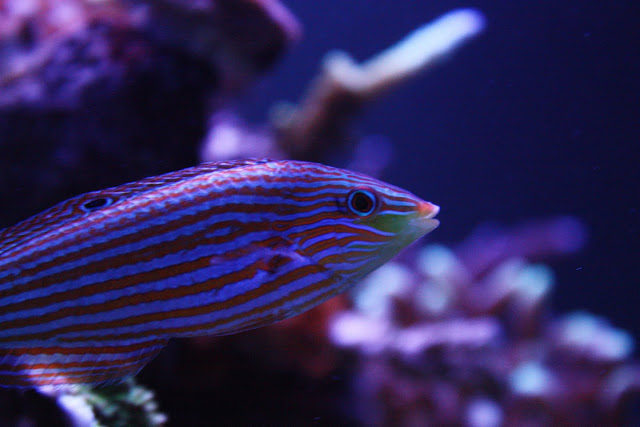
Here's mine a few months back. His eyes and beak are flourescent now and has more orange/red around the pectoral fin area
IMG_1415.jpg


GL
 
Just because you have a wrasse with the markings of a "female" does not necessarily mean it is a female.

All individuals start out life as initial phase fish. These have the "juvenile/female" colors. An initial phase fish is born as either a male or a female. If it is a female, it has the ability to turn into a terminal phase fish (male), which is what is typically sold as a male in the hobby. The initial phase males will never take on the coloration that is associated with a terminal male and will keep the same colors as a female. This is what causes problems in pairing these wrasses in captivity. If you buy a "female" melanurus wrasse, there is a 50/50 chance that it is really an initial phase male.

So to answer your question, it's risky, but if your fish is really a female it should be ok.
 
Just because you have a wrasse with the markings of a "female" does not necessarily mean it is a female.

All individuals start out life as initial phase fish. These have the "juvenile/female" colors. An initial phase fish is born as either a male or a female. If it is a female, it has the ability to turn into a terminal phase fish (male), which is what is typically sold as a male in the hobby. The initial phase males will never take on the coloration that is associated with a terminal male and will keep the same colors as a female. This is what causes problems in pairing these wrasses in captivity. If you buy a "female" melanurus wrasse, there is a 50/50 chance that it is really an initial phase male.

So to answer your question, it's risky, but if your fish is really a female it should be ok.

Thanks for your input. I assumed that the inital phase and being a female were the same until they "changed" sexes (like clowns).
 
All individuals start out life as initial phase fish. These have the "juvenile/female" colors. An initial phase fish is born as either a male or a female.

Are you speaking about Halichoeres species, or labrids in general? Either way I'd be curious to know the source of this info. Are you saying the fish in question are monandrous and not protogynous? I thought that halichoeres were protogynous like many other labrids.
 
Are you speaking about Halichoeres species, or labrids in general? Either way I'd be curious to know the source of this info. Are you saying the fish in question are monandrous and not protogynous? I thought that halichoeres were protogynous like many other labrids.

I'm only talking about halichoeres species. They are diandric protogynous hermaphrodites, in that females can turn into males when presented the opportunity. Initial phase males can't turn into terminal males though, and all terminal males are the result of a female who changed.

I found this info in a scientific journal, and I'll try to find a link to it. Scott Michael also briefly talks about this in his book on wrasses.

My main point in this was just that if you buy a "female" halichoeres wrasse it might really be an initial male.
 
Back
Top