
Mixing aggressive & community? Do I have your attention yet?

KCD1803

New member
Hello all,

I am not new to the saltwater lifestyle, but I think this is the best place for my thoughts about a new tank design / concept. I have always enjoyed a community tank teaming with little fishes, but at the same time there are a few predators I have always longed for. I have thought about doing a reef tank and a separate community tank, but one day I had a crazy idea. I was standing in my local wholesaler's and observing their endless lines of holding tanks holding a variety of fishes from peaceful to aggressive all next to one another separated by only a thin piece of clear acrylic. Well anyhow I will stop beating around the bush, I want to build a 300 gallon tank with a divider down the center lengthwise, one side housing a community reef and the other an aggressive FOWL. In this way it would look like from the side the two tanks are as one. Has this ever been done, other than in holding tanks and quarantines? Any feedback on my thoughts?
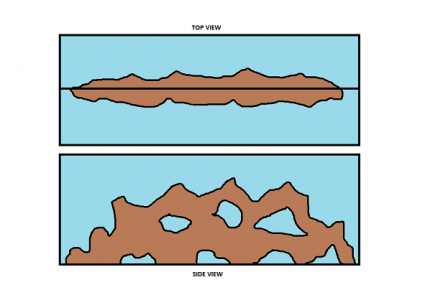
 

Attachments

  • Untitled.png
    Untitled.png
    27.3 KB · Views: 5
First, the center panel would have to be kept very clean. Also, filtration and current would seem tricky , probable would need two overflow boxes and two return lines, not to mention multiple wavemakers on each side. Also, what type of predatory fish are we talking?


Sent from my SM-G935V using Tapatalk
 
It would be just as easy to plumb one tank to connect to another, with a screen barrier on the flow. Film algae growth is a feature that keeps some of the little fishes (particularly comb-tooth blennies) alive, but is visually undesirable, and really is best handled with a magnet cleaner which wouldn't work on the center barrier.

It should be understood, too, that marine fish don't divide the same way as freshwater. Aggression is a function of tank size: even the tiniest fish may fight like a buzzsaw if in too small a space with too many rivals. PREDATION, however, is not about temper, but feeding needs, and if you have a species that eats other fishes, he is not generally a good roommate for anything that will fit in his mouth. The 'food trigger' gets pulled and that's that. I'd say end-to-end with full accessibility for cleaning is a better arrangement, but the system could share a sump, skimmer, etc.

It should be noted, too, that messy eaters can drive the nitrate level too high for coral health unless you have a really, really good and potent skimmer. Marine tanks in general have no filter except a frequently changed filter sock, and often not even that, but do have skimmers to remove excess amino acids.
 
...It should be noted, too, that messy eaters can drive the nitrate level too high for coral health unless you have a really, really good and potent skimmer. Marine tanks in general have no filter except a frequently changed filter sock, and often not even that, but do have skimmers to remove excess amino acids.

THAT is a really good point and something I had not thought of until you mentioned it.
 
Having something like a Gyre in each tank would also assure enough water movement, but you do need something other than a limp flow to assure tank health.
 
Ha! I thought about putting my 60 gallon tank behind my 75 gallon so it would look like my big guys were in the same tank from the front.

But I wanted to upgrade my 30 gallon saltwater to a bigger tank so that won.
 
If you went with coral-safe predators (e.g. grouper, lionfish) and stuck with larger community fish (bigger tangs, angels) you could just mix it all together.
 
Not a bad notion. A big tank----and bigger fish do not necessarily cost hugely: put an lfs aware that you're in the market for the large fish, and they may appear---people who don't check out the adult size of that cute little fish they buy, and a year later are begging the lfs to help them find a home for it. You have 3 worries when combining these fish in the same tank: try not to design dead-ends, where a fish can feel cornered: spires with ample room to go around is a good thing. Go light on venom. A venomous little fish can kill a big one if cornered. And check out mouth size---some are pretty surprising.
 
Back
Top