Molecular phylogenetics and evolution of Holacanthus angelfishes (and Pygoplites)

ThRoewer

New member
Molecular phylogenetics and evolution of Holacanthus angelfishes (Pomacanthidae) (full article)

A b s t r a c t
The angelfish genus Holacanthus includes seven species in the tropical Eastern Pacific and Atlantic. In this study we performed an analysis on all species, the closely related regal angelfish, and the Cortez angelfish, using four mitochondrial and one nuclear marker. Our results support a monophyletic Holacanthus.
The Indo-Pacific regal angelfish, Pygoplytes diacanthus, was found to be the closest relative to Holacanthus. We found a split into two clades with divergences that were consistent with the rise of the Isthmus of Panama. An internally calibrated molecular clock thus placed the origin of Holacanthus to !10.2–7.6 million years ago.
 
...
In addition, that study, which included a thorough representation of most angelfish genera, indicated that the regal angelfish, Pygoplites diacanthus, the sole member of its genus, is the closest relative of the genus Holacanthus, raising the possibility of it being a basal Holacanthus (Bellwood et al., 2004), or potentially well within Holacanthus, thus disrupting its monophyletic status.
Although Pygoplites diacanthus was originally described as Holacanthus diacanthus (Bleeker, 1857), an early morphological phylogenetic analysis by Shen and Liu (1978) indicated that Pygoplites is sister to Apolemichthys. A later allozyme comparison done by Chung and Woo (1998) then placed Pygoplites closer to Pomacanthus than to Holacanthus (see Fig. 1 from Bellwood et al., 2004). However, neither of the two molecular studies incorporated sampling of all seven members of Holacanthus.

Pygoplites diacanthus is widely distributed over the entire Indocentral Pacific. This distribution does not indicate whether Holacanthus originated either from the ancestor of Pygoplites in the TEP after migrating from the central Pacific, or in West Africa, after colonization from the Indian Ocean. Thus, a complete phylogeny of the genus Holacanthus is necessary to elucidate the evolutionary history of this genus.
...

Looks like Pygoplites diacanthus could actually be a Holacanthus after all.
 
Next generation sequencing yields the complete mitochondrial genome of the Regal angelfish, Pygoplites diacanthus (full)

Abstract
In this study, the complete mitogenome sequence of the Regal angelfish, Pygoplites diacanthus (Perciformes: Pomacanthidae) has been sequenced by the next-generation sequencing method. The assembled mitogenome consisting of 16,784 bp includes 13 protein coding genes, 22 transfer RNAs, and two ribosomal RNAs genes. The overall base composition of Regal angelfish is 28.5% for A, 28.9% for C, 16.3% for G, 26.4% for T and show 85% identities to flame angelfish Centropyge loricula. The complete mitogenome of the Regal angelfish provides essential and important DNA molecular data for further phylogeography and evolutionary analysis for marine angelfish phylogeny.
 
Evolution of pygmy angelfishes, including Apolemichthys and Genicanthus

Evolution of pygmy angelfishes, including Apolemichthys and Genicanthus

Evolution of pygmy angelfishes: Recent divergences, introgression, and the usefulness of color in taxonomy (Full PDF available here)

Abstract

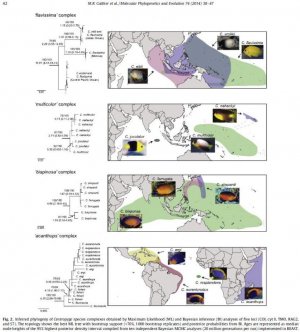
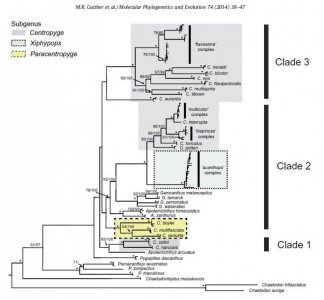
The pygmy angelfishes (genus Centropyge, family Pomacanthidae) are brightly colored species that occupy reef habitats in every tropical ocean. Some species are rarely observed because they occur below conventional scuba depths. Their striking coloration can command thousands of U.S. dollars in the aquarium trade, and closely related species are often distinguished only by coloration. These factors have impeded phylogenetic resolution, and every phylogeographic survey to date has reported discordance between coloration, taxonomy, and genetic partitions. Here we report a phylogenetic survey of 29 of the 34 recognized species (N = 94 plus 23 outgroups), based on two mtDNA and three nuclear loci, totaling 2272 bp. The resulting ML and Baysian trees are highly concordant and indicate that the genus Centropyge is paraphyletic, consistent with a previous analysis of the family Pomacanthidae. Two recognized genera (Apolemichthys and Genicanthus) nest within Centropyge, and two subgenera (Xiphypops and Paracentropyge) comprise monophyletic lineages that should be elevated to genus level. Based on an age estimate of 38 Ma for the family Pomacanthidae, Centropyge diverged from the closest extant genus Pygoplites about 33 Ma, three deep lineages within Centropyge diverged about 18"“28 Ma, and four species complexes diverged 3"“12 Ma. However, in 11 of 13 cases, putative species in these complexes are indistinguishable based on morphology and genetics, being defined solely by coloration. These cases indicate either emerging species or excessive taxonomic splitting based on brightly colored variants.

Based on this article the Genera Apolemichthys, Genicanthus and especially Centropyge may need to be re-evaluated. The current Centropyge Sub-Genera Xiphypops (acanthops complex) and Paracentropyge should be full Genera.

C. fisheri and C flavicauda are genetically indistinguisable and likely just color morphs of the same species.

Also, by these findings the Bandit angelfish (currently Apolemichthys arcuatus) does not belong to the genus Apolemichthys, but rather to Clade 1 of Centropyge together with C. colini and C. narcosis


attachment.php


attachment.php


attachment.php
 

Attachments

  • Centropyge - Fig.1.jpg
    Centropyge - Fig.1.jpg
    62.5 KB · Views: 4
  • Centropyge - Fig.3.jpg
    Centropyge - Fig.3.jpg
    67.6 KB · Views: 4
  • Centropyge - Fig.2.jpg
    Centropyge - Fig.2.jpg
    85.8 KB · Views: 4
Last edited:
Back
Top