My Journey with C./P. multifasciata

Kyle, I'm so sorry to hear about your female.
If you do plan on getting a mate for the male I would do it sooner rather than later since he had been showing some pre spawning behavior. I'd also go with a multibarred female for the best chance at a spawn. Just my 2 cents and I wish you success!
 
Hi Kyle,

Sorry to hear about your losses,... however I would like to ask you something. Please don't feel offended, but I am curious. Why not try to breed something like C. argi first, I mean apparently these are difficult fish to keep alive, why do you think you can breed them?

If you decide to try again, I really would put them in a tank with lots of LR to pick on, to me these sterile tanks with only some PVC for hiding really are not suitable for this kind of fish.

Best of luck with whatever way you choose to continue!
 
Sorry to hear.
But if it was easy, it wouldn't be special. I know how hard it is to take these losses, however. These are very special fish. I hope you persevere and have success!
Good luck to you, Kyle!
 
Thanks for the support everyone! It means a lot to know that there is some interest in this.

Hi Kyle,

Sorry to hear about your losses,... however I would like to ask you something. Please don't feel offended, but I am curious. Why not try to breed something like C. argi first, I mean apparently these are difficult fish to keep alive, why do you think you can breed them?

If you decide to try again, I really would put them in a tank with lots of LR to pick on, to me these sterile tanks with only some PVC for hiding really are not suitable for this kind of fish.

Best of luck with whatever way you choose to continue!

Breeding something else first won't change how difficult it is to keep these fish. Frank B. has successfully bred C. multifasciata at RCT, and Karen is having success with a close cousin, C. venusta. It is possible to breed them, it just takes the hurdle of getting two adults to fully acclimate to captivity.
 
Breeding something else first won't change how difficult it is to keep these fish. Frank B. has successfully bred C. multifasciata at RCT, and Karen is having success with a close cousin, C. venusta. It is possible to breed them, it just takes the hurdle of getting two adults to fully acclimate to captivity.

That I understand, it is possible, but those are experienced breeders of fish. So I was thinking maybe it is a good idea to first "practice breeding" with something like an Argi and then, if you know how to raise the larvae (which for any kind of fish is difficult) give the multifasciata a shot.

Now you will have two problems: keeping the multifasciatas alive and in optimal condition (not easy) and if there is a spawning raising the larvae (not easy). The last part you can practice with the Argi so you will be better prepared should you get eggs from the multifasciata.

I think it will increase your chances a lot because probably nobody has ever raised their first egg successfully.

Just my two cents.
 
This is a very discouraging thread.

I have been gnawing on the idea of keeping a Multibar. I have been building up my confidence of potential success by reading, reading, and reading and then reading some more.

One idea that I have been thinking of, even before reading (most) of this thread, is that the Multibar is a fish that probably would be worth the risk to add directly to your DT. One of my concerns is that it will starve in QT. You hopefully would have favorable conditions in your tank. Pods. Micro algae. Mature live rock. None of this would be in your QT. I did like the one posters idea of a fudge like QT.

Any thoughts on this with your experience?
 
... I did like the one posters idea of a fuge like QT.

Any thoughts on this with your experience?

Though I don't like to 'advertise' that idea... It's exactly what I've done with certain fish, including Multibars. I'm now thinking to add a couple more to my system
 
I could see it working. Throw in some sand, a live rock, some c. Prolifera and pods.

The only thing that would throw the whole thing out is If you had to treat copper.
 
I had one of the four starve, and that is because it was a juvenile that I didn't feed enough and needed more feedings than I was around to offer at the time. It also had succumb to velvet like the male of that pair did. The most recent loss isn't starvation, there is something else that played a role in its death, but I can't figure out what that is. No changes in the parameters to throw it off unless I had some sort of swing I didn't pick up. Other than that, a collection issue is the only other possibility, however, it is unlikely given the time frame it was in captivity.

The one I have that is still living is not starving in any way. It eats with gusto and continues to sample flake foods. Kevin has suggested not feeding it for a short period since that will likely make it hungry enough to actually eat the flakes. That is something I'll do once he is in the display though.
 
Short and happy update!

First off I decided to take Kevin up on his offer for a juvenile/female replacement. She will be arriving Tuesday. I'm very excited, but also keeping in mind this will be the last replacement I do for awhile. Fingers are crossed for continued success with the male I have now.

Spraining of, on the day if my graduation ceremony he is making me very happy. I've fed flake and pellets again for the first time in a couple weeks and he has eaten bit with gusto! He attacked flakes on the surface and did the same to pellets in the water column and bottom of the tank. I'll try and get a video later if he will eat them again.
 
Thanks, Brett. I wish you luck with the new venusta you have!

So as promised, here is the guy munching on some pellets. I grabbed too many with my phone in the other hand ready to record, so I'll be doing a WC shortly.
 
The new angel has arrived and is now enjoying a blacker out QT tank with the male on the other side of the egg crate. I think the male is more stressed about this than her since I had to trap him on one side. We shall see how both are doing in the morning.
 
She eats like a champ already! Chomping away on mysis and brine like she's been in my care for awhile already. The male is curious about another angel in the tank, but shows no aggression. Keeping my fingers crossed for a successful introduction Saturday morning!


Just the male because it was an okay picture:
 
Awesome thread Kyle. I have just received my pair today.

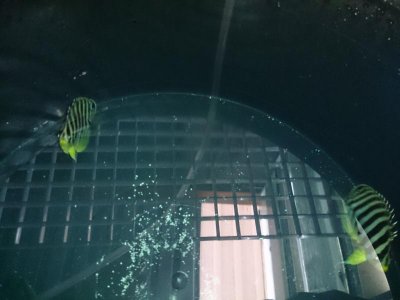
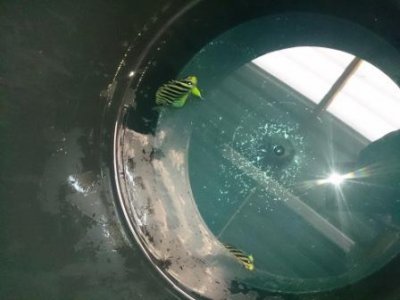
These are from Indonesia, there is quite a large size difference between what is assumed to be the male and female. Male is about 8 cm and female is about 5 cm.

I had initially planned to add them to my QT system but opted for my SPS holding tank instead. They were dripped over an hour before being added. Once in they immediately started grazing on the live rock. I know this is going to be a long road to see if I can get them to adapt to captive life but I am optimistic.

Tomorrow I will be trying a number of different foods and supplements to see if they will accept food from the water column. I will be doing hour dips as well to assist with the removal of any unwanted parasites.

Will post more information as their journey goes on...
 

Attachments

  • DSC_2406.jpg
    DSC_2406.jpg
    40.7 KB · Views: 24
  • DSC_23961.jpg
    DSC_23961.jpg
    25.2 KB · Views: 20
For what it's worth. The only way that I can tell my male from my females other than the slight size difference is that the black stripes on my male are very noticeably thicker than the females'. I'm not sure if such holds across the species, but it's very apparent with mine.
 
Awesome thread Kyle. I have just received my pair today.

These are from Indonesia, there is quite a large size difference between what is assumed to be the male and female. Male is about 8 cm and female is about 5 cm.

I had initially planned to add them to my QT system but opted for my SPS holding tank instead. They were dripped over an hour before being added. Once in they immediately started grazing on the live rock. I know this is going to be a long road to see if I can get them to adapt to captive life but I am optimistic.

Tomorrow I will be trying a number of different foods and supplements to see if they will accept food from the water column. I will be doing hour dips as well to assist with the removal of any unwanted parasites.

Will post more information as their journey goes on...

I wish you luck! The first two-three months are going to seem like forever, but after that, you should be set as long as they are eating. Please do keep us updated on your pair.

For what it's worth. The only way that I can tell my male from my females other than the slight size difference is that the black stripes on my male are very noticeably thicker than the females'. I'm not sure if such holds across the species, but it's very apparent with mine.

Very interesting, I'll have to see if that holds true with the pair as they mature. I'll be making observations on the differences as they grow, but especially once they start spawning and it is clear that the pair is indeed a hetersexual pair rather than two of the same sex coexisting.
 
Back
Top