
You are using an out of date browser. It may not display this or other websites correctly.
You should upgrade or use an alternative browser.
You should upgrade or use an alternative browser.
name of my clown
- Thread starter yeame
- Start date


can some one find me a pic of a clarkii with a white tail or a baby with 4 stripes in the pic he has yellow on the top and bottom of his white tail but in the tank it has a yellow stripe only on the bottom of his tail and if a clarkii which kind hjs top fin is only black because I was chasing him around with a camera I will get another pic of him

it is fine if it isnt an akindynos but what kind of clown is it its not a clarkii with a white tail so what kind is it ? people general names on fish I want the latin name and or a piche looks identical to this and from what i've read the difference is the thin second stripe

criccio
Premium Member
Yours is just one of many, many variations of A. clarkii (with or without a white tail). And A. clarkii is the latin name.
http://wish.wodonga.tafe.edu.au/~kwaldon/clarkii.htm
http://wish.wodonga.tafe.edu.au/~kwaldon/clarkii.htm
so you are saying every yollow,black,white clownfish is a clarkii and that is the only latin name for a yellow,black,white,clownfish
and there is no akindynos or allardi or bicinctus and the list goes on then why do they have different names?
I allso have a fire clown are you saying he is a clarkii to because they are related even though he dosnt have any stripes or is because he is the same shape he is now a clarkii to l
and there is no akindynos or allardi or bicinctus and the list goes on then why do they have different names?
I allso have a fire clown are you saying he is a clarkii to because they are related even though he dosnt have any stripes or is because he is the same shape he is now a clarkii to l

Rob,
That is not what criccio is saying.
A. clarkii is the latin name of a specific clownfish species. It is the most widely dispersed clown in the wild and is available in the most color varieties, easily greater than 30.
If you follow the link criccio provided, you will see many many of the varieties of A. clarkii.
A. bicintus, A. akindynos, A. chrysopterus, A. allardi, A. chrysogaster, etc., etc., are within the Clarkii Complex, but are separate and distinct species.
Some of the of the folks that have answered your question and ID'd your fish have been working with clowns for many many years. It is up to you to either accept or disregard their opinions, but I don't think you'll find too many folks in disagreement on the ID.
fwiw: It is a nice looking specimen, many get real ugly at maturity. Congratulations on taking great care of it.
Cheers.
That is not what criccio is saying.
A. clarkii is the latin name of a specific clownfish species. It is the most widely dispersed clown in the wild and is available in the most color varieties, easily greater than 30.
If you follow the link criccio provided, you will see many many of the varieties of A. clarkii.
A. bicintus, A. akindynos, A. chrysopterus, A. allardi, A. chrysogaster, etc., etc., are within the Clarkii Complex, but are separate and distinct species.
Some of the of the folks that have answered your question and ID'd your fish have been working with clowns for many many years. It is up to you to either accept or disregard their opinions, but I don't think you'll find too many folks in disagreement on the ID.
fwiw: It is a nice looking specimen, many get real ugly at maturity. Congratulations on taking great care of it.
Cheers.
this is from the link you posted --Juveniles and subadults of species can be similar, particularly if they live closely together in the wild. Some A.melanopus and A.frenatus juveniles, for example, are practically identical. Other species such as A.akindynos, A.clarkii and A.chrysopterus have similar sub-adult patterns. Generally, juveniles have one or three white bars, sub adults two (usually thin bars) and a white caudal. Juveniles are distinctive from photographs because of the proportions of their body; their eye usually appears large. Sub adults are only easy to identify when sitting alongside juveniles or adults. As to which species, it is helpful to be able to know the locality and the species or the host anemone.
Only A.percula and A.ocellaris have juveniles and subadults that are remotely similar to the adult species fish in pattern. All other anemonefish have vast differences between the growth stages. I am not clear why this is so, except that many other reef fish (wrasses, etc - hence the common use of the word 'clown' across many species of reef and fresh water fish) have juveniles of similar colour and pattern to A.percula and A.ocellaris, and perhaps therefore there was no reason in the wild to have different colours or patterns within the maturing stages.
Only A.percula and A.ocellaris have juveniles and subadults that are remotely similar to the adult species fish in pattern. All other anemonefish have vast differences between the growth stages. I am not clear why this is so, except that many other reef fish (wrasses, etc - hence the common use of the word 'clown' across many species of reef and fresh water fish) have juveniles of similar colour and pattern to A.percula and A.ocellaris, and perhaps therefore there was no reason in the wild to have different colours or patterns within the maturing stages.

phender
Active member
I'm not sure what what the above quote has to do with your question.
The scientific name for your fish is Amphiprion clarkii. They are often called sebae clowns in the aquarium trade, but should more appropriately be called Clarki or Clark's clownfish.
Their juvenile coloration quite often includes a white stripe across the top of the tail, which as the fish matures, takes over the whole tail.
Clarkis are not the only yellow and black clownfish with white stripes, but the combination of the pattern of the black and yellow, the positioning and shape of the stripes, and the shape of the body and head, identify it as A. clarkii.(It is customary to only give the first letter of the genus name when it has already been established that we are talking about clownfish).
Here are two junveniles showing the stripe on the tail.
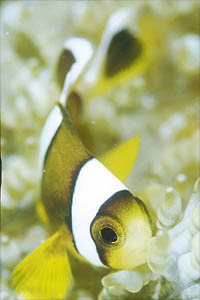
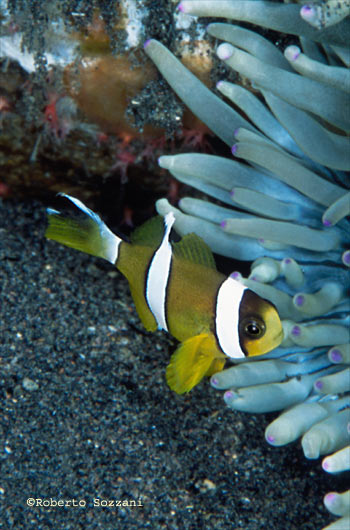
Here is a pic with a bunch of adult fish like your's.

The scientific name for your fish is Amphiprion clarkii. They are often called sebae clowns in the aquarium trade, but should more appropriately be called Clarki or Clark's clownfish.
Their juvenile coloration quite often includes a white stripe across the top of the tail, which as the fish matures, takes over the whole tail.
Clarkis are not the only yellow and black clownfish with white stripes, but the combination of the pattern of the black and yellow, the positioning and shape of the stripes, and the shape of the body and head, identify it as A. clarkii.(It is customary to only give the first letter of the genus name when it has already been established that we are talking about clownfish).
Here are two junveniles showing the stripe on the tail.
Here is a pic with a bunch of adult fish like your's.

dantodd
New member
I really don't understand. Phil, Chris and Scott are all excellent at IDing fish and have tons of experience. If you don't believe what the forum's most experienced folks are saying why did you ask the question?
If you are certain that you fish is akindynos that's great. It really doesn't matter if you are keeping him. If you are interested in selling him or have some desire to "prove" he is not clarkii then plesae post some more pictures.
If you are certain that you fish is akindynos that's great. It really doesn't matter if you are keeping him. If you are interested in selling him or have some desire to "prove" he is not clarkii then plesae post some more pictures.
I dont care what kind it is. I just want to know what it is and thoes fish dont look like mine and the juvies no way when mine was little it had 4 vertical stripes wish I had a pic of then and now the second stripe is way to thin compared to the other clarkii's I have seen the 4th stripe never left his tail just turned his tail mostly white the third stripe is now totaly into his tail the little of yellow on the top of his tail isnt there except in the pic,though he has some yellow on the bottom of his tail.
I just dont think because it is yellow and black dosnt mean it is a clarkii its second stripe is way to thin in the pic I posted it is a little blury but it is like 1/3 the size of the first stripe and it goes threw the top fin ok now saying that again isnt that what makes it not a clarkii?
and as far as the link posted on that page it looks like the allardi african 053 or fuscocaudatus seychelles 049 but the pic at marine center looks allmost identical that is why I was asking if it was an akindynos and do clarkii's have blue stripes
I just dont think because it is yellow and black dosnt mean it is a clarkii its second stripe is way to thin in the pic I posted it is a little blury but it is like 1/3 the size of the first stripe and it goes threw the top fin ok now saying that again isnt that what makes it not a clarkii?
and as far as the link posted on that page it looks like the allardi african 053 or fuscocaudatus seychelles 049 but the pic at marine center looks allmost identical that is why I was asking if it was an akindynos and do clarkii's have blue stripes

Unfortunately, most shops are not diligent in providing proper species ID or related pictures 
fwiw: some A. clarkii do have blue in the stripes. I sold my breeders a year or so back, but I'll see if I can dig up a picture of them with the blue/purple showing.
fwiw2: juveniles in the Clarkii Complex are very difficult to impossible to ID without knowing the collection location.
btw: The other specimen you posted looks good too
fwiw: some A. clarkii do have blue in the stripes. I sold my breeders a year or so back, but I'll see if I can dig up a picture of them with the blue/purple showing.
fwiw2: juveniles in the Clarkii Complex are very difficult to impossible to ID without knowing the collection location.
btw: The other specimen you posted looks good too
phender
Active member
OK, lets go at this another way. Lets take a look at the other black and yellow clowns
Allardi: The head stripe on allardi is thickest on top and swooshes down to a forward pointing taper at the bottom (on yours the head stripe is uniform thickness if not more narrow on top). In adults the tail is white, but they don't have a white band (3rd stripe) at the base of the tail. The overall look of allardi is not nearly as robust as your clown.
Bicinctus: Has only two stripes and a yellow tail.
Chrysogaster: Dark brown or black tail. Rarely collected.(Traveller7 has one on his avatar)
Chrysopterus: White tailed variety doesn't have a full tail band at maturity(most often none at all). The overall body shape is different than your fish.
Fuscocaudatus: Has a smokey black brush shaped marking on its white tail. Is usually more of a dark grey/black rather than dark brown/black. Live in a World Wildlife reserve and therefore are not collected.
latisfasciatus: Deeply forked yellow tail
Sebae: nowhere near that body shape. Has a yellow or black tail.
Tricinctus: Has 3 bars but the tail is dark yellow/orange or black.
Those are all the yellow and black clowns that your fish is not. There is only one left.
I don't remember ever seeing a juvenile clown that I thought had 4 vertical stripes. Maybe you could take a picture of a drawing.
Some clarki clowns have blue stripes and the temperment of a clown is not species specific. It is not unusual for the mid-bar of a clarki to go into the dorsal.
What type of clown did you want us to say this one is?
A picture of a side view might help change our minds, but I doubt it.
Allardi: The head stripe on allardi is thickest on top and swooshes down to a forward pointing taper at the bottom (on yours the head stripe is uniform thickness if not more narrow on top). In adults the tail is white, but they don't have a white band (3rd stripe) at the base of the tail. The overall look of allardi is not nearly as robust as your clown.
Bicinctus: Has only two stripes and a yellow tail.
Chrysogaster: Dark brown or black tail. Rarely collected.(Traveller7 has one on his avatar)
Chrysopterus: White tailed variety doesn't have a full tail band at maturity(most often none at all). The overall body shape is different than your fish.
Fuscocaudatus: Has a smokey black brush shaped marking on its white tail. Is usually more of a dark grey/black rather than dark brown/black. Live in a World Wildlife reserve and therefore are not collected.
latisfasciatus: Deeply forked yellow tail
Sebae: nowhere near that body shape. Has a yellow or black tail.
Tricinctus: Has 3 bars but the tail is dark yellow/orange or black.
Those are all the yellow and black clowns that your fish is not. There is only one left.
I don't remember ever seeing a juvenile clown that I thought had 4 vertical stripes. Maybe you could take a picture of a drawing.
Some clarki clowns have blue stripes and the temperment of a clown is not species specific. It is not unusual for the mid-bar of a clarki to go into the dorsal.
What type of clown did you want us to say this one is?
A picture of a side view might help change our minds, but I doubt it.
Similar threads
- Replies
- 2
- Views
- 840

- Replies
- 8
- Views
- 558

