Need some electrical advice please

detroit_fan

New member
I am in the building stages for my new tank. I am putting in a basment sump and want to run some outlets. The breaker box is a pushmatic 100 amp. I bought the house in june and it had an electic stove, so i replaced it with a gas one and now i have 2 open breakers. The 2 breakers are joined together to make a double and it says 40 on the side, so is this 2 20 amp circuits? Nothing else was on these except fo the stove. I included some pictures of the area, i want to install the outlets on the plywood hanging above the sump so i only need to go a few feet from the box. Here are my questions-

How many outlets should/can i install per 20 amp circuit?

Should i go with GFCI outlets or something else, also any brand recomendations on wire or outlets?

What gauge wire do i need to run to the outlets?

Any other suggestions are much apprecited.

My other question is this, I will have 3 175w mh ballasts for this tank, but i want them plugged into these new outlets. Can i run 3 50 foot extension cords so i can have the ballsts upstairs but plugged into the basement or is this a hazard? If it's ok, what gauge extension cords would i need?

Thanks for any help

:)

P1010053.jpg


P1010057.jpg


P1010056.jpg
 
Hello i am an electrician and there is many things to consider how many amps needed ? also i have found for safty reasons run a gfi breaker for the whole system they come in all different amps and the panel you have is old i have it in my home .you have two 40s each wire or side = 40 amps that is good tho as you depending on what you need you have lots avalible ! how many plugins do you need ?? and hot tub shops have used places so to find a used panel (gfi ) very easy anc cheap !! then just wire it to your house panel let me know as i can draw you up somthing easy!!
 
My advice if you have never worked on a panel box before, is to call a qualified electrician to do it. You can electrocute yourself if you do not know what you are doing. In addition to installing circuit breakers, you will need to know the appropriate wires, outlets, switches, etc. If you mess up you can burn your house down.

To have the safest setup, have the electrician install AFCI (Ground Arc) circuit breakers and use a GFCI outlet on each circuit. I would have him run 20 amp circuits. The number of circuits will depend on your future load.

AFCI circuit breakers will protect your system from fire hazards.
GFCI outlets will protect you from electrocution.
 
thanks for the advice. im not really familiar with this work, but my dad will be helping and he has done this before. He doesn't do fish tanks, so i wanted to ask here about what supplies to get for him to install. So i can buy 2 20A AFCI breakers and install them in place of teh existing double 20A? How do i run my outlets in parallel so they don't all go out if one gfci trips?
 
You can wire GFCI outlets individually, but I am not sure if this is as safe as wiring a lead GFCI followed by regular outlets. This would be better answered by an electrical engineer. By the way, I am only a dump contractor. It might be complicated by using an AFCI circuit breaker. :D
 
Last edited:
The information I have provided above is what I learned from a long thread on my local forum, which included several electrical engineers in the discussion. This thread was the result of a fire that almost burned down one of our hobbyist's house. I have to admit that when the electrical engineers started on discussions regarding GFCI outlets & AFCI circuit breakers and the safest way to protect oneself from fire and electrocution some of the information went over my head. There is more to it than most electricians truly understand. ;)

EDIT: Perhaps posting this question in the lighting forum may draw more electrical engineers into the discussion.
 
I agree with the last, I have a few electrical contractor friends and also a friend thats an electrical engineer. The first guys are great at installing the system, but consult with an "engineer" to design or answer questions about the system design.

I did just that. My contractor friend designed a system and was going to install it for me. I ran the design by the my engineer friend and he found numerous fllaws and noted a few better ways to do it and modified the plans. The contractor agreed with his changes and admitted he learned alot for the modifications.

If you have a local college you can maybe find a senior engineering student to design something for a few bucks, as students are always in need of a few extra $.

One other point my engineer friend stated and I complied, Overbuild you system as its better to have extra breakers and outlets around then to have to later add to an existing system. It is more reliable and more cost affective in the long run. And it seems over time you always find one or two more "things" you just have to have and add to you reef that require power !!
 
<a href=showthread.php?s=&postid=14357336#post14357336 target=_blank>Originally posted</a> by Trevor Edmonton
Hello i am an electrician and there is many things to consider how many amps needed ? also i have found for safty reasons run a gfi breaker for the whole system

That is not desirable for an aquarium system. Individual GFCIs are much more suited to the application. If you use a single GFCI or GFCI circuit breaker, than a single faulting piece of equipment or a nuisance trip will bring down the entire tank.

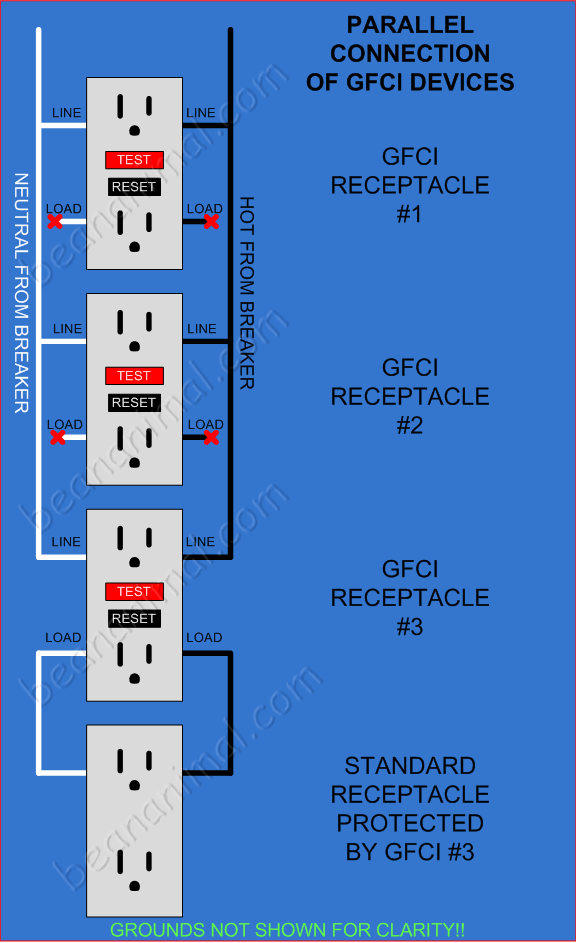
It is a much better idea to split your branch circuit(s) into multiple parallel GFCIs so that each critical piece of equipment is on its own. That way, a fault in one piece of equipment only affects that receptacle, not all of the others.

Here is some basic electrical info:
http://www.beananimal.com/articles/electricity-for-the-reefer.aspx

Here is how the parallel GFCIs would be wired:
parallel%20gci%20illustration.gif
 
What Bean and HighlandReefer said.
I'll add....
You should run no more than 80% of the breaker rating (continuous load). 1920 watts would be the maximum on a 20 amp circuit and 1440 watts would be the maximum for a 15 amp circuit.. Use #12 wire on a 20 amp and #14 on a 15 amp.

Put a small amount of "De-Ox" into each hole of the outlets. It will assure a good connection at the outlet. Sooner or later, anything and everything gets wet, splashed, dipped and it will stop corrosion.
 
Nice to hear an electrical contractor chime in. Thanks for the info.

In my local club, there have been an unusual amount of small fires and one bad fire that almost burned the house down. In all these cases, the fires resulted from the lighting fixtures. The electrical arcs causing these fires were not prevented by GFCI outlets that were being used. This indicates the importance of AFCI (Ground Arc) circuit breakers, especially with the type of electrical equipment used in our hobby.

Another problem I frequently see in many old homes, is that there are no ground wires. If your homes electrical outlets only have two plug holes and not a ground hole, then you should hire an electrician and at least run new proper circuits to your reef system, if not the hole house. :)
 
The arcing at the socket doesn't go to ground so a GFI cannot do it's job. I'm still not convinced a AFCI will detect an arc after a ballast (transformer), the newer "combination" types may. Iv' e seen some burned sockets or overheated sockets on AFCI's that did not trip.

That buzz we all hear eventually is from a broken socket, lamp tips that corroded or the lamp isn't oriented right. Usually we break sockets trying to twist the GD lamp in! When the contacts inside the socket or lamp tips get corroded that gets harder to do, so we force it-that bends the little copper strip inside the socket. I use De-Ox on my lamps also. Makes the lamps go in much easier and helps prevent breaking or damaging the sockets.
It is obviously very important to make sure the lamp is oriented correctly. I had a socket catch on fire (small) a couple of years ago because every time I moved the fixture it rubbed against the canopy and twisted the bulb out of place-that was on an AFCI.

Just like sockets, fires at outlets or plug strips are usually caused by poor contact between the "prong" of the cord and contacts inside the outlet-not overloading. Around salt water the risk is much higher of course. So, the first thing I do on new fixture, outlet or plug strip is put a little anti oxidant at the sockets. Got a new powerhead or lamp? Put some antioxidant on the cord end or lamp tips. IMO, it would eliminate most fires at outlets and some at lamp sockets.

You only need a very small amount and IMO, is very good insurance.
Home Depot sells it.

Sorry-off topic.
 
Holy crap...I would never let an engineer wire anything in my house. We're talking about people that make plans and draw things out...not actually do the work! I guarantee you I know more about wiring homes than 99% of the electrical engineers in this world. My hats off to someone for going out and getting the degree, but that does not qualify you to wire a home. It takes time to develop good workmanship habits and you just don't learn that in school.

That being said, forget the arc fault and GFI breakers. I doubt they make them for your panel anyway and it's much more expensive that way. My first bit of advice would be to get that panel changed out - by a GOOD electrician. 40 year old breakers don't trip very well usually, or they may trip once and not want to reset. Either way it's not safe and can be a pain when you need your power back on. If you do stick with your existing panel, here is what I would do.

Ditch the two pole breakers and find a couple 20 amp single pole pushmatics. They're hard to find but still out there. Run some #12 Romex to where you need your outlets. I don't recommend loading out of a GFI in this scenario. You can do it, but GFI's don't last forever. You're better off using individual 20A rated gfi's so that if one craps out not everything is dead. Also, don't connect your return pump to a GFI. GFI's are not meant to have motor loads connected to them. This is why refrigerators in kitchens are not required to have them even though an icemaker waterline is right there. Make sure your connections are good, because loose wires do start fires. Make sure you wrap the wires around the screw of the outlets the way it tightens and pinch it down good. I've never heard of putting any sealant on one, not that it wouldn't work. I usually just wrap electrical tape around it. Good luck, and make sure someone that knows electrical work checks yours.
 
slathrum- thanks for the post. Is there anything else that shouldn't be plugged into the gfci outlets? What about Skimmer pumps, heaters and mh ballasts?

I think what i have decided to do is use one of the 20A circuits and run it up to my tank room so i can plug my powerheads and mh ballasts into it. The other 20A i will run to the sump area and install 3 outlets in parallel. 1 will be a nomal outlet for return pump, 1 GFCI outlet that has my ac jr & DC8 plugged into it, and 1 more GFCI that has the American DJ power strip hooked to it. That way if a GFCI outlet trips it will only affect things plugged into that outlet, not the whole circuit. I will have to do some load calculations to make sure all my sump equipment will be ok on a 20A.

I wonder what outlet to plug my ranco(heaters) into?
Would it be better to plug it into the non-gfci with the return pump or into a gfci with the other equipment?
 
Holy crap!-Glad I'm not an Engineer then! ;)

I'm a Contractor who employ's Electricians who happen to wire houses and commercial buildings. While Slathrum gives some good points, I have to question why an Electrician would tell anybody not put something on a GFCI that is anywhere near water-especially submerged. AND, guess what? The 2008 NEC requires ALL outlets, sump pumps, plug in wells, softeners, refrigerators or freezers in a basement or garage to be GFCI protected. GFCI's are not nearly as prone to tripping motors as they were years ago. Washing machines have been required to be GFCI protected since 2005 without problems. The new 2008 code requires just about everything in a basement or garage, except fire alarm systems to be on a GFCI, if it has an outlet. We have installed hundreds of outlets for basement or garage refrigerators and freezers without hearing reports of them tripping. I don't quite get the comment about a GFCI not lasting forever-what does?
The best scenario would be to change the panel as Slathrum suggested because Pushmatics are not very reliable. If you keep the existing panel, put an AFCI outlet-per 08 NEC , two would be better, next to panel, then load off them as the drawing shows and run two circuits. Another option would be to install a small sub panel so you can use AFCI breakers. You don't NEED an AFCI for the outlets you run in the basement but you do need it for it for the tank room if you want to be per the NEC. The AFCI in the basement would be for safety reasons only. Things corrode around saltwater. Corrosion leads to arcing. I did not suggest putting "sealant" on the screws. Put antioxidant in the holes of the outlets and lamp sockets. It's a cheap way of stopping corrosion at the contact point. You have 3 years in the hobby. Give it 3 more and see what corrodes.
How many watts are the heaters and pump? I'm assuming they will be in the sump.
(watts/volts=amps) No more than 16 amps on the 20 amp circuit.

In other words-everything is on a GFCI.
I commend you for asking how to do it right.
 
1) The NEC is NOT law. It can be adopted as LAW by a state, municiplality or local government.

2) Any State, municipality or local governmnet has the right to ammend, ignore, or enforce any part of the code that they see fit.

3) To date only 10 States have adopted the 2008 NEC and a few others have localities that have adopted all or part of the 2008 NEC code changes. 30 or so states are still using the 2005 NEC and a few others the 2002 NEC. The 2002 NEC is still very widely used in many localities.

4) AFCI breakers are still very prone to nuisance trips. I would not opt to use them to feed my aquarium unless forced to do so by law.

5) Most AFCI breakers being sold are ALSO GFCI breakrs. Again, not a wise move to place all your eggs in one basket. I would NEVER allow a GFCI (AFCI/GFCI, whatever) breaker to feed my aquarium equipment. I instead rely on individual GFCI receptacles.

6) As far as I know, there is no code requirement for aquarium to be placed on AFCI breakers in any version of the code. An Aquarium equipment is considered cord and plug equipment, even if you drop a few dedicated branch circuits in for it. They would fall under general use receptacles and be subject to the general use branch circuit code relevant to the location (bedroom, garage, whatever) space that they were installed in.

Not being argumentative... just making sure that those following along have a frame of reference.

Anyway.... Use GFCIs and protect yourself.
 
Last edited:
I agree with 1 and 2.

3-Those stats are old-middle of 08. As with every adoption cycle, it takes a couple of years for most states to adopt the new codes. There are always a few that remain 2-3 cycles behind. Those that are arguing against it are basing it on costs, not safety or nuisance tripping. Michigan, where the OP lives, is slated to adopt it in Novemeber of 2009.

4-When they first came out-yes. Not true anymore. We install thousands. 1% failure is would be a high estimate.

5-They are not.
Combination AFCI circuit breakers work by sensing and responding to both parallel and series arcing incidents. Series arcing is often associated with damaged devices or cord sets. A series arc is an arcing incident across a break in a conductor. A common example is a cut across one of the two wires in a lamp cord, with a dangerous arc forming in the gap. Combination AFCI circuit breakers detect the arcing condition and turn off the circuit, thus providing the enhanced protection.
"Combination" does not mean GFCI and AFCI. They will not trip if you stick your hand in a tank with a faulty pump or a heater breaks.

6-2008 NEC Art. 21012(B)-unless it is in a garage or basement-or on your bathroom or kitchen counter. ;)


"Anyway.... Use GFCIs and protect yourself."

That's what started it! :D
 
Just got back from doing some pricing at menards. Here is my problem about replacing the box- it is only a 100amp box, so if i do a new one it will be 200amp, wouldn't that require having a new line ran from the street to my house? I have a feeling it would get expensive fast. If i spend a $1000+ to install a new box i won't have any money left for the tank lol . If it was a safety hazard i would do it, but is it really a hazard?

If you had to give a rough estimate how much to replace my 100a with a new 200a service?

I can do all gfci outlets, not a problem.

What is the benefit of running the 40a to another box and then running the circuits off that? I know you guys do this all day and probably have access to all the equipment and labor, but i gotta pay for all mine so i want to do it as safely, yet inexpensively as possible.

One last question, where can i get some 20amp pushmatic breakers at for a decent price?
 
<a href=showthread.php?s=&postid=14390450#post14390450 target=_blank>Originally posted</a> by wet reefer
I agree with 1 and 2.

3-Those stats are old-middle of 08. As with every adoption cycle, it takes a couple of years for most states to adopt the new codes. There are always a few that remain 2-3 cycles behind. Those that are arguing against it are basing it on costs, not safety or nuisance tripping. Michigan, where the OP lives, is slated to adopt it in Novemeber of 2009.
I pulled the information from an up-to-date NEMA map.
nec-map.gif


The 2008 NEC code adoptions have met more resistance than any other code change and though many states have adopted the code, many inspection agencies are still quietly inspecting the 2002-2005 regs instead of the 2008. I would disagree about the reasoning as well. The AFCI nuisance tripping problems are still very prominent and a major driving force in the debate against the 2008 changes.

Commentary:
AFCIs and the statistics used to shove them down our throats are a feel good scam. Arcing faults do not account for nearly as many fires as the "statistics" show. In reality they account for the fewest electrical fires on record. Resistance heaters are the culprit (of course behind cigarette, cooking and candle fires :D). Furthermore, 40+ year homes account for almost ALL of the electrical fires. They are more than a "few" cycles behind.

As you mentioned, the AFCI is not going to be a reliable method of preventing ballast side arcing fires (melted endcaps, etc). It may help with powerstrip arc due to salt creep. However, there is a much easier method. Don't use plastic power strips and DO put plastic "baby savers" in all unused receptacle positions. Use drip loops and don't place power strips in locations prone to salt creep. I would not "rely" on any device to prevent a fire in leu best practice wiring and component maintenance.

4-When they first came out-yes. Not true anymore. We install thousands. 1% failure is would be a high estimate.
I was not speaking to failure rate. I was speaking to NUISANCE TRIPPING. AFCIs are severely prone to it with motor and ballast loads. I can get a brand new GE AFCI to trip by turning on the vacuum cleaner or running the Kitchen-aid mixer and changing its speed :)

The GFCI breaker/receptacle failure rate is still as high as 50% by many well documented accounts. The AFCI products have not been in service long enough to show a trend (good or bad). Only time will tell what the failure rate of the new generation of products is.

5-They are not.
I was not speaking to "combination AFCIs" designed to protect against series and parallel arcs. My wording was not well thought out (see below)

In any case, the AFCI will trip at a ground fault of 30-50mA (depending on brand). So no it is not listed as a GFCI (5mA max trip) but it is still a GFP device. Cuttler Hammer makes an AFCI/GFCI device that WILL trip at 5mA of ground fault current and other manufacturers appear to be getting approval for their devices too.

I want to be very clear here: It should be noted that if the device is AFCI/GFCI it will be labeled as such. The 30mA-50mA trip threshold of an AFCI IS NOT considered a GFCI and should not be thought of as such. The wording in my previous post may not have been clear.

6-2008 NEC Art. 21012(B)-unless it is in a garage or basement-or on your bathroom or kitchen counter. ;)
And "new" work. I don't think you will find any capable homeowners pulling a permit and inspection for adding a branch circuit in the basement :) Panel upgrade? Of course I would get a sticker :)
 
Last edited:
<a href=showthread.php?s=&postid=14391030#post14391030 target=_blank>Originally posted</a> by detroit_fan
Just got back from doing some pricing at menards. Here is my problem about replacing the box- it is only a 100amp box, so if i do a new one it will be 200amp, wouldn't that require having a new line ran from the street to my house?
Most likely not. If you already have a 100A service entrance, then the feeder is likely capable of 200A. If NOT, then your utility will pay for the upgrade. You are responsible for the new meter socket and cable from there to the panel.


If you had to give a rough estimate how much to replace my 100a with a new 200a service?
/quote] I don't know about your area.. but around here you can get a 100A to 200A upgrade for around $1000.

What is the benefit of running the 40a to another box and then running the circuits off that? I know you guys do this all day and probably have access to all the equipment and labor, but i gotta pay for all mine so i want to do it as safely, yet inexpensively as possible.
It is going to take 2 spaces in the main panel to run 2 circuits or a subpanel. If you run a subpanel, then you can put more than (2) circuits in it.

One last question, where can i get some 20amp pushmatic breakers at for a decent price?
No clue... I tend NOT to buy used switch gear (ebay, etc) because you do not know why it is being sold or what the chain of custody has been. If you have an electrician friend, have him ask at the local parts counter (he will get a better price than you).
 
Back
Top