
You are using an out of date browser. It may not display this or other websites correctly.
You should upgrade or use an alternative browser.
You should upgrade or use an alternative browser.
Need Woodworkers help
- Thread starter TruReef
- Start date


Poplar is not a medium hardwood its one of the softest woods available in the US not much harder than basswood. The natural green tint is what makes it difficult to get a good finish not Minwax vs Sherwin Williams.
Don
Thanks, Don!
The American Hardwood Information Center has it classified as a medium density wood. Which seems consistent from what I've seen with working with various woods, as it seems to fall somewhere in between softer pine woods and hard woods like oak.
Actually if you look back, my reference to having a hard time staining wood with minwax was in regaurds to the oak. Never the less, any one who's ever used or tried a better quality stain over minwax probably has seen a clear difference between the two for themselves no matter which wood you're using. In regards to the poplar wood, one coat of the BAC stain from Sherwin Williams produced the same if not a more richer color than 2-3 coats of Minwax could. And as has already been referenced, sanding techniques on which ever wood you're using typically plays a huge roll on how well a given stain will penatrate the wood on the first coat or two.
Here is the color of the furniture I'm trying to match..
That looks reletively close to samples that I've done with English Chestnut. It's a very nice color IMO when you have other furniture that's similar.
I'll shoot you a pic tonight of the samples, I think it's a very close match.
Thanks, Don!
The American Hardwood Information Center has it classified as a medium density wood. Which seems consistent from what I've seen with working with various woods, as it seems to fall somewhere in between softer pine woods and hard woods like oak.
Actually if you look back, my reference to having a hard time staining wood with minwax was in regaurds to the oak. Never the less, any one who's ever used or tried a better quality stain over minwax probably has seen a clear difference between the two for themselves no matter which wood you're using. In regards to the poplar wood, one coat of the BAC stain from Sherwin Williams produced the same if not a more richer color than 2-3 coats of Minwax could. And as has already been referenced, sanding techniques on which ever wood you're using typically plays a huge roll on how well a given stain will penatrate the wood on the first coat or two.
Poplar is in the low 500's on the janka scale which is how wood hardness is determined regardless of the information youve read. White oak is about 1400 and basswood being one of the softest at 400. Poplar is a soft wood. With the stains your comparing apples to oranges. High pigment stains with poly binders cant be compared to true oil based stains. One is not better than the other its just different. Sanding 180 to 300 will only change penetration one place on the full spectrum color wheel on any material below 1500 on the janka scale. Any wood can be made to be any color easily by knowing how the binders work with the pigments. How they affect the obscurity of the grain makes or breaks a finish. There is more to matching a finish than adding color.
Don
Sorry for the bad pics, I had more at one point but I think I deleted most of them. The color didn't show up great in the light on this one.
But this is the english chestnut that I was talking about.

Here's what ebony looks like over poplar. Way to black looking for my taste. I think the color you're looking to match may indeed be a combination of two stains but I don't think ebony is one of them.

But this is the english chestnut that I was talking about.
Here's what ebony looks like over poplar. Way to black looking for my taste. I think the color you're looking to match may indeed be a combination of two stains but I don't think ebony is one of them.
Poplar is in the low 500's on the janka scale which is how wood hardness is determined regardless of the information youve read. White oak is about 1400 and basswood being one of the softest at 400. Poplar is a soft wood. With the stains your comparing apples to oranges. High pigment stains with poly binders cant be compared to true oil based stains. One is not better than the other its just different. Sanding 180 to 300 will only change penetration one place on the full spectrum color wheel on any material below 1500 on the janka scale. Any wood can be made to be any color easily by knowing how the binders work with the pigments. How they affect the obscurity of the grain makes or breaks a finish. There is more to matching a finish than adding color.
Don
Don, thanks for the input. I wasn't aware of the janka scale.
I'm not entirely sure I understand your logic though behind not comparing the stains. Perhaps if you could show me some data where you see the differences between the two stains as I'd be happy to check it out. They are both oil based stains, that much I know. I didn't see anything in the data sheets on either that mentioned what binders were used. At any rate, I don't see why you couldn't/shouldn't compare one stain to another when considering a color for a project. If one performs better IMO by producing a richer color in one coat, doesn't bloch as easy and is easily applied then in my mind that makes it better and worth the extra cost for a quality product.
Don, thanks for the input. I wasn't aware of the janka scale.
I'm not entirely sure I understand your logic though behind not comparing the stains. Perhaps if you could show me some data where you see the differences between the two stains as I'd be happy to check it out. They are both oil based stains, that much I know. I didn't see anything in the data sheets on either that mentioned what binders were used. At any rate, I don't see why you couldn't/shouldn't compare one stain to another when considering a color for a project. If one performs better IMO by producing a richer color in one coat, doesn't bloch as easy and is easily applied then in my mind that makes it better and worth the extra cost for a quality product.
Some sit on top others penetrate depending on the binder.
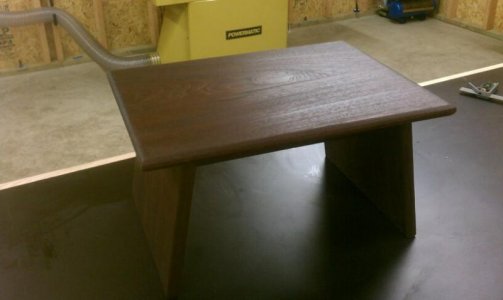
This is an example of one coat of minwax on white oak sanded to 400 done right by my seven year old grandson.
Don
Attachments


TruReef
New member
220 is one grit over sanded for oak but is probably not your issue. Over sanding burnishes the wood and makes the stain not penetrate like it should but it doesnt make a real big difference with oil based stains unless you go way down to like 400.
Don
Some sit on top others penetrate depending on the binder.
This is an example of one coat of minwax on white oak sanded to 400 done right by my seven year old grandson.
Don
So now you got me confused.... How do I know what grit to sand to? 150 or 400???
Does it not matter what kind of wood I use? Am I right that I can stain any kind of wood any color? The only difference in wood choice will be what grain patterns I want to see?
TruReef
New member
Sorry for the bad pics, I had more at one point but I think I deleted most of them. The color didn't show up great in the light on this one.
But this is the english chestnut that I was talking about.
Here's what ebony looks like over poplar. Way to black looking for my taste. I think the color you're looking to match may indeed be a combination of two stains but I don't think ebony is one of them.
Are both of these samples on poplar? What brand stain is this?

davocean
Active member
I'm a carpenter.
Not super fond of working w/ poplar, but sometimes that is what is called out.
This was one I did for a reefer that was poplar, w/ a mixture of stain, jacobean and ebony, 3-1 respectively.
If you do mix stain, I advise you document what you mix, and a good idea to mix a fair amount of touch up so you don't have issues later in matching additional pieces or repairs.
I also have pics of African mahogany, which is my favorite for marine applications.
This pic is right after stain, and before the clear coat was added, which made the grain slightly darken and pop a touch more.

Not super fond of working w/ poplar, but sometimes that is what is called out.
This was one I did for a reefer that was poplar, w/ a mixture of stain, jacobean and ebony, 3-1 respectively.
If you do mix stain, I advise you document what you mix, and a good idea to mix a fair amount of touch up so you don't have issues later in matching additional pieces or repairs.
I also have pics of African mahogany, which is my favorite for marine applications.
This pic is right after stain, and before the clear coat was added, which made the grain slightly darken and pop a touch more.
TruReef
New member
Here's one of African mahogany w/ a red mahogany stain.
A bit more on the red side of what you are trying to match, but that could be adjusted a touch.
Mahogany and Teak are both great for marine use, the African mahogany doesn't break the bank as much as teak.

That's beautiful. I might try & find some of that African mahogany.
All the info here has been on Pigment stains. You will get better penetration if you use a dye. You can get it in oil base or water base. I like the water base. Alot of the pigment stains will NOT penetrate the pours of the wood. The dye will.
Very true, any color any wood.
I am a fan of A. Mahogany, also a fan of Tiger maple

This may not be your color but the grain will remain the same.
A Mahogany in the northwest goes for about $5 a board ft.
Very true, any color any wood.
I am a fan of A. Mahogany, also a fan of Tiger maple
This may not be your color but the grain will remain the same.
A Mahogany in the northwest goes for about $5 a board ft.
Similar threads

- Replies
- 2
- Views
- 126

- Replies
- 3
- Views
- 655