
No coral growth

I too believed that stability is key, so I was a little shocked when I tested everyday and was getting the same values for a month and everything still doesn't look good. However, there is still the possibility that there are some swings throughout the day.

I do have the V2's. I only mentioned the blues and whites because I didn't think the other channels mattered too much. I have them programmed using the excel sheet from the RB website that let's you set a duration and a maximum intensity for each channel. Do you think that 60% max on the blues (both blue channels), 40% on the whites, and the other channels between 5-15% is too much? I have been running that for about a month now and thought it might not be enough.

As others have suggested, I have started doing more infrequent water changes. I have been doing about 10% every 2 weeks instead of every week. I can't resist the urge to do a water change when everything starts to look so dirty so it's hard for me to go so long.

After dealing with this for the past year and finally trying to get help from this forum and still feeling like I'm failing I don't even think I'm concerned with growth anymore. I just want everything to look like it's doing ok.

Great that you have the V2 lights. There is a paper published by Ecotech about Coral Labs and how they determined the best ratio of each color on Radion LED lights to get the best coral growth for the different types of corals.
I tried to mimic this within reason on my Photon V2 lights and I have seen good growth in the short time I have had them running.

I made an Excel spreadsheet similar to the one on the RB website, except I tried to use the coral labs settings for LPS and adjusted them to what I liked to see. I picked which channel I wanted to be the brightest, in my case I chose the violet channel, and then each other channel is a percentage of the violet channel.

Here is a link to the Coral Labs PDF file explaining what they did. In each section they list the values of each channel they used. I just disregarded the intensity setting since RB lights do not have that setting. We can only mix the colors by how bright we set them, we cannot say "I want 10% violet and 5% white, at 50% intensity"

http://ecotechmarine.com/wp-content/uploads/2016/01/Ecotech_CoralLab_WP1.pdf

In the spreadsheet I can increase the intensity of the violet channel and it will automatically adjust the rest of the channels according to the percentage I decided looked good.

Like I said it is a similar ratio to the coral labs LPS settings but not exact, but my corals seem to like it.

I do not have a PAR meter, but my tank is 29 inches tall, and my lights are 11 inches off the water. My settings are bright all the way down to the sand. I will still increase them some every couple of weeks until I get the brightness everything likes.

I have mine coming on about 9:30 am and going off about 10:30 pm. I set the clock on the lights 30 minutes off because I wanted them to turn off at 10:30 not 11 pm. They took away the 30 minute interval settings in the V2 fixtures.
These are my current settings using the spreadsheet I set up:
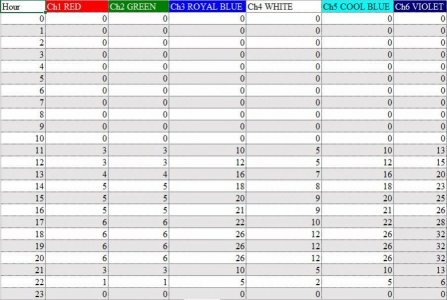
 

Attachments

  • schedule.jpg
    schedule.jpg
    81.3 KB · Views: 6
I have been using coral frenzy for a couple weeks and I have been feeding a lot more. I have noticed a ton of air bubbles forming in and on my sand since I started feeding heavy.

30-40 seems really high for nitrates. I'm not averse to letting things go and see how everything reacts, I just don't want to lose the little that I have now. I have stopped using GFO and my skimmer has been offline for at least a week since it kept overflowing and I couldn't get it to stop.

Should I really just let things go with no water changes while I monitor nitrates? That does scare me a little bit, but at this point I'm on the verge of tearing down and restarting.
 
I have been using coral frenzy for a couple weeks and I have been feeding a lot more. I have noticed a ton of air bubbles forming in and on my sand since I started feeding heavy.

30-40 seems really high for nitrates. I'm not averse to letting things go and see how everything reacts, I just don't want to lose the little that I have now. I have stopped using GFO and my skimmer has been offline for at least a week since it kept overflowing and I couldn't get it to stop.

Should I really just let things go with no water changes while I monitor nitrates? That does scare me a little bit, but at this point I'm on the verge of tearing down and restarting.

What kind of lights did you have before the v2 photons? I think you might have them too bright. Check out my post above regarding the light settings.

I would do a small water change monthly, or every six weeks. That is not too long between.

I would stop dosing everything and monitor your levels. something is making your skimmer overflow and it could be something you are dosing. You might try running carbon.

I would not tear it down and start over, it will just stress everything out.
 
I too believed that stability is key, so I was a little shocked when I tested everyday and was getting the same values for a month and everything still doesn't look good. However, there is still the possibility that there are some swings throughout the day.

I do have the V2's. I only mentioned the blues and whites because I didn't think the other channels mattered too much. I have them programmed using the excel sheet from the RB website that let's you set a duration and a maximum intensity for each channel. Do you think that 60% max on the blues (both blue channels), 40% on the whites, and the other channels between 5-15% is too much? I have been running that for about a month now and thought it might not be enough.

As others have suggested, I have started doing more infrequent water changes. I have been doing about 10% every 2 weeks instead of every week. I can't resist the urge to do a water change when everything starts to look so dirty so it's hard for me to go so long.

After dealing with this for the past year and finally trying to get help from this forum and still feeling like I'm failing I don't even think I'm concerned with growth anymore. I just want everything to look like it's doing ok.


I feel your pain man, you are not alone. Seemingly doing everything right and it's just not working out it seems. Trying to stick with it but when you see a new white spot or a coral has no polyp extension or whatever, it's disheartening. Good luck with it.
 
I had the Marsaqua before the Photons. I want to say I've had the photons since around April. I believe the light is about 6-7" above the water, but I will check that when I get home. I will also take a look at your spreadsheet and see how that compares to my current settings. They were actually a little higher about a month ago and I have since turned them down.

The only thing I am dosing right now is the Acropower which didn't seem to affect my skimmer at all the first week or 2. Then after that it just started going crazy. Do you think I should clean out the skimmer and put it back online to see if it will calm down or should I just leave it offline for now? I actually just started running carbon again yesterday with no GFO.
 
I had the Marsaqua before the Photons. I want to say I've had the photons since around April. I believe the light is about 6-7" above the water, but I will check that when I get home. I will also take a look at your spreadsheet and see how that compares to my current settings. They were actually a little higher about a month ago and I have since turned them down.

The only thing I am dosing right now is the Acropower which didn't seem to affect my skimmer at all the first week or 2. Then after that it just started going crazy. Do you think I should clean out the skimmer and put it back online to see if it will calm down or should I just leave it offline for now? I actually just started running carbon again yesterday with no GFO.

Yes I would get the skimmer working properly. Was it working right before at some point? What kind is it? Different things can make them overflow, like incorrect water depth, new filter socks, dosing certain things. They can be finicky. Mine was overflowing when I first upgrade to the 210 tank, and then when I started running carbon it stopped within a day and started skimming properly. Clean it and try it again, the carbon might have helped already.
 
The skimmer is an Eshopps PSK-75H which is a hang on back type that I had leftover from my previous tank. It has worked well in the past and only very rarely does it overflow, but when it does it usually corrects itself within a day or 2. This past time it was overflowing so bad that the drain on the cup almost couldn't keep up. I will clean it out tonight and hopefully get it back online and working properly.
 
My system is now on its 6th year now. My first year and a half I had zero growth. I tried all the tricks and snake oil only to get Dino a couple of times. Ultimately one thing turned my tank around. I got an auto feeder for my newly acquired anthias. They need to eat several times a day. I took the advise off a lecture at the local reef club given by Copps. Simply put keep your fish fat and happy and your coral will love you for it. I cranked my auto feeder up to tumble 7 times a day.

<iframe width="560" height="315" src="https://www.youtube.com/embed/DBPqPusIFm4" frameborder="0" allowfullscreen></iframe>

As you can see I have no more growth issues...
 
Corals have a heavy demand for both nitrogen AND phosphate (it's why the PO4 level drops in sea water around reefs). They prefer the organic forms of both but will use the inorganic forms. Acropower is amino acids which is one of the organic forms of nitrogen (another organic form is urea from fish poop). You need to either get more fish and feed them more so they provide the corals with nitrogen and phosphate in their waste (fish poop also provides calcium and magnesium crystals corals will ingest) or feed your corals something that simulates natural zooplankton and provides their nitrogen and phosphate that way.

(And I would ditch the skimmer)
 
Last edited:
Well it seems as though the consensus is that I need a dirtier tank. I was so concerned about keeping everything at 0 that I didn't really think dirty would be better. I will continue feeding fairly heavy and holding off on the water changes for a bit while continuing to test everything.

That's interesting about the skimmer. I ran my first tank with PC lights and no skimmer and everything grew like crazy. I only ever added a skimmer because people were talking them up so much.

I checked my lights today and they are almost 5 inches off the water. Is it possible that being that close to the water is providing too much spotlighting and the light is not being spread out enough?
 
A nutrient rich tank does not mean a dirtier tank.
Coral need nitrate, phosphate and more importantly, food, as floating tiny organic particles and dissolved organic.
Fish waste is one of the good food for coral. So feed your fish well and you will see coral grow better.
Also, do not use API test kit, especially nitrate. I use salifert test kits and they are easy to use and accurate enough for this hobby.
 
Don't be afraid to use skimmer, skimmer keep your water saturated with oxygen and even the best skimmer can only takes out ~40% of organic compounds. Many skimmers take out much less than that.
 
My system is now on its 6th year now. My first year and a half I had zero growth. I tried all the tricks and snake oil only to get Dino a couple of times. Ultimately one thing turned my tank around. I got an auto feeder for my newly acquired anthias. They need to eat several times a day. I took the advise off a lecture at the local reef club given by Copps. Simply put keep your fish fat and happy and your coral will love you for it. I cranked my auto feeder up to tumble 7 times a day.

<iframe width="560" height="315" src="https://www.youtube.com/embed/DBPqPusIFm4" frameborder="0" allowfullscreen></iframe>

As you can see I have no more growth issues...

My tanks will never look like that. Good god that's impressive.
 
I know there are Zeovit tanks that do really well, but I have to say that the tanks that employ the "high volume of food in-high nutrient export" method seem to do the best on average. It's not surprising because in the ocean there is an enormous quantity of food for corals to eat and the water is low in nutrients because of the huge exportation of said nutrients by coral, algae, etc...
 
I think what they're trying to say is feed more / export more. I try to follow this method and the net result is faster growth for everything, but you have to watch things; nitrate/phosphate, etc.

Zoanthids are like a canary in the coal mine. If they don't have big skirts, aren't growing, and don't fully open under lighting then there's water chemistry issues involved. Mainly suppressed pH and low calcium carbonate levels by my experiments. Unfortunately neither are fixed by water changes, and can actually be made worse.
 
With everyone suggesting to feed more and all the talk about how corals need the water to be slightly dirty... is there a pretty fine line between feeding enough to encourage coral growth, and feeding too much such that algae becomes an issue? Seems to me that if you're encouraging growth, you're encouraging growth across the board... both good and bad, no?
 
Here is an example...

My last tank before I moved had been running for 8 years. Had corals the size of watermellons. I fed a whole flat of mysis plus other stuff each day... Unmeasurable nitrates and between .003ppm and .006ppm po4. It was an ULNS even with all that feeding. It takes a lot of time to build up to something like this and doesn't usually happen in the first year or two. Nothing in this hobby comes fast so keep it up!

<iframe width="560" height="315" src="https://www.youtube.com/embed/N1cg8gkR_1w" frameborder="0" allowfullscreen></iframe>
 
. . . all the talk about how corals need the water to be slightly dirty. . .

I hate that people explain the nutritional needs of corals this way. Would you say the food on your plate is dirty?! That you wouldn't go to a restaurant unless they served you dirty food?! :(

. . . Seems to me that if you're encouraging growth, you're encouraging growth across the board... both good and bad, no?


To a certain extent this is true. Corals and algae are competing for the same nutrients. Both are pulling ammonia excreted from fishes gills directly from the water before bacteria break it into nitrates. Both are pulling phosphate and bicarbonates from the water for photosynthesis. (You make sure your bicarbonates are at a certain level why not phosphates?) In the wild herbivores help control the algae and when large herbivores (parrotfish mostly) are over fished or urchins die off* fleshy species of algae start to take over and promote heterotrophic (oxygen depleting) microbial populations** that push a system to eutrophic (nutrient rich, reduced oxygen) conditions. I would strongly encourge you to get Dr. Forest Roher's book "Coral Reefs in the Microbial Seas" It's cheap and very readable in spite of talking about very complex relationships between microbes, corals, algae and the various herbivores on reefs.

In the wild there's basicly two ways a reef shifts to eutrophic conditions. (I'll accept that sedimentation that chokes out corals reducing their ability to compete with algae is a third but I think is unlikely to be an issue in our aquaria.) The first is increase of inorganic nutrients with agricultrual runoff and sewage. The second is remove the herbivores that scrub down to a bare substrate***, ie, the Diadem urchins in the Caribbean and parrot fish in the Pacific.

Getting back to our aquariums nuisance algae are able to react quicker than corals are. Wether you use one of the ULNS methods to control nitrates (one form of inorganic nitrogen) and PO4 (inorganic phosphate, aka orthophosphate) or use a simpler system like I do and not worry about the particular numbers you have to have herbivores in your system just like in the wild and/or you need to be activley removing algae. Just stripping out nitrates and PO4 will not stop growing nuisance algae, searching threads here you'll find lots of people with "no measurable nutrients" or "nitrate and phosphate are both 0" and algae problems.


*
http://en.microcosmaquariumexplorer.com/wiki/Cracking_the_Diadema_Code

**
https://www.ncbi.nlm.nih.gov/pubmed/23303369
https://www.ncbi.nlm.nih.gov/pubmed/23882445

***
This impedes the corals ability to compete in several ways. It lets the algae shade corals. It increases the DOC that promotes coral pathogens (read Rohwer's book). It also eliminates the clean substrate coral larva need to settle.
 
Last edited:
With everyone suggesting to feed more and all the talk about how corals need the water to be slightly dirty... is there a pretty fine line between feeding enough to encourage coral growth, and feeding too much such that algae becomes an issue? Seems to me that if you're encouraging growth, you're encouraging growth across the board... both good and bad, no?

Right. get too high on nitrate/phosphate and CUC and fish can't keep.. It also depends on the type of coral you are keeping, SPS needs low phosphate for calcification. It also seems to do better in lower nitrate systems, although some keep them around 15ppm.

Softies in particular seem to like dirtier water, phosphates can be present nitrate can be in the 10-40+ppm range. And you are right, algae then becomes an issue, which is where most people control it with a CUC, algae eating fish, and some other macro algae to help take up the nutrients nuisance algae would otherwise. (I'll be using some Grape Calurpa that came in as a hitch hiker in my sump in my 300 gallon, easy enough to grab a handful out I might also build a turf/algae scrubber).

It's one reason most people stick to either SPS or softies, and don't really mix them. they thrive/grow under different conditions. From my understanding LPS is somewhere in the middle of those 2.
 
Back
Top