Overflow hole plugging

Thunderfan

New member
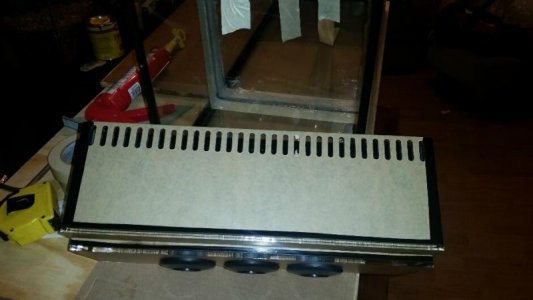
Just got my new overflow in. I had ordered it after deciding what I wanted but before reading enough to know how it should be. It has slots or teeth whatever you want to call them. I realize these are not the way to go and had I figured that out I would have ordered it without them. Oh well, I have to make what I have work. I am thinking about going to a local plastic place and getting a piece that will cover the holes out of their scrap bin. Then using it to cover them up. What would be the best thing to use to "glue" the cover up piece on? I assume it will have to be completely sealed between the two to keep water from getting between the two pieces may not matter I guess.
 

Attachments

  • 2014-12-21 07.58.19.jpg
    2014-12-21 07.58.19.jpg
    36.5 KB · Views: 3
Simply covering the slots may not be the best solution. It will raise the standing water level to the "top" of the box, from where it is presently (at the bottom of the slots.) You want the standing water level to be even with the bottom of the trim on the outside of the tank. While running, the water level will be higher than that, but not so high as to be a potential problem.

To get the water level set, it may require cutting the box down, before covering the slots, and in some cases, cutting the box down is enough. It depends on how it all fits together.
 
Simply covering the slots may not be the best solution. It will raise the standing water level to the "top" of the box, from where it is presently (at the bottom of the slots.) You want the standing water level to be even with the bottom of the trim on the outside of the tank. While running, the water level will be higher than that, but not so high as to be a potential problem.

To get the water level set, it may require cutting the box down, before covering the slots, and in some cases, cutting the box down is enough. It depends on how it all fits together.

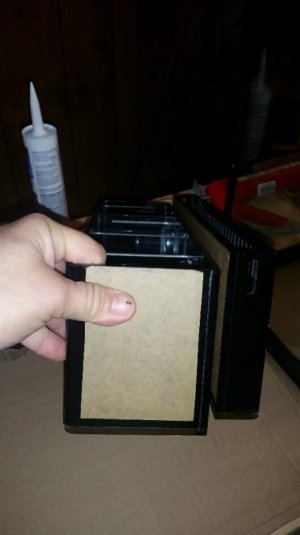
I have not drilled my tank and installed the overflow yet. I thought if I cover the slots and just make the top of the box at the bottom of the trim level. Doing a bean by the way. Here is a side shot of the overflow. I could cut the inside box down but, won't be able to cut enough to get rid of slots.
 

Attachments

  • 2014-12-21 08.01.34.jpg
    2014-12-21 08.01.34.jpg
    26.3 KB · Views: 2
Looking at the external box in comparison to your hand, the external box looks too short to fit a BA system.

Hole placement requirements and water level for best performance (middle of through holes) and I suspect the external box will need to be taller, for this system to work properly, and the system would probably have to be hacked up... more closely resembling a Herbie, and functionally the same.

That is strictly from what I see. Do you have the plumbing parts to do a BA the right way in hand?
 
I don't have the plumbing parts at this moment. I just got overflow friday and was planning on drilling and setting everything up this week. I was planning on picking up plumbing parts tomorrow.
 
Get all the parts together, get everything figured out BEFORE drilling the tank. Once you drill the tank, you are painted into a corner, if something is not quite right.
 
I just used a piece of acrylic I had lying around and didn't use glue. The suction from the overflow keeps it in place until the coralline grows over it and keeps it in place.
 
Get all the parts together, get everything figured out BEFORE drilling the tank. Once you drill the tank, you are painted into a corner, if something is not quite right.

I'm definitely a measure 3 or 4 times cut once type of guy. It will be completely figured out before the bit hits the glass. I just looked at it and I think it will fit. The pass thru holes are towards the top of the exterior box. Will probably use 1" or 1 1/4" fittings inside the box. Where should the top of the 90s be in relation to the pass thru holes? Also, I would assume the emergency pipe height will be in relation to water level in exterior box not level of dt. Would that be correct?
I really appreciate the input.
 
I'm definitely a measure 3 or 4 times cut once type of guy. It will be completely figured out before the bit hits the glass. I just looked at it and I think it will fit. The pass thru holes are towards the top of the exterior box. Will probably use 1" or 1 1/4" fittings inside the box. Where should the top of the 90s be in relation to the pass thru holes? Also, I would assume the emergency pipe height will be in relation to water level in exterior box not level of dt. Would that be correct?
I really appreciate the input.


This is a relational drawing. Since I have no idea of where exactly the holes are on the back of the external box, nor the heights or widths of same, I can't use actual measurements. The 3/4" below the trim on the outside of the tank, is the the minimum distance down on the back of the tank that the holes need to be. Water line is center of the through holes (1 3/4" holes for 1" bulkheads) so the internal and external function as one body of water (no waterfall,) and the elbows are shown in relation to the high water level mark. (approx.) actual water level may need to be lower, depending on adjustment and performance of the open channel. Generally it is between the point illustrated and the horizontal center-line of the elbows. Top of the weir (standing water level in DT) is bottom of the trim as illustrated.

The waterfall into the internal box is ~ 1.5" not bad, but 1" is ideal. Raising the elbows higher (to raise the water level) is not really a good idea (see below.) But again, I don't have the specifics of your boxes.

You will notice that this setup as drawn, is not very safe. The distance from the inlet of the dry emergency (open center pipe) to the top of the external box is very small, with no room to play. This would be begging for a flood. Lowering the inlet to the dry emergency, could very well cause a start up issues, in that there may not be sufficient head pressure to purge the air out of the siphon.

Quite literally, everything needs to be lower in the external box, (including the through holes) while keeping the top edge where it is, even with the trim on the outside of the tank. However, this will also increase the waterfall height to the internal overflow, which will increase the sound level.

All in all, these systems and boxes should be custom built, rather than trying to adapt some manufacturers idea of what an overflow's configuration should be.

Capture_zpsdb2de041.png
 
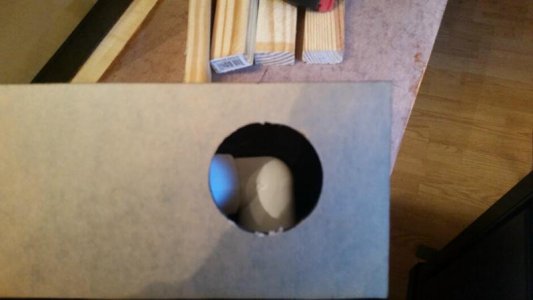
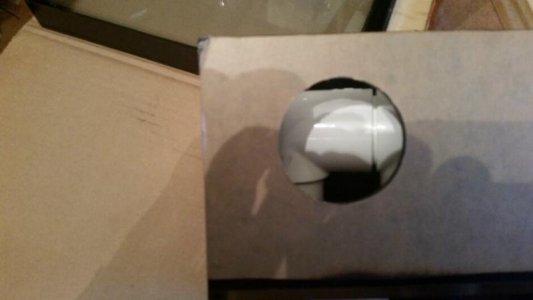
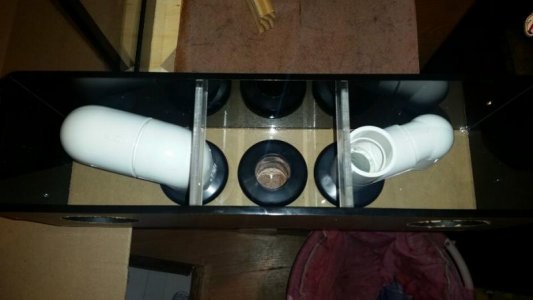
Picked up some parts today to see how this will work. One pic has 1.25" back to back 90 the other is 1" t with 1" 90. Probably make the 1" 90 a 1.25" if that's what will work best. I just put this together to get a reference to where they come out in relation to the pass thru holes. If the back to back 1.25" 90 set up would work I can drill and tap the back of one for the syphon line. Distance from top of 1.5"pass thru holes to top of exterior box is 3/4". If I cover the teeth on interior box it would drop level of exterior box 1/2" because top of interior box would be even with the bottom of the trim. Of course I could always cut 1/2"off of interior box to make them the same. Then fall from interior to exterior would be 3/4". Both inside and outside boxes are 5" tall as they sit. Exterior box is 4" deep.

If this set up will not work I can have a new exterior box made. Obviously I don't want to buy twice but may be a small price to keep from trouble.
 

Attachments

  • 2014-12-22 17.58.51.jpg
    2014-12-22 17.58.51.jpg
    29.6 KB · Views: 4
  • 2014-12-22 17.58.12.jpg
    2014-12-22 17.58.12.jpg
    23.6 KB · Views: 3
  • 2014-12-22 17.57.44.jpg
    2014-12-22 17.57.44.jpg
    34.4 KB · Views: 3
Last edited:
Turn both the 90° up rather than down as they are now, and I think you will see the problem with this setup, which is also seen in the drawing I made. With the 1.25" ells, water will overflow the external box, before the siphon kicks in, and with the 1" elbow, it is going to be too close.
 
Remove the pipe in the exterior box. it serves no purpose in an exterior box. You need the elbow in a Bean Animal due to the side drilled bulkhead. Removing the pipe removes the actual lifting of the water and eliminates the start up time. Literally there is no air to purge so the start up is immediate. (horizontal runs excluded) If you doubt it try it out, it works.

You will need a gate valve a ball valve won't be precise enough for this to work. (it does on a BA not on this herbie type drain)

You only need elbows on the open channel line (so it can work as a durso) Add the siphon start up hose just like BA's diagram.
 
Remove the pipe in the exterior box. it serves no purpose in an exterior box. You need the elbow in a Bean Animal due to the side drilled bulkhead. Removing the pipe removes the actual lifting of the water and eliminates the start up time. Literally there is no air to purge so the start up is immediate. (horizontal runs excluded) If you doubt it try it out, it works.

You will need a gate valve a ball valve won't be precise enough for this to work. (it does on a BA not on this herbie type drain)

You only need elbows on the open channel line (so it can work as a durso) Add the siphon start up hose just like BA's diagram.

On one side I have a tee and I was going to put a plug, drill and tap for the guest fitting. I just have the fittings in to show where they end up in relation to the thru holes.

Trying to make sure I am clear what you are saying. On the syphon side just put back to back 90s? On the open channel would I put a tee like I have or back to back 90s, drill and tap back of 90 for guest fitting? I already picked up fittings to do back to back 90s instead of tees just because it made sense to me. Less air to purge. Is using 1.25 90s for the pick up important? Having a hard time finding a 1" to 1.25" 90 and I don't have much room in my box for reducers. Going to try and flow about 800gph if that matters.
 
For the siphon line only there is no need for any pipe in the overflow. Somehow my fingers missed that key word.

Do the open channel just like BA's diagram but the bulkhead is below the T as your external overflow holes are through the bottom. You can adjust the gate valve to raise the water in the overflow to eliminate the vortex through the siphon. Top of the durso needs to be 1/4" under the display tank water level as well the emergency pipe opening needs to be low enough to handle your flow without draining your sump/overflowing your display.

Keep all the plumbing inside the overflow all 1".
 
For the siphon line only there is no need for any pipe in the overflow. Somehow my fingers missed that key word.

Do the open channel just like BA's diagram but the bulkhead is below the T as your external overflow holes are through the bottom. You can adjust the gate valve to raise the water in the overflow to eliminate the vortex through the siphon. Top of the durso needs to be 1/4" under the display tank water level as well the emergency pipe opening needs to be low enough to handle your flow without draining your sump/overflowing your display.

Keep all the plumbing inside the overflow all 1".

There is no relevance to the location of the top of the durso and the proper operation of this system and the location of the elbows is not related to the water level in the DT. The only relation between the two is the length of the waterfall.

The inlet to the dry emergency needs to be high enough to permit proper operation of the system. It is not in anyway associated with draining the sump.
 
Last edited:
Thanks, I'll dry fit it and take a picture and post to make sure it's right before glueing.

Like I told you before, there is insufficient room in the external box to implement this system without butchering it up. I think you would be better served, albeit out a few bucks, to do a through the back BA, and be done with it. If you have to hack something up to make it work, the odds are it will not work very well, and is just wasting time.
 
Happy to clarify,

Should have stated at least 1/4" below the tank water level for the durso. If the top of your durso is near the display tank water level the weir becomes the durso itself rather than the top of the overflow.

If the emergency is too high your display tank water will raise. The flow is created by raising the water above the emergency depending on your flow the more flow the higher the water needs to be above the pipe opening before enough water can fit, this is caused by the weir created by the pipe and friciton loss of the pipe itself. If the emergency is too low the siphon won't purge (assuming you use elbows in the siphon) If it is too high the display tank water level will raise which will result in a display tank overflow or your return section of your sump draining or more clearly put getting pumped into your display which will destroy your return pump.
 
Back
Top