Both scenarios sound awful to me. :deadhorse:
I still think we are doing more of a service to the fish when we place them into the care of an experienced aquarist with a smaller tank rather than into the "care" of an inexperienced aquarist with a larger tank. To me, it's the aquarist who makes the biggest difference in a fish's "happiness".
+1.
nssmith_mma, I was who you stated earlier "the only person to give a good argument." You seem to be willing to listen and discuss so I have another argument here.
I may be traditional in your eyes, but I firmly believe stunted growth is an evidence of improper environment (most likely smaller-than-required). It is true that fish in general don't reach their wild adult sizes unless they are in large public aquariums. However, if a fish can get to 10" in the wild and doesn't get bigger than 4" in our aquariums, that really tells a lot. It makes sense to me but I don't know if it does to you. Stunted growth is generally a result of stress from lack of available space. Remember, fish can't talk, so it's hard for them to tell you if they are mentally stressed out. The aquarist can do a lot to maintain good water quality so the fish doesn't get sick and look healthy in our eyes. However, this doesn't not mean they are "mentally" healthy. Overall health is not just about physical appearances, but psychological as well. Whatever applies to humans applies to fish too.
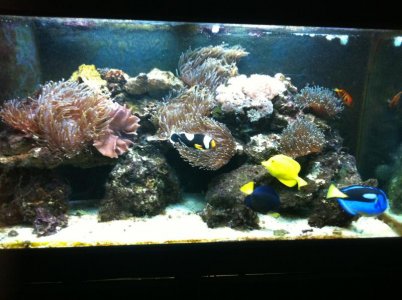
I don't argue that your cousin's 60g tank and the three tangs look healthy, but please apply some common sense here and think like a fish. Would I (a fish who's supposed to get to 10") be happy to only have 60g of space to swim around? I'm going to use this cliched example again. Would you lock a german shepard (who is as active as a tang) in a 10'x10' room for life? My guess is you're gonna say No. So why would that be ok for the tang?
Right...and I agree that stunted growth is caused by a fish being kept in a smaller tank. The problem we humans make is that we anthropomorphize everthing. That means we ascribe human emotions to things that have no capacity for these emotions. Fish don't love, they don't envy, they don't miss friends or family members, they don't get angry, and they don't experience happiness. So no, I don't agree that "whatever applies to humans applies to fish too". In fact, I wouldn't even agree that "whatever applies to german shepherds applies to fish too" because dogs do actually have some capacity for emotion. That's one reason they are so compatible with humans. Make no mistake about it, if you let your fish go free into the ocean, it would not swim back to you or ever think of you again. Now think about letting your dog into the wilderness. It probably would never give you the chance to get far enough away to leave it. Apples and oranges.
A fish's "mental" health is based entirely, and I do mean 100%, on whether or not their basic needs and instincts are being met. If they have the basic necessities such as food, shelter, clean water, and access to mates, then they are totally "happy". My question is this: why then, do we aquarists only focus on the shelter aspect of this? Let's not forget that any living organism's primary motivation at maturity is to reproduce, after all. As a biology major, nothing is more apparent to me than this. So why then, do we not feel the least bit guilty about keeping a fish singly without access to mates? Is that not a need that we are not meeting for the fish? You could put a tang in a 1000 gallon tank, but so long as there are no potential mates present, then one of its basic needs are not being met anyway. A bit of a straw man, I know, but it is a valid point.
Again, my whole premise for my argument is that it is the skill of the aquarist that allows a fish to be "happy" aka have its needs met. With that said, it is at the discretion of the experienced aquarist as to what size of tank is appropriate and you hope that they can make a rational decision based on the conditions only they are familiar with. That includes making a decision, when it comes to this point, as to whether or not you should find a new home for your fish should it begin to become a bit cramped in its current environment. But it also includes whether or not you can keep the fish in the first place, and whether or not you feel your experience outweighs the limitations this fish supposedly has. I think you will often find that the most experienced aquarists are the ones pushing the envelope because they are familiar with their skills and how to properly care for the animal they have chosen to care for.
I'm always up for a good debate by the way. Perhaps the only civil direction to go from here is to simply agree to disagree.