Quinine Sulphate treatment for ICH!

Greetings All,
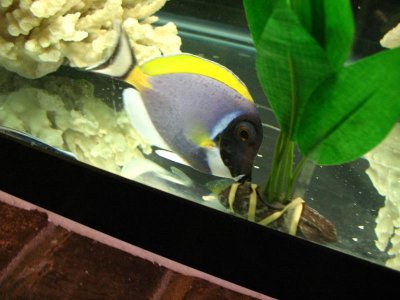
Update on day 2 1/2 on quinine phosphate. The ich was is still present on the fishes. They are all still actively swimming and inquisitive in their surroundings, looking for food. My pH has been stable at 8.4, ammonia has increased as expected to 1.0 ppm - I dosed some ammo-lock this morning and plans are doing a 20 gallon water change tonight after feeding. The tangs look "funny" I don't know how to describe them, it's like pieces of their scales fallen off? I'll try to post pictures. Other fishes are still hanging in their. It is not fun when your fishes are sick! That will teach me to quarantine and dip!
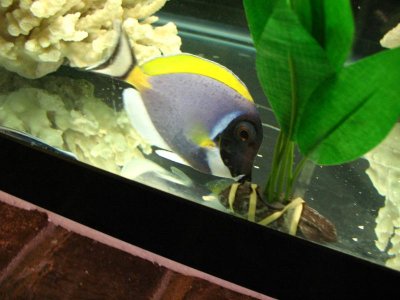
 
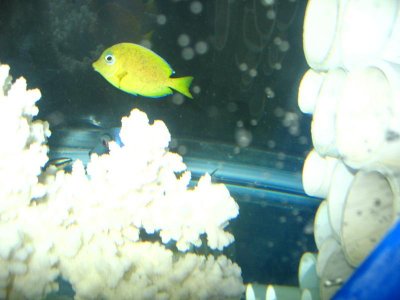
First picture is of my Powder Blue Tang and the second one is of my Atlantic Blue Tang. See how strange their skin looks? If someone knows what this is PLEASE let me know!
Thanks!
 

Attachments

  • What is this2 020.jpg
    What is this2 020.jpg
    54.9 KB · Views: 17
  • What is this2 016.jpg
    What is this2 016.jpg
    43.3 KB · Views: 18
The only time when I will consider any drug that will gravely harm nitrification bacteria in QT is when here is no alternative. And I generally design so that the medium of filtration can be removed from the filter easily for this reason.

If there is a reasonable alternative, a drug that interferes with nitrification will be disqualified.

If the ammonia in QT is 0.4 ppm, 50% water change will only reduce it to 0.2 ppm at best.

If there is poops or uneaten food, sudden surge of ammonia from decay is always possible.

How toxic is say 0.2 ppm? it may well depend on how long the exposure is.

Some drugs like antibiotics aganist bacterial infection need only a week or so of treatment.

To eradicate ich, it takes eight or more weeks.

Eight weeks of water change, reduced or little food for fish, average 0.2 ppm ammonium? No No No for me.
 
The only time when I will consider any drug that will gravely harm nitrification bacteria in QT is when here is no alternative. And I generally design so that the medium of filtration can be removed from the filter easily for this reason.

If there is a reasonable alternative, a drug that interferes with nitrification will be disqualified.

If the ammonia in QT is 0.4 ppm, 50% water change will only reduce it to 0.2 ppm at best.

If there is poops or uneaten food, sudden surge of ammonia from decay is always possible.

How toxic is say 0.2 ppm? it may well depend on how long the exposure is.

Some drugs like antibiotics aganist bacterial infection need only a week or so of treatment.

To eradicate ich, it takes eight or more weeks.

Eight weeks of water change, reduced or little food for fish, average 0.2 ppm ammonium? No No No for me.

Lets see I think this person will tell you the same thing they told me.....

If you would like to suggest ways of resolving the ammonia and nitrite issues, I'm sure I and many people reading would appreciate that but if you are just going to comment about ammonia and nitrite issues, I'm sure there are threads specifically discussing ammonia and nitrites.

I gues he just does not get it.......Wooden you are better at explaing about the nitrification process then me. I guess they think ammonia binding agents are the way to go.
 
Lets see I think this person will tell you the same thing they told me.....

If you would like to suggest ways of resolving the ammonia and nitrite issues, I'm sure I and many people reading would appreciate that but if you are just going to comment about ammonia and nitrite issues, I'm sure there are threads specifically discussing ammonia and nitrites.

I gues he just does not get it.......Wooden you are better at explaing about the nitrification process then me. I guess they think ammonia binding agents are the way to go.

Wooden is sharing his thoughts and treatment criteria - thank you Wooden.

An update.
Did a 20 gallon water change last PM. I don't like to use chemicals if I can avoid it. I added 1/2 teaspoon of Quinine Phosphate 20 gallons of new water.

I think the "spots" on my tangs are where the ich had came off. No one has commented on that yet. What do you think?
 

Attachments

  • What is this2 020.jpg
    What is this2 020.jpg
    54.9 KB · Views: 14
Lets see I think this person will tell you the same thing they told me.....

If you would like to suggest ways of resolving the ammonia and nitrite issues, I'm sure I and many people reading would appreciate that but if you are just going to comment about ammonia and nitrite issues, I'm sure there are threads specifically discussing ammonia and nitrites.

I gues he just does not get it.......Wooden you are better at explaing about the nitrification process then me. I guess they think ammonia binding agents are the way to go.


ammonia binding agents are the way to go when you have ammonia problems. a cycled QT is great, but many times you STILL have ammonia problems.
 
ammonia binding agents are the way to go when you have ammonia problems. a cycled QT is great, but many times you STILL have ammonia problems.

I disagree but OK have fun....

What do you do when you are using copper? Do you ise amonnia binding agents? HOPE NOT...
 
Update Quinine Phosphate Treatment Day 4:
I've been doing 20 gallon water changes on my 55 gallon hospital tank to help with ammonia. Highest was 1.0 ppm. pH 8.4. No Nitrite and Nitrate because there are not enough bacteria in my system to do the nitrification.
The two tangs are looking "normal" again, all dark patches cleared the next day. No signs of ich on fish today. It will be interesting in the next few days to see if I get another ourbreak as the life cycle of ich continues. I've been replacing the medication I take out with each water change. The wrasses are hiding more I think because the tangs are getting grumpier in this small tank, if this continues I will be moving the Lubbock's Wrasse and the Clown Fairy Wrasse to another hospital tank.
One note on the Clown Fairy Wrasse, I notice a yellowing of his "white" belly. This was noted on Terry Bartelme's article: Here's an excerp:

Antimalaria Drugs

Several antimalaria drugs have been used with some degree of success for combating Cryptocaryon irritans. These would include, but are not limited to, chloroquine phosphate, quinine hydrochloride and quinacrine hydrochloride (Atabrine®). A bioassay should be performed before using antimalari drugs, because their strength can vary greatly from one batch to the next.

In my experience, quinicrine hydrochloride was partially effective, but problematic. This treatment caused some of the fish to take on a yellow hue or darken in coloration. It also appeared to cause the fins to begin to fray at about one week into treatment. The recommended treatment period when using quinicrine hydrochloride is 10 days, which is not generally a sufficient period of time to eradicate Cryptocaryon irritans.

http://www.advancedaquarist.com/issues/feb2004/mini4.htm if anyone interested.

Three more days and I'll be finished with the 7 days recommended by National Fish Pharmacy. I hope this works. Otherwise...I think I'll be going the hyposalinity route. Oh my goodness!
 
The recommended treatment period when using quinicrine hydrochloride is 10 days, which is not generally a sufficient period of time to eradicate Cryptocaryon irritans.

http://www.advancedaquarist.com/issues/feb2004/mini4.htm if anyone interested.

Three more days and I'll be finished with the 7 days recommended by National Fish Pharmacy. I hope this works. Otherwise...I think I'll be going the hyposalinity route. Oh my goodness!


My question to you would be....If the person you quoted states The recommended treatment is 10 days, which is not generally a sufficient period of time........WHy would you only do 7 days?

OH and Hypo is just as much of a PITA......Use Cupramine.
 
I've tried Quinine Sulphate with mixed results. It might not of worked because it was too late for the fish or the product just did not work. I never knew you were not supposed to feed the fish. I fed the fish but I performed water changes every other day and replaced the Quinine sulphate with the amount of water that was changed.

I would not worry about nitrites since nitrites usually rise a few days after an ammonia spike. Your fish would die first from the high ammonia so I would concentrate on monitoring your ammonia.

After all these years Cupramine works 100% of the time. You can NOT mix Amquel/Prime or use UV because this will interact with Cupramine making it more toxic as per Seachem. I found out the hard way.

I had mixed results with hypo. While it will cure ich it has no affect on Velvet (another popular faster acting deadly disease than ich). Cupramine will take care of ich and velvet.
 
Hi, my 1st post :bigeyes:

I've just had an outbreak of white spot here in UK. I dithered over the diagnosis but the Tangs gave it away with the typical grains of salt.

Other fish showed rapid breathing and secondary skin infections which confused the diagnosis and only served to delay treatment.

Read all I could about different treatment and in the opted for 10 days of Cupramine at 0.3. About 4 days in things started improving rapidly with the result I cleared it and saved the fish.

My advice is Cupramine and yes my water parameters went off but was able to control with light feeding and water changes. Next time (in a quarantine tank) I wont hold back.

Tried to post a pic of fish on day 10 of treatment but not so easy on this forum :sad2:
 

Attachments

  • group1.jpg
    group1.jpg
    102.7 KB · Views: 14
Hi, my 1st post :bigeyes:

I've just had an outbreak of white spot here in UK. I dithered over the diagnosis but the Tangs gave it away with the typical grains of salt.

Other fish showed rapid breathing and secondary skin infections which confused the diagnosis and only served to delay treatment.

Read all I could about different treatment and in the opted for 10 days of Cupramine at 0.3. About 4 days in things started improving rapidly with the result I cleared it and saved the fish.

My advice is Cupramine and yes my water parameters went off but was able to control with light feeding and water changes. Next time (in a quarantine tank) I wont hold back.


Thanks for sharing. You were on the low side of the treatment level. Seachem suggests .5 for 3 weeks. So make sure you observe the fish good in copper free water for a week to makw sure you got rid of it.

Tried to post a pic of fish on day 10 of treatment but not so easy on this forum :sad2:
 
WELCOME TO REEF CENTRAL pab2005! I'm glad you did your first post with ME!

The reason that I did not chose copper is because I've read and heard that my wrasses are very senstive to them. I've read many positve things about quinine, which is why I've decided to give it a try and post my progress here. I'm not trying to convince people of it's effecacy but only to share my experience. I'm glad that copper works. It's just that with certain copper sensitive creatures, we need to try diffrent things.

Update on Day 5:
No signs of spots, stress, or frayed fins. All tangs, wrasses, and angel look really good! Great colour and actively swimming, begging for food which I do feed.
Now I will just keep on doing the 10-20 gallon water changes with medication replacement and wait...
 
How do do you come to that conclusion?

Also you said "Copper does not "destroy" your biological filtration and it treats parasites. "

But you know it does do some damage

Eight weeks is empirically arrived at. It is a reasonable compromise between patience and effectiveness. Copper and hypo are only effective in killing the waterborne phase of ich and likely not instantaneously. Suppose just one ich organism survives a very brief trip to a fish, ich is not eradicated by just one life cycle.

10 or 12 weeks is better still.

Coppersafe literature, at least once, states that it will depress nitrification by 20% upon initial application until copper resistant strain of bacteria develops. It is likely true with straight copper.

20% reduction can be adjusted by restricting feeding. In addition, the way I cycle with the seed and waste method will create very dense and active nitrification bacteria population that will FAR exceed the need of any bioload within three weeks after the cycle.

Practically, copper is never a concern to nitrification.
 
Wooden, whats your take on using prime or amquel during copper treatment.

I am sorry to tell you (I am not sorry though) that I have never used Amquel or Prime in conjuction with copper.

Some people here say that Amquel binds with some copper formulation

I have only used this type of products when I used a drug that will gravely harm nitrification bacteria. Only then do I need to remove ammonia artificially. Copper is not one such drug.

For a long time, over 25 years, I have always had enough active medium (loaded with nitrification bacteria) standing by at least a few months after adding the last livestock in DT. This medium will allow me to remove any amount of ammonia from any amount of bioload all at once in QT.
 
Back
Top