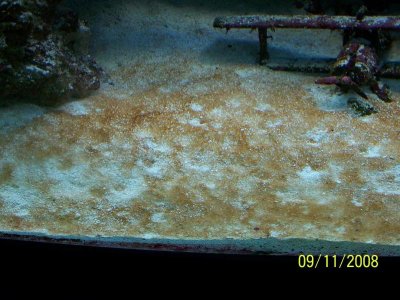
Red Sea Coral Pro- Cyano Problem?

ReefCowboy

New member
Heres the deal,

I read all the goods about this salt, and have been using it for a few months.
Have an 80 gal sps tank with 2 MP40's at high flow setting(in addition to a high flow return, i believe there are low chances of dead spots)only tank inhabitants are a yellow and small blue hippo being fed a small amount of mysis once a day. Skimming is done with a Seaside aquatics CS1 rated for a 150 gal tank. In sump i have a 1'x1' basket fully packed with chaeto.

Changing 10% of the water weekly(religiously).Only dose alk/Ca/Mg(B-Ionic).
My Ro/Di system is a 5 stage unit(4 months old) and every top off water and wc water is tested with two tds meters to make sure membrane/ canisters are good, always reading 000ppm before being added to the tank. I started noticing red slime over the sand and have treated it(ultralife labs)but it keeps coming back, and after water changes it seems to get worse. Ive been trying to think it is something else and the salt isnt the issue, but having been consistent with everything listed above, cant seem to stop thinking it is the salt.

Anyone experienced this issue? Ive read others with similar issue out there, but always though would be the source water quality problem. Reading the triple zeros on both tds meters(while testing them on other water samples to make sure they work), and see the red slime keep coming back, im considering changing to another salt. Coral growth is great, but maybe that salt has an over abundance of nutrients?
 
Not to uncomman for a tank 1 year old. I would keep practicing good reepkeeping habits and wait it out. But you are sure it is Cyano bacteria and not dinos. I ask because dinos love high flow and water changes! Pictures would help but here is a photo of dinos for you to compare to.
 

Attachments

  • algaesm.jpg
    algaesm.jpg
    86.1 KB · Views: 3
I have pretty much the exact same setup as you minus the skimmer. I'm using Red Sea Coral Pro as well and getting lots of cyano in my tank. That's really the only algae I'm getting; I clean my glass basically every 2 weeks and I have no other nuisance algae anywhere in the tank. I'd say about 30% of my sand is covered in cyano and I am unable to get it under control.
 
Guys, thank you for the reply. Coralsnaked,

That pic is pretty similar to what i got, however in my tank that algae seems to be a bit on the darker/vivid red color...im inclined to think i have the bad, red slime...

Quantim0, glad to hear im not the only one with this issue, and i hate to place this salt on the spot when i hear so many people with good results. I also only have red slime, and run a gfo reactor, no other algae at all anywhere. i just didnt know where could the problem be coming from. Ive treated the tank twice for it, and it keeps coming back...

I was thinking of one think though that could be bringin in the excess nutrients....B-Ionic!
Over the past few weeks the alk/ca supplementation has doubled with more growth from some colonies, so doesnt that supplement also provide trace elements? Thats gotta be it....
 
I'm dosing brs two part at the moment.

The algae in my tank is brick red in color so I'm sure it's not dinos.

I don't know if it's the red sea or not but I have a bucket of IO on the way. The rest of the red sea will be used for my qt tank, luckily I don't have much left.
 
Same salt (RSCP), no issues like you outline. I do automated 1% water changes every night, so things tend to be very stable.

This particular tank is fairly new, and I have the usual algae cycles and such, but nothing I've not had before after setting up the other tanks and salts I've used in 30 years of reefing. I'd suspect something else besides the salt first. Personally, I like the high levels of The Big Three in RSCP...they seem to be very stable batch-to-batch.
 
I'm dosing brs two part at the moment.

The algae in my tank is brick red in color so I'm sure it's not dinos.

I don't know if it's the red sea or not but I have a bucket of IO on the way. The rest of the red sea will be used for my qt tank, luckily I don't have much left.

I might do the same thing. I still have about 25% left of the rscp, but might grab another salt to try and check the results. I like the Bionic because i can get a 2x1 gallon pack for 33 bucks around where i live. Its very convenient too. If i switch the salt and notice no red slime coming back, i know i got the issue and can speak for it. After treating for the red slime its taking about 1-2 weeks for it to come back so ill know soon once i switch the salt. If you dose BRS and also have the same issue, looks like the salt must be the first variable to look for
 
Same salt (RSCP), no issues like you outline. I do automated 1% water changes every night, so things tend to be very stable.

This particular tank is fairly new, and I have the usual algae cycles and such, but nothing I've not had before after setting up the other tanks and salts I've used in 30 years of reefing. I'd suspect something else besides the salt first. Personally, I like the high levels of The Big Three in RSCP...they seem to be very stable batch-to-batch.

How long have you had your tank set up while using rscp?
 
How long have you had your tank set up while using rscp?

THIS tank...about 4 or 5 months. But I've used RSCP before on other tanks, as well as many, many other salts. My comment on my current tank is that I'm not seeing anything that I would not have expected from a new tank (with new substrate, etc.)...with is a minor algae bloom (hair algae), some red slime here and there, etc. I just vacuum it up a few times and it tends to go away. Occasionally, over the years/tanks, it will come back, and then go away with a vacuum or two.

I can say in the past few years (on various tanks) since running GFO and doing frequent (and now daily small) water changes I have not seen as much of an issue with cyano or algae in general.

I do have quite a bit of water flow...which I think is helpful.
 
The slime could be fed by nutrients in the salt product. Most will contain some ammonia, and trace elements can encourage microbial growth, too. I would guess that the tank needs more nutrient control, but you might be seeing a bloom of a nasty type of dinoflagellates.
 
The slime could be fed by nutrients in the salt product. Most will contain some ammonia, and trace elements can encourage microbial growth, too. I would guess that the tank needs more nutrient control, but you might be seeing a bloom of a nasty type of dinoflagellates.

What would you recommend me do to control the nutrients? I have plenty of chaeto, but other than that with wc's not sure what else i should do.
 
The few things you could do to reduce nutrients:
Switch to a salt that doesn't add or contain anything that has nutrients that can be used by the cyano/algae/bacteria. I switched back and forth from IORC, Red Sea Coral Pro, IORC, and Red Sea Normal. I'm now on ESV B-ionic salt. its more expensive (2x the price of 200 gallon boxes of IORC), but I know I'm not introducing nutrients with this salt mix where the other two are unknown.

Check your water. If your using RODI - make sure the filters are changed out and the TDS out of the DI is reading zero. Even then, if your DI has a coffee color - change it out. You could still be reading zero PPM TDS and still have 0.5 PPM Phosphates.
 
What would you recommend me do to control the nutrients? I have plenty of chaeto, but other than that with wc's not sure what else i should do.

The few things you could do to reduce nutrients:
Switch to a salt that doesn't add or contain anything that has nutrients that can be used by the cyano/algae/bacteria. I switched back and forth from IORC, Red Sea Coral Pro, IORC, and Red Sea Normal. I'm now on ESV B-ionic salt. its more expensive (2x the price of 200 gallon boxes of IORC), but I know I'm not introducing nutrients with this salt mix where the other two are unknown.

Check your water. If your using RODI - make sure the filters are changed out and the TDS out of the DI is reading zero. Even then, if your DI has a coffee color - change it out. You could still be reading zero PPM TDS and still have 0.5 PPM Phosphates.

Was thinking about switching to IORC, what issues made you switch away from it?
Thanks for the input
 
This study on Advanced Aquarist and my LFS drove my decision:
http://www.advancedaquarist.com/2011/3/aafeature

While most of the studies with IORC and bacteria growth were from contaminated containers - figure 15 represents a sterile mix and bacteria still grow in IORC (granted not by much). The study states that:
the bacteria populations fluctuated but did not consistently rise over time as might be expected if sufficient nutrients were available (cf. Fig. 13). Thus, there is no reason to suspect that any of these five salt mixes themselves contribute to the high levels of bacteria in the make-up saltwater of Fig. 13

I make the opposite conclusion from the study and the data presented. In real world situations, we are going to be following what was presented in fig 13 to some degree (I doubt many of us have 1 molar hydrochloric acid laying around just to rinse our mixing buckets). There's something in IORC and/or our mixing buckets that provides nutrients to bacteria - allowing them to multiply. Those same nutrients fuel cyano and algae growth in our tanks.

dkeller and myself were having a similar conversation in another thread:
http://reefcentral.com/forums/showthread.php?t=2336791&goto=nextnewest
 
How quickly is the Chaetomorpha growing? How much is being harvested out? If Chaetomorpha can't handle the problem, you might want to try some carbon dosing. Also, reducing feeding might be appropriate.
 
Wow! Could it really be the salt?

Wow! Could it really be the salt?

I'm pretty shocked to be seeing this post; only because I have a 120 Gallon Reef that is about 10 month old and for the last 4 months I've been battling Cyano break out. On my old 29 gallon tank I used Instant Ocean salt, but decided to "upgrade" to Red Sea Coral Pro Salt when I established this new tank.

I have been through 3 sets of 3 day darkout periods with no feeding and have cut back my feeding to every 2-3 days.. one cube frozen shrimp. and once to twice a week I feed Reef Chili.

I upgraded my Skimmer to a Reef Octopus Diablo XS200 and load some new cheato in my refugium to help combat the issue, but I still can't get rid of the red.

I dose BRS 2-part hourly on a set of 1.1 ml dosing pumps and I have a BRS dual reactor running ROX carbon and GFO.

I have been checking my water for Phosphates/Nitrates weekly and can't find a source of the growth.

NEVER thought it could be my salt, but after reading this I wonder. I do frequent water changes ~10% every week on my automated system. I just recently stopped my automated system (do to a malfunction and flood in my basement) and I swear that the red reduced with less water change, but still wont' completely go away.

I also have 4 powerheads .. one in each corner and have targeted the areas that are red with more flow, yet this does not deter it from growing.

Somewhat at a loss... I wonder if it could be the salt. I just got a new 175 gallons worth in the mail yesterday on top of it.

ReefCowboy, if you decided to switch up your salt please keep us posted to your results.
 
How quickly is the Chaetomorpha growing? How much is being harvested out? If Chaetomorpha can't handle the problem, you might want to try some carbon dosing. Also, reducing feeding might be appropriate.

I keep an overstuffed basked in which i remove as much as can, and it keeps growing. Maybe i should be removing more. I feed very little, maybe 1/2 of a cube of mysis to my two small tangs once a day.
 
I'm pretty shocked to be seeing this post; only because I have a 120 Gallon Reef that is about 10 month old and for the last 4 months I've been battling Cyano break out. On my old 29 gallon tank I used Instant Ocean salt, but decided to "upgrade" to Red Sea Coral Pro Salt when I established this new tank.

I have been through 3 sets of 3 day darkout periods with no feeding and have cut back my feeding to every 2-3 days.. one cube frozen shrimp. and once to twice a week I feed Reef Chili.

I upgraded my Skimmer to a Reef Octopus Diablo XS200 and load some new cheato in my refugium to help combat the issue, but I still can't get rid of the red.

I dose BRS 2-part hourly on a set of 1.1 ml dosing pumps and I have a BRS dual reactor running ROX carbon and GFO.

I have been checking my water for Phosphates/Nitrates weekly and can't find a source of the growth.

NEVER thought it could be my salt, but after reading this I wonder. I do frequent water changes ~10% every week on my automated system. I just recently stopped my automated system (do to a malfunction and flood in my basement) and I swear that the red reduced with less water change, but still wont' completely go away.

I also have 4 powerheads .. one in each corner and have targeted the areas that are red with more flow, yet this does not deter it from growing.

Somewhat at a loss... I wonder if it could be the salt. I just got a new 175 gallons worth in the mail yesterday on top of it.

ReefCowboy, if you decided to switch up your salt please keep us posted to your results.

Definitely will keep this thread updated about any change as the new salt starts being used. I figure IO salt cant do that much bad since has been around for a good while. I might have to add Ca and Alk to boost it to higher levels favoring corals, but i am tired of fighting the red slime... If it is not the salt, i will be the first one to disclose otherwise, as i would really like to use RSCP. As soon as my 48hrs are up with the red slime treatment, i will do a water change with IORC.
 
Ya good luck. I highly doubt it's the salt - but it doesn't hurt to reduce nutrients.

I used red slime remover to kill off my cyano problem. Worked ok - but the dead slime clogged up my filter sock over night and I had a flood replaced by fresh top off water to change the salinity from 1.027 to 1.022.

My reading were also low (0.03 PO4 and 0 Nitrates). I attributed the problem to my pukani rock leaching phosphates along with poor choices for my live rock supplier.
 
Back
Top