Reef fish evolution

Eep, like like something Sigourney Weaver has fought with at some point in her film career ;)
 
This is such a fantastic thread.

Here's another question for you Luiz (or everyone):

There are quite a few symbiotic relationships in the animal and plant world. Obviously there are some in the reef environment but I can't recall very many that occur between just fish that are not specific to cleaning. Do any reef fish sort of collaborate during feeding times? Any other cool ones you want to share? I'm sure you have a picture of something!

Thanks,
 
Not to hijack the thread with mere FRESHWATER fish, but one instance of evolution has always amazed me: The Haplochromine cichlids of Lake Victoria. Geologists have discovered through core samples that the lake dried up about 13,500 years ago. The parent species were two Haplochromines that re-entered the lake from rivers when they changed their courses and the lake re-filled. In the 1950's there were an estimated 500 species in the lake, all of them evolved in that short time! Of course, the downside is that at the same time, people translocated the predatory Nile Perch to the lake and now there are only an estimated 250 species left. Still, this is evolution at a rate that a researcher could measure in their own lifetime!

Bill
 
has there been any theories explaining why blue/yellow is a very common combination in reef fish?

Colors in fish have eluded biologists (and SCUBA divers) for many years.
Colors are only present in fish in the very shallow water. Reds will disappear below about 30' and any red colors on a fish will appear blue or black. Yellow also disappears rather quickly. A fish like Royal Gramma lives in deep water, I have seen them below 120' but such a beautiful fish as that appears blue and darker blue in the sea.
Copper band butterflies also appear to have dark blue stripes in deep water.
And it is wierd that a fish like a moorish Idol which is mostly black and white is a shallow water fish. The yellow on it's snout shows up clearly but you would think a shallow water fish would be more colorful.
At 60' all fish appear blue no matter what color they really are.
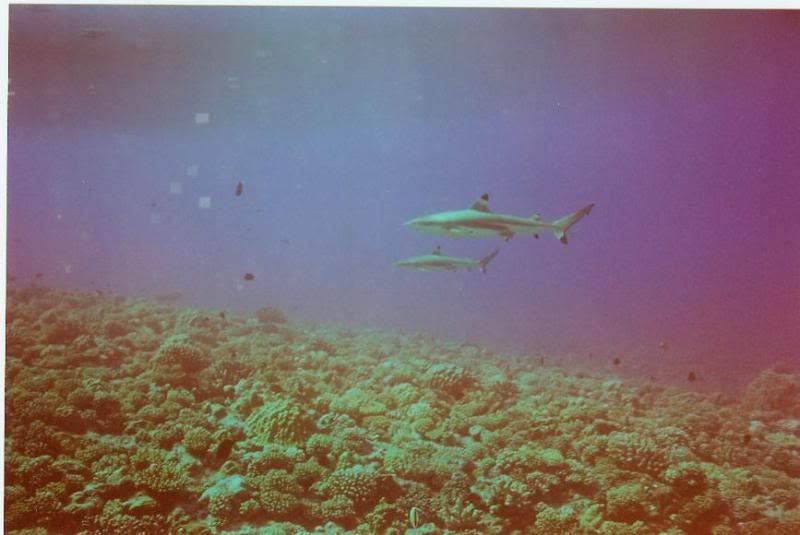
I took this in Bora Bora and I don't remember the depth but see all those gray corals? If you shine a light on them they are all shades of reds, yellows, blues and greens.
Even the black tipped sharks look gray.

Guppies.jpg


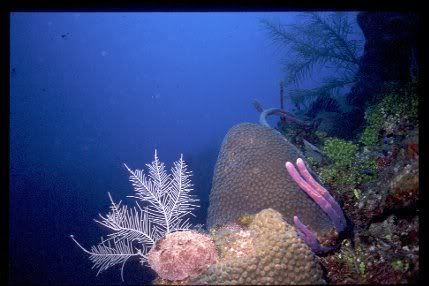
This was in the Caymans and was taken with a flash, the colors are vivid but look at the corals out of the light, they are all gray or blue as everything else including the fish are at depth.
No one seems to know why tropical fish are so colorful and those colors are only seen if the fish swims into shallow water.
Also fish from colder waters are predominately brown or gray

Cayman.jpg


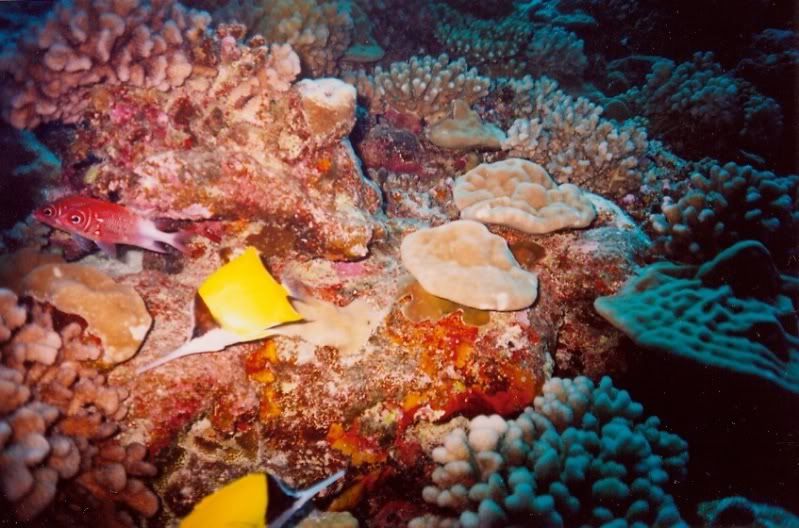
I took this in Tahiti, those fish are only yellow because I used a flash, out of the flash they appear blue as the corals do

LongNose.jpg
 
Last edited:
Not to hijack the thread with mere FRESHWATER fish, but one instance of evolution has always amazed me: The Haplochromine cichlids of Lake Victoria.

That is a simply amazing story of fish speciation!! I recently saw some sort of nature special about it. Fascinating.
 
Yes, African cichlids are absolutely amazing. We call what happened to them an explosive adaptive radiation. A lot of species formed in a very short time, each of them occupying a slightly different ecological niche.

And they may not be as far from reef fishes as many people think. The family Cichlidae is very closely related to the wrasses (Labridae) and damselfishes (Pomacentridae). Together with a couple of other less know and smaller groups, they form the superfamily Labroidea.

cichlids.jpg
 
Back
Top