
Return Pump Manifold Design Questions/Opinions Needed.

offdahooklikeoj

New member
Hi everyone,

Im finally in the process of building my 120 SPS tank. I have read through about every single manifold design thread on this site and I still cannot decide on how I want to design/build mine.

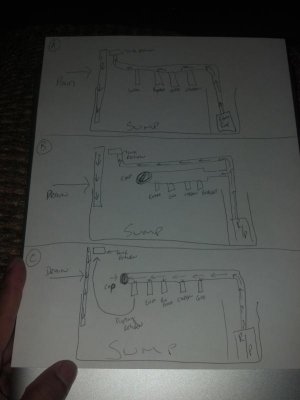
I attached a picture (not well drawn) on the three different designs I have as options. I will have a shut off ball valve and gate valve on each manifold output for carbon, gfo, biopellets/zeovit, etc. Also will have unions, etc for maintenance and possible expansion.

I will be using a Jebao DC12000 as a return pump, I will be using 1.5" pvc for the manifold as much as I can before I reduce it to 3/4" for the display return. The manifold port outputs will be reduced accordingly depending on the reactor.

Im looking for the best possible design from those experienced users, I would like to avoid some issues I read other users have such as gfo reactor flow coming out of whack when turning off other reactors like the carbon reactor.

I look forward to hearing opinions.

Thanks in advance,
Ryan
 

Attachments

  • IMG_20140702_001012.jpg
    IMG_20140702_001012.jpg
    29.6 KB · Views: 6
i plan on doing something similar with a dc6000 pump. i also plan on doing something close to your B drawing. i only want 1 T in my return line so i dont reduce flow to much going to the display. off of that T i will use a ball valve to have the ability to shut off the entire manifold for maintenance reasons. im not too worried about flow on the manifold because my reactors and such run on 1/2'' line max and wont be needing 900+ gph. i also plan on putting gate valves on all the ports of the manifold so i have the ability to fine tune each outlet to my liking.
 
Hi everyone,

Im finally in the process of building my 120 SPS tank. I have read through about every single manifold design thread on this site and I still cannot decide on how I want to design/build mine.

Have you read anything concerning flow characteristics in pump fed plumbing systems? Manifolds are merely branches of a main feed line, and are hardly complicated. Flow characteristics, particularly friction losses and restrictions in feed lines, are more worth researching. If you do some research into the actual value of the some of the methods you want to run with the manifold, you will eventually find that the only one that is really worthwhile is the carbon. The rest can be dealt with by natural means, and some can be controlled by actually increasing the numbers of coral you keep. This is good research fodder. :)

I attached a picture (not well drawn) on the three different designs I have as options. I will have a shut off ball valve and gate valve on each manifold output for carbon, gfo, biopellets/zeovit, etc. Also will have unions, etc for maintenance and possible expansion.

You only need the gate valve or the ball valve. Both is a complete waste.

I will be using a Jebao DC12000 as a return pump, I will be using 1.5" pvc for the manifold as much as I can before I reduce it to 3/4" for the display return. The manifold port outputs will be reduced accordingly depending on the reactor.
Why would you run 1.5" for a manifold then choke your return down to 3/4", in which the friction losses would be extreme? A single 1" branch to feed your exteraneous reactors, from a 1.5" main return line makes way more sense, and keeps your flow rates up instead of killing them.

Im looking for the best possible design from those experienced users, I would like to avoid some issues I read other users have such as gfo reactor flow coming out of whack when turning off other reactors like the carbon reactor.

In any set pump fed system, with multiple outlets, if one outlet is shut off or flow reduced there will be a corresponding increase in flow through the other outlets; how it will distribute, is a somewhat ambiguous question. Even small adjustments will affect the flow through the other reactors. There really isn't anything you can do about it. It is possible to build a manifold that will have more or less equal flow through branches off that manifold, (Calfo's Closed Loop Manifold,) provided you flow through the run, not in from the branch. (Brick wall in the tee.) In such a loop topology, if one branch is closed off, the flow will distribute more or less equally amongst the remaining branches, but they will all still see a flow increase.

I look forward to hearing opinions.


Thanks in advance,
Ryan
A lot of this has to do with physics, and with physics opinions aren't going to help one bit.

With a plumbing system, each fitting the water flows through, the flow rate decreases. (Friction loss.) Therefore it is advantageous to keep the number of fittings to a minimum.

From a Fluid Dynamics (physics) point of view, the best return system for an aqaurium, is a single return line, one size larger than the pump outlet size, all the way up to the tank, and over the top, terminating with a 45° outletting just below the water surface. Since the flow to the DT is far more important than flow to adjunctive methods, this is almost common sense. (discusssing powerheads at this point would be off topic, and they are being asked to do what they are not intended to do$mdash;nor can they do what is commonly thought they do.)

From the same point of view, if you must run reactors, a 'fuge', or what have you, a single branch, reduced to 1" (you don't need much flow to run reactors; a 'fuge' raises other questions.) Each reactor on its own "branch" from the main branch.
 
Have you read anything concerning flow characteristics in pump fed plumbing systems? Manifolds are merely branches of a main feed line, and are hardly complicated. Flow characteristics, particularly friction losses and restrictions in feed lines, are more worth researching. If you do some research into the actual value of the some of the methods you want to run with the manifold, you will eventually find that the only one that is really worthwhile is the carbon. The rest can be dealt with by natural means, and some can be controlled by actually increasing the numbers of coral you keep. This is good research fodder. :)


You only need the gate valve or the ball valve. Both is a complete waste.

Why would you run 1.5" for a manifold then choke your return down to 3/4", in which the friction losses would be extreme? A single 1" branch to feed your exteraneous reactors, from a 1.5" main return line makes way more sense, and keeps your flow rates up instead of killing them.


In any set pump fed system, with multiple outlets, if one outlet is shut off or flow reduced there will be a corresponding increase in flow through the other outlets; how it will distribute, is a somewhat ambiguous question. Even small adjustments will affect the flow through the other reactors. There really isn't anything you can do about it. It is possible to build a manifold that will have more or less equal flow through branches off that manifold, (Calfo's Closed Loop Manifold,) provided you flow through the run, not in from the branch. (Brick wall in the tee.) In such a loop topology, if one branch is closed off, the flow will distribute more or less equally amongst the remaining branches, but they will all still see a flow increase.

A lot of this has to do with physics, and with physics opinions aren't going to help one bit.

With a plumbing system, each fitting the water flows through, the flow rate decreases. (Friction loss.) Therefore it is advantageous to keep the number of fittings to a minimum.

From a Fluid Dynamics (physics) point of view, the best return system for an aqaurium, is a single return line, one size larger than the pump outlet size, all the way up to the tank, and over the top, terminating with a 45° outletting just below the water surface. Since the flow to the DT is far more important than flow to adjunctive methods, this is almost common sense. (discusssing powerheads at this point would be off topic, and they are being asked to do what they are not intended to do$mdash;nor can they do what is commonly thought they do.)

From the same point of view, if you must run reactors, a 'fuge', or what have you, a single branch, reduced to 1" (you don't need much flow to run reactors; a 'fuge' raises other questions.) Each reactor on its own "branch" from the main branch.

The largest return bulkhead fitting I found that can fit the drilled hole is 3/4", I searched for a 1" return bulkhead they are all slightly to large. The return pump outlet is 1.5" so I figured I would keep everything as large as possible before I ultimately had to choke down the return to tank.

I considered running a fuge, however the space and sump I have does not afford me the privilege.

I thought of running two lower powered independent pumps, one for return only and the other for the manifold, but again space will become an issue.

I appreciate the knowledge bud!
:beer:
 
The largest return bulkhead fitting I found that can fit the drilled hole is 3/4", I searched for a 1" return bulkhead they are all slightly to large. The return pump outlet is 1.5" so I figured I would keep everything as large as possible before I ultimately had to choke down the return to tank.

I considered running a fuge, however the space and sump I have does not afford me the privilege.

I thought of running two lower powered independent pumps, one for return only and the other for the manifold, but again space will become an issue.

I appreciate the knowledge bud!
:beer:

Must be a RR tank...they all have inadequate holes for marine systems. But what is compelling you to run the return up through a tiny hole (bulkhead) when you know that it will kill your flow? RR tanks were not made with performance or efficiency in mind, rather to feed the hunger of those that know no better. Don't mean offense by that at all. You would be way far ahead, to run a large line up over the top of the tank, and use the holes for a siphon system. 120 is a great tank, but the manufacturers turn it into junk. Also, I don't see the space issue you are mentioning...

Don't misunderstand me. I see nothing wrong with running a branch from your return line. I don't push the use of a 'fuge' either. The longer I am in this hobby, the more I see the old tossed out methods, become new again, in very much a 'seasonal' manner. Yet the old methods, that came before the technology craze, are still the soundest, and have endured. Methods that date back to the 1960's and 70's, and even into the 80's to an extent.
 
Here's an example of a three port manifold that I recently built. The caps can (and will) be replaced with a JG ball valve to accommodate the reactor of choice.

9863EDDE-BFAB-495E-9DD6-D0B1BC93A5F0.jpg
 
Carbon, gfo and an extra for something that may be needed later. The end is also a threaded cap giving me the option of extending the manifold plumbing if needed. I believe that building in as much flexibility as possible will make things easier if adjustments are necessary.
 
Here is my manifold design


Under the Cabinet:
Pump feeds to the right, returns to tank on the left
Currently only have 2 media Reactors running (1 Carbon, on GFO)

 
... You would be way far ahead, to run a large line up over the top of the tank, and use the holes for a siphon system. 120 is a great tank, but the manufacturers turn it into junk. Also, I don't see the space issue you are mentioning...

Uncle,
I asked a similar question a couple of months ago about my "reef ready" 180 and I think what you're saying here is what I was trying to ask. If I run a properly sized return line up and over the back of the tank would it be beneficial to use all 4 pre-drilled holes in the tank as drain lines back into the sump? Would this help overcome some of the deficiencies in the tank design?
 
Uncle,
I asked a similar question a couple of months ago about my "reef ready" 180 and I think what you're saying here is what I was trying to ask. If I run a properly sized return line up and over the back of the tank would it be beneficial to use all 4 pre-drilled holes in the tank as drain lines back into the sump? Would this help overcome some of the deficiencies in the tank design?

Sorta off topic for this thread, but that always happens ;)

We have been round and round in Bean's thread concerning dual corner overflows. Aside from the typical '1000 ways to skin a cat, anything can be made to work' type solutions, we have not come up with a single 'cover all the bases solution.' These discussions always include 'herbie's modification' as well as Bean's system. The conclusions we have reached, is that Bean's system is not suited to dual corner overflows, however, I was among the first (if not the first) to suggest a dual (independent) 'herbie modificatioin' for dual corner overflows. This is provided you set them up the way they are supposed to be set up (siphon/dry emergency in each overflow,) keep them discreet (don't tie them together,) use the smaller hole for the siphon and the larger for the dry emergency, and use 1" pipe as the smallest pipe size.

This still does not cover all the bases however. The 2 pipe siphon system is not as stable as would be preferable. Two different siphons will not flow identically, (a lot of variables here,) though if the two siphons are discreet, they can be individually adjusted so not to affect the other siphon. Also you are stuck with the manufacturers notion of what would be a good size and configuration for an overflow. E.G. they are too small, and are made worse by the presence of teeth, which reduces the effective length of the overflow by 1/2 - 2/3 depending.

Ultimately the best solution is to stop buying them. A sorta 'starve the beast' approach. If they can't sell them and since mass producers see nothing but dollar signs....... These manufacturers produce non-RR tanks, and most-&if you ask, will do a custom implementation for what I have seen, is a rather modest cost. Visio will pop three holes wherever you want them for free, and install a C2C for a very modest charge. However, DIY is not that hard, if you learn how to cut holes in glass.

After that, the next best solution is to pull the overflows, plug the existing holes with internally capped bulkheads, and do the above. Everything else follows after that.
 
Back
Top