
RODI problem

Posting here because I think this forum gets more views than others and I need some advice before I run out of rodi water. I turn on supply water and plug in the transformer and everything starts as expected. The membranes (2) start to flush, the booster pump is running. It appears when the flush is done the booster pump just shuts off and the system slowly makes some water on house supply pressure. I plugged each component into the transformer directly and they each operate. The system has been operating fine for about 9 or 10 months.
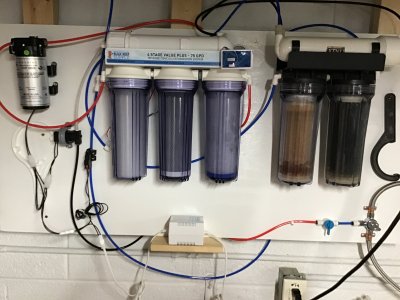
 

Attachments

  • image.jpg
    image.jpg
    1.4 MB · Views: 5
What pressure is across the membranes when 1. The system is flushing and 2. The system ends the flush cycle and goes into the production cycle?

When is the last time you changed your filters? Ever changed the membranes?

Are those two separate RO units (BRS and Kent) running in tandem? If so, are they plumbed together? If yes, what is the order of how the water flows?
 
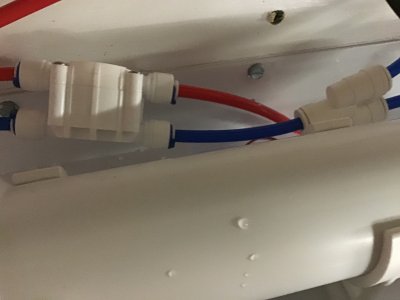
Haven’t replaced filters as I expected to see some sign of reduced water flow or discoloration on media. Follow red lines first. From blue valve into right side booster. From booster into one filter media then into 2 block carbon. Out into that thing in attachment picture, on the red hose. Out on red into BRS membrane. Out of that membrane with reject line into Kent membrane. Kent product line and BRS product line “Y” into the blue hose inlet side of that thing I don’t know the name of and out into 2 mixed DI resin chambers and into pressure switch and on to storage. The reject line from 2nd membrane (Kent) in black hoses goes to auto flush flow restrictor and on to drain. Both membranes are the same age as whole system. I replaced that thing in the picture as I had a new one laying around and now the pump keeps running but I get no product water at all! 😡I get plenty of reject with this issue also so I didn’t suspect that a filter would be the issue but when I ran the old Kent system years ago there was no pump and only a filter and carbon block and only changed them based on time not that they were ever clogged up.
 

Attachments

  • image.jpg
    image.jpg
    1.1 MB · Views: 3
Pressure starts out 50psi then jumps to 80. Which I had originally set to 75. After changing that part the pump runs and no longer stops but I get no product going into storage.
 
So obviously changing out that part changed to a different problem probably still caused by the original issue though. I changed it because at one point in time when I let the storage vessel fill until the shutoff float shut off product water I kept getting reject water going down the drain and was told it was a problem with that 4 hubbed part I took the picture of.
 
I'll admit, I'm a bit at a loss. First, I'm very visual and hands on, so even with the pictures I'm having trouble understanding the flow. Two, I've no experience with (if I understand correctly) two RODI systems plumbed together. If you lived in my area, I'd offer to come by and look at it as having hands on would really help me to help you.

My thought is something after the RO membrane is clogged/restricted flow causing the pressure to increase and causing the solenoid to shut the pump down.
 
Well that’s interesting. As you can see in my first picture the first DI canister is quite depleted. I wasn’t concerned as I have the second one and am still getting 0 tds output. I wonder if something in that first canister is an issue? I can pull it out and run that one empty and see. Basically running 2 membranes in series takes the reject water from the first membrane to feed the second. I have never done it before either and I wonder how to know if sending that high tds feed water into that 2nd unit causes it to quickly fail? Does anyone here that does it that way know?
 
Oh, I get it now, you're feeding the second unit with the waste from the first unit. I would think that could definitely foul/clog the second membrane faster. From Google AI...
  • Membrane Life: The second membrane will experience higher salinity and may clog or require replacement more frequently.

So to be sure I understand:
1. Source water > micron
2. Micron > carbon
3. Carbon > ?
4. ? > BRS membrane
4A. BRS membrane product water > DI?
4B. BRS membrane waste water > Kent membrane
5A. DI > storage
5B. Kent membrane > DI
6. DI (from Kent) > storage
 
Yes that’s the order. Just don’t know how fast that second membrane would fail. I mean I was using about 6 or so gallons of water a week. So for ten months that’s about 44x6 or 264 total gallons but the first membrane is producing half of it so really only 130 gallons of product. Now I don’t know again how that reject water entering the second membrane effects it all.
 
Let’s use process of elimination. First, let’s replace that exhausted DI and see what happens.

If that doesn’t fix the issue, I’d bypass the Kent membrane and go direct from the BRS waste water to the drain, see what that does.
 
Well unfortunately bypassed both and pump still shuts down after about a minute. Going to let this go for the rest of tonight and watch the USA in the world baseball classic. Maybe something will come to me over night. I have new sediment filters so I’ll replace that anyway just to see but I don’t see the logic in it.
 
Well unfortunately bypassed both and pump still shuts down after about a minute. Going to let this go for the rest of tonight and watch the USA in the world baseball classic. Maybe something will come to me over night. I have new sediment filters so I’ll replace that anyway just to see but I don’t see the logic in it.
Hmmm, weird. By bypassing both, what was online? Just the BRS system?
 
Yes. I also pulled the wires off the pressure switch and jumpered them to run the system. Then took my meter and checked continuity on the switch. Switch was closed at start up and then after about a minute it opened. So somehow pressure is rising enough to trigger the switch. I just don’t know if it’s at the 40psi or not. I may have to get one and replace it to see what happens.
 
Back
Top