Rotifer Tower

herring_fish

Crazy Designer
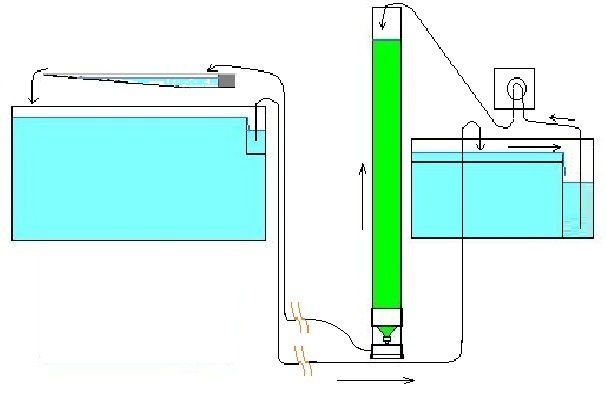
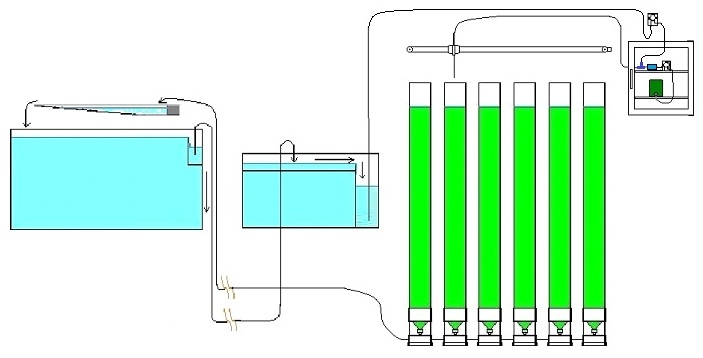
crittertowerflow.jpg

(On top left, ATS with 120G main tank below it. Center, critter tower. Right top, peristaltic pump with 55G sump below it.)

I want to grow different kinds of critters in my garage. Right now I and trying to grow rotifers.

I bought a 6 foot acrylic tube, for another purpose, that is 6 inches in diameter. I also bought a funnel from Grangers for about 3 bucks and after six tries I figured out how to affix it into the end of the tube. It was made of a plastic that doesn't lend itself to being glued but it was the right size and shape. I expect that the solids will settle to the bottom and go out to the main tank where it can be processed.

I attached a set of reducers and connectors to the bottom of the funnel that takes a ¼ inch tube. Since the tower is taller than the main tank, I plan to let the water from the tower, drain back to the show tank using gravity.

I ran the tube from the funnel, up to the desired water line in the tower before letting it descend to the tank. When I pump water into the top of the tower, the same amount comes out of the bottom, up and over the spill way, on its way to the tank, from the garage where the reactor is. If I change out 2 to 2 ½ gallons, I hope that the water quality will stay within acceptable limits. I plan to split it up into 8 or more 1/4 gallon, one minute periods, throughout the day and night with that peristaltic pump and a timer.

I won't have to turn off the skimmer at feeding times. I don't run a skimmer so that food will stay suspended in the water column longer. The pump will chop up some of the plankton but I can't do much about that right now. I have designed a high volume non-traumatic pump but that will have to wait for a while.

I have been able to grow rotifers in a tote (for a whole week, yippy) using liquid food but the food is dead so it will fowl. That means that the water changes are important. I have tried using powders three times and they crashed on the third day each time. I think that this success is a result of my cutting back on the feed and bubbles. If I get the tower to work with liquid food, I will try to see how much I can supplant it with powders. My tank already handles more food than what I plan to use for culturing.

I hope that moving the culture to the tower will be successful. If so, I think that the other forms of critters will work as well.

I have also thought that if I used a UV sterilizer I could use tank water to top off the tower. I have a gravity feed 1/4 inch line that runs out to the garage from the overflow in the main tank to a sump. The pump would lift the water up and over the lip of the tower.

Finally, I would love to grow live phytoplankton but my personality would not allow me to do all of that cleaning of tubes and small bottles, splitting the culture over and over again, only to see big crashes so I decided not to try and instead concentrate on using dead liquids and powders.

The other day, I ran into a guy that simply uses a translucent white 55 gallon drum to grow it outside in the summer. He just puts in some chicken waste and grows it on sun light. He felt that I could do it during the winter in the sun room and my wife said to go for it. If I did that, I would have to store the big batches in a refrigerator. I could buy a used one and put it in the garage. I was told that it will keep for 3 months in the fridge. I could buy a small bottle of green water from the store and start a batch when I need it.

Well that's the plan so far. I wish that I had the time to do all of the stuff that I plan. At work, I just hand my drawings and plans to others and it gets done but at home, it's all on me and I have too many other things to do so a lot don't ever get tried out.

I would love to have feed back on my wacky ideas.
 
Great plan. I think the key is to try to do everything nearly steady state. That avoids big shocks and swings.

I don't think sterilizers will do what you expect. I don't believe they kill everything on one pass. A microbial filter would block stuff. Are you sure you need it?
 
A few people have expressed that the culture might get other things introduced into the culture. Pods are an example. Qwiv suggested that I use something like a coffee filter instead of a UV devise. I don't know if he meant it literally. What are some things that would work in the long run.

What do you mean by a steady state?
 
Steady state means the system runs in a continuous method as apposed to a batch method where something large happens every now and then. Can you introduce the culture to your tank continuously in a very small amount or does it have to be at a feeding?
 
I hope to pump a 1/2 gallon to the tower and out to the tank every 3 hours and I may add a couple of batches on the 1 1/2 hour mark during the night. The timer has 10 trigers per day.
 
It's Alive!

It's Alive!

Actually I should have written that I plan to send one quart at a time.

Well, I finally got it up and running. The culture was running on the bench for about two weeks. I put it in the tower 5 days ago and it hasn't crashed. The population is what I expected. Having the outlet from the bottom of a funnel does seem to be channeling the solid waste out of the tube. It is much cleaner looking than my bucket did.

The next step is to explore an upper limit for the quantity of food. I don't think that I will push it up until I force a crash. I have suffered too long to get to this point.

If this continues to work, I will move on to setting up my second peristaltic pump so that it will be mostly hands off. I have been using Rotifer Diet from Reed Mariculture. It does need to be refrigerated so I might have to get a mini-fridge.

Oh, I noticed that running a part of the tubing up to the desired water line to produce a "spill way" didn't work. The 1/4' tubing will just siphon water over the high point to the final outlet point at the main tank's dump bucket.

I am still looking for ways to improve this set up. Everyone's input is greatly appreciated.
 
Last edited:
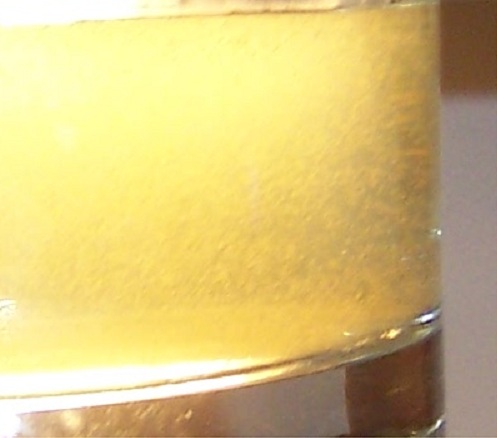
RotiferDensity.jpg


The rotifer density is hard to see but it is pretty good now. This is not a very good picture at all but I thought that I would post it anyway. After leaving the garage and going through the kitchen, this is a picture of what I am getting from the tube as it goes into the main tank.


I'm not sure that it helped but I added an air stone about an inch under the surface of the tower to get more aeration. This is in addition to the slow bubbling that comes almost from the bottom of the tower. This low slow bubbling keeps everything in motion but if I turn up the flow, the air bubbles get very big and split to bring the tower to a look of boiling. Hopefully the air stone doesn't kill much while doing it's job.

The water cleared up and the population is also up. It may have come gotten better anyway though.
 
Last edited:
I've thought about doing something similar to this and it seems like you have it going pretty well. To stop your siphon at the top of your overflow loop place a T in the airline and a piece of tube that points straight up to the height of the top of the culture vessel. This way when water is pumped in the water level rises and empties but it will not siphon because the T will allow air in to break the suction. Also try using no airstone, large bubbles will cause turbulence but won't hurt small organisms, what harms them is small bubbles getting under their shells. Not high flow though just regulate it down.

If a quart of Rotifers is going into your tank that dense every few hours then I'd say it's working pretty well. Continuous population reduction is the most stable way to run a long term culture. It keeps the population low enough to prevent a high demand population which is always on the edge of crashing. And with rotifers multiplying as fast as they do that can happen fast.
 
In such a tall structure holding about 8 gallons, I am afraid of not having enough air exchange with a countable bubble rate. It does cause the water movement but I question whether there is enough aeration.

The small bubble information has been taken to hard. Thank you. Now, should I simply remove the air stone and level the air line in? I thought that having a strong air flow right near the surface would add the interation that I want locally, with a limited exposure to the main population of the culture. The other flow would carry the aerated water all over the tower.

I'm a true newbe here. In your opinion, am I over estimation the need for aeration and under estimating the damage that my second air line can do?

Thank again for your feed back.
 
I am also wondering what other types of critters could be grown using these towers? What adjustments would have to be made in the feeding, aeration and water through-put?

By the way, I measured my input of Rotifer Food. I am using approximately 10mm in the morning and the same amount at night.
 
With the fine bubbles I think you would be fine with Rotifers, I just mentioned it because that's how it's done in a lab but that is also usually with lower densities and creatures that grow larger. A bigger shell makes it easier for bubbles to get trapped and cause floaters, I would just do what works for you. Theoretically you could also grow algae mysis or almost any plankton. My idea was to have a photo culture feed into the Rotifera that then feeds into the tank. Just a dosing pump to feed clean saltwater with nutrient into the algae and let gravity do the rest and a slow bubble to mix the cultures. Your probably ok with the food as long as you have an export for the phosphorous in it.
 
I talked the technical guy at Reed. He told me not to use a stone but to turn up the bubbles full blast. He thought that the rotifers can handle it and they will need the oxygen once I implement a few changes. I told him that I might want to build a bank of these towers but he felt that I might only need one or two. He told me that I should switch to their more concentrated bag that they sell by the liter. He said he does not normally recommend it because most people would over feed using that product. Feeding several more times a day, maybe more, maybe less, was also something that he felt would greatly increase the population density so I need to get and hook up a small, low output dosing pump and a good timer or timing circuit. Finally, he said that as I start increasing the population, I should start testing for ammonia until I get a better idea of how the feeding will affect the culture.
 
Sorry for the belated update.

I bought the concentrated food quite some time back. Just like he said, I finally ended up getting a crash. I'm not too upset about it because I was very distracted by my next step in the project. When I checked out the system, I noticed that the bubbling had fallen back to a countable trickle. In addition to that, I was getting careless in the amount of food that I put in at any given time. Thinking back, I put some big squirts into the tower three of four times in a row. I think that the combination put it over the edge.

I still have the back up culture in the tub so I will simply restock it. I guess that I will clean the tube although I don't think that cleanliness was the problem. From the out side, there doesn't appear to be much build up of solids in the bottom. There has always been a thin layer of crude on the walls of the tube because I don't get in there to clean it like my main tank glass. Anyway, 4 months is plenty long enough. The only thing that is important seems to be regulating the feeding into smaller, more frequent portions. The reason that I was distracted will hopefully fix this problem.

I have expanded on my project. Now I am actively working on a 2 axis robot that can manage the feeding and water changes for six Plankton Towers. I have ordered most of the parts but things are progressing very slowly. I don't know if I can get this running right but it is fun. This is a video of my bench work so far. It is rough (just a pile of wires) but I have passed all of the hardest hurdles.

http://www.youtube.com/watch?v=zBPnccwZjO4

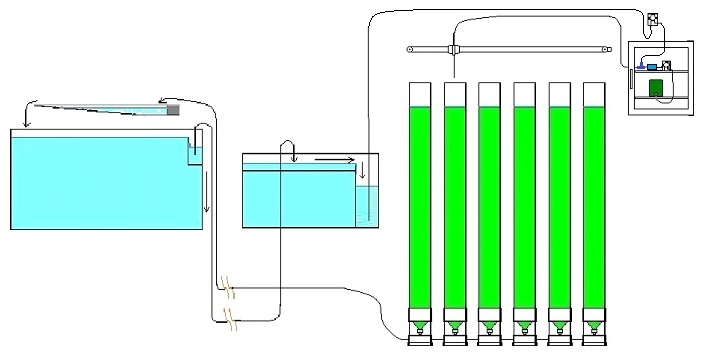
CritterTowersFlow6.jpg
 
Some food remains in the line between the pump and the injector. One of the main reasons why the dosing unit is inside the refrigerator. Now, depending on how tech savy you are...you can run a 3 way solenoid between the food of choice in the refrigerator and the intake of the peri pump. Reason for the additional solenoid valves would be to flush the lines out with salt water between each feeding. A set-up in this manner would also allow the dosing pumps to be relocated outside the refrigerator.


Mike

This made me think that I need to change the tube layout for my robot feeding system on a little garage plankton farm that I am building. If I plumb the replacement water through a solenoid much closer to the food, I can use a single tube to inject all liquids into each station.

I have a solenoid on my auto top off system but I haven't given them nearly enough though. I understand them on a basic level but I need to know them at an intuitive level so that I can made my designs a simple and as cheaply as possible.

I was originally going to feed my towers with solenoids only but with different liquids and powders, there were a few things that made me feel that I needed to build a 2 axis robot.

I have a thread running http://www.reefcentral.com/forums/showthread.php?p=18841420#post18841420 where you can get more details but I was hoping that you guys and gals could give me your ideas for using solenoids to there fullest advantage. The robot is run with an inexpensive micro controller so I can accurately turn them on and off when I want to.

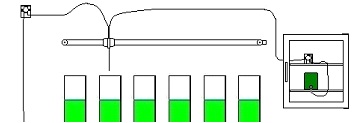
PlanktonTowerFlowOld.jpg
In my old design, I have two tubes going to the moving carriage. This idea allows me to just use one.
In the second picture, I show the solenoid in blue, right next to the pump in the refrigerator.

CritterTowersFlow6.jpg

Again, how can I improve my design.
 
Again, I don't know much about solenoids but I will answer about the micro controller.

I use an Arduino micro controller. There is a very large community of users that populate several forums. Most of the Arduino users on this site (RC) use them for LEDs but they are used for total aquarium control automation and reporting, toy robots, CNC machines, industrial factory automation and more. There are a few other competitors and I can't comment on then in a positive or negative way. I just don't know anything about them.

Two months ago, I knew almost nothing about this stuff but I got support at every turn from super user and professionals that sell and therefore support their products and their implementation.

You can use a micro controller to turn on and off just about anything at any time. The Arduino is programmed using C code so you would have to know something about that. C is a lot better than latter logic. The boards run from in the teens to 50 or 60 buck. There are add on boards, called shields that add specific features and a also very cheap in most cases. They plug in and stack on top of the micro controller.

People on the forums will not write the code for you for free but will point you to the right resource so that you don't have to absorb too much to get something done. I mostly copied, edited and then pasted everything together to get my project working the way that I wanted.
 
For your Arduino and motor control you will want one of these:

http://www.adafruit.com/products/325

And then for the motor control:

http://www.adafruit.com/products/81


Then here is a tutorial to set it all up and how to write the code for it, She even gives you the code to copy and paste!!

http://www.ladyada.net/make/mshield/


The shield can use either DC motors or steppers so it gives you plenty of flexibility in what ever you decide to use. You can even add a real time clock board to the arduino and then it will sit as a complete stand a lone system with the arduino running the timings, solenoids and motors.

Here is the RTC:

http://www.adafruit.com/products/264

Here is the info on the RTC:
http://www.ladyada.net/learn/breakoutplus/ds1307rtc.html

Hope this helps,

VR
 
Back
Top