
You are using an out of date browser. It may not display this or other websites correctly.
You should upgrade or use an alternative browser.
You should upgrade or use an alternative browser.
Show OFF Unusual BTA Color Variations
- Thread starter seapug
- Start date

I Have one that looks just like that. I got it from a local reefer pulling down his tank. But i assumed that he was bleached?
The bottom of his tentacles are now almost florescent green not white anymore. I have been feeding him daily with shots of mysis.
So i am correct to think that it is bleached?
Lisa
The bottom of his tentacles are now almost florescent green not white anymore. I have been feeding him daily with shots of mysis.
So i am correct to think that it is bleached?
Lisa

seapug
Premium Member
If yours is changing color then it might well have been bleached. I do know the one I got is not bleached or dyed, it's an actual hot pink variant. The place where I got it has had them in the past. 3" clones go for $150 + and he thought he was out of them, but found the one I got on a rock facing the back of the tank. I bought another full size GBTA and RBTA with it, so he gave me the pink guy for $20!
See i dunno now. Let me upload a pic and see what you think. When i look really close at the bottome of the tentacles it looks florescent green. But when i look at your pic it is the same type of hot pink that i have on mine. The guy said that is the way it had been since he bought it and he had it for many years so i am not sure...
Gimme 2 min and i will upload a pic
Lisa
Gimme 2 min and i will upload a pic
Lisa
OKay maybe not i can't get a good pick of it. My husband is better at taking pics than i am...lol
Oh we'll whatever i guess. I will continue to feed it and see what happens. Would be cool if it was supposed to be that colour. That hot pink is pretty eye catching everytime someone comes over that is the first thing they see when the walk in the house
And the fact that it spilt is pretty neat to
Lisa
Oh we'll whatever i guess. I will continue to feed it and see what happens. Would be cool if it was supposed to be that colour. That hot pink is pretty eye catching everytime someone comes over that is the first thing they see when the walk in the house
And the fact that it spilt is pretty neat to
Lisa

tpdpercula
New member
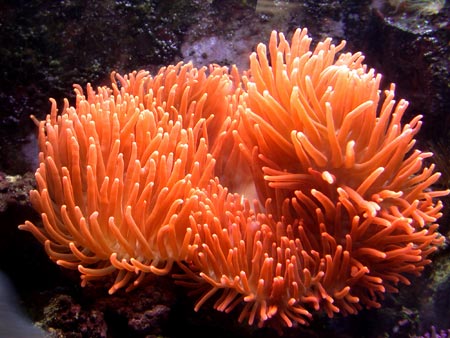
Heres some of mine.

The original 16" mother that I got 6 clones from.


My anemone tank (75 gallon)

The original 16" mother that I got 6 clones from.
My anemone tank (75 gallon)

tpdpercula
New member
Phender, as always beautiful anemones! Hopefully someday I can get a hand on a couple of yours when they split and add them to my species tank.

phender
Active member
<a href=showthread.php?s=&postid=10815932#post10815932 target=_blank>Originally posted</a> by seapug
I know my pink one isn't bleached, unless it's from a strain that has become permanently bleached and has developed all bleached offspring. They keep them in the same tank with all their other green and red BTAs, all of which are in excellent health.
Let me quess, you're from Colorado.
Except for a couple things, what you say seems to be true. Technically cloning/splitting is not producing offspring it is growth. It is not a strain, it is an individual anemone that seems to have lost its ability to regrow its zooxanthellae and clones copies of itself.
Like I said, it is not unheard of that a bleached BTA can live a long happy life. One of our more popular moderators has had one for many years.
Sometimes masking pigments can cover up the golden brown zooxanthallae so that it is not visible. The base of the tentacles of your anemone are transparent. There is nothing to hide the zooxanthellae if it were there.
Enjoy your beautiful anemone. Most RBTAs don't stay that fluorescent pink. Your's likely will. Make sure you find out how much the owners of the original anemone feed theirs, as yours will have no other way of obtaining energy.

MIKE ALERS
New member
WOW PHENDER THAT ORANGE W/YELLOW TIPS IS BEAUTIFUL.
seapug
Premium Member
yeah, it's a clone from Animal Attraction in Greeley. Back when I worked in the rare-plant nursery biz in So. Cal, it's what we called a "sport"-- a random mutation that is vegetatively propagated (a clone). So, yes, it is a mutation where normal pigments are missing, but is not a stress induced condition as we normally think of "bleaching" in the aquarium hobby.
They feed all their fish and anemones PE Mysis, which is my personal preference as well.
They feed all their fish and anemones PE Mysis, which is my personal preference as well.
phender
Active member
It is a little bit different because in this case it is not the anemone pigments that are missing. What's missing is the symbiotic algae that lives within the anemone's tissues.
Was the original anemone living in this condition in the ocean? I kind of doubt it, but we will never really know. What we do know is that it and its clones seem to be doing well without any symbiotic algae and for some reason don't seem to be able to be re-colonized.
Good luck, I'm glad you got it for a good price. Keep you eye on it. Little clones like that can be very fragile and tend to get "lost" in the rockwork never to be found again.
Was the original anemone living in this condition in the ocean? I kind of doubt it, but we will never really know. What we do know is that it and its clones seem to be doing well without any symbiotic algae and for some reason don't seem to be able to be re-colonized.
Good luck, I'm glad you got it for a good price. Keep you eye on it. Little clones like that can be very fragile and tend to get "lost" in the rockwork never to be found again.


Peter Eichler
New member
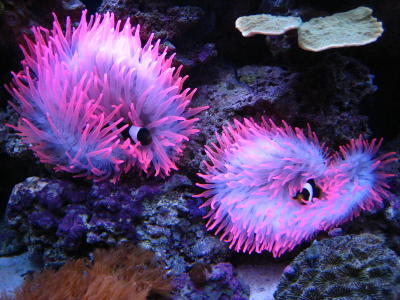
Here's mine, it's growing, healthy, and staying this color.


Haddonisreef
New member
Let me give it a shot!
Haddonisreef
New member


EdKruzel
Premium Member
<a href=showthread.php?s=&postid=10817336#post10817336 target=_blank>Originally posted</a> by phender
It is a little bit different because in this case it is not the anemone pigments that are missing. What's missing is the symbiotic algae that lives within the anemone's tissues.
I had the same appearance with my BTA's. The oddity is it was the clones highest in the tank.
The conditions were:
Nano tank 96watt pc's
10% water change every 2wks
Over-skimmed
HEAVY feedings homemade mixture
Target feedings 2x's a week
DSB and a fuge
78-80 degrees
Nitrate 0
The SPS in this tank grew very rapidly (as did all corals) and the RBTA on the top was bright pink with semi transparent tentacle bottoms with blueish streaks through them. Both anemones were target fed the same, but the one on top captured a considerable amount of food daily; the lower was semi shaded and received very little of the food I presented to the fish and corals (homemade mixture blended to a small size).
As we all know tank raised/bred BTA's are quite hardy and feed in three manners.
Capture passing morsels that hit their tentacles.
Zooxanthellae within the tissue
Osmoconformers absorbing nutrients from the water column.
I believe (strictly opinion) that the bleaching effect is somewhat of an evolutionary affect produced from an abundance of nutrients in captive care. A sustained but limited amount of nutrients come from the zooxanthellae, but this is also a form of natural stress through the process of photosynthesis. Absorbing the proper level of nutrients from the water column and capturing prey items (available in abundance in a tank) is easier controlled by the animal and thus may be a reason to rid itself of a lesser form of nutrient processing.
My BTA's that were bright pink grew and cloned and of the eight clones in two years, the ones that went to tanks with less food available, darkened within a few weeks (maybe 6 or more weeks). Similar conditions to mine left the BTA's bright pink as well, growing and splitting.
Remember this is a theory on observation only.
Similar threads
- Replies
- 17
- Views
- 3K


- Replies
- 208
- Views
- 9K

- Replies
- 8
- Views
- 631


- Replies
- 0
- Views
- 655
