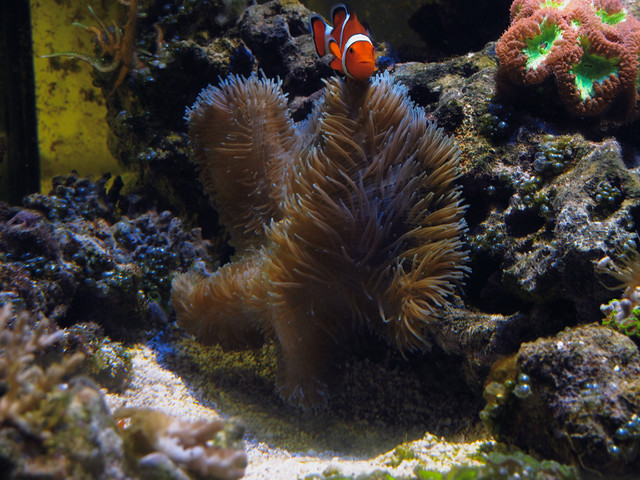
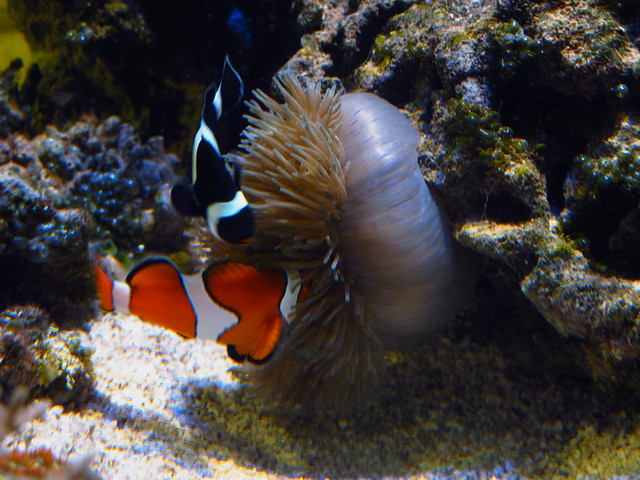
Small Gigantea, safe to add clowns?

Oh its not something that has been shown to be true? So this is based on your personal experiances? ok

FWIW, if you take a look at the scientific literature and compare it to what we know about keeping anemones, almost all of what we know comes from the personal experiences of hobbyists. Do you think that our knowledge of the different lighting needs of the different host anemones came from scientific experiments? How about water flow needs, preferred placement? All of this came from hobbyists who shared information, not scientists doing experiments.

Most the scientific literature talks about chemical pathways and how clownfish interact with their host anemones. Those that do in lab physiology experiments usually fall way short of being useful. He is an example:
http://onlinelibrary.wiley.com/doi/10.1111/j.1439-0485.2010.00405.x/full

On the surface it seems that this scientist has show that the numbers of zooxanthellae in S. mertensii decline significantly when the animal is starved for 3, 45 and 280 days. Therefore S. mertensii must be fed for its zooxanthellae population to be healthy, right? Well.... if you you look at their methodology, you notice that they were using 40 watt fluorescent lights over their anemones.. My conversion of their light numbers came out to 4500 lumens. This means they were using One 40 watt fluorescent over their tanks to try to keep their anemones alive for 10 months. Their results are completely invalid because they didn't have enough light to keep the zooxanthellae alive. Perhaps they should have used some basic hobby magazines in their abstract.

My suggestion was based on my experience and a host of other's, who have kept anemones long term and who have lost perfectly healthy anemones after feeding large meals. Many of these people are scientists by profession. Check with the people who have kept S. gigantea long term. See if they feed large meals of silverside or whole shrimp.
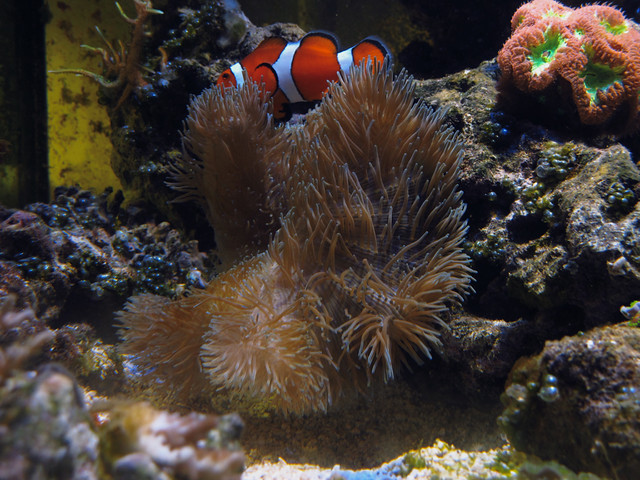
 
Very nice! Got a small bleached gig locally and nursing it's zoox. I hope mine recovers.
 
It's refreshing seeing something like this happen.
Whatever your doing its working.
Good job.
If you don't mind me asking what kind of system are you running?
 
Very nice! Got a small bleached gig locally and nursing it's zoox. I hope mine recovers.

Mine was completely bleached as far as I coule tell when I got it, very little blue on the tips and none of the brown so it can be done. I'm of the opinion that smaller ones are more likely to recover, can't really back that up with hard facts but I've done best with "difficult" species when I get them small.

It's refreshing seeing something like this happen.
Whatever your doing its working.
Good job.
If you don't mind me asking what kind of system are you running?

Nothing too fancy, the DT is a 60 cube (24X24X24) plumbed into a 30g frag tank and a 10g sump. I'm running Biopellets and GFO and carbon from time to time. Skimmer is a SRO XP-1000SSS. Flow is two MP10's on the back wall. lighting is DIY LEDs, a little different than most I have a 30w Bridgelux neutral white and 8 10w 445nm chinese royal blues. PAR at the anemone is in the 200-300 range. Lighting is a little on the lower side, but the anemone has probable tripled in size since I got it.
 
Mine was completely bleached as far as I coule tell when I got it, very little blue on the tips and none of the brown so it can be done. I'm of the opinion that smaller ones are more likely to recover, can't really back that up with hard facts but I've done best with "difficult" species when I get them small..

I agree with you on that 100%. Mine is like 6" and it's bleached. The blue is still there but the brown zoox is pretty much gone. I still haven't gotten a new pic up yet but here's what it looks like so far. Great job at getting you're back to health.
 

Attachments

  • Nem.jpg
    Nem.jpg
    21.8 KB · Views: 19
I agree with you on that 100%. Mine is like 6" and it's bleached. The blue is still there but the brown zoox is pretty much gone. I still haven't gotten a new pic up yet but here's what it looks like so far. Great job at getting you're back to health.

Yeah that looks pretty close to what mine looked like, as long as it'll eat feed it (I mostly used mysis) and give it time.

Edit: I was just looking back at the pics of mine, looks like I got it at the end of February so it's taken just about 5 months for it to recover.
 
This is awesome! I'm so glad everything worked out for you. I noticed you said in the beginning of your thread that the gigantea was eating in the very beginning ... Well, my question is, what if the gigantea just won't eat? (yes, i'm aware that food cut in tiny, tiny pieces is best), but what if the tentacles are able to catch food, but are unable to bring the food to its mouth and eat it? What happens then? Do you keep trying? What to do, what to do ...
 
This is awesome! I'm so glad everything worked out for you. I noticed you said in the beginning of your thread that the gigantea was eating in the very beginning ... Well, my question is, what if the gigantea just won't eat? (yes, i'm aware that food cut in tiny, tiny pieces is best), but what if the tentacles are able to catch food, but are unable to bring the food to its mouth and eat it? What happens then? Do you keep trying? What to do, what to do ...

I have had good luck using small pieces of scallop for finicky eaters. Wipe the scallop around in the tentacles a little and then put the food on the anemone's mouth. If you can push it in just a tiny bit (not completely into the anemone) that will help keep it in place. You might want to cut the current as well. The anemone should start pushing out its stomach to envelop the food. If nothing happens after a few minutes remove the food and try again the next day.

This has worked 3 or 4 times for me. Good luck.
 
I'm going to defer to phender on this one, I have had good luck but am by no means an expert. I got lucky and got one that would eat from the get go.
 
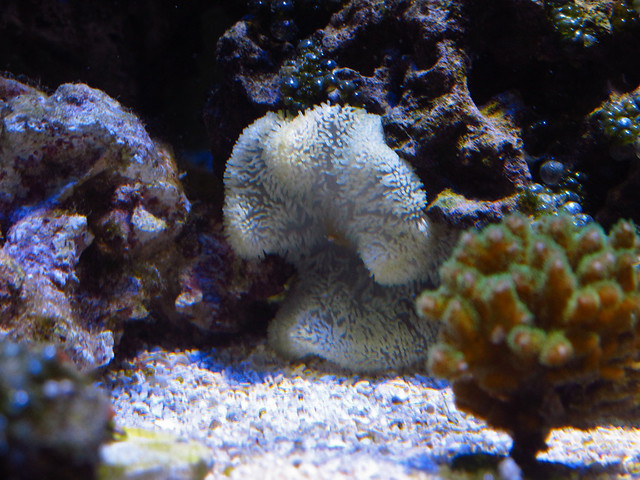
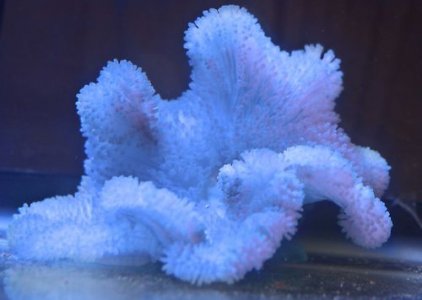
gig with sparse tentacles

gig with sparse tentacles

Thanks for the replies, phender and wfournier.

Wfournier, I noticed also that when you first got your gig in the very first picture, not only was it bleached, but it also had very sparse tentacles. But interestingly, you've still managed to pull it through.

I've tried 3 giganteas in the past, and each time, they come in very fluffy, plush tentacles, but within ONE day, the tentacles become fewer and fewer. Gradually, the anemone looks like it's bald. (hence, the difficulty in feeding)

Usually, with BTAs, ppl attribute this to starvation. However, that doesn't make sense to me, because there's no way it could turn like that overnight. Does anyone have any ideas? or has anyone else had this happen to them?
 
Thanks for the replies, phender and wfournier.

Wfournier, I noticed also that when you first got your gig in the very first picture, not only was it bleached, but it also had very sparse tentacles. But interestingly, you've still managed to pull it through.

I've tried 3 giganteas in the past, and each time, they come in very fluffy, plush tentacles, but within ONE day, the tentacles become fewer and fewer. Gradually, the anemone looks like it's bald. (hence, the difficulty in feeding)

Usually, with BTAs, ppl attribute this to starvation. However, that doesn't make sense to me, because there's no way it could turn like that overnight. Does anyone have any ideas? or has anyone else had this happen to them?

I can't really comment on this too much, my impression is that most of the change happened over time. Some times there are still some areas where the tentacles will be shorter and thinner however I noticed that when I removed some rock which cause flow to increase the tentacles look a bit better. The overnight loss of tentacles is strange though.
 
Back
Top