SPS tissue regrowth after cutting

rgulrich

greybeard
8Feb15 coral fragged in a few locations. Of note is the location on the right "“ it was below the tissue level and into coralline algae growth.

19 days later 27Feb15, tissue has recovered the trimmed areas and polyp growth quite visible. Of interest is that the cutting on the right is growing at the same pace as the one on the left and it was cut, again, well below the level of tissue, with all exposed area covered with coralline algae. The tissue regrew from the center of the branch outward in both of these instances.


Is this a common occurrence? How far to the center and down the branch does the tissue extend? I couldn't locate any papers out there on this topic, and was wondering if anyone else has run across this/noticed it before or if anyone has any references to it in the literature.
Thanks for any and all help.
Cheers,
Ray
 
very interesting! I have never thought of there being tissue deep within the SPS skeleton, but I suppose it makes sense that it could still be alive in there.
 
That is interesting. I just fragged some of my SPS a couple weeks ago. I'll have a close look and see if mine are doing the same. But I do have a question. Are you sure it's growing from the center and not just covering the exposed skeleton with new growth?
Hope that makes sense Lol
 
@erndog1001 - Please do take a close look at your fragged SPS and let me know.
In this instance, yes, I am sure that they grew from the center, as the upper one in the above pic was actually cut about 2-3mm down the branch into coralline algae.
 
Here are some from a recent mariculture shipment from Bali. These we cut a week earlier (7 days), and the tissue re-covered nearly all of the areas we cut.
Lower right in this image:


Bottom middle and middle right on this image - polyps are clearly visible at this point:


This was reflected across the majority of the colonies we trimmed branches off of. Conversely, the A. humilis we worked with has begun to regrow from the edges inward, as was the case with an A. abrotanoides from this shipment as well as a larger one from an earlier shipment.

Thanks again for any and all observations out there.

Cheers,
Ray
 
Fascinating observations! In theory it only takes one cell to survive for new growth to develop. I've seen a lot of regrowth from the sides but have never paid attention close enough to notice if there was ever any new growth starting from the center. It would be interesting to see research looking at how corals protect their skeletons internally from boring sponges that will weaken the skeleton.
 
I looked at mine and it does appear as if its just starting to regrow tissue.But it does seem to be evenly growing from the center out.Hard to be sure yet.I'll keep watching. Very interesting
 
@erndog1001 - I know it can be a challenge (with my skills, at least), but if you have a chance do you think you could get a couple of pictures of the cut site?
 
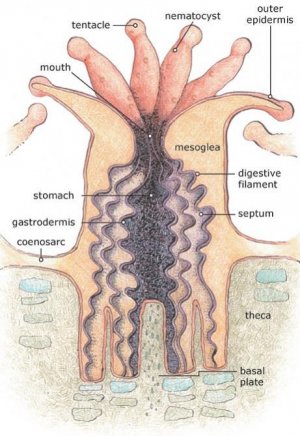
The individual polyps are connected via a system of gastrovascular canals that allow for the sharing of nutrients and symbiotic algae. These canals run through the coenosarc, which is tissue that connects individual polyps at the surface of a coral colony. The outer tissue of the polyp is the epithelium or epidermis.

http://coralreef.noaa.gov/aboutcorals/coral101/anatomy/

attachment.php
 

Attachments

  • image.jpg
    image.jpg
    57 KB · Views: 7
This image does a great job for some of these observations and is what I expected to see. But is does not explain the original example - the first frag was cut approximately 2mm down the branch into the encroaching coralline algae. There was no surface tissue unless it was beneath the encroaching algae. The second, or lower cut I can't be absolutely positive I removed the entire branch (you can see the tissue from the adjoining branch encroaching on the left side), but I'm reasonably sure I took it down to the corraline line. This line is the darkened right edge of the cut the new tissue is growing over. The growth first reappeared in this particular coral (it's in the display tank, up front, so it's pretty easy to observe a number of times a day) in the center of the cuts. With the lower cut, the first corralite appears nearly dead on center of the cut.

I know, perhaps I spend too much of my time with my nose pressed up against the glass...
 
Yes, the illustration really doesn't show two or more polyps connected, but I believe what's going on here is the tissue is also connected within the coral skeleton and there is still tissue remaining within the skeleton even though you removed all the visible tissue via fragging.

In other words, take a shrub for example and you cut it all the way down to the ground. Yet a few months later new branches and leaves start to sprout from the stump because the root system is still present and able to provide nutrients to regenerate. It's similar to what's happening here with the coral. Remember that's what makes corals so amazing, half animal, half plant, so to speak. Or at least they have characteristics of a plant. :)
 
I'll add that I don't think the illustration I posted is actually accurate in terms of colony building.

Here's my theory. Assume a coral starts with one polyp. It begins building a vascular channel up. Then it reproduces more polyps that are connected within and as the new polyps and the original continue to grow they create the tree like structure, but those internal channels are still present within the skeleton connecting the polyps. While the outer tissue may house the nutrient sharing gastrovascular veins, the internal tissue is still present.

There's really no other way to explain what you're seeing with your images.
 
That's the gut feeling I have as well, that the tissue isn't restricted to just the surface of the calcite, but throughout it as well.
I wish I could find a study or two on it, but I'm coming up empty-handed so far.
They certainly are interesting creatures, nonetheless.
Thanks for the input!

Ray
 
I wish I could find a study or two on it, but I'm coming up empty-handed so far.

Ahh, but we just created it! This is our theory and it is true until someone else can prove otherwise! And since we just did science... We are now scientists!

Sincerely,

CuzzA, PHD, XYZ :lmao:
 
Back
Top