Staining Red Oak - What is happening

gt93pony

New member
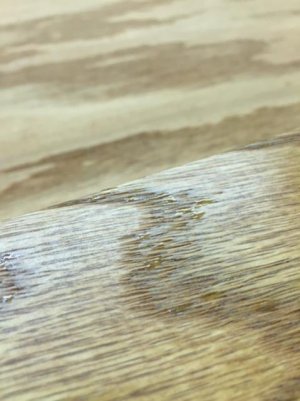
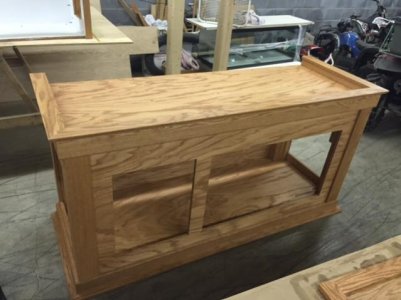
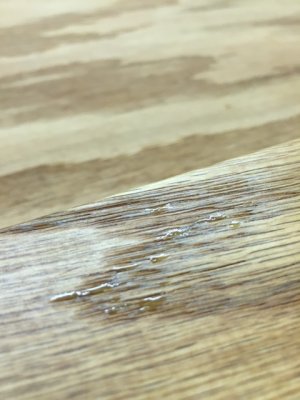
So I have been working on my stand for several weeks now and applied stain this past Friday night. I have a couple places on the solid wood (not veneer plywood) that is "leaching" back out. Whatever it is leaching is clear. I can take a white napkin and dry the spots without pulling any color. I have been running fans on it since Saturday morning and wiping it down every hour or so but it keep producing the liquid. I have NOT applied anything but stain.

The stand was sanded with 120 grit before stain. It was wiped down and blown off with an air compressor before stain. Any idea what is happening here?
 

Attachments

  • IMG_1503.jpg
    IMG_1503.jpg
    39.2 KB · Views: 5
  • IMG_1502.JPG
    IMG_1502.JPG
    96.8 KB · Views: 4
  • IMG_1501.jpg
    IMG_1501.jpg
    37.3 KB · Views: 4
Does it harden on the napkin after a while? If not, it's probably just oil from the wood. If it's just wood oil, you could place a clean rag over it and let it absorb as much as it can. I've found making a thick paste of calcium carbonate and denatured alcohol and buttering the spot will draw out some oils, like linseed oil, from gun stocks. It's worth a shot.

btw, that stand is looking good.
 
Does it harden on the napkin after a while? If not, it's probably just oil from the wood. If it's just wood oil, you could place a clean rag over it and let it absorb as much as it can. I've found making a thick paste of calcium carbonate and denatured alcohol and buttering the spot will draw out some oils, like linseed oil, from gun stocks. It's worth a shot.

btw, that stand is looking good.

I don't know about hardening...I will test it. This is my first woodworking project so I am learning as I go. Thanks.
 
it is coming out of the wood grain where the long hollow "tubes" inside the wood (red oak is known for these, they are quite obvious) meet the surface. it is probably a component of your stain. If I were you I would never use that brand stain on red oak again. wait for this to stop sweating out, and then give it at least few coats of whatever finish you were planning on. I like to use an oil finish for aquarium stands. Red oak is a bit difficult to finish because of the huge "tubes" in the grain. Not the best choice for an aquarium stand.
 
Most likely your issue is coming from the type of stain you used; which we haven't found out yet.

Based on your description, it sounds like you are using an oil based stain. Oil based stains (like Minwax) are known for having bleed out due to using a cheaper oil like linseed oil. And since red oak does have larger pores, the stain will pool during application and slowly bleed out as it dries. This does not mean you will get a bad finish. You will just have to wipe off any excess oil and wait for it to dry completely.
Not to get too technical, but the color in the stain comes from tiny, tiny balls of the pigments that are suspended in a fluid medium; oils, water, etc. When you wipe the stain "on" the surface, you are forcing these balls of pigment "into" the pores. As the stain dries, the fluid medium evaporates and leaves the pigment behind.

Red oak is a fine choice for aquarium stands; mine is built from red oak (and with an oil based stain).
One recommendation I would have made prior to finishing the stand would have been to sand up to a 150grit/180grit finish at a minimum. Sanding only to a 120grit finish is still very course when it comes to finishing wood projects; especially oak. Using a conditioning medium will help fill those pores for a more even finish.
I have seen way too many nice projects get "ruined" by a bad finish because people do not take enough time to sand the wood to a very fine finish. The wood should feel like glass prior to staining as the moisture from the stain is only going to cause the grain to swell; albeit minimally.

I've had great success using red oak and oil based stains over many years, but I know that there could be some bleed out; not every time, but I'm aware it could happen.
Your stand will be fine.
Good job and good luck!

 
Most likely your issue is coming from the type of stain you used; which we haven't found out yet.

Based on your description, it sounds like you are using an oil based stain. Oil based stains (like Minwax) are known for having bleed out due to using a cheaper oil like linseed oil. And since red oak does have larger pores, the stain will pool during application and slowly bleed out as it dries. This does not mean you will get a bad finish. You will just have to wipe off any excess oil and wait for it to dry completely.
Not to get too technical, but the color in the stain comes from tiny, tiny balls of the pigments that are suspended in a fluid medium; oils, water, etc. When you wipe the stain "on" the surface, you are forcing these balls of pigment "into" the pores. As the stain dries, the fluid medium evaporates and leaves the pigment behind.

Red oak is a fine choice for aquarium stands; mine is built from red oak (and with an oil based stain).
One recommendation I would have made prior to finishing the stand would have been to sand up to a 150grit/180grit finish at a minimum. Sanding only to a 120grit finish is still very course when it comes to finishing wood projects; especially oak. Using a conditioning medium will help fill those pores for a more even finish.
I have seen way too many nice projects get "ruined" by a bad finish because people do not take enough time to sand the wood to a very fine finish. The wood should feel like glass prior to staining as the moisture from the stain is only going to cause the grain to swell; albeit minimally.

I've had great success using red oak and oil based stains over many years, but I know that there could be some bleed out; not every time, but I'm aware it could happen.
Your stand will be fine.
Good job and good luck!

This is my first project so I am learning. Yes oil base Minwax. At this point it has almost stopped bleeding out. I am in no hurry so I will wait until it stops completely. As far as 120 grit, the local woodworking shop who sold me the trim suggested 120 so I took his advice again because I am new to this. I believe It is going to turn out okay.

Next question...lacquer (spray can) or poly?
 
Most likely your issue is coming from the type of stain you used; which we haven't found out yet.

Based on your description, it sounds like you are using an oil based stain. Oil based stains (like Minwax) are known for having bleed out due to using a cheaper oil like linseed oil. And since red oak does have larger pores, the stain will pool during application and slowly bleed out as it dries. This does not mean you will get a bad finish. You will just have to wipe off any excess oil and wait for it to dry completely.
Not to get too technical, but the color in the stain comes from tiny, tiny balls of the pigments that are suspended in a fluid medium; oils, water, etc. When you wipe the stain "on" the surface, you are forcing these balls of pigment "into" the pores. As the stain dries, the fluid medium evaporates and leaves the pigment behind.

Red oak is a fine choice for aquarium stands; mine is built from red oak (and with an oil based stain).
One recommendation I would have made prior to finishing the stand would have been to sand up to a 150grit/180grit finish at a minimum. Sanding only to a 120grit finish is still very course when it comes to finishing wood projects; especially oak. Using a conditioning medium will help fill those pores for a more even finish.
I have seen way too many nice projects get "ruined" by a bad finish because people do not take enough time to sand the wood to a very fine finish. The wood should feel like glass prior to staining as the moisture from the stain is only going to cause the grain to swell; albeit minimally.

I've had great success using red oak and oil based stains over many years, but I know that there could be some bleed out; not every time, but I'm aware it could happen.
Your stand will be fine.
Good job and good luck!
+1
Sanding is a pain, but it's very satisfying as you go to finer and finer grits and the surface keeps getting better and better! Finishing is one of the more difficult parts of woodworking, IMO.
 
I agree with the sanding. If you can get it to 150 or 180, it will look better. with that said, good job of the stand. if you choose to stay at 120, add a thin layer of Poly and lightly sand that to 150. That will seal the wood and give you the smooth finish your looking for. Then add another layer of poly and sand the to 220 or 350. then finish with a final coat of poly.
 
You probably should have used a pre-stain wood conditioner.

I was under the impression that pre-stain conditioners were mostly for more porous woods like pine, fir and birch, that can cause light and dark areas from the porous areas sucking up more stain than the rest of the wood. Does Oak generally benefit from these pre-stain conditioners?
 
I was under the impression that pre-stain conditioners were mostly for more porous woods like pine, fir and birch, that can cause light and dark areas from the porous areas sucking up more stain than the rest of the wood. Does Oak generally benefit from these pre-stain conditioners?

You are correct; for the most part.
Any wood can be treated with a wood conditioner prior to staining. The wood conditioner will fill the pores so the stain has a more balanced appearance; not blotchy.
Most often, the harder hard woods (oaks, hickory, cherry) skip the conditioning process as the open pores collect more pigment and accent the natural beauty of the wood's grain. So, does oak benefit from being conditioned? It depends on the look you're trying to achieve, but not really.
 
I agree, we normally skip certain woods when it comes to conditioner, oak being one.
I normally don't even think of conditioning oak.
In ply form it might help if it is cheap ply and has a sloppy glue up, I've found a lot of HD and similar plys sometimes lay out more evenly if conditioned.
It's so hard to guess what the OP's issue may be, it's a natural product, so many things come into play.
I have seen stain seem to leech back out or look uneven when applied in conditions other than specified, improper temperature or humidity.
I have also seen stain bleed back out when setting stained wood in the sun in effort to speed dry, stain gets hot and bleeds back out.
As for sandpaper no less than 150 and really 220 would be my call, if heavily scratched I may do a 150 pass and then 220.
220 for clear as well
 
The wood stopped bleeding Thursday evening. Since I have already stained the stand at 120 grit I think I will spray lacquer on the backslide of a cabinet door and see how that goes. I guess worst case is to sand it back off anyway. Thanks for all the replies!
 
The back side of a door isn't the end of the world, but try a piece of scrap wood first. I read a quote on a woodworking chat room once:

"Test your your finish product on scrap or scrap your finished product!" - good advice!
 
Back
Top