Stone Crab Aquaponics...

MadReefist

New member
With this year success story of aquaponic farming Redfish it has gotten me thinking again about the Stonecrab farming concept. They did it using Mangroves and Sea Purslane and managed to recycle the water 100%. I've thought about this before using the little holding cell LFS stuff wall array tank setups, about 10 years ago. How you rip off their claw and they grow it back an obvious advantage. It didn't seem like the money would be there at the time. But now this seems extra exciting...
https://mote.org/news/article/aquaponic-fish-veggies-worth-their-salt

Any thoughts folks?

My concern is mostly in how best might they be kept, in regards to them not eating each other. A pool with rows of stacks of certain length PVC pipes seems feasible fo the general arrangement, but then there's that pesky issue of their temperament. I kept one on purpose in a tank when I first moved back here like 14 years ago. Between my roomates and I tons of live food was thrown at it. It was about an inch when it came in. It molted fast, grew like 5x in size in about 2 months. Eventually a comparatively decent sized young blue crab was thrown in there with it and after the school of minnows were all gone (a roomate dumped in all at once when I wasn't home) after a day the blue crab was missing a leg; next day it missing missing 2 more; the next day it was missing a claw; the next day he was missing lol! You'd approach the glass and the monster would come charging out and go back and forth in the front panel with his claws all out trying to get you. The thing was a riot. They rival even Alligators in bad attitude. Never did add anther stone crab to see what would happen.
 
The trick to farming crabs (same problem with lobsters) is they need to be individually separated, or they kill and eat each other. This makes for a very space intensive, somewhat complex system, and very labor intensive culturing system. Needs to be lots of $$$ to make it financially feasible.
 
Ah.
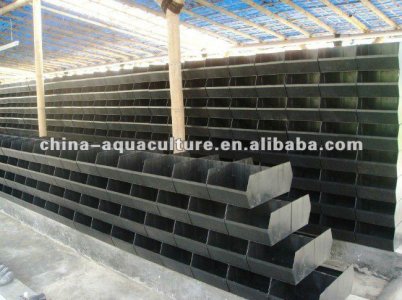
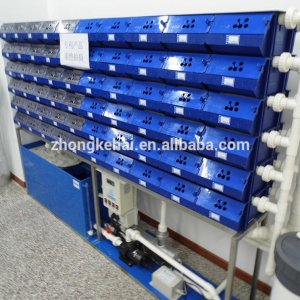
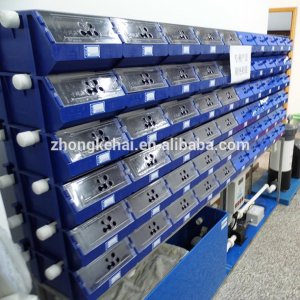
Interesting are these 'crab condominium' boxes:

464170696_622.jpg HTB1VHcXHXXXXXbJapXXq6xXFXXXy.jpg Soft-shell-crab-soft-shell-crab-farm.jpg

"Crab is an aggressive creature which will cause a certain loss if they are breeding together because they will fight and kill each other, especially when shelling.
Crab House provide separate aquaculture box for each crab, equipped with supplying and exhausting water system and increasing oxygen into water function. It can automatically discharge faeces and remnant bait (self-clean patent design) to maintain a good quality water environment in each box. When it needs thoroughly clean, each Crab House can drain all the water completely. Each Crab House has a door to prevent the crab escape. The conveniently open and lock mechanism and a observation window on the door make staff check crabs without opening the door, which greatly saves manpower and time at the same time to minimize the impact on stress responding of aquaculture creature.
Crab House can be free combined into different floors and different boxes each floor according to customer demand (usually one set consist of 10 floors which has 10 boxes each). Each set can do water treatment separately (suitable for small scale aquaculture or experiment lab), also can collect all return water for treatment together (suitable for factory aquaculture).
Crab House saves much more land (if breeding 100 crabs calculating as 400 grams each on average, the ordinary pool for aquaculture covers about 300 square meter, while Crab House only covers net 0.9 square meter area, which improve the land utilization ratio of 300 times. For inland area and far away form the sea, it is also easy to cultivate seawater crab breeding. Crab House consumes less water, save energy and heating and cooling rapidly.
Crab House effectively evade most of the risk and uncertain factors (climate risk-indoor breeding, water quality risk- sterilized and purified recycling water, eliminate other biological causing pathogenic disease risk- single specie breeding in single box) during aquaculture.
Crab House use less manpower (one skilled worker can raise 2,000 to 5,000 crabs) to realize intensive full-year production of high density aquaculture.
Crab House can make more economic profits for reserving and breeding soft shell crabs. The same size and specie of soft shell crab with short aquaculture cycle (3 to 15 days usually) is 4 times more expensive than ordinary one.
Crab House advocates green, pollution-free and organic ecological aquaculture without chemical of catalytic and ripening in order to achieve environmental health and safety. "


$10958.39 for a set of 1000 cells. If you ordered just the boxes themselves and not their extra equipment, proper designs could bring the number per cell down.

"At present, we sell Crab House as set costs 70,000 RMB which include 10 groups (1000 boxes can breed 1000 crabs), a high speed sand filter cylinder (ZKH-SL1200A), an ultraviolet sterilizer (ZKH-ZW4003) and a water pump. Heating machine costs 1,500 RMB and refrigerant costs 9,500 RMB. The entire price above doesn’t cover the tax, freight and mounting fee. Mounting is very ease which can follow the introduction to do so.
http://www.alibaba.com/product-deta...0189265285.html?spm=a2700.7724857.35.1.P4UdLh

So in the hypothetical if you could generate 1 lb. of claws per cell per year that would be 1,000 lbs. gross per set annually, so then figure in wholesale spot prices...

"The season that ended in May 2014 had an average wholesale price of $14.38 per pound, generating about $26 million in dockside sales statewide. The season ending this May probably will top last year, he noted. "It should be an OK year for harvests this decade, but it will still be low historically." Gary Graves of Keys Fisheries in Marathon sees an increase over last season of about 10 percent, he told the Miami Herald earlier this month. A typical crab season sees about 3.2 million pounds of claws landed, historically. Final prices also could exceed last year's record. Retail prices have been reported selling for $35 per pound for jumbo-size claws."
http://www.keysnet.com/2015/04/29/502437/stone-crab-harvest-looks-healthy.html

The feed could be acquired for mostly free going direct to fish markets all the scraps. I know the little seafood spot at the end of my street I can get 2-4 5 galllon buckets (filled 4/5 the way up) of flayed fish carcass per day, as I've done many days this year harvesting it for tree fertilizer and more.

Of course, one might not get a full pound per cell, especially not at first... meanwhile selling top grade heavy-metals-free organic claws direct to end user retail high end buyers IN THE OFF SEASON...

So then if you could work other profit makers into the same macro system...
 
Last edited:
SC breeding habits are quite ideal:

"How many eggs does an ovigerous female carry?
The number of eggs that a female produces is related to her body size. Small females produce tens of thousands of eggs in a sponge. Very large females can produce up to a million eggs per sponge and may produce four to six sponges in a single spawning season.

How often do females mate?
Females are only able to mate immediately after a molt, or when the crab sheds its smaller shell, while their shells (exoskeletons) are soft. Female molting and mating occurs in the fall (mostly September through November). Females retain the sperm received during the fall mating season for up to a year, or until the next season's molt. Sperm is stored in two sacs over the winter and used during the following spring and summer spawning season to fertilize the eggs of each sponge."

http://myfwc.com/research/saltwater/crustaceans/stone-crabs/faq/

"Mating is similar to that in the blue crab, taking place while the female is in the soft-shell stage, with the male cradling the female beneath him. A male will begin “guarding” a female before she molts and will continue to do so until her shell hardens. Mating seems to take place in the fall. After mating, a female will deposit fertilized eggs on the “hairs” under her belly apron in a large mass called a “sponge”. Hatching occurs in 7-18 days, depending on water temperature. Females may spawn several times between March and September with peak spawning occurring from May through July. After hatching, Gulf stone crab larvae go through seven stages before they resemble the adults. During most of this time, they are planktonic, meaning that they are free-floating, at the mercy of the currents and tides."
http://www.lsu.edu/departments/seagrantfish/resources/factsheets/lastonecrabs.htm

So it sounds like youngsters might best be reworked/cycled into the system as a sort of maintenance due to adult claw regrow times:
"Once a stone crab loses a claw or other appendage it takes several molts to fully regenerate the lost appendage or claw (Figure 8). Each time a crab molts it has the ability to regenerate the lost appendage. Regeneration in adult crabs takes one year due to the seasonal molting of adult females in fall and adult males in winter. The regenerated claws start out smaller than the original and will continue to grow through subsequent molts. After three molts (three years in adult crabs) a claw can regain 95 percent of its original size. In juvenile stone crabs regeneration of lost appendages can be more rapid than adults. Juvenile crabs molt two or more times per year giving juveniles the ability to regenerate an appendage in a few months."
http://myfwc.com/research/saltwater/crustaceans/stone-crabs/faq/

The best thing I've found about rearing them:
http://www.nwrc.usgs.gov/wdb/pub/species_profiles/82_11-021.pdf

The thing is however, in my experience with one in the aquarium the molting and growth seemed entirely proportional to its feed intake. So there's this chance that enhanced molting could be 'forced' by ongoing heavy feeding (that is, far more than the annual bounty they might hope to get in the wild). So the challenge there would become about supply chaining that kind of feed volume economically...

Hmm...
" Once they settle to the bottom, the young stone crabs have a wide diet of oysters, mussels, barnacles, snails, clams, worms, jellyfish, blue crabs, hermit crabs and plant matter. Shellfish of all kinds are staple foods of adults, with oysters being a major food item. Feeding is highest on spat and small oysters, but larger Gulf stone crabs eat oysters of all sizes. It has been estimated that they consume an average 219 oysters per year and they may be more destructive to both spat and adult oysters than the oyster drill (conch).

Growth is fairly slow. Some females are mature enough to spawn by age two, and by age three, only 30% are mature. By seven years old, almost all the females are mature. Only the claws on stone crabs are harvested, but claw removal does slow their growth rate. Stone crabs have a large crusher claw and a smaller pincher claw. Both can be harvested if they meet the minimum propodus (claw) size limit of 2 3/4 inches. Claws on males are more slender and longer than females and will produce legal claws at a smaller size than on females."


The age at maturity in stone crabs has also been estimated in different ways. Some researchers stated that both males and females reach maturity by age one based on field observations (Bender, 1971) or laboratory growth data (Savage and Sullivan, 1978). Bert et al. (1986) used laboratory growth data from other studies to predict that males reach maturity at the beginning of age two and females begin to reach maturity at age one. Restrepo (1989a) based his growth curves for males on growth increments from laboratory-raised crabs and molt frequencies from field tagging studies; his graphs predicted that males reach 63 mm CW in just less than two years.

The inconsistencies among studies result from several problems. First, most growth rates used to calculate size-at-age were estimated using laboratory-raised crabs. Both Savage and Sullivan (1978) and Tweedale et al. (1993) concluded that M. mercenaria grew less per molt in captivity than they did in the wild. Yang and Krantz (1976) found the opposite when they accelerated growth of M. mercenaria by using intensive culture techniques. The variation among these studies demonstrates the unreliability of using growth rates of laboratory-reared crabs to estimate size and age at maturity. Next, the effects of regeneration on growth rates were usually not considered. Growth increments of stone crabs can decrease by up to one-third when one or both claws are removed (Sullivan, 1979), and the time between molts may increase or decrease, depending on when in the molt cycle the claws are lost (Savage and Sullivan, 1978). Thus, growth estimates should be based on data from stone crabs that have both original (not regenerated) claws. Only Bert et al. (1986) stated that they eliminated individuals with regenerated claws when they estimated the size at maturity for males. Finally, because sizes at maturity were often
estimated differently in previous studies, they cannot be easily compared. For females, minimum CW of ovigerous crabs was often the only estimate given for size at maturity.

When estimating size and age at maturity, we must consider that crabs mature in stages (Watters and Hobday, 1998; Fernandez-Vergaz et al., 2000): crabs are morphologically mature when their body parts are the appropriate shape and size for reproduction, physiologically mature when their gonads are fully developed, and behaviorally mature when they exhibit behavior associated with reproduction. In crabs, morphological maturity is often accompanied
by allometric changes in growth (Gonzalez-Gurrianran and Freire, 1994; Fernandez-Vergaz et al., 2000), particularly changes in the growth of claws relative to the carapace. Physiological maturity occurs when the gonads can produce gametes. Behavioral maturity is achieved when crabs engage in mating activities. All three stages must be reached for functional maturity, which is when copulation occurs and eggs are fertilized and extruded."[/i
http://www.researchgate.net/publica...enus_Menippe)_Size_at_Maturity_Growth_and_Age

This is good:
"Mass-culture experiments of stone crab (Menippe mercenaria) were successfully performed in 1970. Ovigerous female stone crabs were obtained from traps set in Biscayne Bay, Miami, Florida. The females were held separately in indoor aquaria. A maximum of 10 ovipositions (spawnings) within one inter-molt phase were observed for a single female over a 120-day period. During this period, the embryonic duration of the eggs was approximately 10 days at temperatures of 29 to 30 C, and the period between larval hatching and the female's next oviposition was 2 to 3 days.

The duration of the larval period (five zoeal stages and one megalopal stage) was 14 days at temperatures ranging between 30.5 and 32.0 C, with salinity in excess of 30 ppt; 18 days were required at temperatures ranging from 28.0 to 30.0 C in the same salinity range. The time requirements in mass culture were found to be greatly reduced compared with individual compartment culture methods, which normally would take 20 to 21 days.

Experiments using two different filtered seawater media were performed. In one, seawater was filtered through a 165 μ mesh screen; in the second seawater was filtered through a fine dacron wool filter. Results were similar.

Initial larval culture media was stabilized by adding Chlorella to the culture seawater. The early zoeae were fed with separately cultured rotifers (Branchionus plicatilis) and Artemia nauplii. Only Artemia nauplii were provided for the late zoeal stages. The food for megalopae and juveniles was chopped fish and squid. To reduce cannibalism in the megalopal stages a screen-ring was installed. This screen also provided a good substratum for settling.

The maximum young crab yield was about 360 second-stage crabs in a 200 1 plastic container, and 960 second-stage crabs in a 600 1 capacity wooden tank. The best survival rate from hatching to the first crab stage was about 9%. Mortality occurred primarily in the magalopal stage.

A promising future for stone crab culture is indicated from the growth rates obtained beyond the juvenile crab stage. Individuals reared separately in the indoor aquaria showed rapid growth. The most rapidly growing individual reached a carapace length of 9.1 cm and a weight of 236 g in 7 months from hatching. Approximately 10 molts are required to reach this size from the first crab stage. The color pattern of the cultured crab was noticeably different from that found in nature."

http://onlinelibrary.wiley.com/doi/10.1111/j.1749-7345.1971.tb00031.x/abstract
 
Last edited:
Okay here goes everything I found searching for 'stone crab aquaculture':
NOAA:
"Aquaculture: Commercial mariculture of stone crabs has been considered since the late 1960s due to highly variable commercial landings coupled with high market demand and premium prices for stone crab. The most recent attempts at mariculture show that major hurdles, such as large space requirements and the aggressive nature of the animal, must be overcome before commercial production of stone crab is successful."[/]
https://web.archive.org/web/20110615000519/http://www.nmfs.noaa.gov/fishwatch/species/stone_crab.htm

And more:
"Mass culture techniques to produce large numbers of larval stone crabs, Menippe mercenaria, and blue crabs, Callinectes sapidus, have been achieved in a project at the University of Miami. However, techniques must be improved to reduce and control the problem of cannibalism among larval stone crabs. The stone crab matures, copulates, and spawns viable eggs under conditions of captivity. F2 offspring of blue crabs have also been attained in captivity. Investigations are now underway to improve techniques of larval culture and to test feasibility of rearing crabs to marketable size in cages placed in natural waters.

A Samoan or mangrove crab, Syclla serrata, has been studied at the Hawaii Institute of Marine Biology. The Samoan crab has been maintained in cages suspended from rafts and its growth rate measured. This study indicated this crab could attain marketable size of 1 - 11/2 pounds (0.5 - 0.7 kg) in about 11/2 yr at ambient temperatures (24oC). Tests at higher temperatures (27oC) indicated that the time to reach market size could be reduced to 1 yr. Also, a diet of artificial food resulted in faster growth than natural foods.

In another crab culture project, efforts are underway at Humboldt State College in northern California to develop methods of growing the Dungeness crab, Cancer magister, using locally produced fish wastes as food. The studies are being conducted in two different environments in Humboldt Bay, in pens-one using heated effluents from an electric power plant and the other in bay ponds at ambient temperatures. The diet preference, condition. and growth are determined and evaluated. This project could provide a cheap source of food for an aquaculture operation as well as make use of what is now a waste disposal problem. Early results indicate that a food mixture of rockfish, sablefish, Dover sole, and shrimp offal produced the best results.

Research is underway at East Carolina University on the reproductive cycles and fungal parasites of the blue crab and will begin shortly on the American lobster, homarus americanus. Studies to date on the crab have included observations of the condition of the ovary as seen through the carapace, condition of eggs of ovigers, and occasion of spawning by certain individuals. The crabs which ovulated were successfully induced to attach their egg mass, something not previously reported for the blue crab. Attempts to date to isolate Lagenidium callinectes or other fungal parasites of crab eggs have been unsuccessful.

In laboratory studies at Texas A&M Universitv with young blue crabs (5-40 mm), a sand plus oyster shell substrate supported significantly better survival than did either sand alone or bare glass. The suitability of various temperatures and salinity levels were also evaluated. "

http://www.lib.noaa.gov/retiredsites/japan/aquaculture/report1/wildman.html

An interesting Patent from 1993 (for open sea apparently):
"An artificial stone crab habitat is constructed of used pneumatic tire casings which are modified to allow easy access for harvesting and cleaning operations. Multiple tire casings are stacked and tethered together with a rope or cable harness."
https://www.google.com/patents/US5213058
 
Claw removal mortality rates:

"In an early study, Everglades National Park Service scientists studied the survival rates of declawed stone crabs. "Using commercially accepted techniques," the researchers pulled the claws off 201 adult stone crabs. The results were not pretty. When both claws were removed, half of the crabs died, usually within 24 hours. When one claw was removed, about 25 percent of the crabs died. A more recent study by Robert Elwood at Queens University in Belfast reported that declawed crabs in the UK -- where it is also common practice to amputate crabs and return them to the ocean -- suffered high levels of physiological stress as well as increased mortality rates.

Crabs that survive the trauma of declawing still have a rough go of it. Declawed crabs have trouble foraging for food and defending themselves from predators. They also tend to lose fights with other crabs and have decreased reproductive success. Even if everything goes right, and a declawed crab survives the trauma of amputation and is able to ward off enemies, it will take about 18 months for a "lucky" stone crab to regenerate a new claw of harvestable size."

http://www.huffingtonpost.com/hal-herzog/crustacean-rights-stone-crabs_b_2416083.html

So if it could be kept at say 10-20% removing one claw at a time about that rate might just be the ideal new crab re-insert rate. While no 'crab food' goes to waste...
 

Similar threads

Back
Top