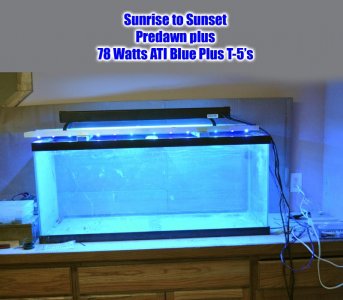
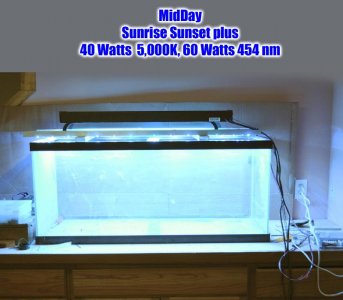
T-5 LED combination and Comparisons.

TropTrea

New member
First off I'll introduce myself and give you some of my lighting experience.

For starters I got into aquariums before many of you back into 1962. At that time I was fasinated with planted fresh water tanks. In 1969 I worked for a lighting manufacturer in the quality control department and started doing some personal research on what lighting was best for fresh water tanks. Slowly my tanks grew and in the 1990's I had over 100 tanks in my basement with my emphise on breeding various rare tropicals as well as breeding and showing Bettas.

In 1998 I opened an aquarium shop which took off great but started to see issues after September 11th. When I opened the pet/aquarium store I got involed in both reptiles and salt water tanks at the same time and started doing more research on lighting. Today I'm strictly into Reefs as a hobby but still doing lighting research. Presently I have one 120 gallon display tank and 3 40 gallon frag tanks.

With Reef lighting I initialy went with mh lighting. I loved the reasearch that Sanjay did with MH bulbs used it a basic guide for lighting my tanks. But in 2003 I got sold on HO-T-5's and converted all my tanks to HO-T-5 after a fire completly destroyed my house. In 2010 I converted one of my 40 gallon breeder tanks to LED's as an experiment and in 2011 I converted the second one. At this time I also added LED's to my my 120 gallon tanks as a suplement to my 8 54 Watt T-5's.

Through the years of playing with both T-5's and LED's I found that they both have there specific advanntages and disadvantages. The T-5's bulbs have considerably wider light spectrums allowing more specifice light frequencies to be hit. The LED's however are more cost effecient. This effeciency comes in two ways, the longer life expectancy between replacing LED's as well as a lower electric bill. The other point ith LEd's is that specific frequencies of light can be concetrated to create better visual effects and to stimulate specific coral growth.

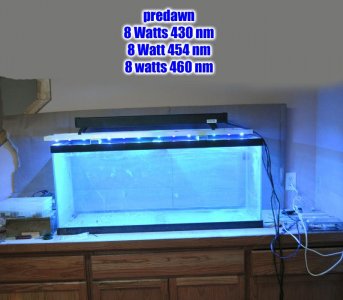
MY present thoughts are combining the best of both worlds into fixtures that use both T-5 lighting as well as LED's. The latest fixture that I built was for a new reefer and combined these two ideas.

Attached are some pictures of this new light on an empty 75 gallon tank. Please keep in mind that on these pictures I'm using 2 39 Watt ATI Blue Plus bulbs in a 4 Bulb fixture and the end product used 2 54 Watt bulbs in a 2 Bulb fixture so the T-5's in the end where slightly more predominant than in the pictures.

I'm looing for feedback from others both good and bad comments. As time goes on I intend to improve on this basic system as well as do several other builds for muyself and possibly others.
 

Attachments

  • Predawn.jpg
    Predawn.jpg
    61.7 KB · Views: 10
  • Sunrise-sunset.jpg
    Sunrise-sunset.jpg
    65.6 KB · Views: 8
  • Midday.jpg
    Midday.jpg
    61.2 KB · Views: 7
seems to me your going in the direction that other big manufacturers like ATI are going with the T5/LED fixtures. I would imagine that if you could offer products that had the bones we need at a pricepioint that is competitive with the major vendors, you might have something. There were some other posts about this type of business...if you are going to sell lights, yuo need to be careful with respect to safety and insurance..if one of your lights caught fire and did damage to an expensive home, what would you be able to offer? then theres testing and UL certification etc...ligths/electricity=danger/risk of fire...
I like the idea personally, I have an 8bulb tek elite over my 90g and id like to take out some bulbs to replace with LEDs, but for me, i dont want to fuss with things anymore, id prefer to have a plug and play fixture and not have to make it work with my apex, just connect it and program it.
Im sure you can find a niche market, but there are things to consider beyond the light itself before you create products to sell to the public...
 
Yes I had thought very breifly about comercial manufacturing the product. However the last few years I had worked in Research and Development of new products for several large companies on a cunsultant bases. Trying to take a product from the idea phase to manufacturing with all the certifications takes time and money. I have seen it done in 6 months with millions in expenses, and I saw it taking over three years.

The big fight I had seen was protecting the product from the patent thieves. As soon as you get a product on the market some peeople are out there figguring how to build it for less and get around the patients. In most cases a new product has at the most a year where it is either not worth it or you better have made the initial costs up because you now have two competetors building it for less than you can.

To date I have built 3 lights for my 120 gallon tank with all LED's and other that liked it on seeing my tank wanted it. What they offered me for it was enough for me to give it up and start building another for myself.

So my idea is for helping the do it your selfer. LED's are a very personal thing what Johnny thinks is ideal Jack will dislike. Even with T-5 lights there are so many combinations and what Paul like Harry dislikes. But with doing it yourself and LED's small $20 change can be the difference between hating and loving it.

I'm not looking at going into business with these. I simply want to sare ideas for the Do it Yourselfer.

On the ATI combinations I have some thoughts. Personlay I woud change the Ration between the T-5's and the LED's so at least 2/3 of the light is comming from the LED's. I worked out a system about 3 years ago where I'm going with 3 phases of lighting. It original started as a moon light idea but expanded from there.

My thoughts was to have 6 454nm moon light on my 120 gallon tank running at 350 ma. But when I hooked them up they were to much for moon lights. The effect they gave was striking though. So I increased the wattage and called them a predawn to post dusk light phase. Since then every build for me has been in three phases.

With my 40 breeder tanks two home build LED systems and the other T-5 I have come to appreciate the full spectrum LED's and prefer them over the T-5's. So for mid day lighting I think the LED''s are the leaders. Whith changing the ratio of LED';s between Blue, Daylight, and Neutral White you can get any color scheme you want.

But the problem falls in the dawn to dusk. I want to cover the entire blue part of the spectrum. With LED's they are wave lenght specific but there are same great T-5 bulbs out there that cover the spectrum with emphisis on the wave lenghts between 420 and 460 nm.
 
Very fortunatly it was an electrical fire in a completly different part of the house from where I had my aquariums. However the Insurance company pointed out to me that if were from MH lighting there would not have been any coverage. As it came out they completly covered the house repairs and gave me my policy max for the house. But the real heartbreak was the impossibility of replacing 50 years of items with loads of memories like pictures, and family herilooms from 3 generations ago.

On getting back to the subject here I'll be posting some pictures of my present tanks as I get a little extra time after Easter. I presently have a fresh water tank I'm also going to set up using LED's. I do miss my breeding of Discus and want to get at least one of my Discus tanks going again. I have not had a fresh water tank since the fire.
 
Why would the insurance company not cover if you had the MH.
So if you have T-5 it would be ok.

Suposedly Metal Hides generate excessive heat and normally not designed for indoor usage. In most MH fires combustiable materials came to close to the MH bulbs and start on fire. Years ago suposedly people used them for everyday lighting in there homes and they were creating more fires on a precentage bases than tungstun lighting. That is when some insurance companies added clauses in the policy that fires started from MH bulbs were not included in coverage.

I will agree that it sounds silly to those that use them on Aquariiums But it is one way the insurance companies goes overboard like our government did on snake head fish. There are over 200 species of snakeheads on three of them get large and are evasive. But they banned all snakehead fish even those that do grow bigger than 3" long. Because several people had one of the invasive species that got to big for their aquarium and put it into a lake.
 
Please do not get me wrong I did not start this thread for the individulas wanting to buy my fixtures. I started it for questions on the different possible combinations and to help those that want to build there own.
 
As I mentioned in the T5 thread, I am currently planning a T5-LED combined build, where the T5s are supplementing the primarily LED lit tank. I want to use the T5s to cover mostly the purple range of light between 400nm and 450nm. Other LEDs will be:

Bridgelux BXRA-40E****-B-00 Neutral White LED 4000k
Luxeon M 450nm
Luxeon Rebel ES 470-480nm
Luxeon Rebel ES 495-505nm

As you can see, I have pretty well every colour above 450nm covered. Other builds typically use Hyper Violet 430nm LEDs to fill out the remainder of the spectrum, with a couple of 410nm LEDs. However, I feel that this may not be optimal coverage for the range. This is why I have chosen to look at T5 supplementation instead. I plan to build a 2-bulb fixture using retrofit parts (Icecap endcaps, parabolic reflector, unknown ballast).

I have looked at Fiji purple, but the purple spike appears to be at 440nm instead of the optimal 430nm. However, it does feature the optimal 660nm spike. The ATI Purple Plus seems to have the exact same purple spike, but lacks a red spike while adding a sub-optimal orange spike (no significant photosynthetic response at this wavelength).

The Blue Plus spectrum is mostly already covered by my LEDs, I don't need to furrther supplement this range.

The ATI True Actinic is very close, spiking at 421 with significant coverage at both 430 and 410 (~0.5 relative). The Giesemann Pure Actinic seems to be exactly the same as the ATI at an additional $7 premium.

Are there any other bulbs I should be considering? My current thought is I'll buy 1 Fiji Purple, and 2 ATI True Actinic. From there I will simply decide whether I want to run the 1+1 or just run 2 ATI True Actinic. Any thoughts?

EDIT: I am also a little bit confused by ballasts. I've seen many mentions of overdriving T5HO bulbs using the Icecap 660 (CoralVue 660) ballast. Is this something that is recommended for supplementation? Also, are dimmable fixtures available on the market individually outside of ATI fixtures? My light is going to be extremely high PAR, and the ability to also dim the T5s will help substantially for acclimation.
 
Last edited:
Curious about your comment on power usage of T5's vs LED's. I looked at LEDs a few months back and at first blush the power consumption appeared relatively equal. (I was looking at a 4' Vertex Illuminata fixture vs my 6-bulb 4' TEK fixture.) The price was prohibitive, so I didn't look into it much, but the power consumption between the two was pretty close.

What I wasn't clear on was if the LEDs are normally run close to the maximum power listing, if if they're normally run lower.
 
Curious about your comment on power usage of T5's vs LED's. I looked at LEDs a few months back and at first blush the power consumption appeared relatively equal. (I was looking at a 4' Vertex Illuminata fixture vs my 6-bulb 4' TEK fixture.) The price was prohibitive, so I didn't look into it much, but the power consumption between the two was pretty close.

What I wasn't clear on was if the LEDs are normally run close to the maximum power listing, if if they're normally run lower.

Generally speaking LEDs will always be more efficient than T5s, especially with more recent technologies. Commercial LED fixtures tend to run at a lower wattage than listed, often claiming things like 36x3W but only running at 36x1W. Your best bet for determining the efficiency of a fixture is to find the datasheets for the LEDs they are using.

For example, if we take a Bridgelux BXRA-40E0950-B-00 Neutral White LED array, it runs at 1030-1150 lumens @ 10.4W; that is 99-110 lumens/Watt. Compare that against a General Electric 6500k 54W Daylight T5, which puts out 4370 lumens; that is 81 lumens/Watt.

As you can see, the Bridgelux LED is significantly more efficient even at it's lowest output (1030 lumens). However, converting from T5 to LED is very expensive, and likely will not pay for itself in any short timeframe. The advantage of LED is the capability to mimic MH without the cooling or electrical bill.
 
I'll disagree about the economy of conversion if youyr looking at the long range picture. With T-5's or MH you have to replace your bulbs at least annualy. With T-5 on an 8 bulb fixture your spending over $200 a year to change your bulbs. LED's last up to 5 years with virtualy 0 manitance cost. so in five years you have saved $1,000.00 in bulbs while the Do it Yourself fixture costed roughly half ovf that if not even less. Then you also have the electrical cost savings that are even more so than what Tpip said.

For the effeciency remember that a T-5 bulb may put out 81 lumens per watt. But that is its total output and its effeciency is greatly dependent unpon the reflector. The range of reflector effecency out there today range from 65% to 90% so in reality out of that 81 lumnen per watt your actualy getting an between 52 and 73 lumens to the corals. With LED's it is closer to a 95% effeciency consideraing they are directional. So in reality you can get twice the light from LED's per watt.
 
I'll disagree about the economy of conversion if youyr looking at the long range picture. With T-5's or MH you have to replace your bulbs at least annualy. With T-5 on an 8 bulb fixture your spending over $200 a year to change your bulbs. LED's last up to 5 years with virtualy 0 manitance cost. so in five years you have saved $1,000.00 in bulbs while the Do it Yourself fixture costed roughly half ovf that if not even less. Then you also have the electrical cost savings that are even more so than what Tpip said.

For the effeciency remember that a T-5 bulb may put out 81 lumens per watt. But that is its total output and its effeciency is greatly dependent unpon the reflector. The range of reflector effecency out there today range from 65% to 90% so in reality out of that 81 lumnen per watt your actualy getting an between 52 and 73 lumens to the corals. With LED's it is closer to a 95% effeciency consideraing they are directional. So in reality you can get twice the light from LED's per watt.

Reflectors are available on the market with 95% efficiency, whereas LED optics rarely exceed 90%, with 92% being upwards of $10 per diode. With a viewing angle of 120 degrees, LEDs without optics have 80% efficiency at most.

There is absolutely no question that LEDs are more economical than T5s, but the break-even is on the order of 3-5 years, which for many people is not worthwhile, especially for a technology so young. Even I am planning to combine T5s with LEDs because I do not feel LEDs are at a stage where they will out-perform a hybrid unit yet.

However, I am more interested in your opinion on my bulb question above.
 
Reflectors are available on the market with 95% efficiency, whereas LED optics rarely exceed 90%, with 92% being upwards of $10 per diode. With a viewing angle of 120 degrees, LEDs without optics have 80% efficiency at most.

While 95% efficient reflectors may be available, as a practical matter, I have a feeling the reflectors in most fixtures are probably significantly below 95%, so unless you are spending the time and effort to change the reflectors, you're likely getting significantly less than 95%

There is absolutely no question that LEDs are more economical than T5s, but the break-even is on the order of 3-5 years, which for many people is not worthwhile, especially for a technology so young.

This is exactly where I'm at. LED's can clearly grow corals, but the technology is young and changing, and prices are still fairly high. I have a hard time shelling out $2k for a technology that is still evolving. It's hard to convince my wife too. :rolleyes:
 
As I mentioned in the T5 thread, I am currently planning a T5-LED combined build, where the T5s are supplementing the primarily LED lit tank. I want to use the T5s to cover mostly the purple range of light between 400nm and 450nm. Other LEDs will be:

Bridgelux BXRA-40E****-B-00 Neutral White LED 4000k
Luxeon M 450nm
Luxeon Rebel ES 470-480nm
Luxeon Rebel ES 495-505nm

As you can see, I have pretty well every colour above 450nm covered. Other builds typically use Hyper Violet 430nm LEDs to fill out the remainder of the spectrum, with a couple of 410nm LEDs. However, I feel that this may not be optimal coverage for the range. This is why I have chosen to look at T5 supplementation instead. I plan to build a 2-bulb fixture using retrofit parts (Icecap endcaps, parabolic reflector, unknown ballast).

I have looked at Fiji purple, but the purple spike appears to be at 440nm instead of the optimal 430nm. However, it does feature the optimal 660nm spike. The ATI Purple Plus seems to have the exact same purple spike, but lacks a red spike while adding a sub-optimal orange spike (no significant photosynthetic response at this wavelength).

The Blue Plus spectrum is mostly already covered by my LEDs, I don't need to furrther supplement this range.

The ATI True Actinic is very close, spiking at 421 with significant coverage at both 430 and 410 (~0.5 relative). The Giesemann Pure Actinic seems to be exactly the same as the ATI at an additional $7 premium.

Are there any other bulbs I should be considering? My current thought is I'll buy 1 Fiji Purple, and 2 ATI True Actinic. From there I will simply decide whether I want to run the 1+1 or just run 2 ATI True Actinic. Any thoughts?

EDIT: I am also a little bit confused by ballasts. I've seen many mentions of overdriving T5HO bulbs using the Icecap 660 (CoralVue 660) ballast. Is this something that is recommended for supplementation? Also, are dimmable fixtures available on the market individually outside of ATI fixtures? My light is going to be extremely high PAR, and the ability to also dim the T5s will help substantially for acclimation.

My aproach has been slightly different with yours. Usining the ATI Blue Plus bulbs there is wider spectrum of coverage with the peak around 460 nm. These bulbs do cover the range of 420 to 500 nm. As far as the range above 500 nm some Cree neutral white LED's provide more than enough light.

However the range below 460 nm is not covered as well I'm comfortable with by the T5's. The tanks that I have lite on predawn to post dusk with simply 460 nm 454 nm and 430 nm LED's give off a florescense much more breathtaking than even pure atinic T-5's. Therefore I refer running a predawn to post dusk time period with roughly a ration of 1 to 4 to 1between the 430nm 454 460nm LED's. I actualy run these on a 700ma driver due to the limited current the 430's can handle.

For the dawn to dusk is where I prefer using the T-5's mainly to extend that blue light range and slightly brighten up to tank. On a 90 to 120 Gallon tank I found just two ATI Blue Plus bulbs does a great job boasting that blue spectrum for dawn to dusk. Other may want to go to 4 bulbs and use other combinations but I would recommond sticking with a combination of blue plus, pure atinic, or a purple plus. This is where personal color taste is the big factor again.

For full midday lighting I like the CREE neutral Whites. But it only takes a few of them to wash out the blueness. However it does produce a crisper pure white compared to the ivory color of the GE 6,500K, or the blueness of the Cool White LED's. Therefore I mix these with the the Cree Royal Blues 454nm on a ratio that meets my visual preference. This usualy come out to be roughly 1 neutral White to two of the Royal Blues.

As far as over driving T-5 bulbs. Yes you cab over drive them however if your looking for economical operation I would not. If they over driven by 10% you will only get about 5% nore light if your lucky. But the life of the bulb will probably be reduced by roughly 25%. Cooling becomes an extremly important factor when overdriving.

As far as dimmable T-5 ballasts I know they have been around for years in the industrial and comercial lighting industry. But keep in mind that when you underdrive a T-5 bulb or any florescent bulb you will also be changing the color spectrum of that bulb. In some cases it is slight and for other cases it can be extreme. This is because various phosperious compounds are used to floresce the light. When the bulb is designed the ratio of these are selected by there reaction to current at a set level. When the level of current is changed some will continue to florese at near the same level and other will floresce at different levels. This cause the various differences between the peaks to change there ratio.

As a final note on the Florescent bulbs. Please read the manufacturers data with caution. Mpost will only gove you a rough spectrum graph because they do not want to be tied to an accurate spectrum peak wave lenght. Even when they do this the lighting standards are way wider than what consider in the Reef hobby. Fortunatly with LED's are built wavelenght specific but if you look at there spike you see it is only 50% of the peak only a few nm away from it peak. Between a 430nm and 454 nm LED there is a gap of near 0 light emited around 442 nm. This is where I like the T-5's to help them out.
 
My aproach has been slightly different with yours. Usining the ATI Blue Plus bulbs there is wider spectrum of coverage with the peak around 460 nm. These bulbs do cover the range of 420 to 500 nm. As far as the range above 500 nm some Cree neutral white LED's provide more than enough light.

For full midday lighting I like the CREE neutral Whites. But it only takes a few of them to wash out the blueness. However it does produce a crisper pure white compared to the ivory color of the GE 6,500K, or the blueness of the Cool White LED's. Therefore I mix these with the the Cree Royal Blues 454nm on a ratio that meets my visual preference. This usualy come out to be roughly 1 neutral White to two of the Royal Blues.

I'm already set for whites, running Bridgelux BXRA 4000k at 80 CRI.

However the range below 460 nm is not covered as well I'm comfortable with by the T5's. The tanks that I have lite on predawn to post dusk with simply 460 nm 454 nm and 430 nm LED's give off a florescense much more breathtaking than even pure atinic T-5's. Therefore I refer running a predawn to post dusk time period with roughly a ration of 1 to 4 to 1between the 430nm 454 460nm LED's. I actualy run these on a 700ma driver due to the limited current the 430's can handle.

For the dawn to dusk is where I prefer using the T-5's mainly to extend that blue light range and slightly brighten up to tank. On a 90 to 120 Gallon tank I found just two ATI Blue Plus bulbs does a great job boasting that blue spectrum for dawn to dusk. Other may want to go to 4 bulbs and use other combinations but I would recommond sticking with a combination of blue plus, pure atinic, or a purple plus. This is where personal color taste is the big factor again.

Between a 430nm and 454 nm LED there is a gap of near 0 light emited around 442 nm. This is where I like the T-5's to help them out.

What bulb do you use for the 430-454nm range? You said that you feel below 460nm is poorly covered by T5s. Based on what you've said above, it looks like I'm going to be researching in more depth to decide exactly what I want to do. I still feel that LEDs are just not quite there with the 400-450nm range, but I'm not sure what my solution to that problem will be.
 
In some cases I see leds on deep tanks run tight optics to punch deep t5s sour be good to add in to wash out some of the top of reef spot lighting and shadows I believe DIY leders should have different optics mixed in
 
I'm already set for whites, running Bridgelux BXRA 4000k at 80 CRI.

I looked up the spec on this LED
2100 ma @ Typ 25.6 Volts = roughly 63 Watts. This is lot of White light for a reef tank which makes we want to back up a bit ask you what the dimensions of your tank are? For a typicial 120 gallon tank 48" X 24" X 24" just two of these would be on the very of to much unless you had them on a controler allowing you to dim them. If you have a taller tank this can be another story.


What bulb do you use for the 430-454nm range? You said that you feel below 460nm is poorly covered by T5s. Based on what you've said above, it looks like I'm going to be researching in more depth to decide exactly what I want to do. I still feel that LEDs are just not quite there with the 400-450nm range, but I'm not sure what my solution to that problem will be.

The 430 NM LED's I'm now usung after considerable experimentation are the ones now sold by Rapid LED. I had tried numerious other and they caused an excessive pink tint to the tank. Even these if used in excess will start giving that pink tint.

For the Royal blue 454nm LED's I like to use the XTEARY-B-D46. Yes this is only a 5 Watt Chip running at 1500ma and typicialy using 3.38 Volts for 5.1 watts but it does put out a lot of light per watt compared to some of the other LED's out there. For my predawn circuit I combine 2 of these with one XPE True Blue 460nm and one of the 430 nm chips for a great balance in covering 90% of the florescent corals.

An interesting thing in my experimentation is I tried sole lighting with one wave lenght chip and my frogspawn showed the most difference between the different wave lenghts.

with a 400nm near UV it only slightly showed florescense
with a 430 nm LED it glowed a bright yellow
with a 454 nm LED it glowed a yellow green
with a 460 nm LED it glowed a blue green
with a 505 nm LED it did not glow at all
with a combination of 1 430, 2 454, and 1 460 it glowed the brightest green.

I also played with increasing the amount of blue to make the florescense more dramatic but I found that after a point the reflective blue light just started overpowering the florescense and everything looked more blue.
 
I looked up the spec on this LED
2100 ma @ Typ 25.6 Volts = roughly 63 Watts. This is lot of White light for a reef tank which makes we want to back up a bit ask you what the dimensions of your tank are? For a typicial 120 gallon tank 48" X 24" X 24" just two of these would be on the very of to much unless you had them on a controler allowing you to dim them. If you have a taller tank this can be another story.

Not sure where those specs are from, but the Bridgelux Data Sheet gives the following specs:
BXRA 0950-B: 1150 @ 500mA, 20.7Vf = 10.4W
BXRA 1350-B: 1690 @ 500mA, 29.6Vf = 14.8W
BXRA 2200-B: 2750 @ 700mA, 37.0Vf = 25.9W

The plan is 3 clusters each with 1 BXRA either 1350 or 2200, and 4-5 Luxeon M running at 10W each. Hung 10" off the tank with Ledil 50 degree (100 degree effective viewing angle) reflectors gives me a 24x24" coverage area for a 72x24x18" tank. These would of course be dimmed.

The 430 NM LED's I'm now using after considerable experimentation are the ones now sold by Rapid LED. I had tried numerious other and they caused an excessive pink tint to the tank. Even these if used in excess will start giving that pink tint.

For the Royal blue 454nm LED's I like to use the XTEARY-B-D46. Yes this is only a 5 Watt Chip running at 1500ma and typicialy using 3.38 Volts for 5.1 watts but it does put out a lot of light per watt compared to some of the other LED's out there. For my predawn circuit I combine 2 of these with one XPE True Blue 460nm and one of the 430 nm chips for a great balance in covering 90% of the florescent corals.

The LEDs listed on RapidLED are 410-420nm, is this incorrect? The only 430nm LEDs I have seen are custom made for LEDGroupBuy.

Like I said before, I already have the 450nm+ range covered, I've done a ton of research here and have finalized that portion of my design. I was actually asking what T5 bulb you use for the 430-454nm range, as you said here:

Between a 430nm and 454 nm LED there is a gap of near 0 light emited around 442 nm. This is where I like the T-5's to help them out.
 
Not sure where those specs are from, but the Bridgelux Data Sheet gives the following specs:
BXRA 0950-B: 1150 @ 500mA, 20.7Vf = 10.4W
BXRA 1350-B: 1690 @ 500mA, 29.6Vf = 14.8W
BXRA 2200-B: 2750 @ 700mA, 37.0Vf = 25.9W

The plan is 3 clusters each with 1 BXRA either 1350 or 2200, and 4-5 Luxeon M running at 10W each. Hung 10" off the tank with Ledil 50 degree (100 degree effective viewing angle) reflectors gives me a 24x24" coverage area for a 72x24x18" tank. These would of course be dimmed.:

Yes I got my data from a vendors dat notes on the chip. But from Bridgelux's sheet, it looks like putting 2100ma on this chip is a sure way of blowing it up. Running 3 of these on a 135 gallon tank at 10 watts each would be just a little less white than what I would do. But remember the white light is mainly for our viewing pleasurte rather than the corals so the balance of Blue to White is amost all personal taste.


The Rapid LED's I bought there and several other vendors on several ocassions. The initial; ones were suposedly 405 to 420 nm that made everything look super pink. Then I tried the Clay Boa that were suposed to be 420nm and they were very close in appearance to 454 Royal Blues. Seemed to have the corals react though slightly different from the 454,s. Last ones I bought were in December from Rapid and they listed both 430 and 420. I bought the 430 and I love them. I rechecked there page and it is not there now.

As far as the 430 to 454 range The T-5 ATI Aqua blue Plus covers them as well as the higher 480 to 500 range. The other option is the ATI Atinic Plus that also covers the 430 to 454 range but also boost the 410 to to 430 range while doing nothing for the range longer than 460.

Personal opinion is people put to much emphsis on the light below 430nm and the main thing is to get a strong spectrum between 440 and 470. For the fantastic florescense look any light longer than 470 nm starts reducing or washing out the florescense. The florescense is still there but the reflective light makes it less obvious.

Looking at ocean spectrrum charts I also see the majority of the penetration is ion the 420 to 460 range. When you hit 600nm the light is antenuated to the point it is barely measurable at 30 meters. And light shorter than 400nm is attenuated the most right at the surface.
 
Back
Top