T-5 LED combination and Comparisons.

Yes I got my data from a vendors dat notes on the chip. But from Bridgelux's sheet, it looks like putting 2100ma on this chip is a sure way of blowing it up. Running 3 of these on a 135 gallon tank at 10 watts each would be just a little less white than what I would do. But remember the white light is mainly for our viewing pleasurte rather than the corals so the balance of Blue to White is amost all personal taste.

Yes, I recently upped my white to 4 clusters instead of 3. I'd also likely be running them at a higher current.

Personal opinion is people put to much emphsis on the light below 430nm and the main thing is to get a strong spectrum between 440 and 470. For the fantastic florescense look any light longer than 470 nm starts reducing or washing out the florescense. The florescense is still there but the reflective light makes it less obvious.

The reason people put so much emphasis on 430 is because there is a photosynthetic spike at that wavelength, and the light is nearly invisible to human eyes. This allows you to add tremendous amounts of par without significantly affecting the colour temperature.
 
Yes, I recently upped my white to 4 clusters instead of 3. I'd also likely be running them at a higher current.

Watch the current your running the Bridglux at. I have heard from some they had no problems running them at an 20% current and from others they had burn outs at 10% over current. If I recall they should be okay with 1050ma drivers but the 1500ma drivers are realy pushing these.

I originaly started wiith some older design bridglux blue chips but did not particularly care for them. I got some of there chips at two different wave lenghts and ones that with the longer wave lenght were not putting out nearly the light as the ones at the shorter wave lenght when I tried runnng them on a 700ma driver together. With Crees I found the longer lave lenght (460nm) were brighter than the shorter (454nm).


The reason people put so much emphasis on 430 is because there is a photosynthetic spike at that wavelength, and the light is nearly invisible to human eyes. This allows you to add tremendous amounts of par without significantly affecting the colour temperature.

A while back someone had a big write up on the so called near UV chips. They actualy did a spectrum anylasis on I believe it was 6 different no name chips from various vendors. The vendor claims were they ran anywhere from 405 nm up to 430 nm as there peaks. His tests showed that they produced 2 different spectrums and that they were not at all related to what the vendors advertised them at. The actual peaks he measured were either in the 400nm range or the 435 nm range. Interestingly one that was being sold as 430nm actualy peaked at 400 and one being sold as a 420nm actualy peaked at 435. With the T-5 ATI blue plus or there Atinic Plus this frequency range is covered nicely.

but where my concern also is in the 490nm area. Out of all the whites from the three manufacturers that put out plots they all show a weak spectrum in this area. Out of the colored chips out there none are realy strong at 490nm. The closes is the Lexeon 505nm. And it is already at 50% power at 495 nm. This is one reason I like to use the T-5 ATI blue plus bulbs because they are still putting out a good amount of light at 490 nm.

From the basic photosenthetic chemicals Chlorophyll a uses light the best between 410 and 440nm, Chlororophyll b at between 450 and 460 nm, Beta Carotene between 445 and 475 nm. Which are the primarly ones in most corals. There is also some Phycoerythrin in some corals that best uses light at 570 nm however it is usualy accompinied with florescent protiens that radiate light in that area. Polycocyanin which loves light at 620 nm is very rare in corals but is the main life blood of Cyanobacteria.

Now another question I believe you stated you were thinking of using 4 T-5's. Are these 4 80 watt bulbs or 4 39 watt bulbs.? If your using 4 39's then I would suggest all ATI Blue Plus bulbs, if you using 2 80's you can either go with 1 or 2 Blue Plus with the option of a Atinic to boast the 410 to 440 range.
 
Watch the current your running the Bridglux at. I have heard from some they had no problems running them at an 20% current and from others they had burn outs at 10% over current. If I recall they should be okay with 1050ma drivers but the 1500ma drivers are realy pushing these.

This is likely due to a misunderstanding of the thermal properties of LEDs. LEDs will burn out if they get too hot, and the lifespan of an LED directly relates to the temperature that it runs at. They were likely pushing them too hard without appropriate heat dissipation techniques. I bet if I put an LED onto a high-end copper video card heatsink, I could easily run them up to 3000mA. However, aluminum maxes out it's heat dissipation capabilities fairly quickly. That is why the new Luxeon M chips only come on large copper PCBs.

Note that when I said I plan to run the chips higher, I meant higher than spec (500mA) but below maximum spec (1000mA).

I originaly started wiith some older design bridglux blue chips but did not particularly care for them. I got some of there chips at two different wave lenghts and ones that with the longer wave lenght were not putting out nearly the light as the ones at the shorter wave lenght when I tried runnng them on a 700ma driver together. With Crees I found the longer lave lenght (460nm) were brighter than the shorter (454nm).

Be careful that you are not mixing up true Bridgelux and chinese "Bridgelux". True Bridgelux does not make a 3W white chip. The Aquastyle LEDs are cheap chinese knockoffs of Bridgelux, so I would not be surprised if the wavelength were completely off.

A while back someone had a big write up on the so called near UV chips. They actualy did a spectrum anylasis on I believe it was 6 different no name chips from various vendors. The vendor claims were they ran anywhere from 405 nm up to 430 nm as there peaks. His tests showed that they produced 2 different spectrums and that they were not at all related to what the vendors advertised them at. The actual peaks he measured were either in the 400nm range or the 435 nm range. Interestingly one that was being sold as 430nm actualy peaked at 400 and one being sold as a 420nm actualy peaked at 435. With the T-5 ATI blue plus or there Atinic Plus this frequency range is covered nicely.

I would be interested to read this writeup, especially what near-UV LEDs they were looking at. The clay-boa Hyper Violet 430 LEDs are relatively new, so unless this was recently, they were likely not included.

but where my concern also is in the 490nm area. Out of all the whites from the three manufacturers that put out plots they all show a weak spectrum in this area. Out of the colored chips out there none are realy strong at 490nm. The closes is the Lexeon 505nm. And it is already at 50% power at 495 nm. This is one reason I like to use the T-5 ATI blue plus bulbs because they are still putting out a good amount of light at 490 nm.

My current plan is to use 1 ATI Blue+ and 1 ATI True Actinic. Hopefully this will cover my gaps.

From the basic photosenthetic chemicals Chlorophyll a uses light the best between 410 and 440nm, Chlororophyll b at between 450 and 460 nm, Beta Carotene between 445 and 475 nm. Which are the primarly ones in most corals. There is also some Phycoerythrin in some corals that best uses light at 570 nm however it is usualy accompinied with florescent protiens that radiate light in that area. Polycocyanin which loves light at 620 nm is very rare in corals but is the main life blood of Cyanobacteria.

Coral do not contain Chlorophyll b. Coral contain Chl. a and Chl. c, but not Chl. b. They also contain Chl. a at a 10-1 ratio with Chl. c. This means that hitting Chl. c peaks is significantly less important (almost negligible) for coral. The primary accessory pigments are Peridinin and Neo-peridinin constituting 77-84% of total Carotenoids. Note that clams (Crocea) contain Chl. c at a 0.6 ratio to 1 Chl. a. We can look at the image below to find the absorption maximas of these pigments:

Photosyntheticpigmentsabsorptionmaxima-1.png


As you can see, the most important photosynthetic wavelengths are ~430 (Hyper Violet) and 465-475 (Cool Blue). Chlorophyll a also loves 660 red light. However, this is generally provided by a good neutral white LED array, no need to supplement more red light.

Now another question I believe you stated you were thinking of using 4 T-5's. Are these 4 80 watt bulbs or 4 39 watt bulbs.? If your using 4 39's then I would suggest all ATI Blue Plus bulbs, if you using 2 80's you can either go with 1 or 2 Blue Plus with the option of a Atinic to boast the 410 to 440 range.

I am going to be using 2 bulbs, but since my tank is 6 feet long, I will be using 4 3 foot long bulbs. As I said above, my current plan is 1 ATI Blue+ and 1 ATI True Actinic.

EDIT: After thinking about your posts, I may upgrade to 3 bulbs (6 bulbs). I would put 2 bulbs in front of my LED fixture, and 1 bulb behind. Front to back:
  • True Actinic
  • Blue+
  • LED Array
  • True Actinic

With the way my tank is designed in my head, this would put the back True Actinic above or slightly behind the crest of the rock structure, allowing full Violet coverage. The tank would only be viewable from the front (and maybe the left side, depending on final renovation). These lights would be approximately 10" above the water surface.
 
This is likely due to a misunderstanding of the thermal properties of LEDs. LEDs will burn out if they get too hot, and the lifespan of an LED directly relates to the temperature that it runs at. They were likely pushing them too hard without appropriate heat dissipation techniques. I bet if I put an LED onto a high-end copper video card heatsink, I could easily run them up to 3000mA. However, aluminum maxes out it's heat dissipation capabilities fairly quickly. That is why the new Luxeon M chips only come on large copper PCBs.

Note that when I said I plan to run the chips higher, I meant higher than spec (500mA) but below maximum spec (1000mA).


Be careful that you are not mixing up true Bridgelux and chinese "Bridgelux". True Bridgelux does not make a 3W white chip. The Aquastyle LEDs are cheap chinese knockoffs of Bridgelux, so I would not be surprised if the wavelength were completely off..

Yes I'm aware of the thermo issues with basicly all electronic devices. However pushing a LED that is rated at a max of 1000ma to 3,000ma would need some extensive cooling. I have pushed Cree LED's to roughly 150% of there rated power constant current power rating as well as with no problem. But when I started exceeding there pulsed power rating by about 25% it was instant LED burn out. If you push them to hard the heat does not have time to despisate and as a result the LED pops like a fuse.

The two different Bridglux sources is news to me. The bad thing about that being when you purchase from a second vendor how do you know which Bridglux your actualy getting? This could be why some individuals swear Bridglux are the best and others claim they are garbage.

A few years back when I had a pet store I found the same issue with Marineland products. There were the official Marineland products and a knock off Mairineland Chineese brand even the packaging looked the same unless you closely read the small print on the label. A 350 gph filter from the official Marineland could easily be confused with one from Mairineland that was rated at 350 liter per hour.

I would be interested to read this writeup, especially what near-UV LEDs they were looking at. The clay-boa Hyper Violet 430 LEDs are relatively new, so unless this was recently, they were likely not included..

Yes I know the Clay Boa LED's were included. As a matter of fact the reason he listed checked into this is that he purchased the Clay Boa LED's at 430 and found they looked to him the same as some he had purchased priorly from another vendor. I do not remember where the two peaked but his spectrum anylasis did verify they both peaked within 3 nm of each other.

If you searh through Reef Centeral you should be able to find it. It is only about 6 months old and I found it when I was reseaching one of my updates that I did not like the UV LED's I was using at the time. That is what convinced me to order the 430nm that he tested out from Rapid.

My current plan is to use 1 ATI Blue+ and 1 ATI True Actinic. Hopefully this will cover my gaps..

Yes it should do a good job. It is one of the two options I would recommend dependent upon the LED's your using. More Cyan LED's would move to two Atinics, and no Cyan LED's would move me to two Blue Plus bulbs.


Coral do not contain Chlorophyll b. Coral contain Chl. a and Chl. c, but not Chl. b. They also contain Chl. a at a 10-1 ratio with Chl. c. This means that hitting Chl. c peaks is significantly less important (almost negligible) for coral. The primary accessory pigments are Peridinin and Neo-peridinin constituting 77-84% of total Carotenoids. Note that clams (Crocea) contain Chl. c at a 0.6 ratio to 1 Chl. a. We can look at the image below to find the absorption maximas of these pigments:

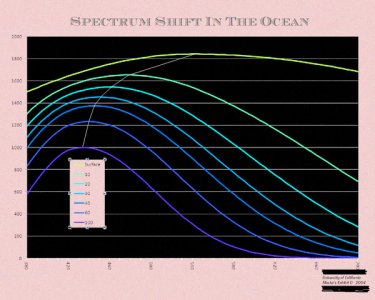
There have been numerious studies on this and everyne seems to reflect slightly different numbers. The big things to remember are that each of these chemicals have primary peaks and secondary peaks. The other point is what light do they receive in the ocean. Light in the longer wave lenghts are attenuated out of the spectrum they receive much faster than light at shorter wave lenghts. Many corals that may have proteins in them can use light at 620nm or longer never receive in nature more than 1 % as much light that they receive at 450 nm. Light shorter than 460 nm has the most penetration ability of the ocean however light below 440nm gets most of its attenuation right at the surface. By changing the ratio of light a coral is receiving in time the ratio of proteins in the coral actualy changes to the ones that the most light is available for which allows them to gradualy addapt. However if the difference is great enough the actual color of the coral will change as the ratio of proteins change.

The other point is you have florescens of the proteins. Over 100 florescent proteins have been found in corals. Most of these are activated by light in the 440 nm to 470 range with some reaching as low as 380 nm ar as high as 680 nm. Changing the light from what they are used to does result in color shifts as the chemical rations readjust.


I am going to be using 2 bulbs, but since my tank is 6 feet long, I will be using 4 3 foot long bulbs. As I said above, my current plan is 1 ATI Blue+ and 1 ATI True Actinic.

EDIT: After thinking about your posts, I may upgrade to 3 bulbs (6 bulbs). I would put 2 bulbs in front of my LED fixture, and 1 bulb behind. Front to back:
  • True Actinic
  • Blue+
  • LED Array
  • True Actinic

With the way my tank is designed in my head, this would put the back True Actinic above or slightly behind the crest of the rock structure, allowing full Violet coverage. The tank would only be viewable from the front (and maybe the left side, depending on final renovation). These lights would be approximately 10" above the water surface.

Not that my idea or your is better but this is what I found works best for me.

Front
PreDawn Post Dusk LED's angled to the back bottom ratio 1 near UV, 2 Royal Blue, 1 True Blue. These run about 2.1 Watts each so I do not need a seperate driver for the near UV)

Dawn to Dusk ATI Blue Plus

Mid Day LED's 1 to 1 Ratio Neutral White to Royal Blue. (5 Watt LED's)
Mid Day LED's Royal Blues with a few Neutral White to meet the overall color effect desirable. (5 Watt LED's)

I do not run Lenses any more since my LED's are only about 2.5 inches off the surface. When I did run lenses the shaddow effects created to much of a disco effect in my eye. If I had them 10" over the surface then lenses would be a necessity.

 
I'd also like to note that a long time ago I found this graph on the light spectrum in the ocean. I look at it more or less as a good refennce to get the right light for Corals. However for normal viewing most people would consider this too blue.
 

Attachments

  • Spectrum Shift in the Ocean.jpg
    Spectrum Shift in the Ocean.jpg
    101.1 KB · Views: 5
Yes I'm aware of the thermo issues with basicly all electronic devices. However pushing a LED that is rated at a max of 1000ma to 3,000ma would need some extensive cooling. I have pushed Cree LED's to roughly 150% of there rated power constant current power rating as well as with no problem. But when I started exceeding there pulsed power rating by about 25% it was instant LED burn out. If you push them to hard the heat does not have time to despisate and as a result the LED pops like a fuse.

My example was just intended as an example. I have no intentions of driving my LEDs above their pulsed peak rating. I'm well aware of the limits of the LEDs, and will not exceed them in my build.

The two different Bridglux sources is news to me. The bad thing about that being when you purchase from a second vendor how do you know which Bridglux your actualy getting? This could be why some individuals swear Bridglux are the best and others claim they are garbage.

The combination of the industry's "bin" system for rating LEDs and the prevalence of Chinese knockoffs makes it difficult. As far as I've seen, the only way to be confident in your purchase is the reputation of the vendor. RapidLED, Steve's and the other vendor which can't be mentioned here are all trusted sources.

A few years back when I had a pet store I found the same issue with Marineland products. There were the official Marineland products and a knock off Mairineland Chineese brand even the packaging looked the same unless you closely read the small print on the label. A 350 gph filter from the official Marineland could easily be confused with one from Mairineland that was rated at 350 liter per hour.

It seems that in our "niche" market, this is a common problem. It is much easier for Chinese knockoff to infiltrate the market, and since products are sometimes purchased through wholesalers instead of directly from manufacturer, it is not always possible to avoid them.

Yes I know the Clay Boa LED's were included. As a matter of fact the reason he listed checked into this is that he purchased the Clay Boa LED's at 430 and found they looked to him the same as some he had purchased priorly from another vendor. I do not remember where the two peaked but his spectrum anylasis did verify they both peaked within 3 nm of each other.

If you searh through Reef Centeral you should be able to find it. It is only about 6 months old and I found it when I was reseaching one of my updates that I did not like the UV LED's I was using at the time. That is what convinced me to order the 430nm that he tested out from Rapid.

I'll look into it. I currently have no intention of using violet LEDs anyway, Royal Blues will be the shortest wavelength LED in my build. If LEDs rated at 430 nm aren't even putting out 430nm, that is even less reason to use them until more consistent diodes are developed.

Yes it should do a good job. It is one of the two options I would recommend dependent upon the LED's your using. More Cyan LED's would move to two Atinics, and no Cyan LED's would move me to two Blue Plus bulbs.

Current plan is 1 Bridgelux array (~1500 lumens), 4 Luxeon M (20000-24000 mW), 2 Cool Blue Rebel ES, 1 Cyan Rebel ES.

There have been numerious studies on this and everyne seems to reflect slightly different numbers. The big things to remember are that each of these chemicals have primary peaks and secondary peaks. The other point is what light do they receive in the ocean. Light in the longer wave lenghts are attenuated out of the spectrum they receive much faster than light at shorter wave lenghts. Many corals that may have proteins in them can use light at 620nm or longer never receive in nature more than 1 % as much light that they receive at 450 nm. Light shorter than 460 nm has the most penetration ability of the ocean however light below 440nm gets most of its attenuation right at the surface. By changing the ratio of light a coral is receiving in time the ratio of proteins in the coral actualy changes to the ones that the most light is available for which allows them to gradualy addapt. However if the difference is great enough the actual color of the coral will change as the ratio of proteins change.

The other point is you have florescens of the proteins. Over 100 florescent proteins have been found in corals. Most of these are activated by light in the 440 nm to 470 range with some reaching as low as 380 nm ar as high as 680 nm. Changing the light from what they are used to does result in color shifts as the chemical rations readjust.

This (bolded) is true of most studies. Different methods, different testers, different equipment, etc etc will yield different results. Until one study proves to be the one true study, all we can do is use our own judgement. In reality, as long as we use our own common sense, our fixtures will grow coral better than any commercial (hobbyist) fixture on the market.

Not that my idea or your is better but this is what I found works best for me.

Front
PreDawn Post Dusk LED's angled to the back bottom ratio 1 near UV, 2 Royal Blue, 1 True Blue. These run about 2.1 Watts each so I do not need a seperate driver for the near UV)

Dawn to Dusk ATI Blue Plus

Mid Day LED's 1 to 1 Ratio Neutral White to Royal Blue. (5 Watt LED's)
Mid Day LED's Royal Blues with a few Neutral White to meet the overall color effect desirable. (5 Watt LED's)

I do not run Lenses any more since my LED's are only about 2.5 inches off the surface. When I did run lenses the shaddow effects created to much of a disco effect in my eye. If I had them 10" over the surface then lenses would be a necessity.

I read about your current fixture in the original post. I personally find your pre-dawn to look a little bit too "windex-y". I'll likely run the T5s sunset to sunrise for 12 hours, and dim in the LEDs with them running at max for about 8 hours. I'll adjust this as I see fit for the health of my coral.

I won't actually be running lenses on anything other than the Cool Blue and Cyan LEDs. The Luxeon-M and Bridgelux will be using wide beam reflectors, which usually have better colour blending than lenses/optics.
 
The combination of the industry's "bin" system for rating LEDs and the prevalence of Chinese knockoffs makes it difficult. As far as I've seen, the only way to be confident in your purchase is the reputation of the vendor. RapidLED, Steve's and the other vendor which can't be mentioned here are all trusted sources..

Then you have the fact that known quality manufacturers do not make near UV LED's. I have heard several stories on this mainly that the only way to get the 410 to 430 nm LED's is to make actualy a LED at a more standardized wavelenght and then filter out the unwanted light. Suposedly this is also evedent in some of more standard LED's which is refected in the big differences in there mw ratings.

I'll look into it. I currently have no intention of using violet LEDs anyway, Royal Blues will be the shortest wavelength LED in my build. If LEDs rated at 430 nm aren't even putting out 430nm, that is even less reason to use them until more consistent diodes are developed.
.

I have had very mixed feeling about the "violet" LED's. I tried several of them myself and only found one that I liked. Most simply made thing look pink for me. Then there are some theories that excessive light under 410 nm can be just a harmfull as excessive light over 620 nm. So when I do use them it is very minimal. But I will say even with minimal use they do make a difference on both growth and florescense.


I read about your current fixture in the original post. I personally find your pre-dawn to look a little bit too "windex-y". I'll likely run the T5s sunset to sunrise for 12 hours, and dim in the LEDs with them running at max for about 8 hours. I'll adjust this as I see fit for the health of my coral.
.

Yes it is unique blue look. And it is also a photography nightmare. The florescens of the corals do pop like in a comic book or an old florescent painting on black velvet. But this lighting is on only alone for only the first hour and last two hours of the lighting cycle. When the ATI Blue Plus kick in they do brighten things up. Also considering I'm only using about 35 watts max on these light they are not producing a lot of light but just enough to make the corals floresce fantasticly against a blue/black background. When the T-5's kick in the florescense is virtualy the same however the back ground colors come up more. I'd like it a hair brighter but again these are only on for only 1 hoiur at dawn and 2 hours at dusk. Then when the rest of the LED's kick in things look super bright if you saw the whole cycle. Depending on the ratio I use though the end effect can look like anything between a 11,000K and a 20,000K plus.

I found myself initialy hating the super blue tanks like those using a 50.50 split between ATI Blue Plus and Coral Plus, but since I went to LED's I like the differrent blue effect they produce and how they make the florescent corals pop. Even with Atinics I never got a florescent pop like LED's give me.

If your using two or more drivers, put one driver on just the shortest wave lenght LED's you have. Then look how that driver running alone looks and you might switch thinking like I did.
 
T5 for the continuous blue wavelengh(<500nm).
Royal blue LED for the strongest 450nm power.
White LED for PAR.
 
T5 for the continuous blue wavelengh(<500nm).
Royal blue LED for the strongest 450nm power.
White LED for PAR.

Based on that response I will just assume you are regurgitating and did not read this thread.

In case it helps you in the future, White LED is not used for PAR, it is used for colour rendition and because it is pleasing to the human eye. Coral would be perfectly happy with no white at all. I don't know what "T5 for the continuous blue wavelength" is supposed to mean, but 450-505 is easily covered by LED with the only gap occurring at 485. Royal blue are not the strongest growth LEDs, but are more appealing to the human eye.
 
Then you have the fact that known quality manufacturers do not make near UV LED's. I have heard several stories on this mainly that the only way to get the 410 to 430 nm LED's is to make actualy a LED at a more standardized wavelenght and then filter out the unwanted light. Suposedly this is also evedent in some of more standard LED's which is refected in the big differences in there mw ratings.

That seems unlikely. I strongly doubt that they can make a violet LED output 960 mW if they are just filtering. For reference, your average 3W blue LED puts out ~1100 mW.

I have had very mixed feeling about the "violet" LED's. I tried several of them myself and only found one that I liked. Most simply made thing look pink for me. Then there are some theories that excessive light under 410 nm can be just a harmfull as excessive light over 620 nm. So when I do use them it is very minimal. But I will say even with minimal use they do make a difference on both growth and florescense.

Excess of any light is harmful. I can put too much green light in and the coral will bleach, the key is moderation and acclimation. The benefit of violet is increased coral growth and PAR with minimal effect on colour temperature.

You can avoid that "pink" look by adding additional Cyan. Cyan counters purple colour temperatures.

Yes it is unique blue look. And it is also a photography nightmare. The florescens of the corals do pop like in a comic book or an old florescent painting on black velvet. But this lighting is on only alone for only the first hour and last two hours of the lighting cycle. When the ATI Blue Plus kick in they do brighten things up. Also considering I'm only using about 35 watts max on these light they are not producing a lot of light but just enough to make the corals floresce fantasticly against a blue/black background. When the T-5's kick in the florescense is virtualy the same however the back ground colors come up more. I'd like it a hair brighter but again these are only on for only 1 hoiur at dawn and 2 hours at dusk. Then when the rest of the LED's kick in things look super bright if you saw the whole cycle. Depending on the ratio I use though the end effect can look like anything between a 11,000K and a 20,000K plus.

I found myself initialy hating the super blue tanks like those using a 50.50 split between ATI Blue Plus and Coral Plus, but since I went to LED's I like the differrent blue effect they produce and how they make the florescent corals pop. Even with Atinics I never got a florescent pop like LED's give me.

If your using two or more drivers, put one driver on just the shortest wave lenght LED's you have. Then look how that driver running alone looks and you might switch thinking like I did.

I have no doubt that the large amounts of Cool/True Blue make the coral look outstanding, but I simply can not stand the colour of the water under that type of lighting. The key in the end with this tank is to ensure it is appealing at all points, not just during the day.

I plan to have every colour separately driven. I have 4 colours: Neutral White, Royal Blue, Cool Blue, Cyan. Each will be on a separate channel.
 
Based on that response I will just assume you are regurgitating and did not read this thread.

In case it helps you in the future, White LED is not used for PAR, it is used for colour rendition and because it is pleasing to the human eye. Coral would be perfectly happy with no white at all. I don't know what "T5 for the continuous blue wavelength" is supposed to mean, but 450-505 is easily covered by LED with the only gap occurring at 485. Royal blue are not the strongest growth LEDs, but are more appealing to the human eye.

Yes white gives you more PAR. But Par is not a the greatest measurement for corals. While corals can use 80% of the PAR that is created at the 400nm to 490nm range they may be only able to use 5% if the Par created in the 600 to 700 nm range.

You can take two light sources ine giving a flat spectrum between 380nm and 480 nm and put in on a tank with everything identical to another tank with a flat power spectrum between 380 nm and 700 nm. The PArt meter may read 150 on the first tank and 250 on the second tank. But the first tank with the lower PAR will have much better coral growth as well as coral coleration. Why because it getting more Blue light.

This goes back to the days of metal hides. People went to 6,500K metal hides with high par ratings and wondered why people with 12,000K metal hides with lower PAR rating were getting better growth. Look at a power spectrum of the cean at various depts. The red light drasticly fades 3 times faster than the blue light fades. Corals in nature see very little red light compared to what we are giving them in our aquariums. And the few corals that need red right have a unique protein in them that take the blue light and floresces it red to give them there needed red light.

If you want to turn a florescent red coral to brown then drench it with full spectrum white light. The coral will not need to need make its own red light anymore so the amount of florescent red proteins will gradualy decrease in the coral till it is in balance with the surroundings. But those florescent red proteins is what gave it the Red color we loved in that coral initially.
 
That seems unlikely. I strongly doubt that they can make a violet LED output 960 mW if they are just filtering. For reference, your average 3W blue LED puts out ~1100 mW.
.

If you got a rating in mW from numerious different LED light sources to compare you would find they are not all as effecient. The most effecient actualy is the Royal Blue in the lower wave lenghts.

Just as a quick Comparison at 700ma dive current between sme Chips

Rapid LED's Violet = 545 mW
Cree XTE Royal Blue = 1080mW
Philips LXML-PR02 Royal Blue = 1120 mW
Bridgelux 3W LED Royal Blue = 740mw

But the XTE Royal Blue driven at 1500ma can put out 1950 ma @ 1500ma.


Out of the different Violets I have tried the Rapid was the brightest to the naked eye. Which is why I doubt it is a 410nm and is probably a wide spectrumed 430nm that extends into the 410 nm range.

It is interesting why Cree, Phillips, and Bridglux do not make a LED under 440nm that runs over 100ma. There has to be some thing holding them back in that technology. Unless it is just a matter of market demand. However I do know there are medical instriuments that use multiple low powered Violet LED's to get enough violet radiation.
 
Could pouir LED's be obsolete in 2 years?

Yes LED technology is changing fast what I would called the best possible build a year ago I probably would not do today. But I just got a couple articles in my email and think we are about to see another big jump in LED technology.

The first was a short article from PHilips in which they hope to release a 200lm per Watt 7 Watt LED to the opublic in early 2015. The note it as a replacement for Florescent bulbs.

But the second article it linked to was even more interesting.
http://************.com/2012/12/18/cree-xlamp-mkr-led/
This goees back to December of this year and brings out the fact that CREE already has a 200ml per watt LED. The interesting is it reaches these level when run at 100ma and looses effeciency as the power goes up. It also looks like they will updating the XP, XT and XM leries with some of the new break throughs they have made.

But this brings up some other thoughts in my mind. Say you have a 10 Watt LED that pumps out 1,600 lumins. Say you do have a LED that that runs at 3,000ma using 10 watts of power and produces 1,500 lm. But you can take the same LED and run it at 100ma where it is using 1/2 of a watt but producing 100 lms. To get that same light level you have two options.

A. using led producing 1600lm at 10 watts.
B using 16 leds producing a total of 1600lm but using a total of only 8 watts.

You could say it would increase your build cost by 16 times since your using 16 times as many LED's. However you would eliminate the cooling costs almost completly. You would be talking a different drive than is readily available since you would need a 100ma driver pushing 40 Volts for each group of LED's. But on a 100 gallon tank with many of these set up you would possibly saving $5.00 per month in electrical costs dependent on your location.

Reading through these and about a dozen other articles today I noted that the most effecient LED's are in the 450 to 470 nm range. These articles were not written for the aquarium community but did stress the fact that the challange is converting the blue light to green light make them brighter using florescent phosphates.

Now I'm back to my original thoughts a few messages back here in order to produce near UV light in the 420 to 440 range are they using phosphates to convert that light to shorter wavelenghts. Florescense is normaly a shorter excitation wave lenght and a longer emission wave lenght. But could they be starting with a wave lenght below the human eye range and florescesing it in the short end of the blue range?

This bring up another question for those out there. If you have run a UV LED for several years can you see any deterioation or shifts in the light spectrum?
 
Due to the way that the white light is generated on Phillips' new 200lm/W LEDs, it is unlikely they will be effective in aquaria. They use 3 LEDs, one blue, one red, and one blue coated with phosphor to produce green @ 380lm/W. As a result, this would not produce the wide spectrum white light that we use today. It is also likely that the CRI on such lights may be low, although that is simply speculation.

I can't really comment on UV/Violet LEDS (UV would be <400nm, which we don't actually use).

What colour of light would you say the ATI Blue+ contributes to the tank? Is it fairly white light, or is it closer to the appearance of 470nm LEDs? 450? Note, I am not asking about the actual spectrum of the light, just the appearance it adds for colour balancing purposes.
 
What colour of light would you say the ATI Blue+ contributes to the tank? Is it fairly white light, or is it closer to the appearance of 470nm LEDs? 450? Note, I am not asking about the actual spectrum of the light, just the appearance it adds for colour balancing purposes.

The Blue plus cannot realy be compared to a single LED' light. It has a light spectrum that begins at about 390nm and extends up to about 520 nm. However it does have two distinct spikes at 420 nm and 460 nm. Yes it is whiter looking because any light emitted in the green spectrum when combined with either blue or red does create a brighter appearance. There is little if any red light with the Blue Plus but a lot of blue light ant various frequencies..

Another possibility in the KZ Blue Plus Bulb that is simular but has spikes at 420 nm and 550 nm. This makes it look slightly bluer as 450nm is not picked up as readliy as 460 nm by the green sensors in the human eye. But is about equaly picked up by the blue sensors.

Some may suggest a Pure Atinic bulb that has a bit stronger of a peak at 420 nm however it does not have as much above 440 nm to brighten up the tank as well.
 
Due to the way that the white light is generated on Phillips' new 200lm/W LEDs, it is unlikely they will be effective in aquaria. They use 3 LEDs, one blue, one red, and one blue coated with phosphor to produce green @ 380lm/W. As a result, this would not produce the wide spectrum white light that we use today. It is also likely that the CRI on such lights may be low, although that is simply speculation.
.

I think time will tell after the actual power spectrums become available for this new LED. If the Red, Green and Blue Spikes are wide spectrumed then it could be workable as a fill in, But if they are narrow spikes then they would be almost useless for our purpose.
 
The Blue plus cannot realy be compared to a single LED' light. It has a light spectrum that begins at about 390nm and extends up to about 520 nm. However it does have two distinct spikes at 420 nm and 460 nm. Yes it is whiter looking because any light emitted in the green spectrum when combined with either blue or red does create a brighter appearance. There is little if any red light with the Blue Plus but a lot of blue light ant various frequencies..

Another possibility in the KZ Blue Plus Bulb that is simular but has spikes at 420 nm and 550 nm. This makes it look slightly bluer as 450nm is not picked up as readliy as 460 nm by the green sensors in the human eye. But is about equaly picked up by the blue sensors.

Some may suggest a Pure Atinic bulb that has a bit stronger of a peak at 420 nm however it does not have as much above 440 nm to brighten up the tank as well.

While I appreciate all that information, that is not what I was looking for. I am simply asking how much blue colour temperature is contributed to the tank for colour balancing purposes. I am trying to determine whether I would prefer 7.5mW/lm or blue light or 11mW/lm with a single Blue+ and 2 True Actinic.
 
While I appreciate all that information, that is not what I was looking for. I am simply asking how much blue colour temperature is contributed to the tank for colour balancing purposes. I am trying to determine whether I would prefer 7.5mW/lm or blue light or 11mW/lm with a single Blue+ and 2 True Actinic.

The Blue Plus and especialy the Atinic are actualy beyound the range of color temperature. The balance of a blue plus is in the range of 470nm with very little if any red light. The color temperature scale ends in the range of 480 nm as a predominant hue but contains a considerable white element that the blue bulbs are missing. So for true color temperature it is hard to say other than they are beyound the infinite point.

However in peoples presception I would put them in the 20,000K range. As many of the so called 20,000K light bulbs are bluer than a true 20,000K light source.

The Great thing with LED's is that you you can just change a couple LED's and get a noticable change to meet your eye. With your concen for light below 450nm I would use one Atinic and one Blue plus for a good starting base. Then add a combination of Blue LED's and Neutral White LED's to hit your personal color eye. For starters I would use 2 LED's in the Blue family (460nm or lower) for each neutral white. From there pulling or adding just two neutral whites will give you about a 1,500K color change either whiter or Bluer. But the combination of a 1 to 2 LED ratio and a the Blue Plus/Atinic would start you out with roughly a 14,000K true color temperature look.

The over all color effect of the Blue Plus bulbs is a blue-blue green color. The KZ Blue is slightly more Blue than the ATI. Intensity wise on a pair of 54 Watt tubes of Blue Plus I would say the intesity is about equal to 60 to 70 Watts of LEd lighting with a ratio of about 20 Watts Cool Whites, 30 Watts of Blues and 10 to 20 Watts of Cyan LED's. But in reality you getting light at some much shorter wave lenghts with the T-5 than with those LEDs.

I hope I'm giving you the rigfght direction. Otherwise I'll post some light spectrums.
 
However in peoples presception I would put them in the 20,000K range. As many of the so called 20,000K light bulbs are bluer than a true 20,000K light source.

The Great thing with LED's is that you you can just change a couple LED's and get a noticable change to meet your eye. With your concen for light below 450nm I would use one Atinic and one Blue plus for a good starting base. Then add a combination of Blue LED's and Neutral White LED's to hit your personal color eye. For starters I would use 2 LED's in the Blue family (460nm or lower) for each neutral white. From there pulling or adding just two neutral whites will give you about a 1,500K color change either whiter or Bluer. But the combination of a 1 to 2 LED ratio and a the Blue Plus/Atinic would start you out with roughly a 14,000K true color temperature look.

The current plan is either a 3 or 4 bulb fixture with 1 or 2 Blue+ and 2 True Actinic bulbs.

The problem with the 1 neutral white to 2 royal blue is that different LEDs and different manufacturers have different outputs and spectra. I prefer to use a mW/lm ratio to determine the colour balance.

For example, one BXRA-0950-B Neutral White @4000k puts out 1150 lumens at spec. A Luxeon M 450nm puts out 4200mW at spec. This means 1:2 W:B gives me a mW/lm ratio of 7.3mW/lm. To determine the relevant ratio for your recommendation, we must find the ratings at spec (typical radiometric output/luminous flux at test (700 for this example) current):
Luxeon ES Rebel 440nm @700mA - 1120mW
Luxeon ES Rebel 5000k @700mA - 200lm

This means that at 2:1 440:5000k, we get ~11.2mW/lm. In order to replicate this, I could use BXRA:LuxeonM at 1:3 which gives me 11mW/lm. This was my plan.


The over all color effect of the Blue Plus bulbs is a blue-blue green color. The KZ Blue is slightly more Blue than the ATI. Intensity wise on a pair of 54 Watt tubes of Blue Plus I would say the intesity is about equal to 60 to 70 Watts of LEd lighting with a ratio of about 20 Watts Cool Whites, 30 Watts of Blues and 10 to 20 Watts of Cyan LED's. But in reality you getting light at some much shorter wave lenghts with the T-5 than with those LEDs.

I hope I'm giving you the right direction. Otherwise I'll post some light spectrums.

Yes, this definitely helped. Since the Blue+ seems to have some Cyan built in, I will leave Cyan out of my build. I think my build will be:

2x BXRA-0950-B @4000k
6x Luxeon M 450nm
4x Luxeon ES True Blue 470-480nm

2x ATI Blue+
2x ATI True Actinic

I will also leave room for 2 Cyan LEDs if there is too much purple colour. For the record, this build is nearly identical to a build by another user on another forum. This build is also overkill for the tank I am planning, but is primarily intended as a test of concept.
 
2x BXRA-0950-B @4000k
6x Luxeon M 450nm
4x Luxeon ES True Blue 470-480nm

2x ATI Blue+
2x ATI True Actinic

I will also leave room for 2 Cyan LEDs if there is too much purple colour. For the record, this build is nearly identical to a build by another user on another forum. This build is also overkill for the tank I am planning, but is primarily intended as a test of concept.

The total balance for mid day looks very close to what I would aim for. But I would also use some of the 450nm LED's as a boast to the florescense in a predawn effect.

This is a personal thing but I love a late evening look to my tank where the florescense pop like something fantastic. If you want that effect simply use 3 of your 6 450nm LED's in a Pre dawn to post dusk period.

Someone posted some pictures of the effect someone got with a simular lighting to mine on the T-5 tread . If you look back at it you will see what what talking about. The big difference being they have mostly green and cyan corals popping but other colored corals that are florescent pop just as well, especialy Acans and Zoos, many of the brain corals, and Montipora's.

If each color is on a seperate channel you can switch with only one or two channels running at a time and see what I'm refereing to. I think you will be surprised what just Blue LED's on the tank looks like in a good way.

Actualy I started playing with LED's by creating a moonlight strip of all blues. I oversetimated there brightness for moonlight but fel in love with the effect it created on the tank. Much more dramatic than strict Atinic T-5's.
 
Back
Top