tiny white microorganisms on tank

jazzyndjay

New member
I wasn't sure which forum to post this in, so I felt that this might be the most appropriate. I have had this tank up and running for 7 months now and have never had anything die in it since the beginning. Last week one of my anemones passed away, then I did a water change a few days later and another anemone died. A few hours later one clown died. The next day 2 more clowns died. Then a damsel and today 3 clowns died. They do not have anything on them before they die, the only symptom is the rapid labored breathing. After they die their fins look ripped up, but they were fine before they died so I am very confused. There are thousands, maybe millions of small white microorganisms on the tank wall and on the sand. There are more and more every day. I first noticed them after the 2nd anemone died. They move around very fast and there are more of them on spots where there is algae on the glass. Does anyone have any idea what this could be?
 
Sounds like pods to me (a good thing). However, all these fish dying and the 2 anemones is a bad thing. Have you tested your water parameters lately (pH, ammonia, nitrate, etc.)? I'd also test the WC water. How long are you letting the salt mix before doing a WC? Are you using RODI or tap? More info is needed.
 
Sounds like pods to me (a good thing). However, all these fish dying and the 2 anemones is a bad thing. Have you tested your water parameters lately (pH, ammonia, nitrate, etc.)? I'd also test the WC water. How long are you letting the salt mix before doing a WC? Are you using RODI or tap? More info is needed.

It does sound like them it just doesn't look like the ones I've seen. I went to a few different places today they all said they think it is pods but the sample I brought them they were swimming around. They're not swimming in my tank they are just on the glass and the sand. And the fish are not eating them so I am baffled. I do use tap water. We have well water so there is no chlorine but I still treat it just in case and I also like the bacteria that it puts into the water and the stress coat, and I also use the marine conditioner. This past time I used a different kind and it was the stress zyme. I had never heard of that messing up a protein skimmer but I guess it does. I do test them each week and also each time I go to a LFS I have them check it. They use the API test tubes also and they always come out perfect. I usually mix the water the day before I do the water change so it has at least 24 hours to settle but I will admit that occasionally I don't have time or I forget and I mix it just a few hours before. I have absolutely no idea what is going on with this tank and no one at any of the places I went to today could help me either.
 
a little blurry because I can't upload photos unless the resolution is 800
 

Attachments

  • 20130503_0819231107709234.jpg
    20130503_0819231107709234.jpg
    36.9 KB · Views: 20
I would say baby snails is another possibility; expect you said these things move fast. :D I don't know what to think about the well water; except is it possible that it has become contaminated somehow? Even slightly (your livestock would be much more sensitive to any changes than humans).
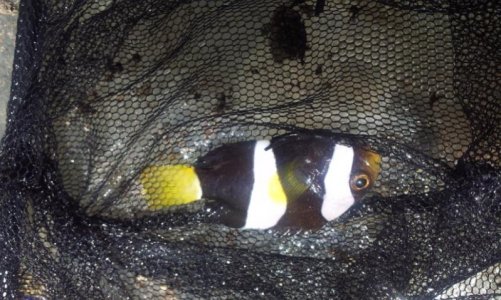
It doesn't explain the white things on the glass or the anemones dying, but your fish might be dying due to disease. Do you QT? Velvet, Ich are possibilities; Clownfish are particularly prone to a parasite called Brooklynella. Read here for a description of symptoms.
 
One more just died right before my eyes. I have 1 clown left. It looks fine ATM no labored breathing like the others. I was thinking that it couldn't be either because they have no spots on them, no slime, no fin rot until a while after they die I'm guessing because I've been finding them in the morning. But it has only been the clowns that have died besides one angel. Any suggestions?
 
I think it may be contaminated by my own fault. I realized that my daughter likes to put things in the water. I just found a fly, some to KS from outside and a leaf in the water. Also I don't always wash my hands before I go in there and I know that my daughter sticks her hands in there quite often. She is 2 years old so as you can imagine her hands are not very clean lol. But could this be my problem? I'm just having difficulty understanding why I am just now having a tank wipeout from some of these things that have been going on for so long.
 
Contamination could be a real possibility by what you are saying ...
Could have just been that one thing you didn't see your daughter put in that did it
 
Contamination could be a real possibility by what you are saying ...
Could have just been that one thing you didn't see your daughter put in that did it

Or daughter could have put something in the tank itself.....

To the OP: Are any of your corals affected?
 
I have found cereal among other things in the tank. What I find strange is that I still have a condylactus anemone left. It must be something bacterial or of the sort that is only affecting the fish. I still have 2 Molly Miller blennies left and 2 firefish gobies. The only fish that have died in the tank are clowns and one angel which was a new fish.
 
Not really on topic, but more than 2 clowns, of the same or different species, should never be kept together. They're fine when juvis, that's why the LFS as a tank full of them. But when the sexually mature and form bonded pairs, they will not tolerate other clowns in the same tank. Clowns are as territorial as any fish we commonly keep and will be relentless in attacking any other clown. The biggest clown will be the dominate fish and literally any competitors. Of course, there are occasional exceptions, but they are very rare
 
What specifically are your water parameters? Sg, ammonia, etc? It sounds more like a water quality issue than a disease issue tbh.
 
From the picture, they look like copepods & isopods to me. Both are harmless.

As for everything else, what size is this tank?
Often, one thing dying can cause a chain reaction in the water chemistry that causes other things to die. Your first anemone dying could've raised ammonia, which if not dealt with would start to kill other organisms.
 
I had 2 api test tubes they came out 0 ammonia 0 nitrites 0 nitrates ph is perfect I didn't ask what it was I know I should but II usually just take their word for it the salinity is normally 22 but when they tested it they said it was high. I didn't even ask what it was because I was in such shock that it was high. I went home and checked it and my hydrometer said it was 18 so I was like maybe it's broken? I added a couple gallons of fresh water and checked it again. It still said 18 so I was confused. I left it for a few days. The rest of my fish died. I went back they checked it again. Everything is still perfect. The hydrometer was not broken it really was at 18. I am so embarrassed that I just left the salinity so low and I believe that may be why the rest of the fish died. They had a lot to say to me about that and made me feel horrible, but the salinity is always 22. I check it almost every day. So now they think that is why my other fish die but I do not agree. I thought at first it may have been the anemone dying but I had checked the params shortly after and there was never any ammonia spike in the tank. I do think the white things were pods now but most of them are gone. I was thinking it was some parasite that I couldn't see, but I couldn't figure it out and now it is too late. I thought maybe I would let the tank sit for a few weeks before i put any new fish in it in case it was a parasite in hopes that it would die off. Any suggestions?
 
What specifically are your water parameters? Sg, ammonia, etc? It sounds more like a water quality issue than a disease issue tbh.

I'm certainly not an expert by any means, but I don't really think it is water quality because there is another anemone in the tank and all of the other inhabitants are still alive and well. The only things that died were fish. At first just the clowns, but after the last water change and the salinity was low the rest of the fish died. So maybe toward the end it was the low salinity, but I would've thought that it would've effected the nem more than anything else.
 
Back
Top