Unsure of fish disease, Please advise

DolphinzFan

New member
Please advise. Thanks.

1. How old is this aquarium? Transfered 93 gal tank to 180 tank added base rock. 180 is @2 months old. 93 was 7 months old.

2. If less than six months old, what is ammonia level? levels are zero

3. What is SG of this aquarium? How measured? Current is 1.025, use refractometer.

4. When was the last fish added to this aquarium? 2 weeks ago.

5. Was it quarantined? If so, how? And how long? Was it prophylactically treated? How? Was not QT (my mistake, lesson learned)

6. If you are using a copper based medication, which one? How often do you measure level? When? Not used

7. If you are using hyposalinity, how did you calibrate your refractometer? This method I would like to try. refract has been calibrated with LFS, use specific water.

8. Please describe in detail, the appearance of the fish? If there is one or more pimples, are they lumpy? What color? This is where I don't know how to start.
1st fish that died had white spots on it's body, fins, and seemed like eyes. This fish also had what I thought was fungus infection. As it had what I would call a film (cotton like) and look like was shedding it. It was a gold rimmed tang. Also had a Ebbli die and blothed Anthias. These fish seemed as if nothing was wrong that I could see.

Current fish - Several have white spots on them (fins, and some body). I will list each fish in tank and what it looks like.

a. Coral beauty: Color is fine. Has some spots on fins. Still eating. Seems to pick at other fish that has more white spots on them.

b. - B&W clown - For the most part seems fine. But body seems I would call cloudy, best I can describe. Still eating fine. Has been in host anemone less often than normal.

c. - Snowflake clown - Also seems fine. Noticed a few spots on it today.

d. - 2 - Diamond Gobies - Seem fine as well. Nothing that I can spot at all.

e. - Royal gramma - Some white spots on fins, and body. Eats normal.

f. Bi-color blenny - Seems fine also.

g. Blue Chromis - Spots on fins and some body.

h. - Yellow Tang - Spots on fins and body. Just developed this morning. Some like small pimples. Tends to be by cleaner shrimp like it wants to be cleaned. And like itches itself in the sand.

i. Blue hippo tang - White spots on fins, body, and eyes. Color seems fine. Moving about very spastic at times. Also by cleaner shrimp. And rubbing in sand like itching.

j. Copperband butterfly - Spots on fins and body. One eye is like hazed over.

k. Blonde Naso tang - Some spots on body and eyes. Does not swim like he used to. Stays in front of MP10 almost all the time except when eating.

l. lawnmower blenny - Acting crazy is all I can say. Don't see spots on him, but is always acting like itching. And moving around spastic. Also is nipping on all other fish that have spots.

9. Please describe the behavior of the fish as best you can. Is it acting reclusive? Is it always up towards the top of the aquarium? Is it avoiding light? How active is the fish? See above. Best I could describe.

10. Is the fish eating? What? All fish are eating normal. I feed them Rod's original, and herbivore.

I have went this long because I trusted my local fish guy. I have been treating the tank with Bactershield, and Parashield as per LFS. Medicating as per directions.

Please advise what is my best steps moving forward if possible.

I do not have a QT tank, but have a 40B tank that is clean and ready to be used. With MP10 ready, heaters, and filters.

I am new to the hobby and have tried to learn what I can as much as I can. This is the first time I have had any problems at all.

Here is my test that I did yesterday.

Sal:1.025
PH: 8.19
Nitrates: 10
Nitrites: 0 (never above since cycle)
Ammonia: 0 (same as above)
Cal: 408
Alk: 8
Mag: 1280

Temp: 78.9 (kept at 79 or below, until recent meds then to 80)

Only issue I have had was a week ago the sump water was low, and cause temp probe to be out of water spiking temps to 83.

Any more info I can provide I will. I would also be willing to talk with someone if that would help better describe info above. PM me if able.

Thanks for your help, and please forgive me for my mistakes as I'm still trying to learn.
 
Is there any reason that you don't think this is classic "ich" AKA white spot?

I do believe this is the case, but new to the hobby I'm unsure. And want to treat properly and not make even more mistakes as I already have.

The part that baffles me is some fish don't have "ICH" but have I would call a cloudy body. Like a film on them.

And if ICH I want to do the right thing as I'm sure it's prolly to late or near. And don't know to treat my DT tank ot set up a QT. And what to do to my DT if I QT all my fish.


Please forgive my stupidity.
 
You're not being stupid (and sorry if my post came across that way - it was meant as a genuine question) there's a chance that the "cloudiness" you have described could mean that it's not classic ich but possible actually Velvet Disease.

http://saltaquarium.about.com/od/ichparasiticdiseases/a/aaich_oodinium.htm

This link outlines the symptoms and has links for more info etc. If you do think it might be velvet then quick treatment is needed before it becomes fatal. If it seems more like classic ich (you'll fin links to all ich types on there somewhere) it can usually be left to resolve itself.
 
You didn't come across that way. That's just myself. I read about velvet and it seems that it is not velvet. The reason I say this is only because that velvet turns tan or brownish and I have not seen anything like that.
 
Velvet can also be white-ish in it's early stages. Hopefully it's not because that would be much worse than a classic ich.

Could you post a picture?
 
Velvet can also be white-ish in it's early stages. Hopefully it's not because that would be much worse than a classic ich.

Could you post a picture?

I will try to post a pic. of one of them. The blue chromis is prolly the worse or yellow tang.
 
It could be a lot of things. If it appears to be a sprinkling of salt it is likely to be ich (cryptocaryon irritans), but if it is more like a film or "smudgey", it is something else. Got any pictures? Any peeling skin on any fish?
 
If you struggle to get a picture then there are a few things you can check for yourself.

Are the gills clear of spots?
Are the fish breathing normally or rapidly?
Do this cloudy fish look like they have a film coating on them, or like they have become discoloured?

Both of those fish types are prone to skin parasites so it's not too surprising they are the worst.
 
I can not seem to get a good picture. This is what it looks like on my fish, but not as many spots. And same spots on fins and some have on their eyes.
 

Attachments

  • ich.jpg
    ich.jpg
    16.8 KB · Views: 7
It could be a lot of things. If it appears to be a sprinkling of salt it is likely to be ich (cryptocaryon irritans), but if it is more like a film or "smudgey", it is something else. Got any pictures? Any peeling skin on any fish?


The gold rimmed tang that died had the peeling. None of the others look like him. As pic above most all look like this except there are far less spots on them. And as you described it looks like the sprinkling of salt. None of the fish have it near as bad as the pic I posted.

The Naso, and clown seem to have like a haze on them somewhat like a cotton haze. Best I can describe. Haze is over one of the eyes on the naso. And the copperband eye is almost hazed over. There does to appear a film on the naso ,and clown.

I will continue to try and catch them but It's going to even more stress them.

Thanks.
 
Personally I would be inclined to say crypto/classic white spot from what you have described but I have never seen ich been on the eyes (perhaps Snorvich knows more). So I'm not too sure really.

Crypto can cause colour "fading" so to speak, which could explain why your Clown looks cloudy. But with the eyes, I have only ever known of them to become cloudy, not to get spots on them.
 
The gold rimmed tang that died had the peeling. None of the others look like him. As pic above most all look like this except there are far less spots on them. And as you described it looks like the sprinkling of salt. None of the fish have it near as bad as the pic I posted.

The Naso, and clown seem to have like a haze on them somewhat like a cotton haze. Best I can describe. Haze is over one of the eyes on the naso. And the copperband eye is almost hazed over. There does to appear a film on the naso ,and clown.

I will continue to try and catch them but It's going to even more stress them.

Thanks.

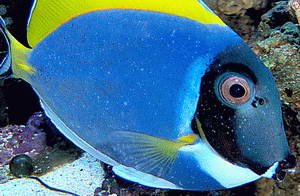
Peeling is symptomatic of brook and uronema. A haze over all the body is consistent with velvet. Based on the timeline, it is not likely to be ich since ich is a progressive parasite that eventually overwhelms rather than immediately kills like the three mentioned above. I will go get the description of treating brook/uronema. The powder blue picture does look like ich.
 
Brooklynella hostilis and Uronema marinum

Introduction
Brooklynella hostilis (Brook) and the less common, and often misidentified, Uronema marinum (Uronema) are both ciliate parasites similar to oodinium and Cryptocaryon irritans that infect the skin of many species of marine fish. Brook is often referred to as “clown fish disease” but while clown fish are highly susceptible, other fish can catch it as well. In recent years, Uronema has been commonly brought in with Chromis.

In both Brook and Uronema infections, acute symptoms can appear very rapidly and fish can go from being very healthy to near death in a few hours. Unless treated quickly, fish are more likely to die than to recover.

The life cycle of both parasites is similar to that of Velvet and Ich as described in other stickies. Both of these parasites have a direct life cycle: they live on the fish, feeding and the population growing very rapidly, then drop off into the water column (where they can live quite happily for some time) and then go on to infect another fish.

Symptoms and Diagnosis

Fish with either Brook or Uronema lose color very rapidly, appearing pale and “washed out”. Often there is thickening of the skin’s mucus; so much so that the fish appears to have a rough white coating . Fins may be frayed and the skin may evidence pealing. Often the scales are loosened in the infected area and may come away from the fish when it is caught in a net. The major difference between Brook and Uronema is that the lesions associated with Uronema marinum have a more defined margin between the thickened mucus and normal skin that is often red and inflamed. However, the symptoms and treatments are so similar that accurate diagnosis is not required for successful treatment.

Behavior of the fish toward the end of life includes rapid breathing, no feeding and the fish becomes listless, hanging near the surface or sitting on the bottom of the aquarium. If the fish are examined carefully during the end stages they often look thin and the skin appears to be stretched tightly over the muscle blocks. This is because the fish has lost water through the lesions caused by the parasite as it feeds on the skin, and the animals have become acutely dehydrated.
It is quite difficult to misdiagnose these infections; the most frequent disease that it can be mistaken for is marine velvet (Amyloodinium ocellatum). However, fish with marine velvet do not develop such a severe mucus layer nor do the fins become brittle. Also marine velvet tends to be a sort of pale gold color unlike the white lesions of Brook and Uronema.

Prevention
1. Do not share equipment between tanks (good practice in any case)
2. Quarantine your fish AND invertebrates

Quarantine your fish AND invertebrates
Foregoing quarantine is the most common way that parasites get into a system. Fish with a low level of infection or water from an invertebrate system that has infected fish in it are the major sources of bringing this parasite into a reef tank. Quarantine period is critical. It has been calculated with a 50% safety value that to be 95% certain that any fish is marine white spot free then the quarantine period should be 71 days (just over 10 weeks), for 99% certainty increase the period to 84 days. Quarantine period and fallow requirements are described in more detail in one of the stickies in this group of marine fish disease descriptions. However, a confidence interval of 90% is achieved at 6 weeks and for many reef keepers 6 weeks plus a prophylactic treatment is considered a gold standard. Why quarantine my invertebrates? Well you can introduce trophonts, theronts or tomonts either with the water or on living rock or a coral’s skeleton. As such anything that is wet should ideally be quarantined, most especially if it came from any system containing fish.

Treatments
Environmental Treatments
Freshwater dip


In freshwater the parasite drops off the skin of the fish very rapidly. However, not all parasites drop off so while this improves the situation it does not correct it completely. If the fish are simply returned to the tank where the outbreak occurred then they will just become re-infected. For this treatment to be effective the fish should be kept in a quarantine tank and the main display tank kept fish free for 8 to 12 weeks. Once in the quarantine tank the treatment should be repeated on days 1, 2, 3, 5, 7 & 11 followed by 4 to 6 weeks of observation in a quarantine tank.

As these parasites breach the skin as they feed on the fish the skins integument is broken and the fish’s osmoregulatory potential is hugely reduced. This is exacerbated in freshwater so remember that a heavily infected fish could easily become physiologically stressed with this treatment method, ironically due to dehydration!

One of the most important things about a freshwater dip is that it will buy you some time to start another treatment or to set up a quarantine tank as even a very badly infected fish can lose most although not all, of its parasite in a few minutes and improve quite dramatically.

To carry out a freshwater dip:
1. Take some freshwater (RO is best) and heat it up to the same temperature as the tank
2. Adjust the pH of the freshwater to match the tank using a commercial pH buffer.
3. Catch the fish and pop it into the freshwater bath, watch the fish carefully and be prepared to remove it if it becomes very distressed. Normally 3 minutes in a freshwater bath will dislodge most parasites; this can be extended to five minutes.
4. Catch the fish and put it back into the tank. Do not pour the freshwater back in the tank as this may introduce the parasites back into the display tank.

Chemical Treatments - Formalin

While formalin is toxic, carcinogenic and an irritant, it is, however, one of the best treatments for Brooklynella hostilis and Uronema marinum. It can be purchased readily from your chemist and some off-the-shelf cures contain it or a related chemical (paraformaldehyde or gluteraldehyde) so a read of the labels or data sheets of some products is essential if you want to use it.

The best way to use this chemical for Brooklynella hostilis and Uronema marinum is as a formalin dip followed by a long term formalin bath (see environmental treatments).

To use it as a short dip in seawater, make up a bath in seawater at 200 to 250ppm for 1 hour. The dip component of this treatment regime should be carried out on days 1, 2, 3, 5, 7 & 11 after each dip the fish should be returned to a quarantine tank to which formalin has been added (see below).

For the long term bath component of this treatment, add 25ppm of formalin to your quarantine tank (it’s toxic to some invertebrates and algae, including most coralline algae species, so cannot be used in a reef situation)

Remember liquid formalin (which is how you will get it from the chemists) is 37 to 40% formaldehyde and you want 25ppm so you need to add 0.0625ml formalin per liter rather than 0.02ml to get the correct dose.

As this chemical is very toxic it is recommend that appropriate protective clothing is worn such as gloves and safety glasses and use it in a well ventilated place.

Acriflavin
In my opinion, Acriflavin is one of the most under-used treatments available to marine fish keepers. It has a broad range of effect, being effective against protozoans, bacterial infections and external fungal diseases. It is as “reef safe” as any other “reef safe” treatment and is easily obtained. It can be bought in several formulations from the LFS but make sure it isn’t combined with malachite green or methylene blue which have toxicity issues in marine systems.

It is effective at a concentration of 6 ppm against many ciliates (Paperna, 1984) and this dose should be added to the aquarium on days 1, 2, 3, 5, 7, & 11. Your skimmer should be turned off and any activated charcoal removed. It dyes the water a greenish yellow color but after treatment turning your skimmer back on and adding activated charcoal helps remove the coloration (and do water changes).

Prescription Medicines
Flagyl (metronidazole) is by far the most effective drug available against these diseases. Indeed it is the only effective treatment for fish that are internally infected with Uronema marinum, but it has to be administered in the diet. To treat with Flagyl (metronidazole), add 34mg/l (34mg/kg bodyweight is required if treating the internal disease) of the drug to the aquarium water to be treated. A single dose should be effective, but it can be repeated daily, if required, as the drug is well tolerated by most fish. It is a very reef safe drug having little impact on invertebrates BUT it will kill off all protozoans and anaerobic bacteria in the treated tank, so, like all medications that are used in a reef tank, it will have some undesired effects on the ecological stability of the tank.

Conclusion

If you suspect Brooklynella hostilis or Uronema marinum then immediate action is require as these diseases progress so fast any delay can lead to losses. However, if prompt action is taken these are relatively easy parasitic infections to treat and you should be able to avoid losses. I cannot recommend enough the importance of quarantine in preventing this disease entering you reef tank.
 
Here is a pic of haus (Naso).

As you can see the haze over his eye. He don't really have the ICH spots except on his face.

I have more pics coming you can see on Hippo tang better.

DSCN0024_zpsdd78fe2c.jpg
 
From the picture of the naso, I would say you have brook or uronema almost certainly. I provided the information above for treatment. But it is possible you have more than one problem.
 
Velvet can also be white-ish in it's early stages. Hopefully it's not because that would be much worse than a classic ich.

Could you post a picture?

Yes, it can be white-ish and many would describe it as a fish looks pale. The naso picture above definitely looks like brook or uronema, the timeline of the fish that died is not consistent with ich, but more like brook or uronema, especially with the skin peeling. (which is actually from dehydration)
 
Back
Top