Uronema marinum

JohnnyB in SD

New member
I have some inverts that were exposed to Uronema marinum: Euphyllia ancora - Hammer coral, Duncanopsammia axifuga - Duncan, couple ricordias. The information I have seen indicates that the parasite can continue to live off bacteria on their mountings.
They are in a 20gl QT with a cleaner shrimp.
Have done a couple transfers between sterilized QTs.
Put a couple Chromis in with them to see if the parasite showed signs of activity. Chromis only made it 48-72 hours, but didn't seem to die from the parasite, suspect they were just weak from a not so great LFS.

Would like to eventually get the inverts into my main system, but must ensure they are not carrying the parasite with them. At this point, I plan to continue sterilized transfers and keep my eyes open for some quality Chromis to test again.
Any other ideas or suggestions?
THANKS
 
Inverts can not be cured of this disease and they will always have the potential for hosting the disease and if given the chance will infect a vertebrate. Their host of choice is chromis and some have kept other species without being affected. However there's always a risk the disease will attack any fish.
 
Frankly, I think the risk is pretty low. Uronema marinum is a free-living parasite, and does not have a complex life cycle like Cryptocaryon or Amyloodinium. It reproduces via binary fission and can't really be "hosted" by invertebrates per se. If you have the equipment, you can do a scrape of the coral skeleton and wet mount it for examination with a microscope. Uronema are fairly large and should be easily seen if present.

If you're really concerned about it, then the only real option is to keep the corals in a dedicated aquarium and never introduce fish. But again, I think the risk is low. I would likely just do a couple of dips in fresh SW to "rinse" the corals and maybe a dip in CoralRX for good measure.
 
Uronema is not really a parasite but rather a scavenger that normally feeds on detritus, leftover food or dead tissue. The last point is how it usually infects fish, which in general means a fish needs to have some tissue damage in the first place, usually paired with a compromised immune system.
You can have uronema in your tank and never get an outbreak as long as you keep your fish fit and healthy.
 
Stickies

Stickies

Yes, I have read Snorvich's information repeatedly, and consider it the most sensible I have come across.
It seems that Flagyl may be a possible treatment:
Prescription Medicines
Flagyl (metronidazole) is by far the most effective drug available against these diseases. Indeed it is the only effective treatment for fish that are internally infected with Uronema marinum, but it has to be administered in the diet. To treat with Flagyl (metronidazole), add 34mg/l (34mg/kg bodyweight is required if treating the internal disease) of the drug to the aquarium water to be treated. A single dose should be effective, but it can be repeated daily, if required, as the drug is well tolerated by most fish. It is a very reef safe drug having little impact on invertebrates BUT it will kill off all protozoans and anaerobic bacteria in the treated tank, so, like all medications that are used in a reef tank, it will have some undesired effects on the ecological stability of the tank.

Where would you suggest I try to obtain some of this from?
Has anyone actually tried it on LPS, able to report the results?
 
Frankly, I think the risk is pretty low. Uronema marinum is a free-living parasite, and does not have a complex life cycle like Cryptocaryon or Amyloodinium. It reproduces via binary fission and can't really be "hosted" by invertebrates per se. If you have the equipment, you can do a scrape of the coral skeleton and wet mount it for examination with a microscope. Uronema are fairly large and should be easily seen if present.

If you're really concerned about it, then the only real option is to keep the corals in a dedicated aquarium and never introduce fish. But again, I think the risk is low. I would likely just do a couple of dips in fresh SW to "rinse" the corals and maybe a dip in CoralRX for good measure.

To me, the risk of this parasite in my main 240gl system would be enough to drive me out of this hobby if it happened. I have seen what it does to apparently healthy fish in a QT, and it kills faster than anything I've ever come across. There is no way I would rebuild after loosing ALL my potentially infected livestock that I've collected over many years, and nuke absolutely everything down to ground zero with bleach, acid, etc.

I like the idea of examination with microscope to ensure any treatment is effective. I'm thinking use some rock with (something?) to attract the buggers. Or perhaps another Chromis. But I have a sense that they don't do well unless they're in a group?
 
Yeah, that has been my experience. Thankfully, they are inexpensive.
Would you say Flagyl is my best course of action?
 
Last edited:
Canaries in a Coal Mine

Canaries in a Coal Mine

I thought I would give an update, in case someone else runs across a similar situation.
I took all the livestock and placed them into 5 gallons new seawater with 2 measures of Metroplex. The shrimp was looking sketchy, so I stopped at 2 hrs.
In the meantime, I sterilized their 20gl QT and all equipment with bleach, and refilled it with new seawater.
After moving the livestock back to their QT, they returned to normal appearance quick enough. The shrimp was very lethargic at first and I thought he'd be a goner, but recovered after an hour or so. The corals were mostly closed up from the agitation of being handled and lighting changes. There was also an xlarge Nassarius Snail, which showed no negative effects.
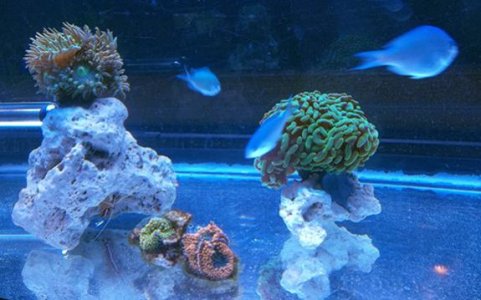
I went out and picked up 3 Chromis, freshwater dipped them for 3 minutes, and dropped them into the QT. They have been in there for 5 days now, are eating like piranhas, and looking as good as any Chromis I've ever had. Previously, most fish have died within 3 days of being exposed to the Uronema. Aside from watching them for signs of infestation, I'm not sure what else to do to ensure that it has been eradicated.
The main point of stating all this is to illustrate that Metro appears to be effective against uronema marinum and is safe for inverts, based on what I have observed. However, because of the limited scope of this experience, I can't recommend using it at a high concentration for an extended length of time in a valued reef display, unless you observe carefully and have somewhere to quickly move distressed animals to if need be.
 

Attachments

  • Canaries ina Coal Mine.jpg
    Canaries ina Coal Mine.jpg
    37.7 KB · Views: 6
Uronema is not really a parasite but rather a scavenger that normally feeds on detritus, leftover food or dead tissue. The last point is how it usually infects fish, which in general means a fish needs to have some tissue damage in the first place, usually paired with a compromised immune system.
You can have uronema in your tank and never get an outbreak as long as you keep your fish fit and healthy.

This is correct. Uronema is an opportunistic pathogen. It is probably ubiquitous in most aquariums.
 
Chromis over time whittle down their numbers to one or possibly two.

This is a very general statement. I have had 7 chromis in my system for a good few months now with no agression at all. I have also had groups of chromis in the past which have displayed the behaviour of whittling themselves down to one. It definitely isn't always the case though. The difference for me this time is that I have Anthias which the Chromis shoal with and I feed heavily.
Chromis IMO are one of the most under rated fish for a reef tank, they make a beautiful addition as a school, especially when shoaling with other fish.
 
This is a very general statement. I have had 7 chromis in my system for a good few months now with no agression at all. I have also had groups of chromis in the past which have displayed the behaviour of whittling themselves down to one. It definitely isn't always the case though. The difference for me this time is that I have Anthias which the Chromis shoal with and I feed heavily.
Chromis IMO are one of the most under rated fish for a reef tank, they make a beautiful addition as a school, especially when shoaling with other fish.

Give it two years.
 
I agree that it is a generalization. I take care of a 450 gallon tank in the lobby of Central Garden & Pet that has had 8 Chromis viridis in it for 8 years now. They can coexist in larger tanks if they're fed frequently and have a lot of hiding spaces.
 
I agree that it is a generalization. I take care of a 450 gallon tank in the lobby of Central Garden & Pet that has had 8 Chromis viridis in it for 8 years now. They can coexist in larger tanks if they're fed frequently and have a lot of hiding spaces.

Yes, I agree. Larger tanks work (for chromis and anthias) but tank size is relevant.
 
Back
Top