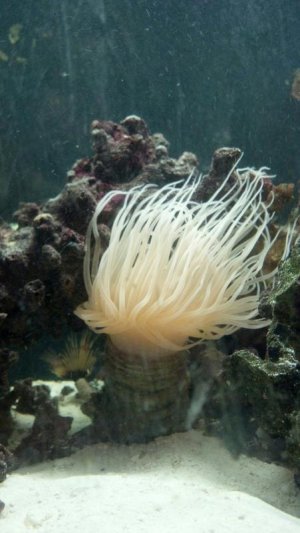
what anemone do I have and im intrested in getting a bubble tip

nlehe12

New member
I have acquired this anemone and I was told its a long tentacle, how ever I think it is not. it eats my fish!! I have to feed him krill. I am wanting a bubble tip so my clown fish can host in it and it wont eat my other fish(I am hoping?) Can anyone tell me what kind it is and will a bubble tip be easier/ what I think I am wanting please help!!

 

Attachments

  • anemone.jpg
    anemone.jpg
    49.8 KB · Views: 2
That is not a "long tentacle" anemone (Macrodactyla sp.), that is a tube anemone (Cerianthus sp.), and it is a non-photosynthetic carnivore, hence the disappearance of your fish. If you do not want to loss any more fish, I would suggest possibly returning it to the LFS that sold it to you as a LTA.
 
A tube anemone cam be vey nice in the right tank. But they require deep sand beds (10cm or more) and relatively low current. They don't need any light at all.
And yes, they eat whatever is careless enough to get too close to their tentacles.

As a beginner in the late 70s I had several of these (those days they were the only anemones - besides Actinia species - you could keep alive over extended time).
One day I added a pair of ocellaris to the tank, thinking they would be careful enough to stay clear of it - I was wrong! The male was so exited about seeing an anemone that he swam straight in - and got killed and eaten before I even had a chance to intervene.

They are better kept only with very large fish or in a special tank by themselves. You may add feather worms and other invertebrates like starfish, sea urchins or sea cucumber that will stay away from the tentacles due to their way of life.

A reef tank is the wrong place for them.
 
Entacmaea quadricolor (BTA) can and likely will move around until it finds a spot it likes. All too often that isn't a spot you like. Mine has decided that it likes a place behind the rocks at the backside of my tank and settled down there.
They usually do need a good amount of light but the details on spectrum and intensity depend very much on the actual specimen and where it comes from.

Cerianthus (what you have now) are pretty much sessile, very much like soft tube feather worms. They usually live on sandy or muddy grounds in a tube they build with their secretions and rubble and debris that it contacts.
If you put it in a place with enough gentle flow, not too much light (they are more night active so just one actinic blue tube should be fine) and deep enough sand they will stay put. If they don't like it and leave their tube it becomes problematic as they will perish without their tube. What can help in that case is to put them in a piece of PVC tubing (make sure to remove any burrs on the edges) that matches their old tube in diameter.
 
Back
Top