What to do, Brooklynella???

ryddo

Member
I have a 265 gallon aquarium with 3 yellow tangs, 1 six line wrasse and now 1 clownfish. The current tank setup has been running for about 6 months, ph 8.0-8.1, temp 79. Going to check ammonia, trate and trite this morning.

Here is what happened. Last week I noticed the clowns looked like they had ich, small salt like specs all over their body. I immediately went to the store and purchased a quarantine tank, filter and heater. I then began reading about the tank transfer method which caused me pause for a day and not setup the qt. I had planned on purchasing 2 - 10 gallon aquarium setups for the ttm the next day but when I looked in the tank the next morning the illness seemed to have disappeared. Now I started questioning if I actually saw ich at all. So about 6 days have gone by with no signs of any infection and I wake up today to both clowns looking like crap! White slime on their body and the female is definitely going to die today. She is swimming upside down and not looking good at all, picture attached.
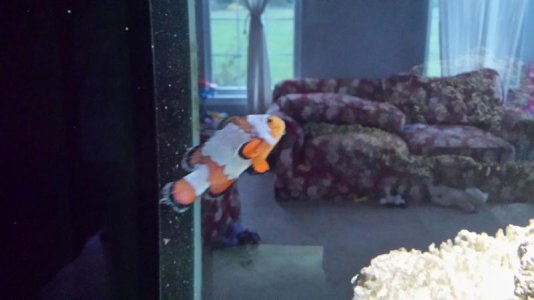
sick fish.jpg

After coming back in from the bus stop with the kids the fish was dead. So from the time I noticed the fish appeared to have brook this time to the time she died was about 45 minutes.

So what I need to know is:

1 - I assume this is brook, can this be verified from the picture?

2 - I have another clown in the tank that I am going to fw dip and formalin dip. I assume the ttm is not a good option for this situation?

3 - Will the yellow tangs or wrasse be infected? I am planning on putting them in qt just want to know if they should be dipped before putting in qt?

4 - And finally, how do I get this out of my aquarium? Is the fallow method the best option here?

Please, I need help!

Thanks,
Ryan
 
1 - I assume this is brook, can this be verified from the picture?
The clown does indeed look like it was infected with brook

2 - I have another clown in the tank that I am going to fw dip and formalin dip. I assume the ttm is not a good option for this situation?
You will have to formalin dip him and would recommend using ttm as each time you do a formalin bath, the fish should be in clean unaffected water.

3 - Will the yellow tangs or wrasse be infected? I am planning on putting them in qt just want to know if they should be dipped before putting in qt?
all fish that were in the same tank with the clowns are also infected with brook and should be formalin dipped as well. They should also be moved into clean unaffected water after each formalin bath (ttm)

4 - And finally, how do I get this out of my aquarium? Is the fallow method the best option here?
Many people have different opinions on whether to let it sit through a fallow period or to just break down the tank and start over. From what I was told 6-8 weeks of having no fish in the DT should be enough.

Please, I need help!

Thanks,
Ryan[/QUOTE]
 
If it is brook which it looks like it is, a fallow period will not get rid of it, this is my experience but i have also found other threads stating the same fact.
 
If it is brook which it looks like it is, a fallow period will not get rid of it, this is my experience but i have also found other threads stating the same fact.

Uronema does not respond to a fallow period as it does not have an obligate fish host. Brook and Uronema are similar in appearance. If it is a clownfish, the odds are with brook. If chromis are involved, the odds favor uronema marinum.
 
To my knowledge Brook will be gone after a fallow period of 6 weeks.
The best treatment for brook are formalin baths, best accompanied by tank transfers (following the TTM protocol) to prevent reinfection. When executed like that you will also rid your fish of (possibly present) ich and likely also even latent velvet or uronema infections.
The "official" recommendation is to do daily dips and transfers but in my experience following the 3 day rhythm of TTM is usually sufficient and less stressful to the fish.
In several cases I got brook killed off with just one bath and transfer.

Infection of other fish can happen through the water but the most common distribution is through direct or indirect physical contact.
 
To my knowledge Brook will be gone after a fallow period of 6 weeks.
The best treatment for brook are formalin baths, best accompanied by tank transfers (following the TTM protocol) to prevent reinfection. When executed like that you will also rid your fish of (possibly present) ich and likely also even latent velvet or uronema infections.
The "official" recommendation is to do daily dips and transfers but in my experience following the 3 day rhythm of TTM is usually sufficient and less stressful to the fish.
In several cases I got brook killed off with just one bath and transfer.

Infection of other fish can happen through the water but the most common distribution is through direct or indirect physical contact.

What he said. Brook fallow period is six weeks.
 
Thank you all for your information. My plan is to do the formalin dips and qt all fish. I will allow the fallow period to be no less then 6 weeks. Again, thanks for the help!!
 
BTW: At this point I put all my new fish, and especially clownfish, through a 45 to 50 minute formalin bath (20 drops Formalin 37% per gallon) before they even go into a QT.

One of the few fish that died on me, likely of a gill infection, was a tiny regal angel that I didn't dip due to its size of just about 30 mm. I think that had I dipped him he might still be around.
 
Not to hijack the thread but how many baths does it take to get rid of brook. I did incoming bath and all looked ok after treatment. Had flame angel with chloroquine and TTM. Up to three transfers . Took angel out of TTM and DIDNT complete chloroquine for 21 days. Angel had not been eating. So I was going to resume further treatments later to see if he would eat . Put him in a tank with sand and rock. Still not eating . Turning into current and breathing harder. So I pulled him back out into bare tank , added chloroquine, with 2 drops of quick cure to the gallon. . Frustrated . Frustrated. Will go thru TTM one more time with him with chloroquine and two quick cure dips in between. . I just hope he eats otherwise he will be skinny as anything or too weak to survive coming out of treatment
 
BTW: At this point I put all my new fish, and especially clownfish, through a 45 to 50 minute formalin bath (20 drops Formalin 37% per gallon) before they even go into a QT.

What do you use to administer the drops? How many ml is it per gallon?
 
What do you use to administer the drops? How many ml is it per gallon?

People often use 20 drops as a rough equivalent of 1ml. I recommend to get a real syringe so your treatment is using an accurate dosage. If you are an Amazon Prime user, $9 gets you 100 1 ml syringes, same day delivery(for me at least) - http://www.amazon.com/slip-tip-disposable-syringe-without-needle/dp/B007ZDHYTK/ref=sr_1_1?ie=UTF8&qid=1446140133&sr=8-1&keywords=1+ML+TB+slip-tip+disposable+syringe+MVI+100%2Fbx
 
I use a syringe but just count drops. One drop more usually doesn't do any harm as the recommended dosage on the Formalin MS bottle I go by is rather on the low end.
 
Not to hijack the thread but how many baths does it take to get rid of brook. I did incoming bath and all looked ok after treatment. Had flame angel with chloroquine and TTM. Up to three transfers . Took angel out of TTM and DIDNT complete chloroquine for 21 days. Angel had not been eating. So I was going to resume further treatments later to see if he would eat . Put him in a tank with sand and rock. Still not eating . Turning into current and breathing harder. So I pulled him back out into bare tank , added chloroquine, with 2 drops of quick cure to the gallon. . Frustrated . Frustrated. Will go thru TTM one more time with him with chloroquine and two quick cure dips in between. . I just hope he eats otherwise he will be skinny as anything or too weak to survive coming out of treatment

I have treated full blown brook on a clownfish successfully with just one formalin bath and transfer to a clean tank.

A flame angel not eating is a bit concerning as they are usually not problematic in that regard. High breathing frequency, lethargy and refusing food while not showing the typical brook symptoms (clamping fins and whitish patches on the skin) could rather point to velvet.
 
I have treated full blown brook on a clownfish successfully with just one formalin bath and transfer to a clean tank.

A flame angel not eating is a bit concerning as they are usually not problematic in that regard. High breathing frequency, lethargy and refusing food while not showing the typical brook symptoms (clamping fins and whitish patches on the skin) could rather point to velvet.

Yes it is an issue with the flame. Tried to give live mussel for him to pick on. Yet nothing . I assume it's the chloroquine causing the majority of the refusal. It also maybe due to bare tank with minimal decor. It seemed like brook to begin with but difficult to rule out velvet also due to the breathing and facing into the current. So I am treating for all 3 . Velvet, brook, and ick . Hoping to complete the treatment with him eating afterwards . Will try garlic soaked mysis next and also live brine. . One thing I am really thinking of is the report that snorvich showed as chloroquine being bound to glass. I will do a 50% water change and redose chloroquine tomorrow.
 
Back
Top