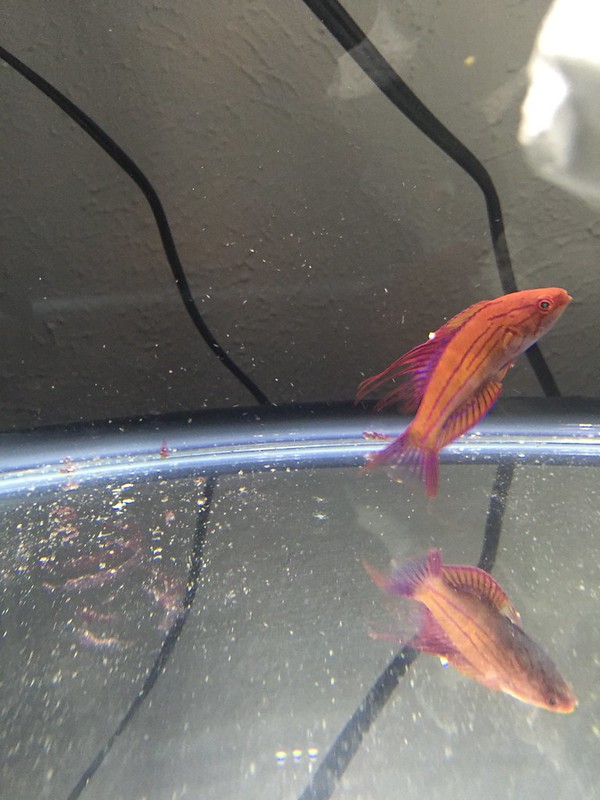
White spot on dorsal fin

texdoc77

New member
Received my new filamentous flasher from DD yesterday and noted that it had a small white spot on the dorsal fin. Wasn't sure but today it looks slightly bigger. Thought he was DOA when I received him yesterday, but eventually her perked up once I got him in my QT. I have reviewed c. irritans along with lymphocystis and it looks like it could be either. For further info he is not swimming well, looks like his tail is weighing him down (this could be normal I have never had a wrasse before) but he is eating.

I have added some pix, any thought would be greatly appreciated:
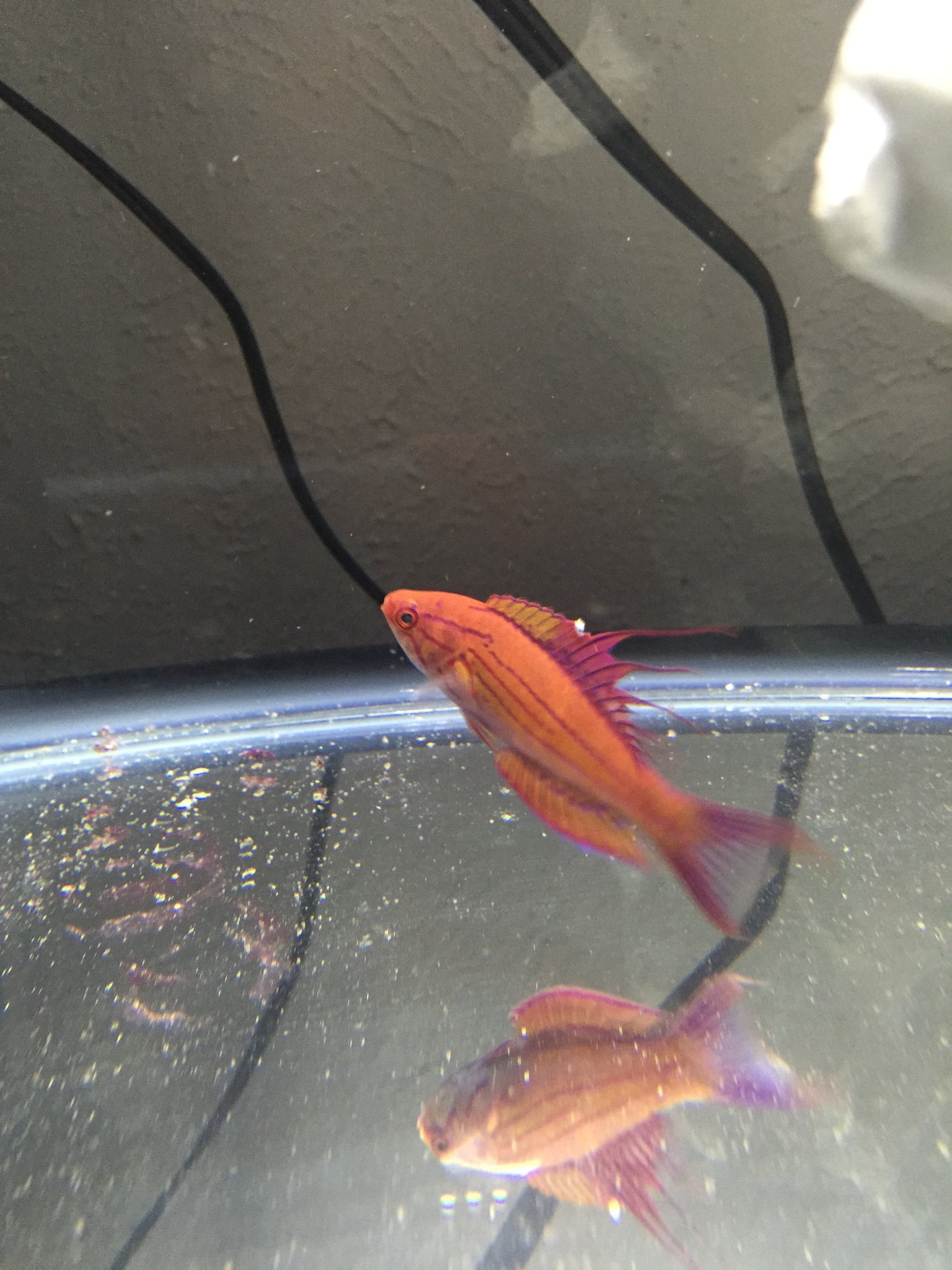
19506589593_baa76694ce_k.jpg

20119557702_b2df23d5b1_c.jpg
 
Doesn't look like crypto...likely lymphocystis. When you say he is not swimming well, can you describe what you mean?
 
He is swimming close to the bottom in a very vertical fashion. But not erratic or sideways. So like I said maybe normal for wrasses never had one before.
 
Does he swim like that when food is provided? Could just be that he hasn't fully recovered from the stress of shipping.
 
Yes he does but actually he has been in hiding for the last several hours though.

Any other help is appreciated.
 
It's a clear case of Lymphocystis. You find info about it in this publication: Lymphocystis Disease in Fish

Usually it's nothing to be too worried about. You will find it mostly on new fish that were either kept in copper or had their immune system weakened by otherwise poor conditions and were injured by fights or netting which gave the virus an entry point.

It's the least dangerous Iridovirus and fish will usually get over it without treatment as long as you keep them under good conditions. It is infectious on contact (bites among fish, nets,...), though there are indications that this is actually a very specialized virus family where each strain only infects a certain fish family. I kind of fond that confirmed by my own observations: in one tank only the clownfish got it, one likely infected the other, but a banggai cardinal in the same tank didn't get it.
And right now I have two new regal angels, where one likely infected the other, but the two marine bettas in the same tank didn't get it.

It usually takes a couple of weeks to go away and after that the fish's immune system should fight new infections of the same strain off.
 
It's a clear case of Lymphocystis. You find info about it in this publication: Lymphocystis Disease in Fish

Usually it's nothing to be too worried about. You will find it mostly on new fish that were either kept in copper or had their immune system weakened by otherwise poor conditions and were injured by fights or netting which gave the virus an entry point.

It's the least dangerous Iridovirus and fish will usually get over it without treatment as long as you keep them under good conditions. It is infectious on contact (bites among fish, nets,...), though there are indications that this is actually a very specialized virus family where each strain only infects a certain fish family. I kind of fond that confirmed by my own observations: in one tank only the clownfish got it, one likely infected the other, but a banggai cardinal in the same tank didn't get it.
And right now I have two new regal angels, where one likely infected the other, but the two marine bettas in the same tank didn't get it.

It usually takes a couple of weeks to go away and after that the fish's immune system should fight new infections of the same strain off.

Thank you for the ID. I too felt like lymphocystis was a possibility, however, the images I saw on google looked FAR worse than what he had. However, as you point out the history is very consistent with this type of infection and already in my QT he is doing quite well. When I got him I was THIS close to taking a pic and flushing him as he was not moving or doing anything when I unpacked him (from DD). However, slowly but surely he perked up and now he is eating like a champ and that white spot has already gotten better.

Thanks again
 
OK now how long?

OK now how long?

So the lympho appears to have resolved though there is still the damage to the fin. At this point how long do I continue to QT? Another 72 or do I count this as part of the 72. I am assuming the 72 is in more reference to C. irritans and as such the presence or absence of lympho would not really affect it but IDK, which is why I am asking...

Thanks in advance.
 
So the lympho appears to have resolved though there is still the damage to the fin. At this point how long do I continue to QT? Another 72 or do I count this as part of the 72. I am assuming the 72 is in more reference to C. irritans and as such the presence or absence of lympho would not really affect it but IDK, which is why I am asking...

Thanks in advance.

Regarding the 72 days, are you running your DT fallow, or are you just asking how long to QT the fish to ensure it is free of parasites (namely C. irritans)? If the latter, I would put the fish through TTM and then observe for another couple of weeks afterward.

Has the odd swimming behavior resolved itself?
 
I do not, at least I hope I do not, have C. irritans in the DT, it was just preventive QT. I have not read through the TTM, so I will need to do some research before I ask any questions about that, but I thought that was for treatment.

Concerning the odd swimming, yes and no and thanks for asking. I had received two fish from DD a mccoskers and a filamentous and they both evidently swim a little more upright than my other fish. However, my mccoskers did begin to tilt with swimming and then eventually whirl while swimming and could not eat and passed on. I also purchased a carpenters wrasse and he has been fine and also swims a little more upright so I suspect it is just their swimming style and my ignorance.
 
The upright swimming may be due to the smaller tank space in QT. I suspect they will be more active swimmers when they get to the DT.

As far as TTM is concerned, it is both a treatment and a preventative. It exploits the most predictable life cycle stage (the protomont) by preventing the cyst stage from forming (thus preventing new infective theronts from forming). I use it on all new acquisitions irrespective of whether they have visible crypto symptoms or not. When performed correctly, it's about as close to 100% effective as you can get in this hobby. Definitely recommend reading up on it. There's a lengthy thread in this section that has all the details:

http://www.reefcentral.com/forums/showthread.php?t=1996525
 
I think you are right about the smaller tank space in QT for the Wrasses...

I will look into the TTM, I love exploiting life cycles lol.
 
Back
Top