

ThRoewer
New member
...
Perhaps, I feel like the melanistic argument has changed a bit since originally proposed. For instance it was originally cited that chrysopterus was one of the species that linked melanism to anemone host. It seems now that it more of a locale variant such as the Solomon Island and PNG variants. Clarkii and tricinctus definitely exhibit melanism in certain host anemones though.
On clarkii and percula I have witnessed the change, though with the percula it went differently than expected: When I put my pair #3 into a gig they actually lost a lot of their black.
Anemones definitely have a part in this, but I don't think it is as clear cut as previously thought.
With percula I feel that there might be rather sub populations (or genetic strains) that prefer either gigantea or magnifica. Field and lab studies have shown that percula larva look for the type of anemone their parents were in. While they are open to take both anemones in a pinch they clearly prefer the ones that smell like "home".
Hard to go wrong with any of those species once healthy. I think you are aware of the challenges of both chrys and latz.
I've had latezonatus before and know that they are not easy due to their cold water (20°C to 24°C) origin. Though it appears they can handle it a bit warmer. Most challenges with clowns I had in the past came from lack of remedies for Brook and bacterial infections. Now, with the right medications at hand I don't worry as much as before. I feel as long as I get them in a decent state I will be able to get them through.
If I could get a nice pair for a reasonable price I would probably prefer latezonatus over all others, simply because they are the most in need of being captive bred and probably one of the more "special" clowns.
Fiji blue stripes can turn completely brown, from yellow. I know, I've got a pair.
That is my concern - that they turn out like the one Blue Zoo shows on their website.
Here is a good write up on blue stripes.
http://www.reef2rainforest.com/2014...g-and-diverse-blue-stripe-clownfishes-part-5/
I know that article and agree that likely many of the local variants will turn out to be district species in their own right.
With chrysopterus there is already some genetic evidence that the Solomon "chryopterus" are only distant relatives of the Fiji ones:
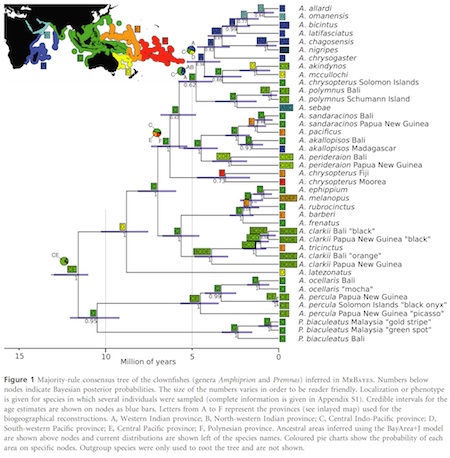
Clarkii may be another candidate for reconsideration, simply because of the seemingly wide distribution range and vast number of "color variants".
The black Darwin "ocellaris" are most likely also a district species.
Another issue to me is, why a slightly larger opercular thorn justifies to put the maroons into their own genus.


