
You are using an out of date browser. It may not display this or other websites correctly.
You should upgrade or use an alternative browser.
You should upgrade or use an alternative browser.
A great refugium lightbulb, IMHO!
- Thread starter gregt
- Start date

I've used a GE outdoor-rated timer with no problems. Been using it for over a year.
I've also used a cheaper, Lights of America outdoor-rated timer, which leaked voltage, and ended-up shorting the ballast within a couple of weeks. No fire hazard, just ruined lights.
The LOA outdoor-rated timer also destroyed the ballast on CFLs I had in lamps on timers around the house. It was too much of a positive correlation to be a coincidence. (Not slamming LOA, because the timers are inexpensive and a good value for incandescent purposes, but merely pointing-out that the more expensive, brand-name timer has worked flawlessly for me with CFLs.)
I've also used a cheaper, Lights of America outdoor-rated timer, which leaked voltage, and ended-up shorting the ballast within a couple of weeks. No fire hazard, just ruined lights.
The LOA outdoor-rated timer also destroyed the ballast on CFLs I had in lamps on timers around the house. It was too much of a positive correlation to be a coincidence. (Not slamming LOA, because the timers are inexpensive and a good value for incandescent purposes, but merely pointing-out that the more expensive, brand-name timer has worked flawlessly for me with CFLs.)

prop-frags
SPS Slave
Great thread; although I must admit to not reading the whole thing 
After hitting a couple of the links Marc provided, I kept browsing and came up with some interesting bulbs that might work well for refugium applications:
Panasonic Full Spectrum
CF 150w Equiv 6500k
Par38 100w Equiv Wet Location
After hitting a couple of the links Marc provided, I kept browsing and came up with some interesting bulbs that might work well for refugium applications:
Panasonic Full Spectrum
CF 150w Equiv 6500k
Par38 100w Equiv Wet Location

melev
Well-known member
The first one was always one I thought would be neat to use in a submerged environment, provided you could keep the ceramic base and socket dry.
The second one is the wrong spectrum. It works, just not as well. I ran the 6500K bulb over my refugiums for 1.5 years, so I know it works.
The last one looks like what I use now, but it is $15.99 each - too much!!
The second one is the wrong spectrum. It works, just not as well. I ran the 6500K bulb over my refugiums for 1.5 years, so I know it works.
The last one looks like what I use now, but it is $15.99 each - too much!!
Naperville Reef
New member
how often should the TCP 51k bulb be swapped out if it is running for 14 hours a day?
landscapen
New member
i used an outside light from home depot
Naperville Reef
New member
thanks melev.....
sales weasel
New member
Guys, I did a search but only found one mention of the Philips Agro-Lite in another thread. I bought one of these at HD today along with the clamp-lite reflector. I can't find any data about this light other than what's on the box. The Philips site says it's unavailable. Maybe my HD just has lots of them leftover. Here are the specs I have from the box:
50w Agro-Lite Plant Light 120V
"For the Acceleration of Indoor Plant Growth"
2000HRS Avg Rated Life
Standard Base
R20 (2-1/2" Diameter)
Can't find anything about the actual kelving rating.
Has anyone used this light?
50w Agro-Lite Plant Light 120V
"For the Acceleration of Indoor Plant Growth"
2000HRS Avg Rated Life
Standard Base
R20 (2-1/2" Diameter)
Can't find anything about the actual kelving rating.
Has anyone used this light?
I suspect the Phillips agro light, 50w r20, is a halogen light. (??)
If so, we are talking apples and oranges. Remember that a halogen is an upgraded version of an incandescent. With a halogen, your energy will be utilized creating primarily infrared light (heat), even with an agro light, which tends to have added blue spectrum.
These are ideal for terrestrial plants. No idea how they will work with macroalgae. My concern is that microalgae, the type that grows near the surface, will love it. Cyanobacteria may love it also.
Let us know how it works, but keep in mind that with a halogen (if it is) you are paying higher electricity bills for less lumens and more heat.
If so, we are talking apples and oranges. Remember that a halogen is an upgraded version of an incandescent. With a halogen, your energy will be utilized creating primarily infrared light (heat), even with an agro light, which tends to have added blue spectrum.
These are ideal for terrestrial plants. No idea how they will work with macroalgae. My concern is that microalgae, the type that grows near the surface, will love it. Cyanobacteria may love it also.
Let us know how it works, but keep in mind that with a halogen (if it is) you are paying higher electricity bills for less lumens and more heat.
sales weasel
New member
Nope, not a halogen. Its a small reflector flood/spotlight. They came in three sizes. Two were flood/spotlight type and one was more of the traditional incandescent shape. I plan to call customer "no-service" at Philips today in my quest to id the kelvin rating.
Abalone joe
New member
I can't say for sure but it seems to me that while macro algea is aquatic and of course an algea, It has a chlorophyll set simular to that of green plants. That's probably why there has been so much success with red leaning 5100K lamps. I know with terrestrial plants the blue-er light helps keep plants more compact.
It may be better for your overall system to grow your refugium algeas under the 5100K lights instead of higher Kelvin lights. If blue light causes compact growth most of the energy is probably stored for reproduction with only a minimal increase in tissue density. Using the 5100K may cause the algea to grow tissue faster in search of a better light source while also trying to increase the overall surface area available to absorb light. Increased tissue equals more bound nutrients and more calories spent on growth.
Just a thought.
It may be better for your overall system to grow your refugium algeas under the 5100K lights instead of higher Kelvin lights. If blue light causes compact growth most of the energy is probably stored for reproduction with only a minimal increase in tissue density. Using the 5100K may cause the algea to grow tissue faster in search of a better light source while also trying to increase the overall surface area available to absorb light. Increased tissue equals more bound nutrients and more calories spent on growth.
Just a thought.
Abalone joe
New member
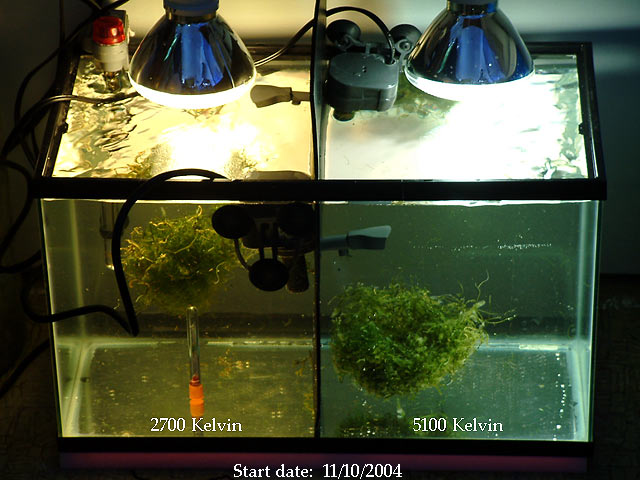
I meant leaning to the red relative to Daylight at noon. I believe DL at noon is usually stated around 6500K. 2700K may be a little low with regaurd to most plants. I notice the date 11/10/04. How long did you run the experiment?
I understand it's may be kind of tedious but it would be very enlightening... to run an experiment with a single volume of water divided into three sections segragrating the light types while ensuring identical water conditions. The light values being 2700K, 5100K and 6500K. Start the experiment with three samples of cheato- one in each section. Each sample should be not only of the same volume but also weighed so starting mass and ultimate density of growth can be derived. The 6500K would be for the most part the control because I would guess that most people probably use this spectum of light over their fuges. A better control would be to find the average light spectum in it's most common natrual habitats. Daylight adjusted by average depth it is found.
BTW... What did you find from the tank in your post?
I understand it's may be kind of tedious but it would be very enlightening...
to run an experiment with a single volume of water divided into three sections segragrating the light types while ensuring identical water conditions. The light values being 2700K, 5100K and 6500K. Start the experiment with three samples of cheato- one in each section. Each sample should be not only of the same volume but also weighed so starting mass and ultimate density of growth can be derived. The 6500K would be for the most part the control because I would guess that most people probably use this spectum of light over their fuges. A better control would be to find the average light spectum in it's most common natrual habitats. Daylight adjusted by average depth it is found. BTW... What did you find from the tank in your post?
Abalone joe
New member
I hate cyanobacteria.
melev
Well-known member
Joe - I ran the test you see above twice, for 3 weeks and then again for 4 weeks. The side under the 5100K grew much better than the 2700K bulb. The tank was divided in half, with the black divider preventing any light leakage. A powerhead was inserted through the divider on both sides, so that the flow would be equal as well. Once a week, I'd pump out the water from the test tank and refill it from my reef tank. The lights were on a timer, if I recall. It was a while ago.

Abalone joe
New member
I've read in a couple of places ( I don't remember where. ) That Cheato does best if kept in constant motion. Like rolling in the water flow. Can anyone confirm this or does it grow just fine resting on the bottom as long as there is good water flow?
Similar threads

- Replies
- 0
- Views
- 138
- Replies
- 0
- Views
- 157