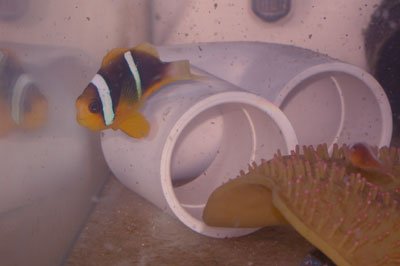
A.Theillei ,anybody tried it?

Clownfishfan

New member
Has anyone actually been smart enough to pair an a.sandarcinos with an a.occelaris to see if it produces a.theillei ? I can understand why no one has tried pairing A.chrysopterus and A.Sandarcinos since A.Chrysopterus is hard to keep,expensive,and it has color variants. But A.Sandarcinos has no color varients,its easy to keep,and is not expensive same for occelaris except occy's have a black color varient(which obviously couldn't be a parent of a theillei). Anyone know of any threads (preferably with pics) or someone who has actually tried it? I mean seriously the worse thing that could happen is you get a funny looking fish ...
 
Surely someone tried it? I did find a thread on rare clownfish but I am unable to see the pics to verify. If anyone is a member there and could pm me the pics of the theillei pair and juvie that would be great(pm me and I will give you a link to the thread) ,but I completely understand if you dont.
 
I have tried twice with sandarcinos and chrysopterus. Both times it seemed like it took, but when the chrysopterus got old enough to breed things fell apart. There were a couple old timers who no longer post who tried the ocellaris x sandaracinos but neither were successful. If it was easy, it would probably happen more in nature. One hypothesis is that the different species of clowns don't read each other's body language very well, so when it comes breeding time and the female starts to get aggressive, the male doesn't give the proper response and gets his behind kicked. I guess every once in a while the female isn't that picky, or the male gets the response "close enough" and spawning takes place.
You could go through a lot of clowns trying to get the right pair, or you could get lucky the first time. After seeing my last sandaracinos male literally get his face ripped off, I stopped trying. Maybe a sandaracinos x ocellaris wouldn't be quite as aggressive towards each other.
In chrysopterus x sandarcinos the chrys. is always the female. Anybody know the dynamic between the ocellaris and the skunk?

edit: eco-tropic and Jhardman were the ones that had the mixed pairs. I did a little searching (you can too) and eco-tropic had one mixed pair to get leucs spawn twice but was never able to raise the babies to metamorphosis. It wasn't because he didn't try and he had some skills in that area.
 
Last edited:
I had luecokranos with blue stripe and orange skunk.

The leucrkranos was always overly aggrressive to the orange skunks but not so much to the juvi blue stripe. In the end she chose the blue stripe.
 
Ineresting about the chrys/sand pair,that hypothesis really does make since!I wonder if it eould change anything if starting out with a proven breeding female paired with a juvie or pairing 2 that are only a few weeks old so they would literally grow up together ?

@reefvette , I wonder why that is?size maybe?
 
Ineresting about the chrys/sand pair,that hypothesis really does make since!I wonder if it eould change anything if starting out with a proven breeding female paired with a juvie or pairing 2 that are only a few weeks old so they would literally grow up together ?

In my case, the second time around, I started with the smallest chrys I could find and had it in QT with 4 - 1month old orange skunks that I had raised myself. I put in 4 so it would spread out any possible aggression. When we went to their "breeding" tank it took the skunk that hung out closest to the chrys. They lived together fine for about a year until the face eating incident.

This is them in QT and in their new home.

I looked very hard for CB chrysopterus at the time, but none were available. I still don't think there are more than a couple people who have had success with chrysopterus.
 

Attachments

  • gExpt2.jpg
    gExpt2.jpg
    16.3 KB · Views: 20
I have tried a number of pairings with varying success but no spawns. if you want A. thiellei start with 10 spawning pairs of ocellaris and ten spawning pairs of sandaracinos. Then move the females into the tanks of the other species' males.
If you want leucokranos substitute ocellaris for chrysopterus. Skunks are one of the harder species to get to spawn. If you were to do the above, I suspect the pairs with the ocellaris females would be the first to produce.
If you're serious, collect any fish you wish to breed as leucokranos from Solomon Islands. For thiellei they should be from Philippines.
 
Beautiful !
Did breeding skunk clownfish prove to be tough,like spawning?I've read that it's harder to get them to spawn ? Not sure about raising them....
 
The only fish I am able to get as a proven spawner is a.occelaris. I really am serious ,I want to produce a.theille from it's root! I wonder if having the skunk male and occy female would make it easier since it's the female that's usually takes longest to get to spawn? I am going to pair the proven breeder to a juv/male skunk and try and see what happens.if she rejects him or he just doesn't seem to understand I will try your way(just one pair of each though since that's all I have room for).
 
They lived together fine for about a year until the face eating incident.


This is what puzzles me...
It's understandable why they couldn't spawn because the 2 complexes are so different ,but what I don't understand is lueks are relatively common compared to theillei considering Occelaris and sandarcinos dont look a whole lot different compared to chrys X sand but they are very uncommon.
 
The only fish I am able to get as a proven spawner is a.occelaris. I really am serious ,I want to produce a.theille from it's root! I wonder if having the skunk male and occy female would make it easier since it's the female that's usually takes longest to get to spawn? I am going to pair the proven breeder to a juv/male skunk and try and see what happens.if she rejects him or he just doesn't seem to understand I will try your way(just one pair of each though since that's all I have room for).
If you had to choose only one of your introductions to be a proven spawner, I should think A. ocellaris as the female would be optimal just because they're easier to breed and the female is probably more important in getting the pair to spawn. Couple that with their availability and I think its a no brainer.
After seeing that Jordan's (Ron Popeil) nigripes was spawning by herself I should think a male is just a technicality!

I too like Phil's theory about the mixed signals.
 
Keep in mind that while Sandaracinos are found in places other than Philippines, there is no documentation that I can find of any thiellei being collected anywhere else. Same goes for A. leucokranos in the Solomons. This is why I say to find pairs that came from the same region as A. thiellei. There may be something about these regional variants. Also consider the possibility of recessive genes. There was a fellow in Sao Paulo who got a couple leucs out of a batch of sandaracinos.
 
I think it is entirely possible that there is only one chrysopterus x sandaracinos and one ocellaris x sandaracinos pair in the wild. There are more leucs because that pair has been around longer and their offspring have produced babies either with each other or with chrys. or skunk parents. These baby hybrids might even have an advantage because they can settle in and share anemones with 3 or more different types of clowns instead of just one. Besides chrys., sand., and other leucs, leucs have been found sharing anemones with pink skunks and clarkis as well.

Anemone preferences and behavioral differences do a good job of keeping clowns from hybridizing in the wild.
 
I think it is entirely possible that there is only one chrysopterus x sandaracinos and one ocellaris x sandaracinos pair in the wild. There are more leucs because that pair has been around longer and their offspring have produced babies either with each other or with chrys. or skunk parents.
Anemone preferences and behavioral differences do a good job of keeping clowns from hybridizing in the wild.
I can't swallow this one. This would indicate a very high survival rate for their offspring given the number entering the industry. Even a leuc/leuc pairing only produces ~33% that actually look like the parents. Clearly, this is a rare occurance, but for one pair to have been reproducing since before the "species" was first described in 1973 is far fetched. The longest lived clowns in captivity has been fewer than 30 years... and that's under pretty much ideal conditions with no predators.
We also have to consider the number of fish collected in Philippines compared to other areas in the Pacific. I don't think anyone has a higher rate of ornamental export. So, Solomon Islands would probably have many more leucokranos than we're seeing.

These baby hybrids might even have an advantage because they can settle in and share anemones with 3 or more different types of clowns instead of just one. Besides chrys., sand., and other leucs, leucs have been found sharing anemones with pink skunks and clarkis as well.
Now this sounds reasonable to me. My next question would be is A. ocellaris or A. clarkii more prevalent in the wild? A. clarkii would be by this logic. I don't know whether this is true or not.
 
Even a leuc/leuc pairing only produces ~33% that actually look like the parents.

This has become an urban myth. Someone said that many years ago, no pics exist that I am aware of, nobody repeated this experiement. My leuc pair produces offsprings that all have caps, orange/pinkish color of luecs and in general look like the parents with variations in the cap department. Not a single one exhibited chrys traits, not even as larvae. And I have seen chrys larvae.

There was a fellow in Sao Paulo who got a couple leucs out of a batch of sandaracinos.

I can get you leucs-looking fish out of a pair of percs, if I don't take care of the fry. Those two sandies were most likely misbars and looked like leucs.
 
MarinaP,
After seeing your juvis, i am pretty sure that if you bred a orange skunk and chyrsoterus in that case you would get some that look like male and some that look female.

In your case I think the head barring pattern 33 % would have a mom like and 33 would have a dad like and then 33 would be mixed.

EITHER WAY I WANT some of those babies
 
I didn't mean to imply that all the current hybrids in the wild have come from one pair. I am saying that it is possible that the original cross only happened with one pair of fish that may have produced for 10-20 years. Since that time and during that time, the hybrid offspring produced more hybrids by breeding leuc x leuc, leuc x chrys, and leuc x sand.. Most of the leucs I see now look to be more chrysopterus-like than the pics of leucs I saw in the 80's. This would partially explain why leucs and theillei only occur in limited locales rather than everywhere the parent species ranges overlap.

I am not sure how my logic fits into populations of ocellaris and clarki,(unless you mean because clarkis will go into any host anemone, where ocellaris only have a couple) but I know that clarki is much more widespread than ocellaris. I don't know about shear numbers, but I am guessing that clarkis would win out there as well.
 
This has become an urban myth. Someone said that many years ago, no pics exist that I am aware of, nobody repeated this experiement. My leuc pair produces offsprings that all have caps, orange/pinkish color of luecs and in general look like the parents with variations in the cap department. Not a single one exhibited chrys traits, not even as larvae. And I have seen chrys larvae.
.....

Not an urban myth, just different results than yours. That "someone" was Fernando Nostratpur of the Birch Aquarium in La Jolla, CA. He wrote an article, complete with pictures, for "Aquarium Frontiers" magazine, when it was still being published. I was lucky enough to see the babies in person and was very disappointed that very few of the babies looked like their parents. If you send an email to Fernando, he will very likely be happy to send you a copy of his article with pictures.
 
Back
Top