AC vs DC Pumps. Which Run Hotter?

I just replaced an eheim 1262 with a jebao dct4000. For the same amount of water flow, the dc pump consumes less power than the ac pump to begin with. (25 watt vs 65watt on killawatt) The dc pump was silent compared to the ac pump, now I'm thinking of changing my skimmer to one that uses dc pump.

I ran the eheim pump in a bucket of water with vinegar outside the house overnight, with ambient temp around 60F, the next day the water was warm to the touch.

so yes, dc pump consumes less power and therefore runs cooler, based on empirical evidence and not just a conjecture.
 
I'm curious how you came to the conclusion that "DC pumps typically dissipate about 1/2 of their heat to the air via external power supplies and controller"? How did you measure this?

Good question gcarroll, i did some homework to validate my guess, there is nothing conclusive, just that energy to move the water is X, but, how much is dissipated in heat from different pumps is pretty much up in the air.

I'm not a scientist, but, when I was running the pump externally I put my hand on the L1 pump, PS and controller, the pump pretty much felt only slightly higher than room temperature, however, the PS was/is uncomfortably hot to the touch and the controller is warm, but, not uncomfortable. This is not quite fair, because there was water running through the pump, clearly adding some cooling value. I'm now running it internally (just a little quieter), so it's too late for I/R test.

The above said, it's about GPH vs watt, apply whatever percentage you want to P/S and Controller 0%, 10%, 25% or 50%, the L1 seems to be more efficient and would have to put less heat into the water than the A/C pumps I'm familiar with.

Vectra L1
Flow: 3,100GPH
Max Head Pressure:21.5ft
Watts:130

Take your pick of A/C pump
Blueline 100HD/55HD
GPH:1900/1100
Max Head Pressure 45ft/28ft
Watts:390/180

RIO 32HF
GPH:1920
Max Head Pressure: 14ft
Watts:120

or

SICCE Syncra Pro 9000
GPH:1900
Max Head Pressure 12ft
Watts:130

Clearly the flow of L1 DC Pump at 3100gph is 50%+ more than the other 4 above AC pumps and head pressure is 2x the SICCE9000, same as the 55HD and about 1/2 of the 100HD on the same wattage as the SICCE 1/2 the 1/3rd the wattage of the 100HD and 2/3rds the wattage of the 55HD. Only the RIO is lower wattage, but, has 50% less flow and 1/2 the head pressure. I didn't see anything comparable for Ehiem at 800gph, you would need 4 80watt pumps to equal 1 L1 or 320watts.

Now consider that the wattage is from the wall on all 5 pumps and that the P/S and controller on the L1 drive a percentage (I'm guessing at 50%) outside of the water. Any conclusion I can draw would suggest the L1 moves more water with less energy than comparable AC pumps (really no mainstream submersible 3100gph pumps, so you would have to use two or compare to an M1 which still has more flow 2000gph @80 watts than the other pumps).

Also consider I run the L1 at about 35% of it's capability, which I'm sure put's less heat/energy into the water. When I want to clean the tank or I'm not happy with ORP or the likes, I can crank it up from say 1500gph to 3100gph, if I had an A/C pump, I would have to buy bigger than I need and put a valve on it to adjust the flow down to keep my LPS happy, which of course would still equal 100% of the heat being put in the water.


Sorry for the run-on, but, since I did the homework, figured I'd share.
 
I'm curious how you came to the conclusion that "DC pumps typically dissipate about 1/2 of their heat to the air via external power supplies and controller"? How did you measure this?
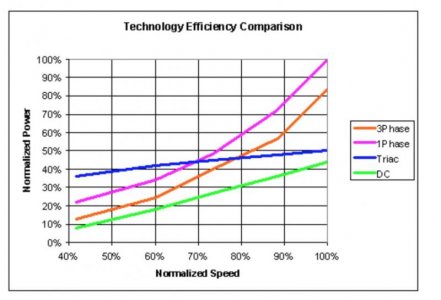
Sorry could not stop researching the subject, this is a pretty good link to some science behind my gut.
http://controlresources.com/techeval/
attachment.php
 

Attachments

  • Screen Shot 2016-07-18 at 12.01.45 PM.jpg
    Screen Shot 2016-07-18 at 12.01.45 PM.jpg
    48.5 KB · Views: 5
Since we are talking the Vectra, Tim Marks stated in the Reef Builders interview that the rated power is that what is going to the pump, not being pulled from the wall. He also stated that all of that heat is going to the water is used as a submersible pump.

AC pumps only pull their rated power at 0 head. What they pull in actual use can only be determined by measuring it. Also DC pumps loose a lot of steam as head pressure is increased. That is why most don't recommend a Vectra for a basement pump despite the 21 ft max head.
 
i dont think there's a universal answer to this question.

Ultimately, it probably depends on the pump.

my fluval SP4 is fairly efficient for an AC pump. DC pumps in the same GPH range tend to be nearly the same wattage. I've never noticed any major heat issues either.

DC pumps have a separate controller that may put out heat outside of the aquarium, which may reduce some but not all of the heat at the pump.

"really no mainstream submersible 3100gph pumps" Take a look at fluval SP6 for a pretty comparable GPH to the Vectra L1...and it's about as mainstream as it gets., 3100gph @ 130W vs 3434GPH @ 135W, i'd reckon the fluval is damn near equal on power consumption. Technically the AC pump would be slightly more efficient, something like 23.8 gallons-per-watt on the L1 versus 25.4 gallons-per-watt for an SP6. Not a huge difference, just should be noted that AC vs DC doesn't always mean less power. Of cousre, the head loss on the two pumps is likely a slightly different curve, so it's not directly comparable, but at around 4-5ft of head, they would perform comparably from what I'm seeing on these charts.

Personally, I opted for an AC pump, the fluval sp4 in my case, because I wasn't super excited with the politics behind ecotech and the vectra not playing with other controllers, and the reliability of DC pumps in general seems to be questionable for some of the cheaper brands. Also with my current system, I'm driving a manifold and so the ability to adjust the flow rate would be lost on me, as I would have to re-adjust the entire manifold each time I did that. An AC pump will use more or less power depending on how i have my manifold opened up, which is perfect for me.
 
Last edited:
So I just plugged in a Kill-a-watt to check my Fluval SP4 and my Waveline DC 10000 II:

Fluval SP4:
No Flow: 0.87A 41.3 watts
'full' flow: 1.00A 65 watts (full flow is about 4' of 1" PVC pipe with 4 elbows in my mixing station)

Waveline DC 10000 II
Power brick only (Controller unplugged)
0 A

Feed Pause (no flow; similar numbers when pump is unplugged from controller)
0.03 A, 1.1W

Level 8 (roughly equivalent flow to the Fluval SP4)
No Flow: 0.65 A 76.7 watts
Full flow: 0.65 A 76.7 watts

Level 10
Full Flow 0.84A 99 watts

I had no easy way of measuring voltage or current going go the motor of the waveline pump without disassembling the connector or controller, something I wasn't willing to do, so it is still impossible to say exactly how much power is being used by the controller vs the motor when the pump is actually running. It's entirely possible and expected that the controller will be using more power when current is flowing to the pump.


A couple of observations:
  1. The Fluval is a newer pump and one of the most efficient AC pumps out there. Many older pumps will be less efficient.
  2. The differences between these two pumps are not that great; dispelling the blanket statement that 'DC pumps are way more efficient than AC pumps'
  3. The power for the Fluval is less than the product of the Voltage & Current because it has a power factor less than one
  4. At roughly equivalent flows the Fluval used more current than the Waveline but dissipates fewer watts. If I had to guess, I would say the watts used 'in the water' are probably similar for both. i have to check on what this means for your electric bill.
  5. The DC pump uses the same amount of power whether it is throttled down or not while the AC pump uses less. as a practical matter, you would turn down the flow on the DC pump rather than throttling it with a valve, but this means that difference between the Fluval and Waveline is less than one would expect for less than maximum flows.
 
Well done!


So I just plugged in a Kill-a-watt to check my Fluval SP4 and my Waveline DC 10000 II:

Fluval SP4:
No Flow: 0.87A 41.3 watts
'full' flow: 1.00A 65 watts (full flow is about 4' of 1" PVC pipe with 4 elbows in my mixing station)

Waveline DC 10000 II
Power brick only (Controller unplugged)
0 A

Feed Pause (no flow; similar numbers when pump is unplugged from controller)
0.03 A, 1.1W

Level 8 (roughly equivalent flow to the Fluval SP4)
No Flow: 0.65 A 76.7 watts
Full flow: 0.65 A 76.7 watts

Level 10
Full Flow 0.84A 99 watts

I had no easy way of measuring voltage or current going go the motor of the waveline pump without disassembling the connector or controller, something I wasn't willing to do, so it is still impossible to say exactly how much power is being used by the controller vs the motor when the pump is actually running. It's entirely possible and expected that the controller will be using more power when current is flowing to the pump.


A couple of observations:
  1. The Fluval is a newer pump and one of the most efficient AC pumps out there. Many older pumps will be less efficient.
  2. The differences between these two pumps are not that great; dispelling the blanket statement that 'DC pumps are way more efficient than AC pumps'
  3. The power for the Fluval is less than the product of the Voltage & Current because it has a power factor less than one
  4. At roughly equivalent flows the Fluval used more current than the Waveline but dissipates fewer watts. If I had to guess, I would say the watts used 'in the water' are probably similar for both. i have to check on what this means for your electric bill.
  5. The DC pump uses the same amount of power whether it is throttled down or not while the AC pump uses less. as a practical matter, you would turn down the flow on the DC pump rather than throttling it with a valve, but this means that difference between the Fluval and Waveline is less than one would expect for less than maximum flows.
 
Well, there are only so many types of motors - I never thought about it, but I should have figured out that the DC pumps were actually brushless DC pumps. In the end, it doesn't matter much. What people care about is power consumption/efficiency and noise (and to a lesser extent, the adjustability that DC pumps have.) If you can give me an AC pump (like, say, a Fluval SP4) that does the same thing, I'm fine with that.

I had the SP4 as my return pump before I got the Waveline. Honestly what I like about the Waveline over the Fluval is the ancillary features it has - it will stop if the pump runs dry, the adjustability, the ramped startup, and the 30 min feed button. But honestly, if you told me I had to stick with the SP4, I'd be perfectly content.
 
Since we are talking the Vectra, Tim Marks stated in the Reef Builders interview that the rated power is that what is going to the pump, not being pulled from the wall. He also stated that all of that heat is going to the water is used as a submersible pump.

AC pumps only pull their rated power at 0 head. What they pull in actual use can only be determined by measuring it. Also DC pumps loose a lot of steam as head pressure is increased. That is why most don't recommend a Vectra for a basement pump despite the 21 ft max head.


Where do you come up with this? Did you review a flow chart/curve? Please do some homework before attempting to berate my post.

1st see the amps (done at 10x resolution for extreme accuracy for the pix) 117v at the wall on l1. I won't attempt to explain watts vs va but if you want to do some research before your next post. You will see .67 amps at 40% output or 78 v/a from the wall and 1.19 amps at 100% output or 139 v/a. Typical power factors for motors to convert v/a (yes this is an rms amp meter) are between .7 and .9 at 120v lower voltage usually is equal to a lower power factor. If we use .9 pf 139.3va is 125.37 watts at the wall.

Loosing flow when using near zero is not a reasonable comparison because the L1 is able to push to 24' at 1gph and the Sicce 12' at 1gph doesn't hardly warrant the Sicce 9000 being better for the basement. Both pumps 130w curve suggests 12' for the L1 is about 1250gph and ZERO for the Sicce. Take the same for the blueline HD 55 built for high head pressures shows 27' max on their chart (28 on the sell sheet) at 12' their curve shows 14gpm which is only 840gph on 180 watts.

So help me understand this magic A/C efficiency at higher head pressures.
84cd12f20eaa849e58dddbd117eababc.jpg
1668165a740e03764ba9be8888e4edfc.jpg


Sent from my iPhone using Tapatalk
 
So I just plugged in a Kill-a-watt to check my Fluval SP4 and my Waveline DC 10000 II:

Fluval SP4:
No Flow: 0.87A 41.3 watts
'full' flow: 1.00A 65 watts (full flow is about 4' of 1" PVC pipe with 4 elbows in my mixing station)

Waveline DC 10000 II
Power brick only (Controller unplugged)
0 A

Feed Pause (no flow; similar numbers when pump is unplugged from controller)
0.03 A, 1.1W

Level 8 (roughly equivalent flow to the Fluval SP4)
No Flow: 0.65 A 76.7 watts
Full flow: 0.65 A 76.7 watts

Level 10
Full Flow 0.84A 99 watts

I had no easy way of measuring voltage or current going go the motor of the waveline pump without disassembling the connector or controller, something I wasn't willing to do, so it is still impossible to say exactly how much power is being used by the controller vs the motor when the pump is actually running. It's entirely possible and expected that the controller will be using more power when current is flowing to the pump.


A couple of observations:
  1. The Fluval is a newer pump and one of the most efficient AC pumps out there. Many older pumps will be less efficient.
  2. The differences between these two pumps are not that great; dispelling the blanket statement that 'DC pumps are way more efficient than AC pumps'
  3. The power for the Fluval is less than the product of the Voltage & Current because it has a power factor less than one
  4. At roughly equivalent flows the Fluval used more current than the Waveline but dissipates fewer watts. If I had to guess, I would say the watts used 'in the water' are probably similar for both. i have to check on what this means for your electric bill.
  5. The DC pump uses the same amount of power whether it is throttled down or not while the AC pump uses less. as a practical matter, you would turn down the flow on the DC pump rather than throttling it with a valve, but this means that difference between the Fluval and Waveline is less than one would expect for less than maximum flows.


Take a peek at the post from the wall on a real rms amp meter using 10x CT for higher precision (wasn't sure of the detail needed when I did the test). The draw from the wall showing .67a at 40% and 1.19a at 100%, also included in the pix is the controller power position. I think the facts support that less power is drawn from the wall at lower "throttle"


Sent from my iPhone using Tapatalk
 
The Fluval is 135 watts at the wall. Did you check to see what the Vectra is at the wall?

chances are, the vectra may be even more at the wall, since 130w rating is "at the pump" according to a post earlier in this thread, given the controller uses power too, that must mean the actual rating is greater than 130w at the wall?

unfortunately I don't have an L1 or an SP6 so i can't test this! Would be an interesting comparison none the less!

The SP4 might be more comparable to an M1, with a slight GPH advantage to the M1.

I should find my killawatt and see what my SP4 is drawing, would be curious to see if it matches the results above. I believe these fluval's are askoll motor blocks, similar to lagunas, the vertex v-6 and the older red dragon, before they went DC. Needless to say, it's clearly a motor block that can hold it's own against DC.
 
chances are, the vectra may be even more at the wall, since 130w rating is "at the pump" according to a post earlier in this thread, given the controller uses power too, that must mean the actual rating is greater than 130w at the wall?

unfortunately I don't have an L1 or an SP6 so i can't test this! Would be an interesting comparison none the less!

The SP4 might be more comparable to an M1, with a slight GPH advantage to the M1.

I should find my killawatt and see what my SP4 is drawing, would be curious to see if it matches the results above. I believe these fluval's are askoll motor blocks, similar to lagunas, the vertex v-6 and the older red dragon, before they went DC. Needless to say, it's clearly a motor block that can hold it's own against DC.

Did you see my pix from the wall?
 
ah, so 139 watts. So indeed, it's slightly above the 130w. Not by too much though.

Does kind of speak praises for the fluval SP series though - seems these pumps can seriously hold their own with DC in many scenarios, give or take head differences.

although i think how a pump handles head depends on the design of the pump as well. like an eheim 1262 is rated a lot higher on head pressure than most AC pumps in the 900gph range (it can keep up or outperform a fluval SP2 at higher heads despite the SP2 having a higher GPH rating. it also draws a lot more wattage for the rating it has, makes me wonder if it's just got more torque at a given rpm?
 
ah, so 139 watts. So indeed, it's slightly above the 130w. Not by too much though.

Does kind of speak praises for the fluval SP series though - seems these pumps can seriously hold their own with DC in many scenarios, give or take head differences.

although i think how a pump handles head depends on the design of the pump as well. like an eheim 1262 is rated a lot higher on head pressure than most AC pumps in the 900gph range (it can keep up or outperform a fluval SP2 at higher heads despite the SP2 having a higher GPH rating. it also draws a lot more wattage for the rating it has, makes me wonder if it's just got more torque at a given rpm?

Nope you didn't read the whole post, it's 139 v/a, I don't have a 2K fluke and for motors the kill-a-watt is junk nowhere near it's 2% claimed accuracy, it only samples every 1 second, in the scope of 60hz, lots happens in 1 second. In order to compute watts, you have to look at the draw 60 x per second as the average is fluctuating, as is the voltage true RMS gives accurate average amperage with 60 hz resolution, again not the most expensive in the world but my Klein CL800 is good enough for this test especially with a 10x CT.

Anyhow to simplify you typically count on watts to be between 700 and 900 for 1000v/a. So I gave the other posters credit for .9 power factor which is 125 watts from the wall at .7 it would be like 97 watts from the wall. Take a look at sleepydoc's post where the kill-a-watt shows .87a at 41watts, this is a PF of less than 50% or 500, this is not likely, it's more likely the low resolution of the kill-a-watt running an unloaded A/C motor only needing a push every 30th of a second or so to maintain RPM. Anyhow if you use v/a which is MUCH easier to measure .87 (we will assume his wall voltage is low like mine) 117v, his v/a would be 101.7va using the same 90pf I applied to the L1 is ~91watts for an 1800gph pump / max HP of 12ft.

So... assuming we both wanted to pump to 4' (sleepydoc's tank) we need to use his 1a x 117v or 117va x .90pf or 105w. The L1 DC pump would push about 2300gph and the SP4 1347gph. If we use my controller dialed down to 40% in the pix, we are talking about 78v/a or 70watts at 90pf. While I think everyone agrees that the SP4 is one of the most efficient A/C pumps, it can't match DC for the same watt/flow or heat transferred to the tank.

Summary: If we use V/A we can agree that the kill-a-watt is close enough to a real RMS meter.
SP4 117va under load for 1347gph to 4'
L1 139va under load for 2300gph to 4'
L1 78va under load for 1350gph to 4'

L1 uses more than 30% less energy from the wall than SP4 to do the same work. Even if the PS and Controller account for ZERO heat load, L1 puts more than 30% less heat into the water, we know this isn't true, as if you I/R the PS it runs about 145 degrees in 78 degree ambient air.

Hope this creates some clarity and eliminates the gut. I admit, I stated with gut, but, the challenge confirmed my gut. I run a 150 mixed reef 30" deep on less than 4amps, I just never took the time to see exactly where it went.
 
well watts / va are nearly the same thing for us laymen, more than anything, comparable numbers is what's important.

you're right though, 1a @ 117v would seemingly be more watts then 65w? Not sure what's going on there, maybe the killawatt sucking like you said. I also have some aeon smartstrips, wonder if they're any more accurate...

i do have a fluke 289, lol. you think that'd be more accurate? i'd have to rig up some kind of crazy thing to put it in the circuit though.
 
Last edited:
okay here we go, for shits and giggles:

the average and the current value are the things to look at here:
sp4_average.jpg


check this out though, it's claiming it's only got a 51% duty cycle, so whatever it's drawing it's only using that half the time, maybe this is where that 65w came from? EDIT: actually nevermind i think this is just the duty cycle of the 60HZ AC from the wall...
sp4_duty.jpg


and likewise, the wiring mess I was talking about, cause that's not precarious at all....yeah probably shouldn't leave it like this, LOL:
sp4_wires.jpg


however that rating would be like 114VA - now mind you the SP4 is only rated at 88w, it was the SP6 that i was mentioning that is 135W...so i'm not sure how the duty cycle and whatnot may calculate into this, 114 definitely seems too high for the wattage.

BTW i was also able to calculate the "crest factor" and that was like 1.5 I believe...

the more i read about this, the more it seems like we can't really determine the actual wattage on an AC motor without knowing the power factor, and if we can't trust a killawatt, then we'd have to get something fancier. but needless to say, the SP4 is rated at 88w max SP6 at 135w and the L1 is 130w, something tells me this is a case where the actual wattage is lower than the VA / apparent wattage. that said, it's not truly fair to be saying the DC pump is using 30% less if the power factor on the AC pump is way different and not actually using as much as it seems from the VA. the actual ratings from the manufacturers would seem to agree with this anyway.

I found my kilowatt....

109VA - 66W - 0.60 PF

that's what I got anyway....

I do suspect this is also important in terms of how much heat is put into the water. Cause even if the thing has a low power factor and is "dirty" so to speak, it's still only consuming so much in watts, actual power, so it should only be putting out that much heat (in actual power, or watts) as well. And while technically that dirty/low PF devices can draw more from the upstream transformers/generators, residential power generally doesn't charge for dirtying up the power factor, some corporate/business power lines do, however, and thus the big push for PFC in computer power supplies and the like....but something tells me for residential purposes, it makes no difference to us, and the actual wattage is more important in terms of how much heat is going to get dissipated into the tank.

 
Last edited:
Propellers vs Waterwheels (Flat) Designs - Efficiency

Are the modern propeller designs more efficient than the traditional flat designs? Will one or the other move more water at the same power (wattage).

Are the new generation of DC return pumps mostly using a propeller design? I recently bought an Ehiem compact (AC) and it had a sort of hybrid design propeller and the published data on the box seems to indicate it moves more water than pumps using the same or even more wattage. So how does prop design affect the efficiency of a pump or powerhead?
 
Correct! For most residential application we are bill for watts consumed not PF.


okay here we go, for shits and giggles:

the average and the current value are the things to look at here:
sp4_average.jpg


check this out though, it's claiming it's only got a 51% duty cycle, so whatever it's drawing it's only using that half the time, maybe this is where that 65w came from? EDIT: actually nevermind i think this is just the duty cycle of the 60HZ AC from the wall...
sp4_duty.jpg


and likewise, the wiring mess I was talking about, cause that's not precarious at all....yeah probably shouldn't leave it like this, LOL:
sp4_wires.jpg


however that rating would be like 114VA - now mind you the SP4 is only rated at 88w, it was the SP6 that i was mentioning that is 135W...so i'm not sure how the duty cycle and whatnot may calculate into this, 114 definitely seems too high for the wattage.

BTW i was also able to calculate the "crest factor" and that was like 1.5 I believe...

the more i read about this, the more it seems like we can't really determine the actual wattage on an AC motor without knowing the power factor, and if we can't trust a killawatt, then we'd have to get something fancier. but needless to say, the SP4 is rated at 88w max SP6 at 135w and the L1 is 130w, something tells me this is a case where the actual wattage is lower than the VA / apparent wattage. that said, it's not truly fair to be saying the DC pump is using 30% less if the power factor on the AC pump is way different and not actually using as much as it seems from the VA. the actual ratings from the manufacturers would seem to agree with this anyway.

I found my kilowatt....

109VA - 66W - 0.60 PF

that's what I got anyway....

I do suspect this is also important in terms of how much heat is put into the water. Cause even if the thing has a low power factor and is "dirty" so to speak, it's still only consuming so much in watts, actual power, so it should only be putting out that much heat (in actual power, or watts) as well. And while technically that dirty/low PF devices can draw more from the upstream transformers/generators, residential power generally doesn't charge for dirtying up the power factor, some corporate/business power lines do, however, and thus the big push for PFC in computer power supplies and the like....but something tells me for residential purposes, it makes no difference to us, and the actual wattage is more important in terms of how much heat is going to get dissipated into the tank.
 
Back
Top