Air noise in Bean Overflow

kzziboy

New member
Somehow somewhere there's air getting into my full siphon line on my Bean Overflow. Suggestions where to start?
Everything is glued EXCEPT the screw on cap at the top. Using teflon tape for a seal...
Also the inside 90's in the overflow box are not glued. Could that be the culprit?
Or is my flow not efficient enough?
Using 1 inch pvc throughout.
Return pumps: Rio 1700 that should be around 300 gph at this height and a cheap Ebay pump that should be about 200 gph.
I've read some things about maybe not having high enough return flow.
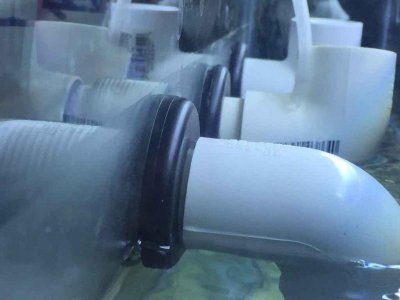
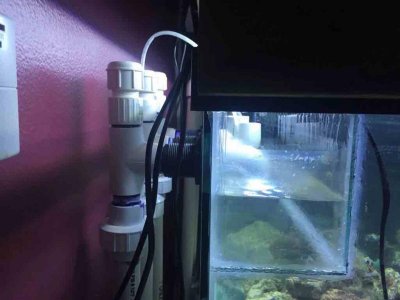
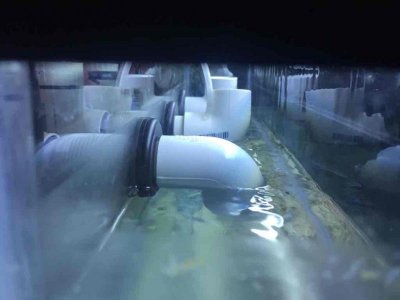
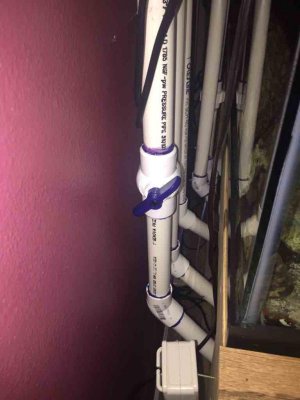
Here's some pictures of the setup.
Any help is appreciated! IMG_2666.jpgIMG_2665.jpgIMG_2664.jpg


Sent from my iPhone using Tapatalk
 
Teflon tape should not be used on PVC threaded fittings. The tape is for metal pipe threads to prevent galling. It does not adequately seal PVC fittings, and manufacturers of the fittings say it should not be used. Tape puts more stress on the pitch line, which distorts the fitting.

You want to use a non-hardening thread sealant (Spears Blue75,) and use it according to the label instructions. Also the connection should not be tighter than finger tight plus 1 - 2 turns.

The elbow on the siphon is not fully submerged, and it will not be air tight, unless it has been glued. The water flow will suck air right into the line from above the water line, just the same as cavitation in a pump will suck air in past the volute o-ring seal. Folks are suggesting that the interference fit is enough, however it is not. The elbows should be either thread fitted into the bulkhead using a thread sealant or they should be glued. An interference fit cannot be expected to be air tight. It just does not work that way. Proper assembly, and techniques assure a functioning system.

Also, the system is set up wrong. The siphon elbow should have the inlet down, which it does. However, the open channel should have the elbow inlet facing down as well. (e.g. submerged.) The air inlet should come out of the top of the tee, outside the tank. The system cannot be adjusted correctly, nor will the system work as it is supposed to work. Refer to the detailed graphics for the proper assembly here:

http://www.beananimal.com/projects/silent-and-fail-safe-aquarium-overflow-system.aspx

Your flow rate is low, and probably lower than you estimate, so this system is most likely overkill, and you could have gotten away with a 1.5" durso (top to bottom.) However, this system is very versitile, and has a wide range of operation. 500gph should not present any problems provided the system is set up properly.
 
No, I don't think it's because the elbows aren't glued. Well, it's certainly possible the friction fit will leak air, but i don't think that by itself is the problem.

i think you simply haven't closed the siphon valve enough. What's the valve like on the siphon right now? You did put some kinda valve on it right? Can you close it more? Have you tried adjusting it? What were the results?

This sort of plays in with return flow, you're dialing back the drain flow to compensate for the return flow, essentially. You want that siphon closed enough that the water level rises up to the open channel. It should still be possible to do that with lower flow, you will just need to close the valve a lot more.

I also don't think it's because the teflon tape, unless you just didn't tighten it enough. I've got enough threaded joints done with teflon and none of them leak, only time i've ever had a threaded joint leak was when it was clearly just not tightened enough.

normally the siphon valve should be closed enough that the water level rises create a slight trickle in the open channel. However, you've got the open channel facing up, and the water level looks to be no where near it....at the very least you need to close the valve more. and i would make it face down, and drill a hole in the top to create a little mini durso type thing. Though it looks like you got all the holes on the same level, if you want it slightly higher you can cut the elbow down, or just turn the elbow so it's basically slightly sideways, but facing down, you can sort of use the sideways slant to set the level at which the open channel picks up water....

i also agree that your flow is kind of underwhelming for such a drain setup. you could easily run 1000gph+ on that.

Also, is it even a problem? I mean, give how low your flow rate is, i can't imagine this is a very loud setup, even with air getting in? I guess what i'm saying it, does it even really matter? I mean, it could very well be leaking air into the elbows, but this by itself isn't really a problem unless it's noisy. I suspect a higher flow rate would eliminate the problem some more. You could try wrapping the pipe in tape or that paste stuff, and twisting it in there real good. If that is the culprit, then it should be possible to test it before you do anything drastic like gluing it, but unless it's a problem i'm not even sure it matters at such a low flow rate.
 
Last edited:
Hi guys. Yes, I realize the second pipe facing up. I was trying different things and I hadn't turned it back down. I did havebit facing down before.
There is a valve. I have tried to dial it back. What should the height of the water level be in the overflow box? Above the elbows?


Sent from my iPhone using Tapatalk
 
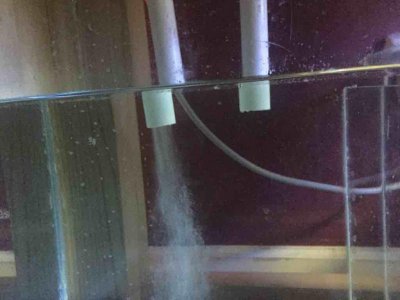
Here's a couple more pictures I took. One is the position of the valve and the other is how far below the sump water surface the pipe extends. I snapped it right when bubbles were coming out. It's not constantly like that. Happens about every 20 seconds or so. Also FYI...the pipe is right at about 1 inch below the water line. IMG_2668.jpgIMG_2667.jpg


Sent from my iPhone using Tapatalk
 
4 possible sources of air that I can think of:
  1. It's just taking a really long time to purge all the air from the system because of the low flow
  2. Leaking in from the cap threads
  3. Leaking in from the friction fit at the elbow
  4. Entraining air from small vortices at the surface around the inlet to the siphon elbow, or bubbles caused by the water flowing over the edge of the overflow.

If you have low flow in your system the last is likely not the culprit. Watch the flow for a while and you will see the air getting sucked in if it is.

If the first is the problem, you should be able to diagnose it by playing with the gate valve on the siphon and manually tuning the system to eliminate the air.

The other two are impossible to distinguish from each other, and both are possible. I would second Uncle's suggestion of using the thread paste. Teflon tape can work, but the paste is more reliable in my experience. The Spears 75 he suggests is a bit hard to find, but I've used Rectorseal T+2 without issue.

There are people who have used an unglued, friction fit at the bulkhead without issue, so I can't say definitively that it won't work, but doing so is using it differently from how it was designed to be used, so there are no guarantees. A small burr or ridge on the bulkhead or pipe would be all it would take to make enough of a gap for air to leak in. Remember that a siphon works by the weight of the water at the bottom pulling down and creating a vacuum at the top, so there will be a significant negative pressure gradient from the inside to the outside of the pipe that will tend to suck air in any small defect.

I would start by making sure options 1 & 4 aren't the issue. Assuming that's not the case, pick up a small tube of the thread sealant and try sealing the threads on the cap with it to see if that makes a difference. If the air persists then it's likely leaking in at the bulkhead. If that's the case, your options are to cement it in place or try gooping it up with thread sealant and using that to seal any small voids. Uncle won't like that idea and will correctly say that that's not what the thread sealant is designed to do, but it's essentially the same function and if not gluing the elbow in place is a priority it's worth a shot. Note that doing this may make gluing the joint harder in the future, should you need to do so.
 
I was watching it earlier. It was creating small vortices and sucking in a bit of air. How high should the water be in the overflow box?
Should it be ABOVE the 90 degree elbow that leads into the bulkhead?
Plus, if it is, won't the siphon line see increased flow and cause more noise and bubbles?
 
What causes thread sealant to seal is water pressure. Water pressure presses the sealant against the threads, thus filling the leak channel at the thread peaks/valley, and it remains fluid. Without something (like the threads) to hold the sealant in place, what can one expect to happen over time... remember there is a "negative" pressure inside the drainline...

The water level should not be above the elbows; but the water level will probably be in the upper half of the horizontal part of the ell. If it was above, you would probably have too much flow in the open channel, and the associated problems attributed to dursos with too much flow, especially with 1" pipe. This is where you would see/hear bubbles and gurgling. With the higher head pressure you would see an increase in flow in the siphon. If you see a vortex, that is where air is being sucked in, and it needs to be properly sealed.

A siphon has no air in it, unless it is being sucked in, and will operate silently with no bubbles. There is a point that a siphon will make noise, but it is far above what your system is capable of.
 
Last edited:
Uncle: Not sure I follow your logic. The thread sealant is a paste/viscous fluid. It's not like a flap that's held in place by pressure. The sealant doesnt' care whether the gap is in the threads or around a slip fitting, nor do the fluid characteristics of the sealant change. If the gap is too big for it to seal it won't work. If it's small enough, it will.

Kzziboy: To fix the vortices, you can try closing the gate valve a bit to raise the level in the overflow. If you can upsize the elbow, that may help as well - it would put the bottom closer to the floor of the overflow & further away from the surface as well as have a larger diameter, decreasing the flow velocity at any given point.

If all it's doing is causing an occasional bubble but not otherwise bothering you, you can certainly leave it as is. As long as it's not entraining enough air to break the siphon it's probably not causing any harm.
 
I was watching it earlier. It was creating small vortices and sucking in a bit of air. How high should the water be in the overflow box?
Should it be ABOVE the 90 degree elbow that leads into the bulkhead?
Plus, if it is, won't the siphon line see increased flow and cause more noise and bubbles?

It should be in the upper half of those elbows, let's just say that. Heh, basically what uncle said. But his advise is assuming you correct the open channel pipe. If you didn't correct it, you have no choice but to pretty much submerge the elbows to make it right. I don't think there's a "correct" fixed height it should be, its all dependent on flow. However, I think it's safe to say you need to close the valve more. Just try it.

You know it's closed too much when the open channel is taking too much water. You close the valve until the open channel is taking a slight trickle. Does that make sense? Right now, how you have it, the open channel can't take a trickle until the water is all the way above the elbow. You want SOME water in the open channel, just some, not a lot. Only the emergency should be dry. Get the system operating so there's some water going into the open channel, and then adjust it from there.

Note that because you used a ball valve and not a gate valve, making minute adjustments is going to be more difficult. The "correct" position of the valve might require a lot of fiddling to get right. It is a balancing act, so you need to make adjustments til you find the sweet spot.

I think given that he has venturis we can stop worrying about the thread sealant/paste anyway, that seemed like a red herring from the start and I think he's now confirmed that. This all just seems like a tuning issue, made slightly more difficult due to low flow rates. I do think paste or teflon tape will certainly do SOMETHING to help create it seal, of course it might also just act as a lubricant and allow it to pop out easier, lol. I think it's completely unnecessary on the inside seals, even if it was leaking a little. The threads on the tees, sure, use something, but if he already used teflon tape, i trust that enough...

My guess is that the venturi is forming because the water level isn't rising high enough above the siphon 90, due to some combination of low flow, and the valve being opened too much. This should be resolved by closing the valve some more.
 
Last edited:
Uncle: Not sure I follow your logic. The thread sealant is a paste/viscous fluid. It's not like a flap that's held in place by pressure. The sealant doesnt' care whether the gap is in the threads or around a slip fitting, nor do the fluid characteristics of the sealant change. If the gap is too big for it to seal it won't work. If it's small enough, it will.

Kzziboy: To fix the vortices, you can try closing the gate valve a bit to raise the level in the overflow. If you can upsize the elbow, that may help as well - it would put the bottom closer to the floor of the overflow & further away from the surface as well as have a larger diameter, decreasing the flow velocity at any given point.

If all it's doing is causing an occasional bubble but not otherwise bothering you, you can certainly leave it as is. As long as it's not entraining enough air to break the siphon it's probably not causing any harm.

You need to look at some illustrations to see how thread sealant actually works. Should not be that hard to find. The OP's siphon is not sealed, and it needs to be sealed. Palliative answers are not going to solve the problems. Messing with the water level to seal an air leak, also messes with the flow in the open channel, which can create more problems than the air leak in the siphon. It is a simple matter to seal it up the proper way. Glue the elbows in, or change out the bulkhead to use a threaded fitting that will seal with thread sealant. I wonder why they call it thread sealant, rather than socket sealant...:)

There are reasons this system was designed the way it was, using the parts that were used. One of them is being stared at right in the face right now. You may have to hunt up the parts, but I can generally find a source in under a minute. No reason someone else should not be able to do the same thing. People are just in too much of a hurry, and they end up with problems.
 
Last edited:
BRS has ABS bulkheads: Thread x Thread; Slip x Thread; Thread x Slip; Slip x Slip.

1", 1.25", 1.5" threaded street ells are a dime a dozen it seems. The reducing 1.25" x 1" Slip x Thread, might take a few minutes to locate.
 
Uncle, it's already been made clear that this isn't the problem. He's stated that he's got a venturi going on, likely because the water level is sitting so low on the siphon-90 due to the low flow rate and incorrect tuning. Close the valve more. That's the solution, the only solution. It's simple, it's easy, it doesn't require changing any plumbing.

I think you're being a bit extreme though. If he's already got slipxslip bulkheads and they're glued on the backside, I would not start telling him to cut apart his plumbing and redo it without a TON of evidence showing this was actually the problem, which we don't have. I'd sooner tell him to just glue in the elbows, and I wouldn't even give that advice without having him try to seal them off better with something slightly inappropriate for the task, to confirm that's the issue before committing to gluing together a system that might have a problem in it somewhere. None of that is necessary as we know the problem lies elsewhere.

You were so quick to jump to calling this all out as technically wrong and spent so much time trying to tell him how to do it the right way, that you've ignored evidence showing that it's not even the problem at all, and the actual problem is much simpler, a venturi sucking air into the siphon.

A bit of personal advise: I think it would be wise to drop the opinion and take a more empathetic look at these situations. You've got a quote about simplicity in your own signature for crying out loud, a venturi would have been the simplest answer, by far. I can tell your opinion about how to do plumbing correctly is clouding your judgement, and I know you know a lot about this stuff, but you are so focused on doing things the "right way" that you've ignored your own quote! Always check the simple answers first! Notice my first comment was exactly that - asking about the valve adjustment. Not trying to be rude or mean or anything, I know we get into these little bouts a lot - I'm just trying to help you see this from an outsider perspective.
 
It's quite the battle!
Seriously though, thanks for your input. I'm guessing after reading more that this is mostly caused by low flow. I'll be looking for a higher gph pump.
Anybody got a good one they want to sell??!!
In the mean time, I'm going to put a short piece of pvc pipe on the bottom side of the 90 in the overflow box to keep the air from swirling in there. I also shaved a bit off the 90 for the open channel. Maybe that will help.

Totally agree with what everyone says about a gate valve. I HATE that ball valve, but of the 4 places in my town that sell pvc items, NO ONE HAD A GATE VALVE! I'll be heading to a neighboring town with a Menards this weekend and they have them.
 
It's quite the battle!
Seriously though, thanks for your input. I'm guessing after reading more that this is mostly caused by low flow. I'll be looking for a higher gph pump.
Anybody got a good one they want to sell??!!
In the mean time, I'm going to put a short piece of pvc pipe on the bottom side of the 90 in the overflow box to keep the air from swirling in there. I also shaved a bit off the 90 for the open channel. Maybe that will help.

Totally agree with what everyone says about a gate valve. I HATE that ball valve, but of the 4 places in my town that sell pvc items, NO ONE HAD A GATE VALVE! I'll be heading to a neighboring town with a Menards this weekend and they have them.

Hah, if neptune systems would ever release their new COR pumps, i might have 2 pumps to sell! If you want a reliable/mostly affordable AC pump i would suggest fluval SP series. I think the smallest model comes in just over 1000gph. eheim 1262 might also be a contender but it's on the low side. I have an SP4 on my 120g and it's fine. can always dial the pump back if you need to with a valve, lol, that'd be the opposite problem from what you have now.

I would highly suggest just ordering the spears gate valve from BRS online. It's rebuildable so if it ever breaks down, you can repair it without cutting apart plumbing. On a fish tank environment, that's super nice.

Most hardware stores will only have gate valves in copper/brass style fittings which are not what you'd want to put on an aquarium!
 
Uncle, it's already been made clear that this isn't the problem. He's stated that he's got a venturi going on, likely because the water level is sitting so low on the siphon-90 due to the low flow rate and incorrect tuning. Close the valve more. That's the solution, the only solution. It's simple, it's easy, it doesn't require changing any plumbing.

I think you're being a bit extreme though. If he's already got slipxslip bulkheads and they're glued on the backside, I would not start telling him to cut apart his plumbing and redo it without a TON of evidence showing this was actually the problem, which we don't have. I'd sooner tell him to just glue in the elbows, and I wouldn't even give that advice without having him try to seal them off better with something slightly inappropriate for the task, to confirm that's the issue before committing to gluing together a system that might have a problem in it somewhere. None of that is necessary as we know the problem lies elsewhere.

You were so quick to jump to calling this all out as technically wrong and spent so much time trying to tell him how to do it the right way, that you've ignored evidence showing that it's not even the problem at all, and the actual problem is much simpler, a venturi sucking air into the siphon.

A bit of personal advise: I think it would be wise to drop the opinion and take a more empathetic look at these situations. You've got a quote about simplicity in your own signature for crying out loud, a venturi would have been the simplest answer, by far. I can tell your opinion about how to do plumbing correctly is clouding your judgement, and I know you know a lot about this stuff, but you are so focused on doing things the "right way" that you've ignored your own quote! Always check the simple answers first! Notice my first comment was exactly that - asking about the valve adjustment. Not trying to be rude or mean or anything, I know we get into these little bouts a lot - I'm just trying to help you see this from an outsider perspective.

I think what is needed to cease the personal comments, and deal with the issue at hand... it is simple, according to the images posted, the system is set up wrong, air was in fact being entrained by siphon, and the system cannot be properly adjusted in its current configuration; and I advised the OP on how to fix it the correct way. If you do not appreciate that, that is fine. However, what I suggested was simple and straight forward, and what the OP needed to hear; there was no consideration given to what you wanted to hear.

The exchange concerning "proper" sealing of the bulkheads was an exchange between Doc and myself, not with you or the OP. There was no need for personal comments between Doc and I, and it is not a competition. However, in past exchanges with you, it has always ended with you making personal comments. It has been continuous since I corrected some inaccurate information you were putting out.

Sorry you were offended, but my interest lies with the "OPs" and getting their systems to work the way they are supposed to, out of the box; and it seems you are more interested in following me around to create more problems... you are free to try and contact me offsite, if you have something to say to me, but this is not the right place... for that reason, I have not been responding, and will continue to not respond, to your posts, because I cannot see them unless someone quotes you. To avoid further conflict, I would suggest you place me on ignore in like manner.

The point here is: the system will not operate properly, nor can it be adjusted correctly, if it is not set up correctly. Neither can flow rate related issues be diagnosed, unless the system is set up and adjusted correctly. I covered these things in my original post; and if the OP had followed the advice given, the problem would have gone away (e.g. the possibility of air leaks in the siphon would have been eliminated; and the water level would have gotten adjusted correctly; and then a baseline for the system could be established. Everything else is just guesswork and maybes. Now the OP is looking to purchase a larger pump, and it has not been established that he actually has a flow rate problem...

Whether the OP wishes the system to opereate correctly or not, is his choice.

 
It's quite the battle!
Seriously though, thanks for your input. I'm guessing after reading more that this is mostly caused by low flow. I'll be looking for a higher gph pump.
Anybody got a good one they want to sell??!!
In the mean time, I'm going to put a short piece of pvc pipe on the bottom side of the 90 in the overflow box to keep the air from swirling in there. I also shaved a bit off the 90 for the open channel. Maybe that will help.

Totally agree with what everyone says about a gate valve. I HATE that ball valve, but of the 4 places in my town that sell pvc items, NO ONE HAD A GATE VALVE! I'll be heading to a neighboring town with a Menards this weekend and they have them.

My applogies that it seems there is a battle going on. I don't read posts made by some members; and also there are some points that I miss, due to cross-posting, or me walking away from the computer for a few hours, and coming back and continuing without looking at the current state of things. I am human, and it happens. (The vortices are an example; however, it still follows that air was being entrained by the siphon.)

Not to toot my own horn, but I have been dealing with, and fielding problems with this system for the past 6 years or so. In almost every case, (all of them actually) the problem was due to implementation errors. Nothing I say is meant to be taken personally. It is simply a statement of fact. Correcting those errors, is the most direct path to solving any of the problems, and there are very few of them with this system. It was Bean's goal to present a system that works the first time, everytime out of the box; and it is a "one size fits all" solution. It was also a goal to maintain a consistancy in the provided information. Unfortunately, it is not possible to control the consistancy of information on an open forum.

FWIW: I turned down my 120 seed tank last night, to ~500gph, (It normally runs ~1200 - 1300gph.) I had to close the valve a considerable amount, but the system functioned as it should...
 
Hi Uncle. I'm sorry everyone is getting upset. I do indeed wish for my system to run correctly. I also don't wish to buy another pump if I don't have to.
If you refer back to the pictures I originally posted of the set up I have corrected the direction of the 90° elbow's.
What do you feel is most important that I correct? Do you feel I should glue the screw on cap at the top of the standpipe? Also do you feel that I should seal the pipe inside the overflow box?
Was there anything else that you feel I need to correct?
Personally I don't feel I should have to glue the On the standpipe for the open channel or for the emergency channel. likewise on the connections inside the overflow box for those two channels.
The main problem lies with the main siphon channel and getting the air bubbles out.


Sent from my iPhone using Tapatalk
 
you just need to eliminate variables through trial and error. there is no need to do anything until you've eliminated all of the possibilities.

trying to get the system tuned in existing form via the ball valve (or upgrading to a gate valve, if you so choose) should be the first course of action. it's really just a matter of closing the valve and seeing if you can eliminate the venturi.

as for the rest - please ignore it. the fact this guy thinks i'm "following him around" and that all his statements are "statements of facts" shows how conceited he is....we're on a public forum, i just was trying to help you, and direct you away from extremist advice, which I think even you recognize some of which as such...if he wishes to address this in private then he can provide me some contact information to reach out to him, but i'm not going to contact him through the forum, last time I did that the person ran to the mods and claimed i was harassing them. people are just opinionated. it's nothing new in this hobby.
 
Back
Top