
You are using an out of date browser. It may not display this or other websites correctly.
You should upgrade or use an alternative browser.
You should upgrade or use an alternative browser.
Algae Turf Scrubber ?
- Thread starter Fishamatank
- Start date

herring_fish
Crazy Designer
Can you use carbon and phosban in the same reactor?
I can't answer that question but if you are using algae of some kind, why do you need Posban?
I can't answer that question but if you are using algae of some kind, why do you need Posban?
ATS is not set up yet but wanted to start out with carbon...
Amphiprion
Premium Member
They are better suited to separate containers and different flow rates, but it can be done. You can't tumble the carbon, so you'll have to pack all of it in there, which makes the GFO a bit less efficient. Plenty of people run GFO in canister filters without tumbling it, though, and it works just fine.

ricwilli
Member
Thats what I use only I need to change it more often.
I went to the Smithsonian exhibit in the late 90's and got a tour of the facility behind the glass. They told be that Julian Sprong took the same tour and felt that the only think that was missing was the use of carbon so that is when I started using it.
I believe that Dr. Adey's paradigm is flexible. He likes things to be as natural as possible so he likes to promote plankton in the system. Therefore a refugium is Ok and so is running carbon as long as the water is not pumped directly through the carbon because it would be a trap for it.
Are you saying that a canister "full" of carbon with a pump on it, is the wrong way of using carbon in a system?
herring_fish
Crazy Designer
I'm saying that a canister "full" of carbon would not work for what I am trying to do in my system. I do own one just incase I have an accident or failure in the tank but I don't use it.
I don't know if you care about mechanical filtration and what it can do to the free floating plankton population. Many people would say that the pump kills a lot of it and the fish eat even some more so why worry.
I am trying to keep foods in the water column as long as possible, dead or alive. It works for me but if you put a little more in so that the filter feeders get a meal and then skim it out and/or filter it out, then it doesn't have a chance to brake down.
I try to let it stay until it does brake down and then suck that up with the algae. 'pretty much the same results. It's just a different philosophy. One isn't clearly better than the other.
Dr. Adey's idea was to have a system with lots of plankton that comes from the refugium. The fuge was not designed primarily to grow macro algae. He put grasses in there because it created a better habitat for the critters that spawn and provide the plankton.
He also did a lot of work on non-traumatic pumps that wouldn't kill the critters that pass through them. Of course he designed very big systems for aquaculture and exhibits. He scaled down his concepts for the home aquarium because it worked there as well.
So ...I don't pump it through carbon but it might work for what you are trying to do.
I don't know if you care about mechanical filtration and what it can do to the free floating plankton population. Many people would say that the pump kills a lot of it and the fish eat even some more so why worry.
I am trying to keep foods in the water column as long as possible, dead or alive. It works for me but if you put a little more in so that the filter feeders get a meal and then skim it out and/or filter it out, then it doesn't have a chance to brake down.
I try to let it stay until it does brake down and then suck that up with the algae. 'pretty much the same results. It's just a different philosophy. One isn't clearly better than the other.
Dr. Adey's idea was to have a system with lots of plankton that comes from the refugium. The fuge was not designed primarily to grow macro algae. He put grasses in there because it created a better habitat for the critters that spawn and provide the plankton.
He also did a lot of work on non-traumatic pumps that wouldn't kill the critters that pass through them. Of course he designed very big systems for aquaculture and exhibits. He scaled down his concepts for the home aquarium because it worked there as well.
So ...I don't pump it through carbon but it might work for what you are trying to do.
justgettinstarted
New member
I have a question for those of you who run these.
Are the lights on 24/7 or are they on a daylight cycle?
I ask because I am just curious as to the growing cycle. My thought is for more of a greenhouse application where there would be natural sunlight exposure. But I know from plant growing experience that with normal plant a 4-5 hour photo period during the night is enough to trick the plant into growing 24hrs a day but you only have to pay for that 4 hours worth of electric.
Thoughts concerns etc?
Are the lights on 24/7 or are they on a daylight cycle?
I ask because I am just curious as to the growing cycle. My thought is for more of a greenhouse application where there would be natural sunlight exposure. But I know from plant growing experience that with normal plant a 4-5 hour photo period during the night is enough to trick the plant into growing 24hrs a day but you only have to pay for that 4 hours worth of electric.
Thoughts concerns etc?
herring_fish
Crazy Designer
You can do it any way you want and do just fine. Do I understand that you will be taking advantage of free sunlight? It you can do that, it would be great. I can't because we have big temperature swings here and that would effect the main tank temp. In San Diego, you have a mild climate.
Here is something to consider but it may not be a big deal.
Here is something to consider but it may not be a big deal.
The general idea is that when the lights in the main tank are on, there is photosynthesis among the inhabitants in the tank. This breathing helps to keep the pH a little higher but it drops at night when the lights go off. If you bring a scrubber on line during the off hours then the peak breathing in the scrubber will compensate for the drop off in the main tank.
This should smooth out or dampen the pH swings that occur during the day and night. Sometimes you need to have the two over lap or conversely, you might have to have a lag between the times that you turn on the lights in the two systems.
It may only be because people don't fine tune but many people do over lap, having the scrubber on about 14 to 18 hours a day with the middle of the light period of the scrubber being in the middle of the dark period in the main tank. ....but there are no hard and fast rules.
Sometimes, the pH regulation takes a back seat to nitrate control so that, users often increase or decrease the length of the light period according to the nutrient level that they want. The current fad outside of the scrubber world is that CO2 is a major player in pH control. If the lighting in the two systems over lap, the CO2 stays relatively depressed so the effectiveness of the counter lighting still works well.
justgettinstarted
New member
Thanks for the useful info herring!
The system I am envisioning would be in an actual greenhouse not a residence so the temp swing would be minimal. I am still in the planning stages and am just kind of feeling out all the options available. Overall tank volume would be between 3,500 and 4,000 gal. Was thinking I have a couple different options for an ATS. One would be lengthwise along the greenhouse in that case 20' long by 4 feel tall (160 sqr foot of growing) or I could do it at one end which I would think could be 8' tall by 10'wide (same sqr footage). I was thinking that they would both be nice in the summer time because of the evap these could be used to stabilize daytime temps with all the vents open due to the evap and perhaps a fan blowing alongside them.
Still in the very early planning stages so trying to think of all the possibilities.
The system I am envisioning would be in an actual greenhouse not a residence so the temp swing would be minimal. I am still in the planning stages and am just kind of feeling out all the options available. Overall tank volume would be between 3,500 and 4,000 gal. Was thinking I have a couple different options for an ATS. One would be lengthwise along the greenhouse in that case 20' long by 4 feel tall (160 sqr foot of growing) or I could do it at one end which I would think could be 8' tall by 10'wide (same sqr footage). I was thinking that they would both be nice in the summer time because of the evap these could be used to stabilize daytime temps with all the vents open due to the evap and perhaps a fan blowing alongside them.
Still in the very early planning stages so trying to think of all the possibilities.
herring_fish
Crazy Designer
You sound like you are making a major investment there. I think that you should buy Dynamic Aquaria by Dr. Adey. You can see several different designs for full fledged, full function, full scale Algal Turf Scrubbers. You want to see all of your options.

biomekanic
New member
Something that occured to me last night was that one possible way to have a surge on a verticle system would be use a SCWD.
My idea was that the ATS would be fed from an in sump pump hooked up to a SCWD. One end of the SCWD would just return the water to the pump, the other would be plumbed to the ATS. This would result in a surge, without having anything tipping or dumping.
Any thoughts on that?
My idea was that the ATS would be fed from an in sump pump hooked up to a SCWD. One end of the SCWD would just return the water to the pump, the other would be plumbed to the ATS. This would result in a surge, without having anything tipping or dumping.
Any thoughts on that?
herring_fish
Crazy Designer
Sorry to ask. What is an SCWD.
biomekanic
New member
herring_fish
Crazy Designer
As yet, I really can't quite visualize how that would work in a vertical, two sided version. Is that what you are talking about? Can you explain it.
As a side note: When Santa Monica was working up his designing, I told him about the turbulence so he rigged up a surge device to add surge. I think that it was one of those reservoirs that is triggered by a siphon. It sounded a little like a toilet unfortunately. He tested it and didn't find much increase in efficiency so he stop using it. I don't think that it was successful in agitating the strands enough to separate them. The extra surface area made up for it.
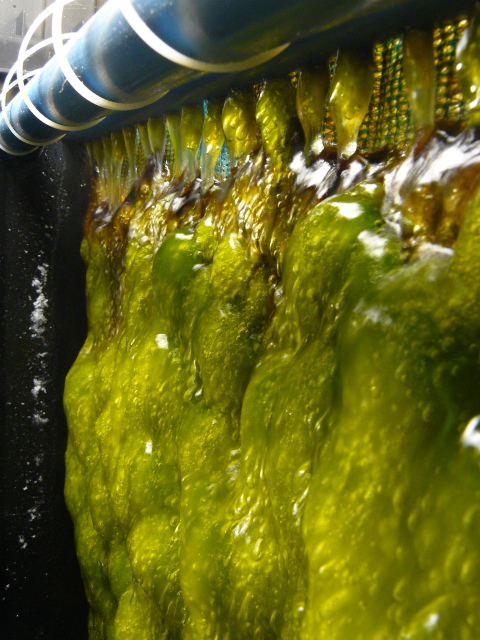
In this picture, that I have posted before, you can see how algae can get matted over time. It is a picture before the algae begins to suffer. I used it just to show my point and because it is a good close up from the right angle. Actually, this tank is very successful. The owner cleans the screen before efficiency drops.
As a side note: When Santa Monica was working up his designing, I told him about the turbulence so he rigged up a surge device to add surge. I think that it was one of those reservoirs that is triggered by a siphon. It sounded a little like a toilet unfortunately. He tested it and didn't find much increase in efficiency so he stop using it. I don't think that it was successful in agitating the strands enough to separate them. The extra surface area made up for it.
In this picture, that I have posted before, you can see how algae can get matted over time. It is a picture before the algae begins to suffer. I used it just to show my point and because it is a good close up from the right angle. Actually, this tank is very successful. The owner cleans the screen before efficiency drops.
Amphiprion
Premium Member
That's the main tradeoff with that particular design, but it is what I employ, due to lack of space. The frequent cleanings do make a fairly big difference, I've noticed. That being said, that particular screen doesn't look like it has all that much flow, but that might just be the way the picture looks. It obviously works for his tank, though, which is impressive. It's worked beautifully for my application, as well, but it's not for everyone.
herring_fish
Crazy Designer
Yes, scrubbers are very forgiving and stable. How long have you been running a scrubber, particularly with SPS? Can you post pictures?
Amphiprion
Premium Member
I've been running it for 8 months off and on (mostly due to equipment failure and/or re-designs of the scrubber). I don't have any recent pics of the scrubber itself, short of the last iteration. I can get some before I clean it, though, since it is easiest to see what kind of growth it gets then. I've recently had to start using razorblades and toothbrushes to scrape it, since it gets some pretty tenacious stuff on it.
herring_fish
Crazy Designer
Have you tried a spatula or a drywall blade? A spreading blade for Venetian plaster has rounded corners.

I've been playing with ATS in two systems, a Biocube 14 and an Oceanic 90. Started the ATS in each case because of problems.
Bad cyano in the Biocube in the early months of my saltwater experience. Started the ATS 9 months ago. Took me a long time to get it working well. It's undersized and poorly designed by SM's criteria. Ended up turing a phosban reactor into a lit refugium with chaeto. The chaeto + the ATS has it in good shape now.
I 'inherited" the 90 last August. I didn't know how bad it was until I got it home. Nitrate 500+, phosphate 7.0+! Lots of water changes, an oversized ATS, lit refugium with chaeto, 2nd 100+ gallon sump a floor below...a lot of work, but now it's doing very well. Got everything from mushrooms to zooas & LPS and even a bit of SPS. The SPS is a survivor put in by the previous owner. Would have sworn it was dead, but it's growing and spreading. A pink encrusting montipora.
I also run GFO and GAC. The GFO to leech phosphates out of the rocks. I can't detect the phosphates anymore but suspect they're still there. The GAC to clear the water and whatever other benefits it may provide. The water does get tinted without the GAC. From one of my experiments I think the GFO helps clear the tint as well.
I have a mandarin and a green gonipora in the 90. Both for about 4 months. Got them partly to test the "live food from pods" theories about the ATS. The mandarin's doubled in length and the gonipora's happily growing as well. Looking good!
SM's new product looks interesting. I'm upgrading the Biocube to a Cadlights 39 shortly. Might try to build one for that system.
Bad cyano in the Biocube in the early months of my saltwater experience. Started the ATS 9 months ago. Took me a long time to get it working well. It's undersized and poorly designed by SM's criteria. Ended up turing a phosban reactor into a lit refugium with chaeto. The chaeto + the ATS has it in good shape now.
I 'inherited" the 90 last August. I didn't know how bad it was until I got it home. Nitrate 500+, phosphate 7.0+! Lots of water changes, an oversized ATS, lit refugium with chaeto, 2nd 100+ gallon sump a floor below...a lot of work, but now it's doing very well. Got everything from mushrooms to zooas & LPS and even a bit of SPS. The SPS is a survivor put in by the previous owner. Would have sworn it was dead, but it's growing and spreading. A pink encrusting montipora.
I also run GFO and GAC. The GFO to leech phosphates out of the rocks. I can't detect the phosphates anymore but suspect they're still there. The GAC to clear the water and whatever other benefits it may provide. The water does get tinted without the GAC. From one of my experiments I think the GFO helps clear the tint as well.
I have a mandarin and a green gonipora in the 90. Both for about 4 months. Got them partly to test the "live food from pods" theories about the ATS. The mandarin's doubled in length and the gonipora's happily growing as well. Looking good!
SM's new product looks interesting. I'm upgrading the Biocube to a Cadlights 39 shortly. Might try to build one for that system.

Similar threads

- Replies
- 0
- Views
- 340
- Replies
- 0
- Views
- 463
- Replies
- 0
- Views
- 615
- Replies
- 0
- Views
- 665
- Replies
- 0
- Views
- 346