All coral dies or loses color

Spyderturbo007

New member
I've been trying to nail down this problem for about 2 years and haven't had any luck. I've made a few posts over the year, but hope to consolidate everything here and maybe someone will see something I missed.

Setup:

  • 55g Cornerflow
  • ~15g Proflex Model 2 Sump
  • Bubble Magus NAC 3.5 Skimmer
  • 300w Finnex Heating Tube
  • Neptune Apex w/BOB for ATO
  • Pacific Sun Hyperion S LED (2 x 145w SMT Panels)
  • PondMasters Model 7 Return Pump
  • 2 x MP10wES Pumps
  • 6 Stage RO/DI w/ Dedicated Chloramine Removal Block and Secondary DI stage

Additives

  • Red Sea Salt (Regualr, not Reef)
  • Kalk - Don't need to add since all my coral dies
  • Polyfilter (have been running for 6-months thinking there might be some contaminant)
  • GAC (Also thought this might pull any contamination out)

Parameters (Most Recent)

  • Phosphate = 0.04ppm (Hanna)
  • Calcium = 415ppm (Red Sea & Elos)
  • Alkalinity = 8.34dKH (Hanna)
  • Nitrate = 1ppm (Red Sea Pro)
  • Magnesium = 1260ppm (Red Sea / Elos)
  • Temperature = 78.8 - 79.4 (Controlled by Apex)
  • pH = 7.85 - 8.05 (Apex Probe when windows are closed)
  • Copper = 0pp according to SeaChem test kit. Unfortunately our ICP-OES doesn't have the detection limits I need and we don't have an ICP-MS in my lab.

Testing Verification

  • Verified Calcium, Magnesium Phosphate in my laboratory using Calibrated ICP-OES
  • Verified temperature probe using NIST traceable thermometer
  • Verified Red Sea Nitrate with 1ppm Laboratory Standard
  • Verified Refractomer with 35ppt laboratory standard
  • Run Certified Reference Materials alongside regular testing for Calcium & Magnesium

  • Added more fish in an attempt to increase Nitrate and Phosphate (Both used to be zero)
  • Switched lights from 4 x 54w T5HO to 2 x 145w LED Fixture
  • Started feeding Oyster Feast & Phyto
  • Started target feeding coral on a regular basis
  • Dropped Alk from ~11dKH to ~8dKH thinking system might be ULN
  • Tested for Stray Voltage
  • Looked for pests, but don't see any

Inhabitants

  • 2 x Banggai Cardinalfish
  • 2 x Snowflake Clowns
  • 1 x Bristletooth Tang
  • 1 x Turbo Snail
  • 3 x Hermit Crabs
  • 1 x Skunk Cleaner Shrimp
  • A few Nassarious & Cerith Snails


Keep in mind, these changes happened over the period of 2 years, so it isn't like I tried everything all at once.

The lighting was the biggest difference. Previously (before December 2013), I never had much coralline algae growth and all corals would go drab after a few weeks in my tank. Some would slowly die and others would just look terrible. After trying everything I could think of, I decided I would switch lighting. Unfortunately, I cooked some of them in the process. I removed the ones that are completely dead, but now the others are losing their flesh.

LPS do alright, but are drab in color. All SPS are losing their flesh.

One weird thing my wife pointed out was that there was reef epoxy on the live rock I bought from the LFS. I didn't know any better when I bought it, but it had to have been used.

Timeline Pictures. Lighting was "Upgraded" in December so pre-December was the T5 and post December is the LEDs.

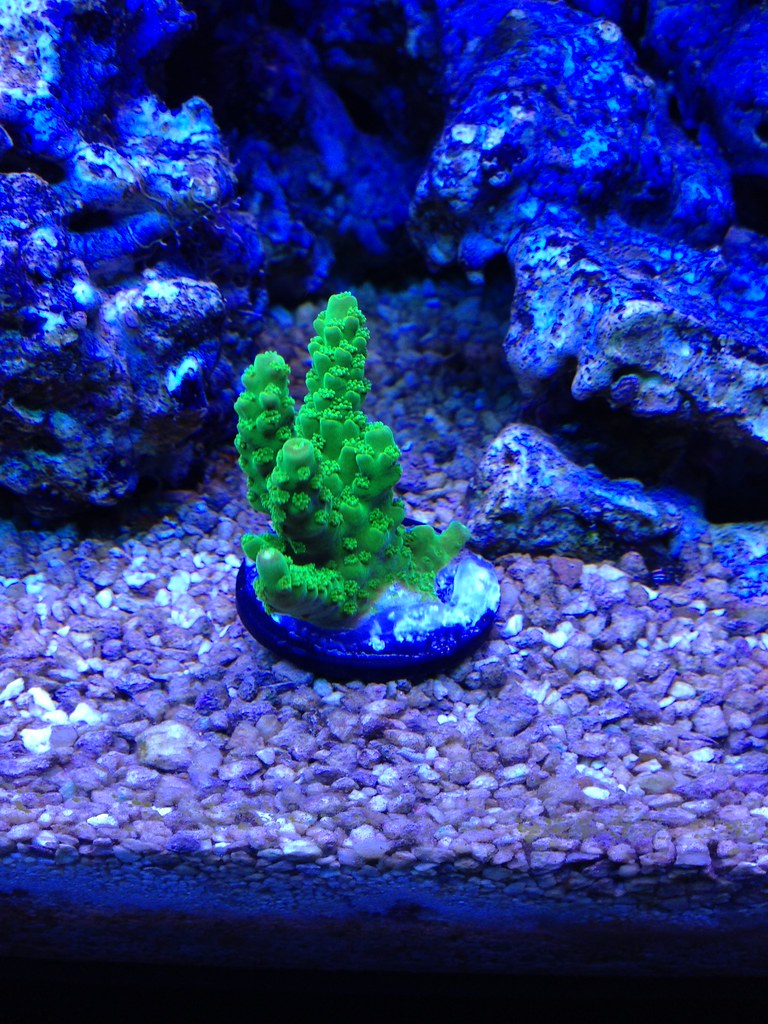
Misc Acropora when purchased (10-21-12)
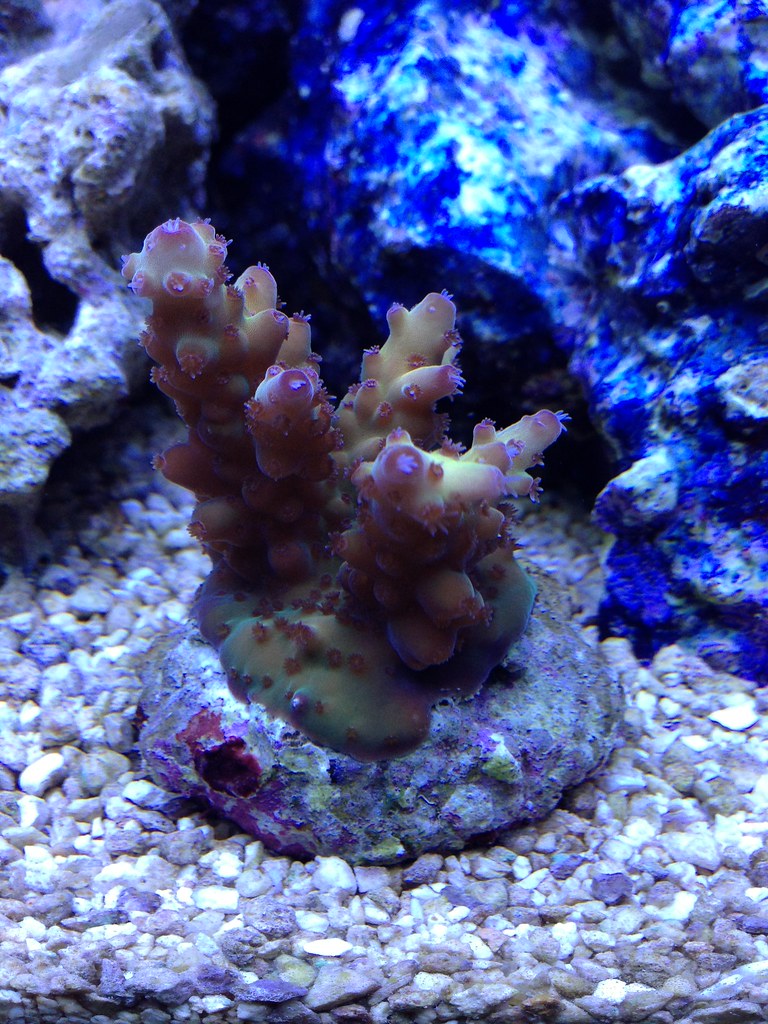


Misc Acropora (11-30-13)
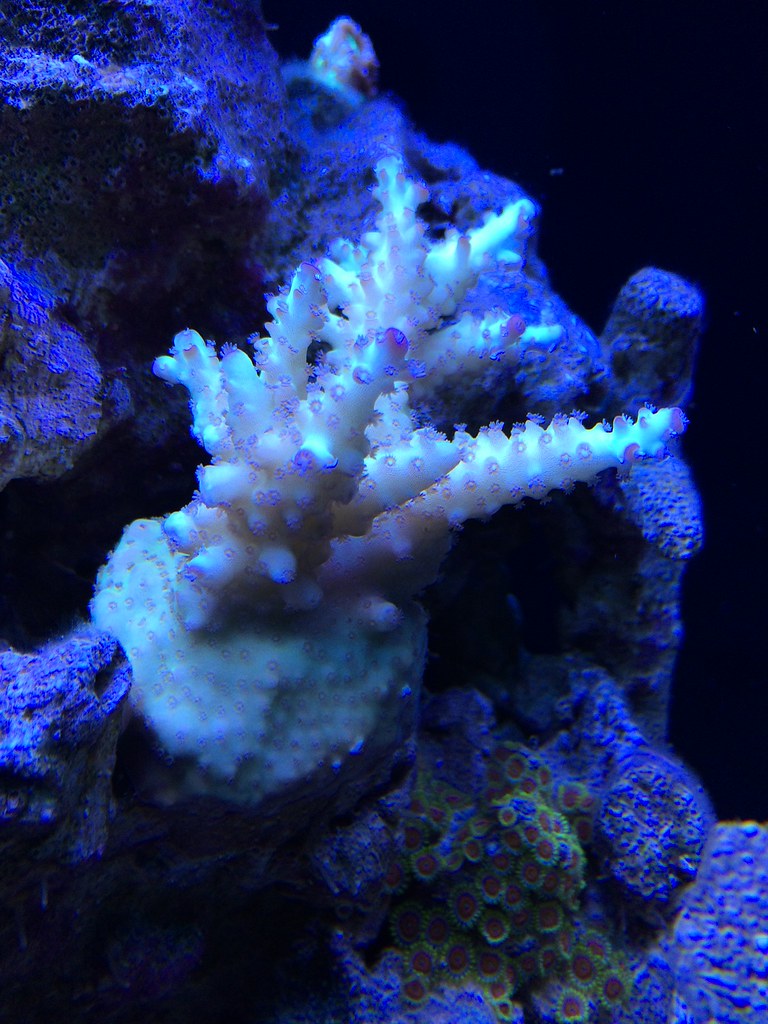


Misc Acropora (6-4-14)
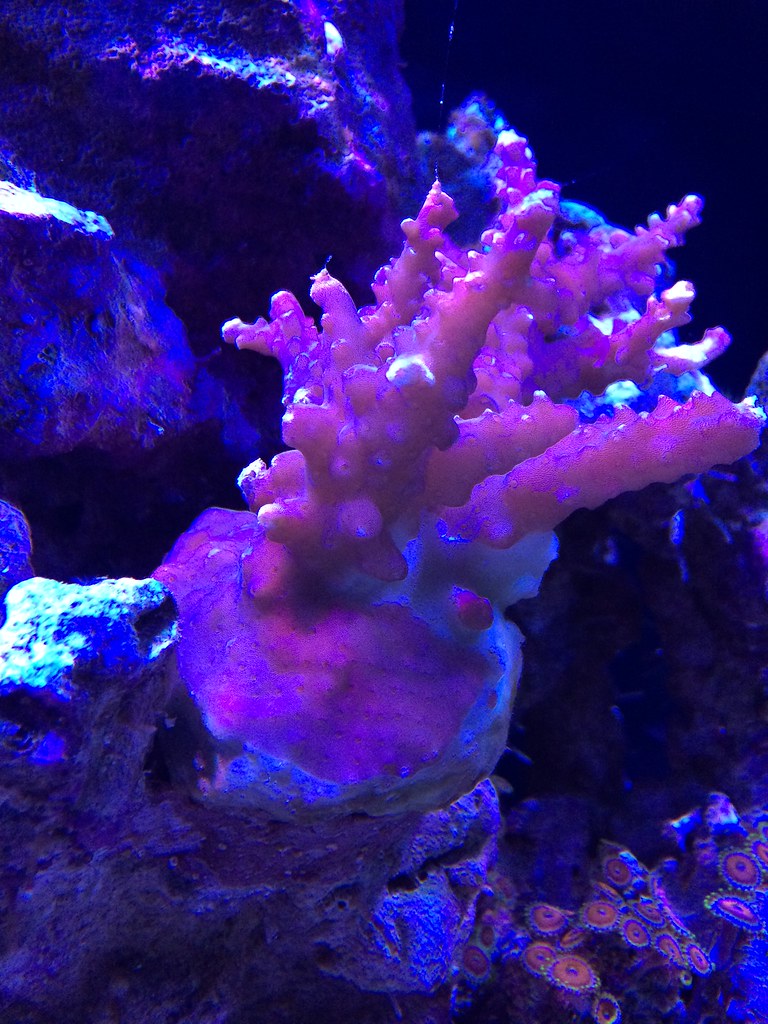
14155399398_462b373f16_b.jpg


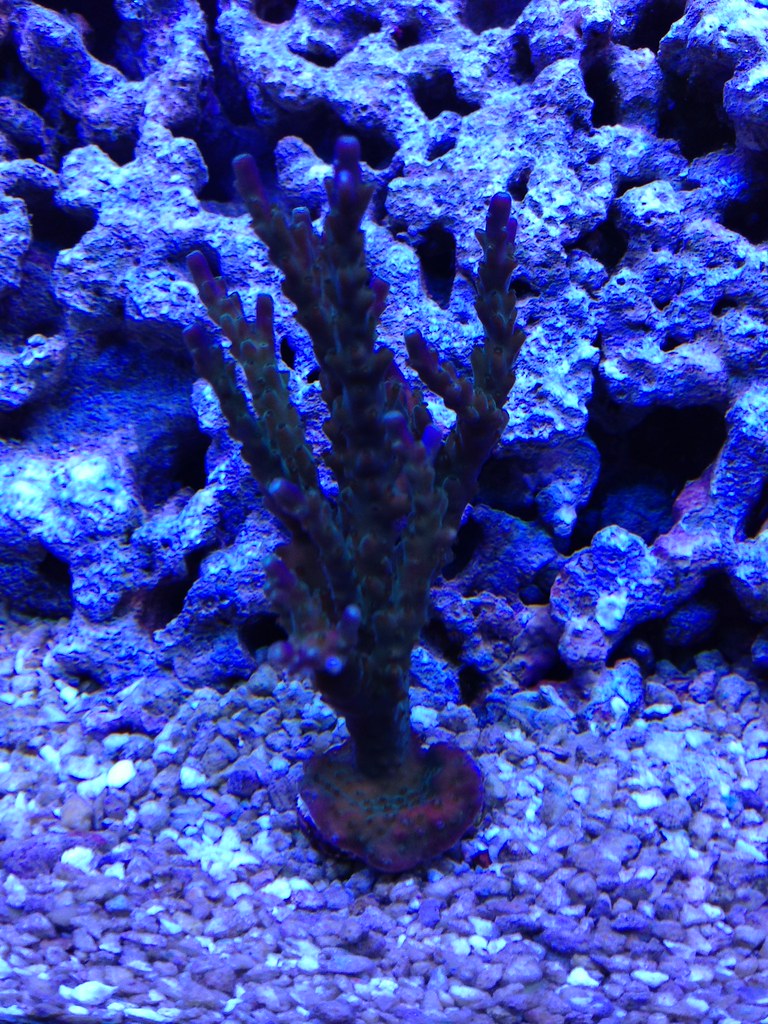
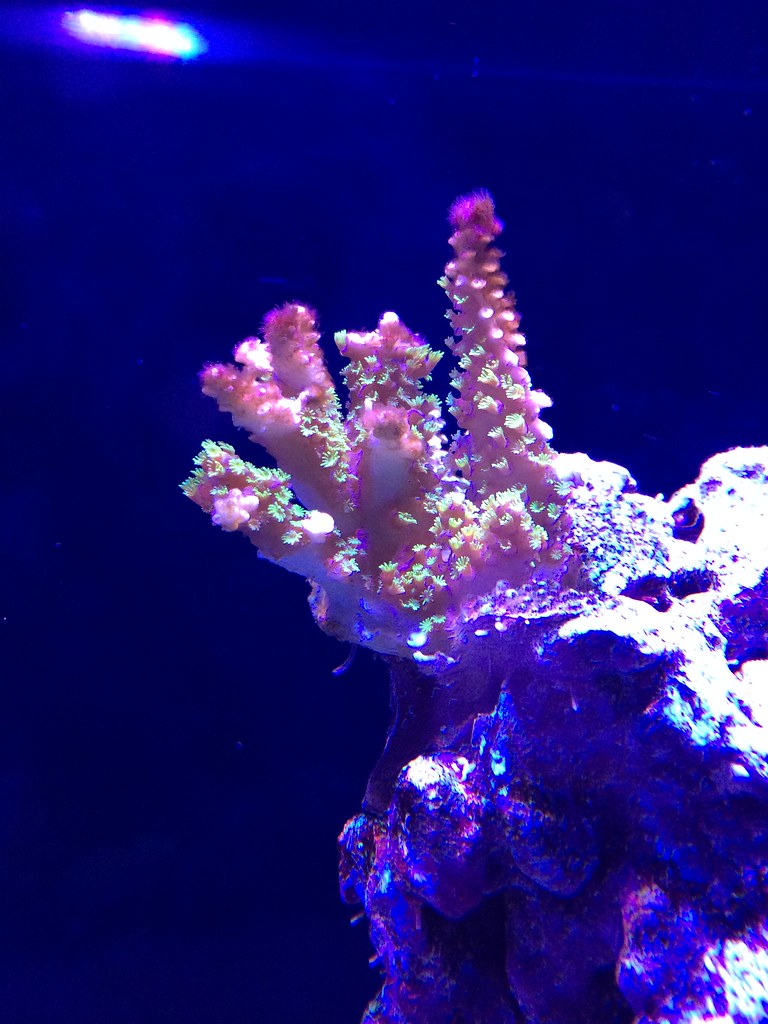
Bennet Tort when purchased (1-26-13)


Bennet Tort (11-30-13)
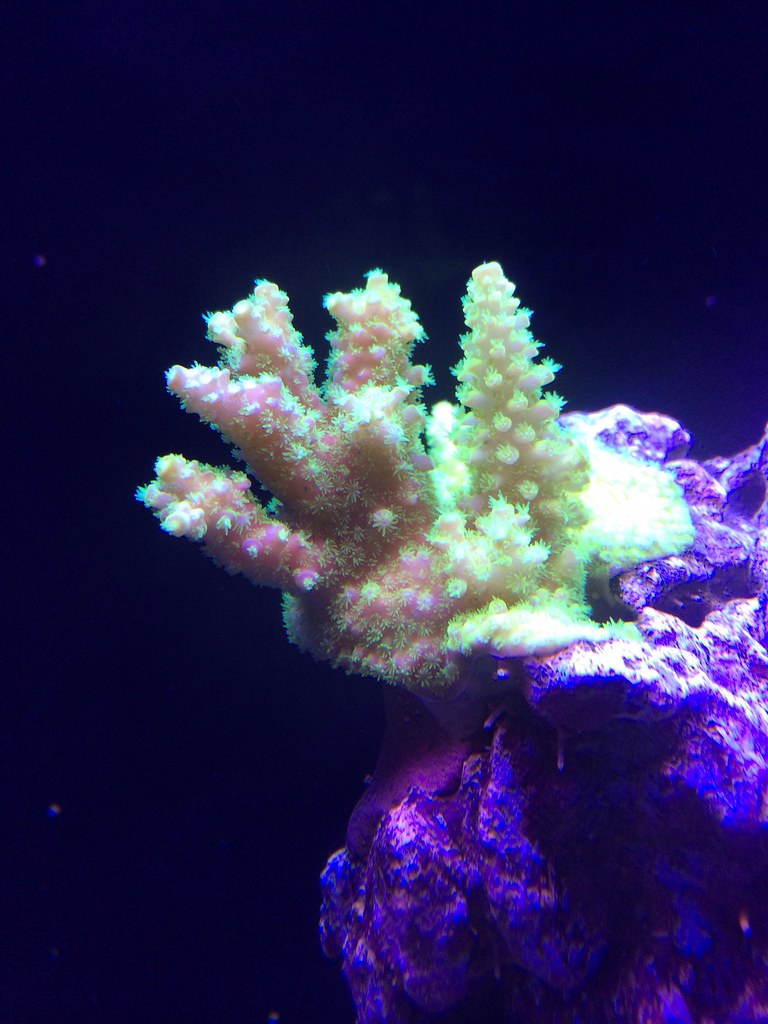


Bennet Tort (1-13-14)


Bennet Tort (6-4-14)

14342054735_09a1abf7f0_b.jpg


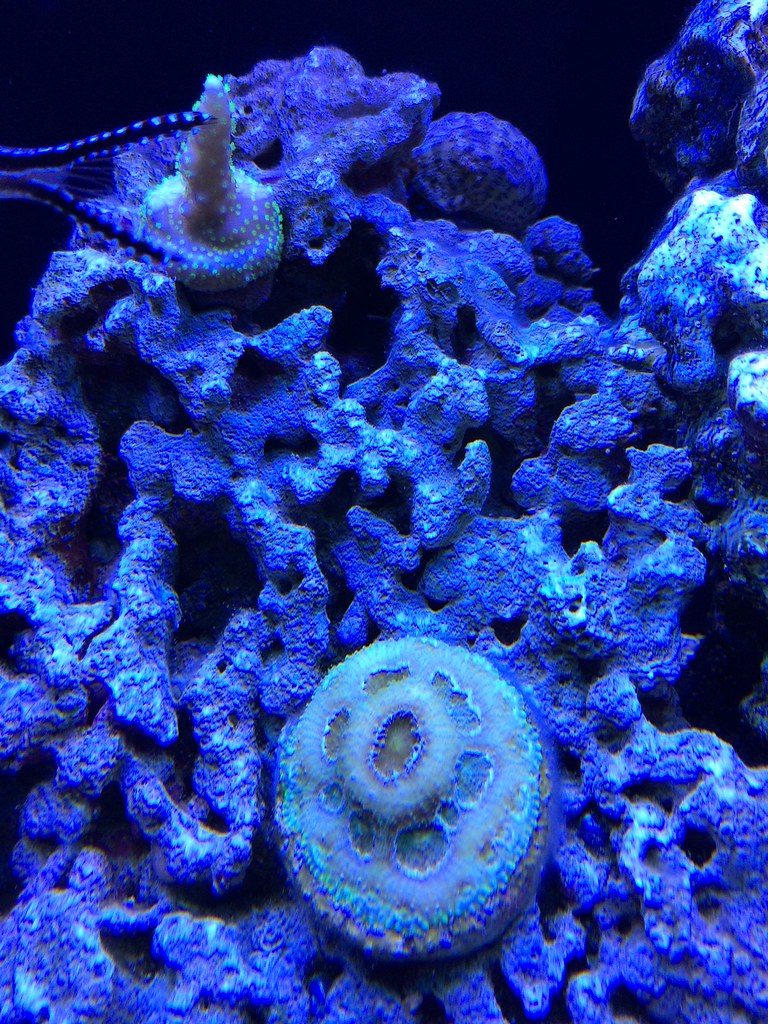
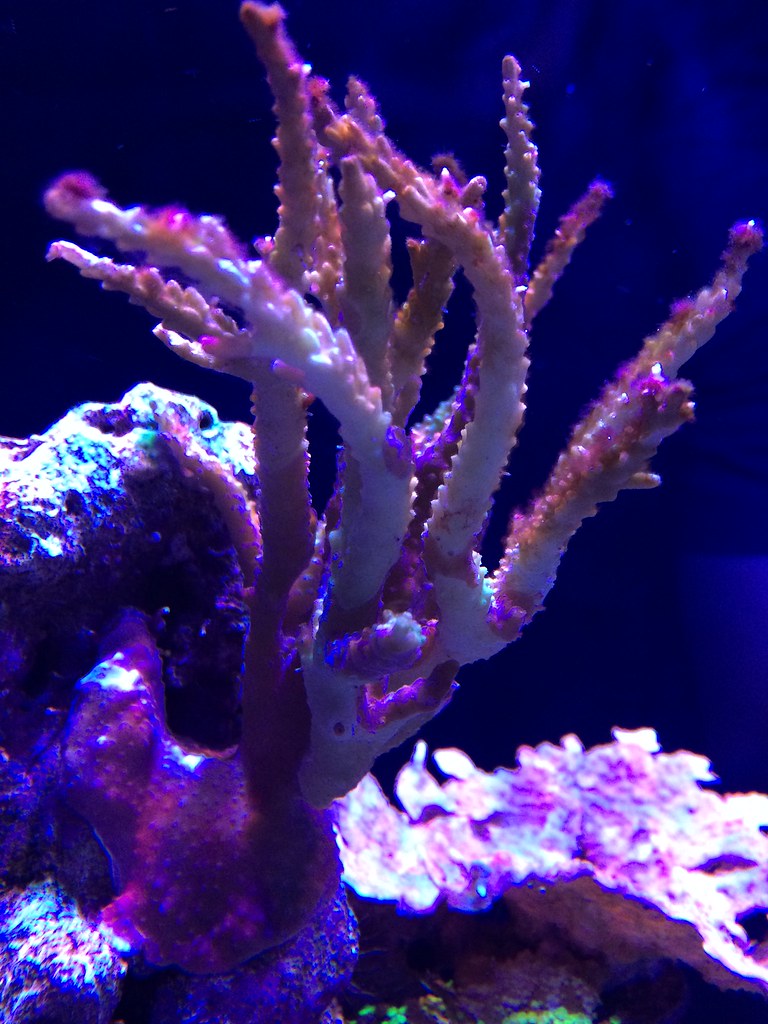
Valida when purchased (1-23-13)


Valida (11-30-13)
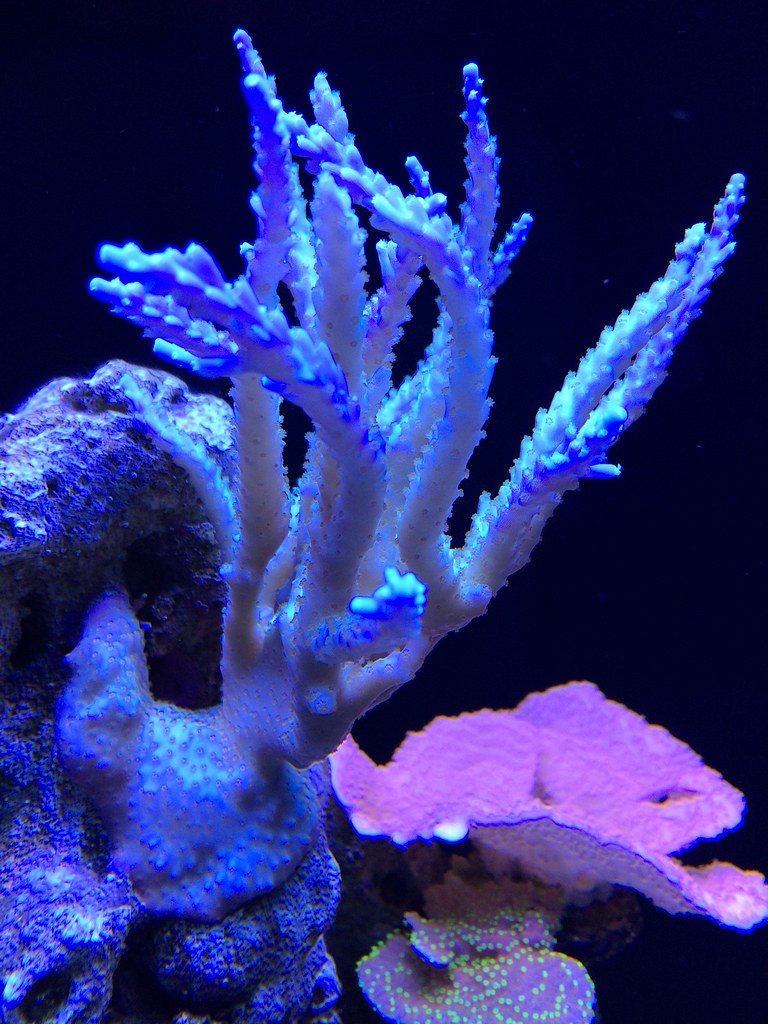


Valida (6-4-14)
14318922476_1cebe0d506_b.jpg
 
Last edited:
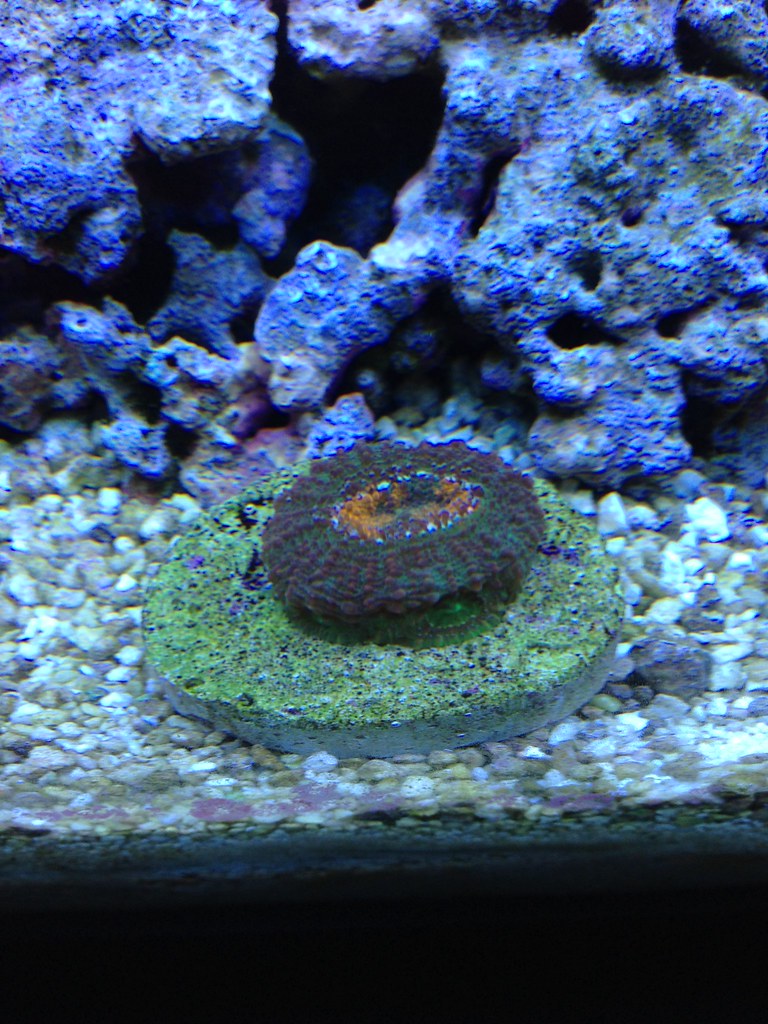
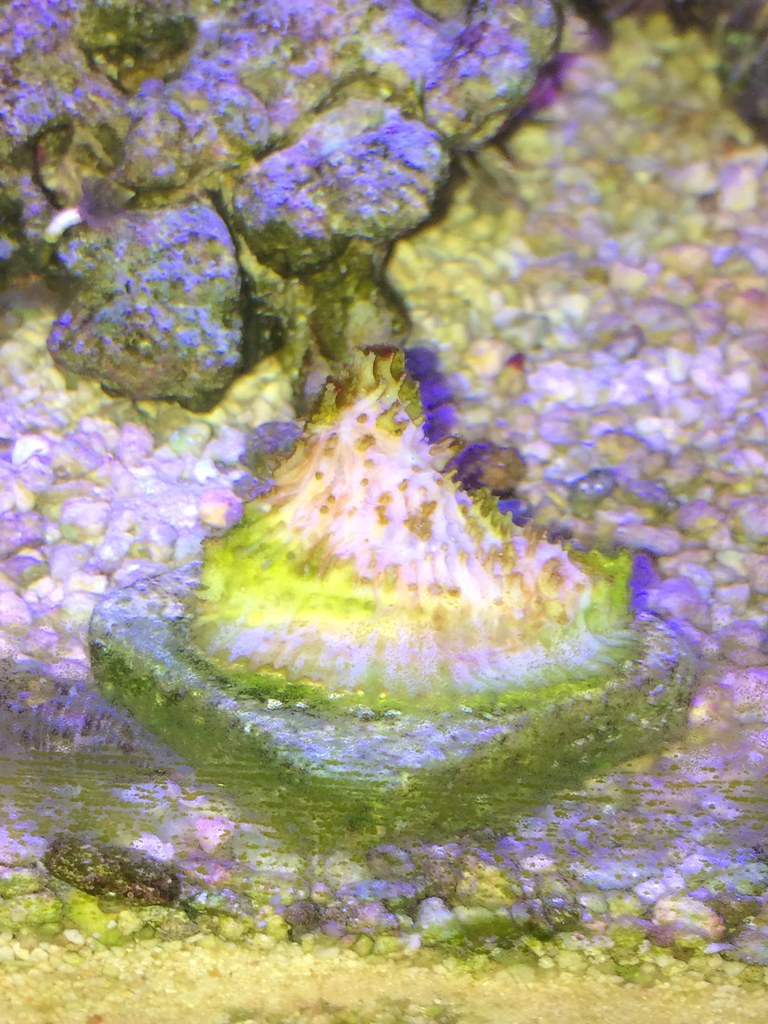
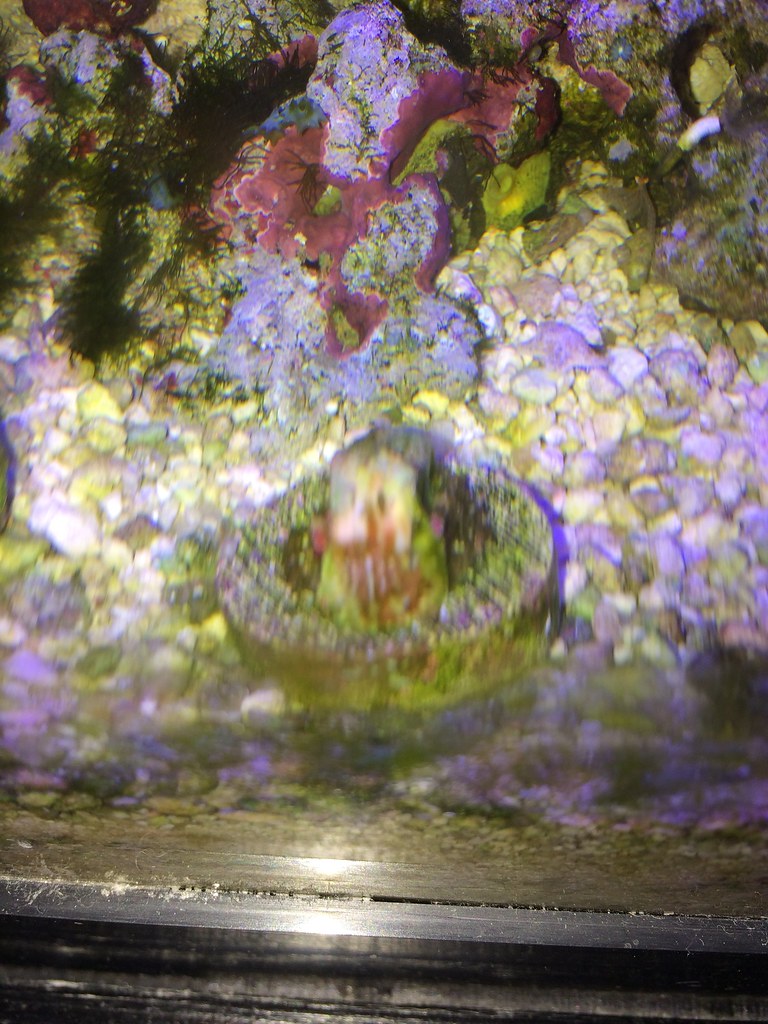
Orange Crush Acans when purchased (4-27-13)


Orange Crush Acans (11-30-13) - You can see the bleached Purple Bonzai Acropora in the background that I lost.


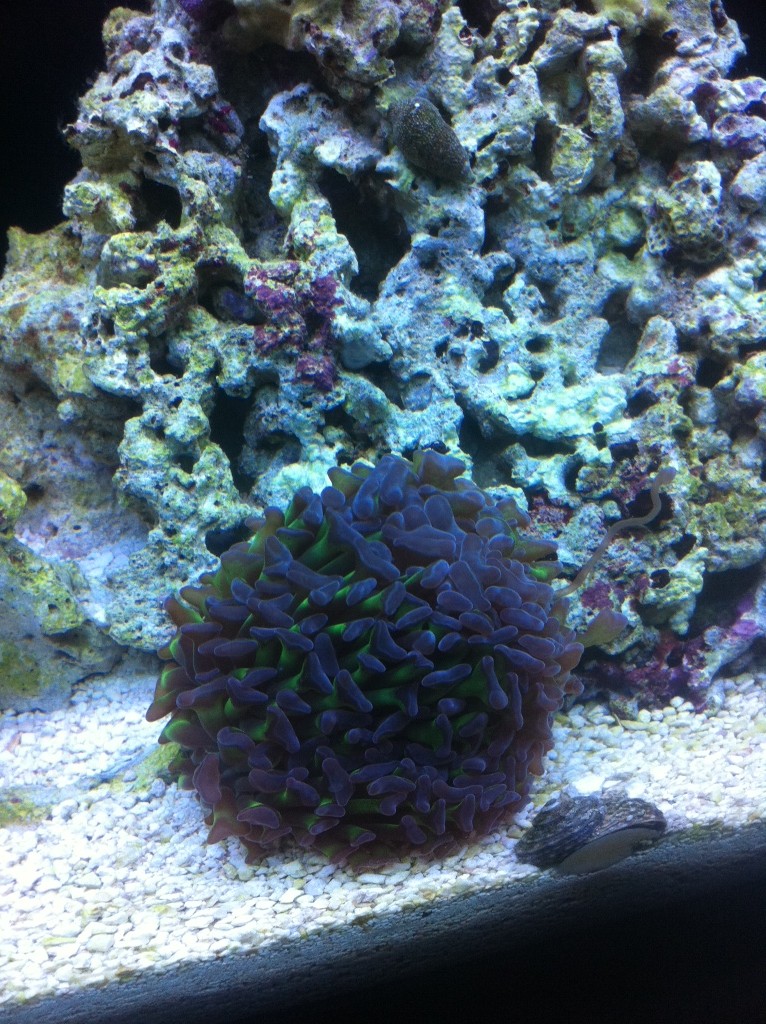
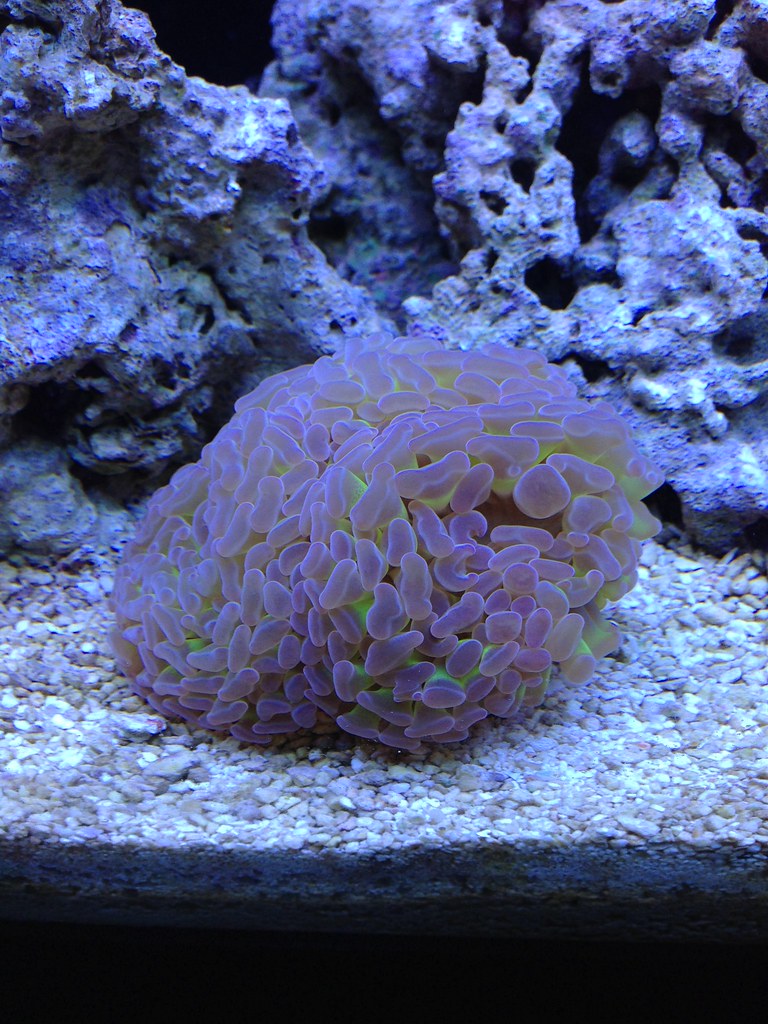
Aussie Purple Hammer Coral when purchased (8-9-12)


Aussie Purple Hammer Coral (11-30-13)


Corals that have completely died:


I went through a round of that in my 90g where all SPS and LPS started bleaching out and receding. After stabilizing my Alk and now dosing Kalk via Litermeter III over a couple of months, everything is coming back slowly, but definitely an improvement.

Good luck!
 
Have you taken any PAR readings to determine what your actual light intensity is? Have you had any success with soft corals?
 
Im a little confused about what happened. So your corals werent doing well, meaning they were bleaching and losing color, so you tried a lot of things, then switched lights, and now they are bleaching, losing color and dying more?

You probably know more than me based on all the data you supplied, so i assume you changed the intensity of your light slowly, and not a huge increase or huge decrease?

My first assumption for sps that are bleaching and dying is water quality issues. you disproved that, so then i would look at the lights. Have you tried shading one of your corals? maybe your lights are TOO intense. shade one of your corals and see if it starts to color back up. If not, then thats not the issue. Maybe your light isnt intense enough. Try moving your coral up really high, if it doesnt color up, then thats not the issue either. If those dont work, then its not your light intensity. I know LED are the new thing now, and i personally really like LED, but really if you arent seeing results at all, try a more proven method. try your T5 light with ATI bulbs. I KNOW T5 lights will grow corals, and if changing to your LED light just made it worse, maybe you should switch back for a while.

If its not the standard things you test for in the water(i assume your readings are consistent, and do not fluctuate very much), and its not the light, is it the flow? are they too blasted, or are they not getting enough? i wouldnt think this is an issue in your tank, but just looking for any possible explanation

you already said no pests (and there wouldnt be a single pest that would cause issues for ALL of your corals).

Do you have only LPS and sps stony corals? how do softies do in your tank? if softies do fine, and stonies do not, it doesnt narrow it down much because stonies are generally more sensitive, but maybe there is an issue specifically targeting stony corals, ie there is an issue with some chemistry affecting their ability to be stony.

If you have literally tried everything, and i kinda feel like you have, then there may be some contaminant that people do not regularly test for? the reef epoxy SHOULDNT be an issue, and any glue you used that was a super glue GEL shouldnt be an issue, but what brand was it, and what are the ingredients? what container do you use to mix saltwater, what container do you use for auto top off? do you have any weird air fragrance things in your house, do you smoke? do you use cleaning chemicals in your house around your tank or sump, and do you have any other pets?
 
I went through a round of that in my 90g where all SPS and LPS started bleaching out and receding. After stabilizing my Alk and now dosing Kalk via Litermeter III over a couple of months, everything is coming back slowly, but definitely an improvement.

Good luck!

Mine is what I could consider stable. Between January 19th of this year and the other day when I tested, the Alkalinity has stayed between 7.84dKH and 8.34dKH. The beginning of last year (2013), I kept it around 7.3dKH thinking that high Alkalinity + ULNS was the cause of the problem. I've since let it come up "naturally" through water changes. When I first set up the tank (June 2012) it was in the 9-10 range before I brought it down by switching salt from IO to Red Sea.


Have you taken any PAR readings to determine what your actual light intensity is? Have you had any success with soft corals?

Unfortunately I haven't and don't have access to a PAR meter. A gentleman on this forum was going to lend me his, but I haven't heard back from him. Perhaps a "Please can I borrow your PAR meter" PM would be in order.

Zoanthids seem to do alright and my LPS does "alright", but nothing that I would call fantastic. They grow, but never have any nice color. I'll throw some pictures at the end of some of them.


Im a little confused about what happened. So your corals werent doing well, meaning they were bleaching and losing color, so you tried a lot of things, then switched lights, and now they are bleaching, losing color and dying more?

Confusing, right? :hmm5:

I'll try and sketch a rough timeline, but to be honest, I can't give you 100% correct details.

When the tank was set up I was using Instant Ocean Salt so my parameters matched that salt (Ca ~430ppm, Alk ~10dKH), but things looked "drab" so I thought that having an ULN system + high Alk was my issue so I switched salts back in January of 2013. Alk was allowed to drop naturally through water changes over the course of about 8 weeks.

June 2013, I increased my Magnesium level to ~1,600ppm to kill off Bryopsis, which worked. Magnesium came down naturally over the course of 12 weeks and was back to normal the middle of September.

In August of 2013 noticed that my remaining clownfish (the female died for no reason in February 2013) was being lethargic and had what I thought was "stringy poop", so I dosed PraziPro. Again, in November of 2013, the same thing happened so I dosed it again. After adding a second clown in April 2014, I've found that clownfish get lethargic and have what "kind of" looks like stringy poop when they eat huge mysis shrimp. My mistake.

Since PraziPro is considered reef safe, I didn't think this had any effect on my color or growth issues.

After having no luck with anything, I decided to swap out my lights with the LEDs. That was done in December of 2013 starting at what Pacific Sun recommended for power and photoperiod. Max intensity 40%, 180 minute sunrise and 180 minute sunset. This was their "acclimation" suggestion.

1pm - Lights come one
4pm - Lights reach maximum intensity of 40%
8pm - Daylight ends and lights enter Sunset
11pm - Sunset ends and moonlights turn on

Where Pacific Sun screwed me was that 40% was way too much if you use the on-tank mounting kit. So it burnt all of my corals really bad. In February 2014, I hung the fixture and the lights are about 15" off the surface of the water. After hanging, I turned the fixture down to 33% because everything was cooked and I didn't want to do any further damage. After leaving it that way and watching the flesh fall off after it had turned brown, I thought that maybe I didn't have enough light, so I bumped it back up to 40% about 3 weeks ago. Things continue to deteriorate. But it is possible that the initial cooking did too much damage for the coral to recover from.....


I know LED are the new thing now, and i personally really like LED, but really if you arent seeing results at all, try a more proven method. try your T5 light with ATI bulbs. I KNOW T5 lights will grow corals, and if changing to your LED light just made it worse, maybe you should switch back for a while.

I've been thinking the same thing, although throwing $1,400 in the trash makes it hard to do.

If its not the standard things you test for in the water(i assume your readings are consistent, and do not fluctuate very much), and its not the light, is it the flow? are they too blasted, or are they not getting enough? i wouldnt think this is an issue in your tank, but just looking for any possible explanation

I have one MP10wES at each end of the tank. They run Reef Crest at a max intensity of 65% during daylight and then go into Lagoon mode at night with max intensity of 30%. I think that would be enough, but I don't know for sure.


If you have literally tried everything, and i kinda feel like you have, then there may be some contaminant that people do not regularly test for? the reef epoxy SHOULDNT be an issue, and any glue you used that was a super glue GEL shouldnt be an issue, but what brand was it, and what are the ingredients? what container do you use to mix saltwater, what container do you use for auto top off? do you have any weird air fragrance things in your house, do you smoke? do you use cleaning chemicals in your house around your tank or sump, and do you have any other pets?

I brought up the rock being sold as used (with the epoxy) thinking it might have been contaminated by whoever had it before me. I could kill my LFS for pulling this crap. I really hate them there, but that's another story.

I buy the Super Glue brand Gel at the Dollar Store. Salt water is mixed in a gray Brute container I bought from Home Depot.

RO/DI is a little bit of a production. :D I initially store water for my ATO in this container I bought from Amazon. Because it's a nightmare to try and use that to pour into the ATO container under my tank, I transfer it into 1g washed out Iced Tea containers. From there, they get poured into the ATO container that sits under the tank. I bought this one from Amazon too.

I smoke cigars, but never in the house. About a year ago, when grasping at straws, I told my wife no more candles, or any type of air freshener. She doesn't use anything near the tank except Windex, which she is forbidden to spray in the living room (that's where the tank is at).

I do have a pest control company come in every 3 months to spray for bugs, but the guy knows to stay really far away from my tank. He also doesn't get anywhere near my mixing station in the basement. My wife is always home and supervises each visit.

The only other pets I have is one Cat and a Betta.
 
After having no luck with anything, I decided to swap out my lights with the LEDs. That was done in December of 2013 starting at what Pacific Sun recommended for power and photoperiod. Max intensity 40%, 180 minute sunrise and 180 minute sunset. This was their "acclimation" suggestion.

1pm - Lights come one
4pm - Lights reach maximum intensity of 40%
8pm - Daylight ends and lights enter Sunset
11pm - Sunset ends and moonlights turn on

Where Pacific Sun screwed me was that 40% was way too much if you use the on-tank mounting kit. So it burnt all of my corals really bad. In February 2014, I hung the fixture and the lights are about 15" off the surface of the water. After hanging, I turned the fixture down to 33% because everything was cooked and I didn't want to do any further damage. After leaving it that way and watching the flesh fall off after it had turned brown, I thought that maybe I didn't have enough light, so I bumped it back up to 40% about 3 weeks ago. Things continue to deteriorate. But it is possible that the initial cooking did too much damage for the coral to recover from.....

Ok, so you are pretty sure that switching lights did cause some damage? That kind of leads me to suspect what you are experiencing is a residual effect of the light burn, but after 4 months I would have thought things would perk up.

I dont know how to save your current corals. This seems rather frustrating.

I do have an idea. Have you added anything since you changed your light? If not, you could go find a no name, purple or drab acro frag that looks HEALTHY. make sure its healthy, it just doesnt have to be something magnificent. Light acclimate this frag to your tank, and DONT CHANGE ANYTHING for a few months. Just light acclimation. If this frag grows, and doesnt bleach, you know that your other corals were damaged by the light, and it is not a chemistry or flow issue.

Also, I have read that when switching salts, you should sort of mix the new salt in with the last bit of old salt, to sort of acclimate your tank to the new salt. I dont know if that is a real thing, or if that is even a big deal since you are basically acclimating your tank to a new salt when you do water changes. (and also you were having issues before you changed salt, so i really don't think that's it)
 
Wait, when did you switch from IO to Red Sea salt? Were your corals fine before the switch?

I'm going to guess on this, but maybe June of 2013. That's probably close, but might be a few months one way or the other.

They were always drab in color, but the were growing. If fine, you mean the flesh wasn't falling off, then yes, they were. :spin1:
 
Ok, so you are pretty sure that switching lights did cause some damage? That kind of leads me to suspect what you are experiencing is a residual effect of the light burn, but after 4 months I would have thought things would perk up.

Things have continued to get worse, but I agree that it is probably residual. I'm 100% sure that the damage was caused by the lights. I wish they would have told about not sitting them on the tank. It cost me a lot of money.

I dont know how to save your current corals. This seems rather frustrating.

It's really sad prying coral off the rock and throwing it in a trash can. :sad2: Based on how things are progressing, I don't think what I have will recover and I'm thinking that I might just throw away all the SPS i currently have since it is all dying.

I do have an idea. Have you added anything since you changed your light? If not, you could go find a no name, purple or drab acro frag that looks HEALTHY. make sure its healthy, it just doesnt have to be something magnificent. Light acclimate this frag to your tank, and DONT CHANGE ANYTHING for a few months. Just light acclimation. If this frag grows, and doesnt bleach, you know that your other corals were damaged by the light, and it is not a chemistry or flow issue.

I did, but it died too. But that was right after I got the light and it was still sitting on the tank.

I've been seriously considering throwing all the dying coral in the trash, switching my lights back to the T5s and going back to IO salt. I know everyone says to do things slowly, but I've done that for 2 years and things have only seem to gotten worse. Maybe I really need to do something drastic. At least before the coral was alive and growing a little.
 
...
Unfortunately I haven't and don't have access to a PAR meter. ....

Easy solution to that... buy one! :)

But seriously... with the amount of grief and $$ loss you're looking at in trying to track this down, wouldn't it make sense to buy a PAR meter to see if it's lighting? You're testing water parameters in a lab (granted, you can do it for free!) but yet just eyeballing light intensity?

$155 at Apogee for the sensor head. Wire it to a multimeter that you probably already have. Multiply mV reading by 5 and you have PAR.
 
First, you should be commended for such a thorough post. It's refreshing to see all of the information right up front as opposed to having to drag it out of the OP.

These are kind of shots in the dark but it almost looks like you are starving the tank. If you are really running ULNS, you have to do some supplementing to keep things healthy. Another thought is your carbon. What kind are you running and are you running it in a reactor? How much are you running?

I've been in your shoes and, in fact, ended up tearing my entire tank down and starting over in January. It was the tank of death. First, I got a bad batch of carbon that basically wiped out my entire tank in a week. Then, I noticed that nothing was doing well. I think at least part of my problem was that I used artificial 'live rock' but I have no proof.
 
I agree with the starving your tank comment. i had issues for years and never could understand why I was. the main steps I took were: (1) taking out all my equipment that was draining PO4 or NO3, except for my refugium, (2) feeding my tank like crazy, both fish and coral food, probably 3-4x what I was before, (3) switched to MH as LED's weren't cutting it. Once I started noticing NO3 and PO4 increasing, suddenly everything started to gain color and grow fast.

also, try to keep your Mg higher, nearer to 1400. i wait until mine gets to 1350 and then I dose 100ppm and go through that cycle.
 
Easy solution to that... buy one! :)

But seriously... with the amount of grief and $$ loss you're looking at in trying to track this down, wouldn't it make sense to buy a PAR meter to see if it's lighting?

You're probably right. Maybe I should just buy the entire contraption as opposed to messing around with a multimeter. I'll have to do a little research and see what's out there.


First, you should be commended for such a thorough post. It's refreshing to see all of the information right up front as opposed to having to drag it out of the OP.

These are kind of shots in the dark but it almost looks like you are starving the tank. If you are really running ULNS, you have to do some supplementing to keep things healthy. Another thought is your carbon. What kind are you running and are you running it in a reactor? How much are you running?

Thanks. I hoped that would help nail down the issue. My tank used to be ULN, but isn't anymore. Up until about 6 months ago I had never registered any Phosphate or Nitrate. Since then, I have added another fish, I feed them more and also add both Oyster & Phyto Feast according to the directions.

Since then, my Nitrates float between 1 - 2ppm and my Phosphate seems to be around 0.04ppm.

I probably run about 1 - 1.5 cups carbon. I was using it very aggressively thinking that there was some contaminant in the tank. I use the BRS Premium 0.8 ROX Carbon.

_________________________________________________________________

I sat down and had a long talk with my wife last night about the tank and its future. She doesn't help with the maintenance, but she really enjoys the tank and understands what I'm doing and why I'm doing certain things. I decided I would let her make the decision, because whatever I'm doing just isn't working. I ran out of salt the other day and she decided that we would be switching back to Instant Ocean from Red Sea.

Her reasoning was that the best our tank every looked, was when we were using Instant Ocean. It didn't look great, but things were growing, they just didn't have much color. She also pointed out all the issues I've had with Red Sea test kits, that she wonders if their salt isn't as poorly made.

I'm going to start doing water changes with the IO and keep everything else the same. She also thought that it might be a good idea to frag off what is salvageable and dispose of the coral that is losing all of its flesh.

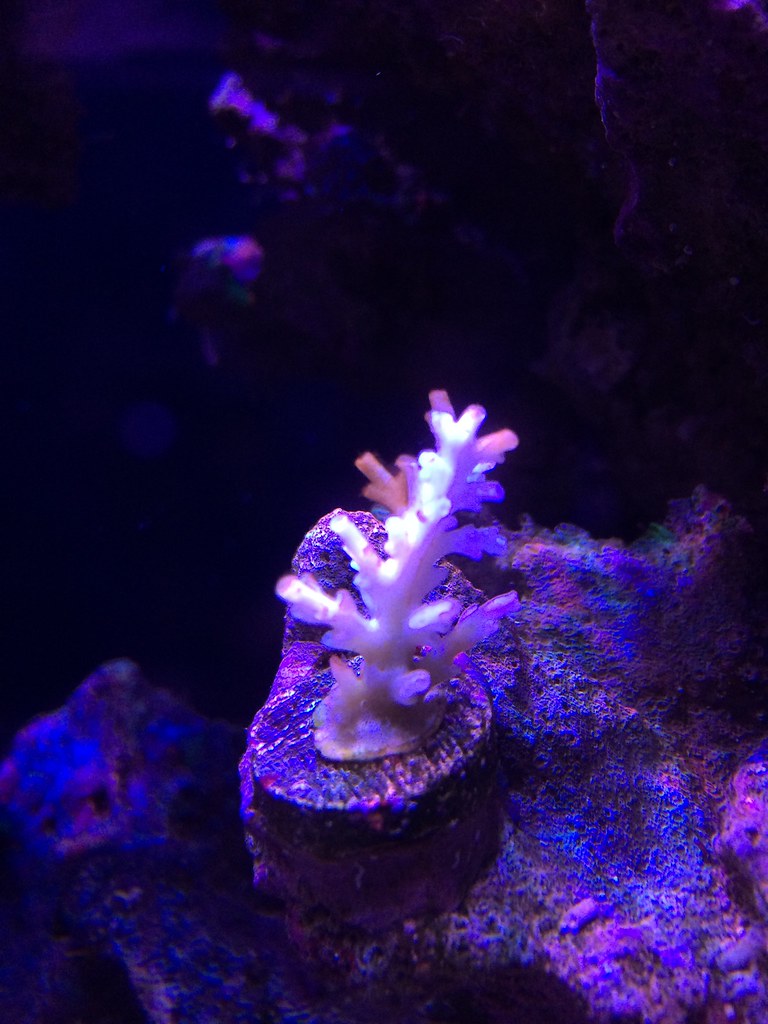
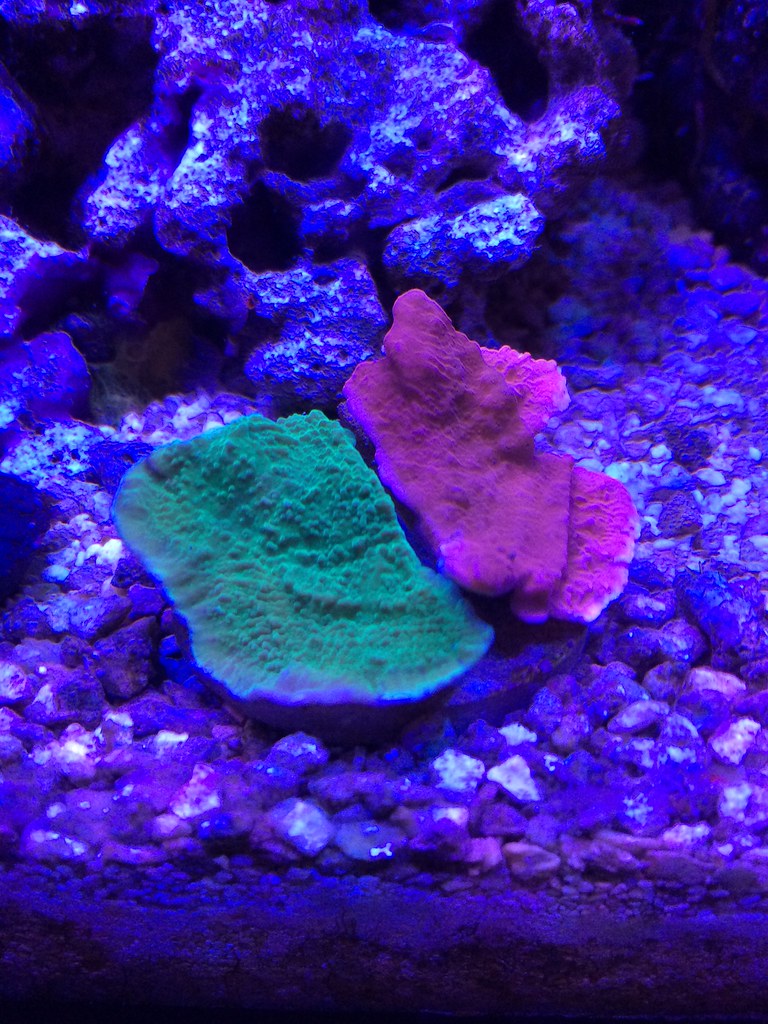
I took your advice 100%hydrophylic and picked up two cheap frags last night and am acclimating them to my lighting. They are sitting on the sand. I'll move them up and they will be the test pieces. I was just going to get an Acro, but I lost my Montipora (it was my favorite) so I got another one to replace it.

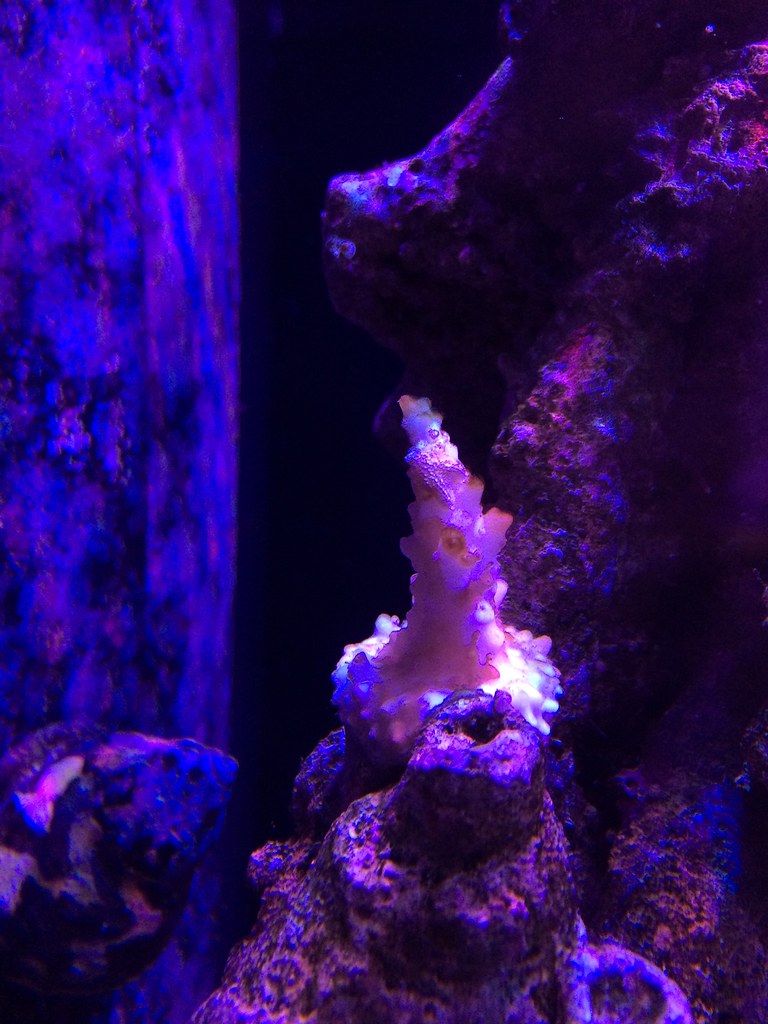
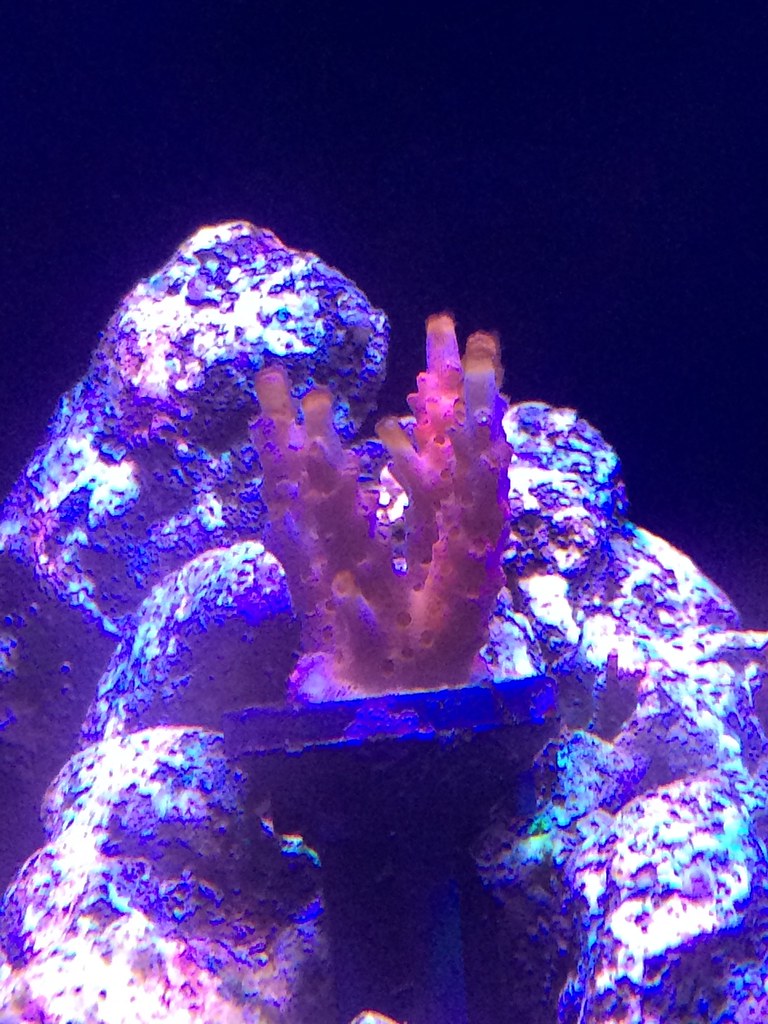
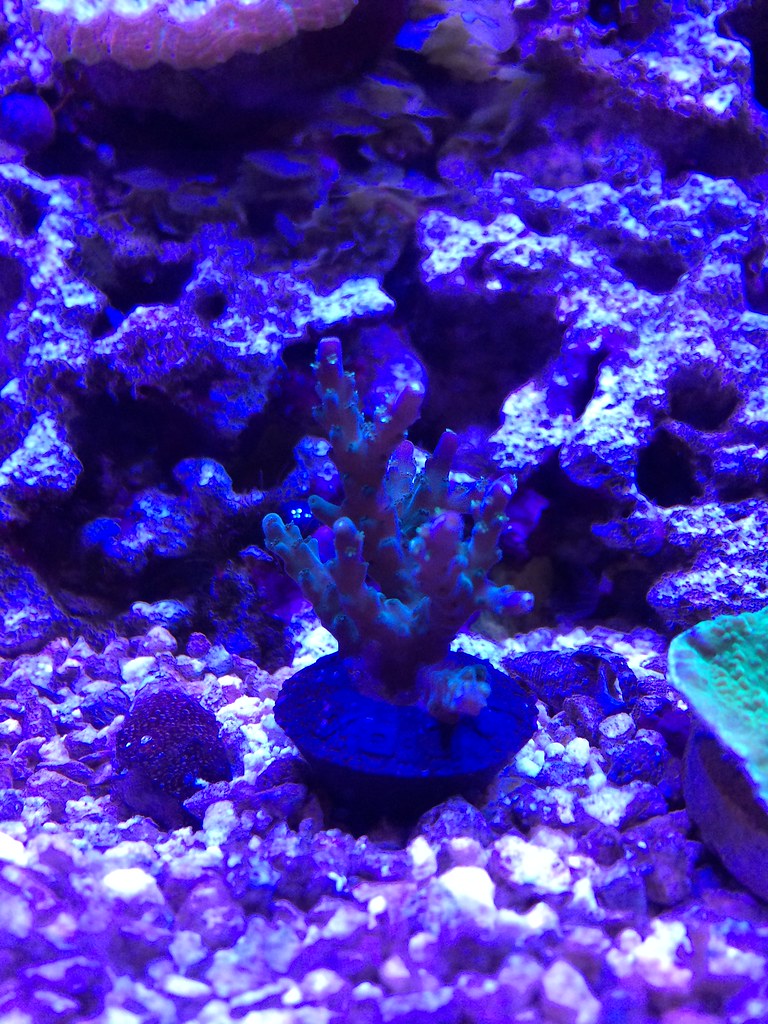
Here they are. It's pretty cool having some color in the tank. Sorry for the terrible Acro shot, but my iPhone isn't a fan of the lighting. Especially at night when it's predominantly blue.


Verde Acropora

14225495867_1cf0ef3d83_b.jpg


Red & Green Montipora


14411936545_ab4d8ae0bc_b.jpg
 
I probably run about 1 - 1.5 cups carbon. I was using it very aggressively thinking that there was some contaminant in the tank. I use the BRS Premium 0.8 ROX Carbon.

hmm, that stuff is quite strong. try backing down to just 1/2 of the recommended dose. at full dosage it will strip hard.

have you considered running a refugium instead of all the reactors for carbon and PO4? plus, Caulerpa is a great indicator of the health of the tank. If you are not feeding your tank enough, the caulerpa will die back.
 
hmm, that stuff is quite strong. try backing down to just 1/2 of the recommended dose. at full dosage it will strip hard.

have you considered running a refugium instead of all the reactors for carbon and PO4? plus, Caulerpa is a great indicator of the health of the tank. If you are not feeding your tank enough, the caulerpa will die back.

I use Chaeto the same way. I know my nutrients (at least nitrates and phosphates) are OK if the Chaeto is growing but I don't have much algae in the display.
 
hmm, that stuff is quite strong. try backing down to just 1/2 of the recommended dose. at full dosage it will strip hard.

I think 1/2 cup is the recommended amount for my tank, but I decided to go aggressive thinking there was some type of contaminant that I can't test for or identify. It's probably been long enough that I could go that route.

have you considered running a refugium instead of all the reactors for carbon and PO4? plus, Caulerpa is a great indicator of the health of the tank. If you are not feeding your tank enough, the caulerpa will die back.

I would love one, but my problem is the stupid sump I bought. I have the ProFlex Model 2 The left chamber is for the socks, the center has my skimmer in it and the one on the far right has my probes, ATO float, return pump and my media reactor pump. There isn't room to run my skimmer in the far right chamber and I don't think can keep the skimmer in the same chamber as the refugium, can you?

I tried running the skimmer in the 3rd section and it was microbubble city.
 
I think 1/2 cup is the recommended amount for my tank, but I decided to go aggressive thinking there was some type of contaminant that I can't test for or identify. It's probably been long enough that I could go that route.

The left chamber is for the socks, the center has my skimmer in it and the one on the far right has my probes, ATO float, return pump and my media reactor pump. There isn't room to run my skimmer in the far right chamber and I don't think can keep the skimmer in the same chamber as the refugium, can you?

I tried running the skimmer in the 3rd section and it was microbubble city.

Re: Carbon - that is for sure step 1 for you, reduce down to 1/4 cup. Rox .8 is just so powerful.

Re: Refugium - best to run the fuge after skimmer, and not together for sure as likely will cause problems with the skimmer pump. the model 2 is pretty big. you could use that 3rd compartment and section it in half (or more) with eggcrate to separate the return pump. you don't need sand with macro algae, so could just tie some to some live rock. it will grow quickly. id recommend caulerpa over chaeto, just know that you need to keep lights over it all night and a good portion of the day (I do 18 hours per day) or else it will go asexual and poison the tank [extremely rare for someone to have this happen, so don't let it intimidate].

what are the measurements of that 3rd compartment?
 
Back
Top