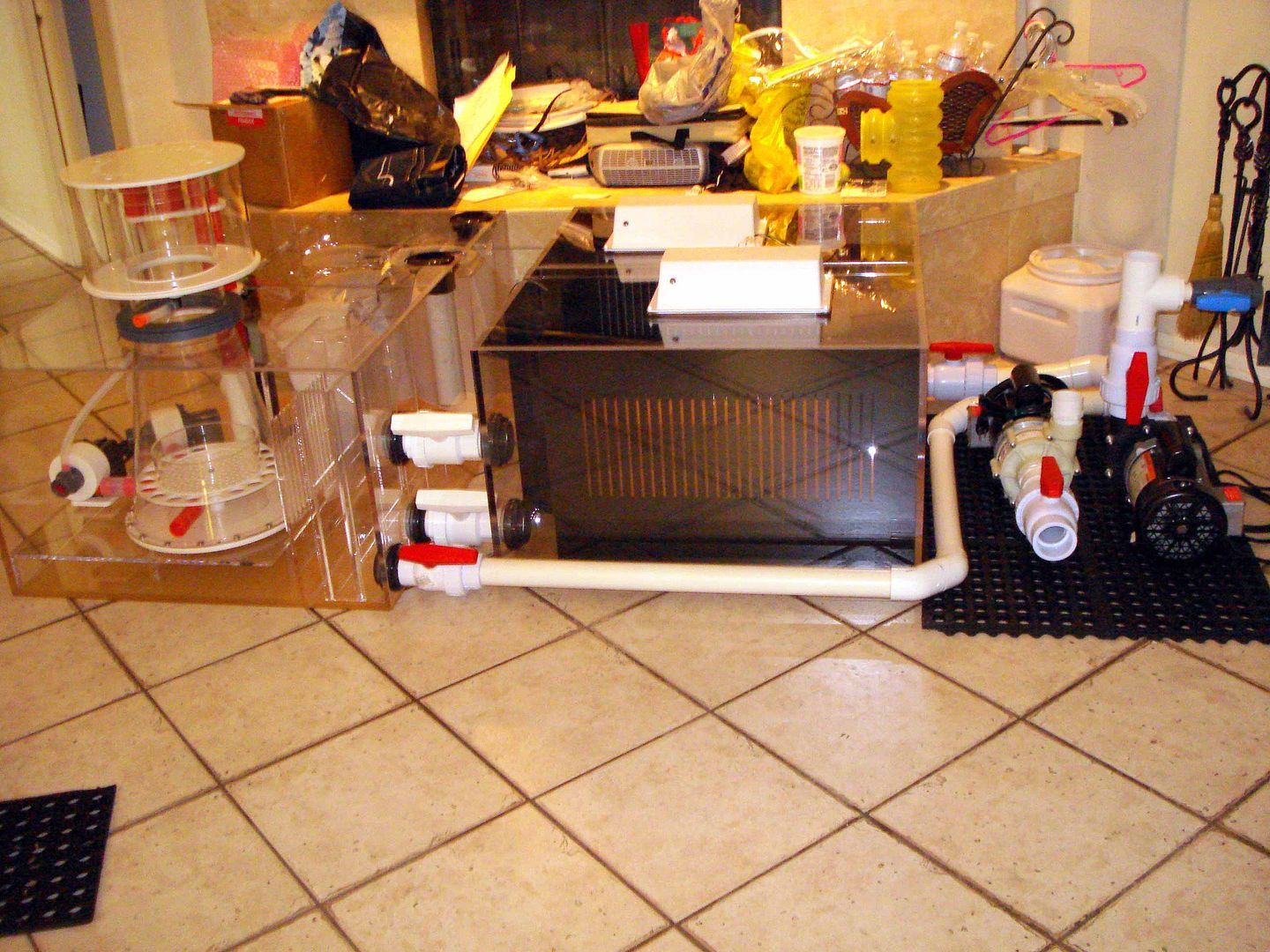
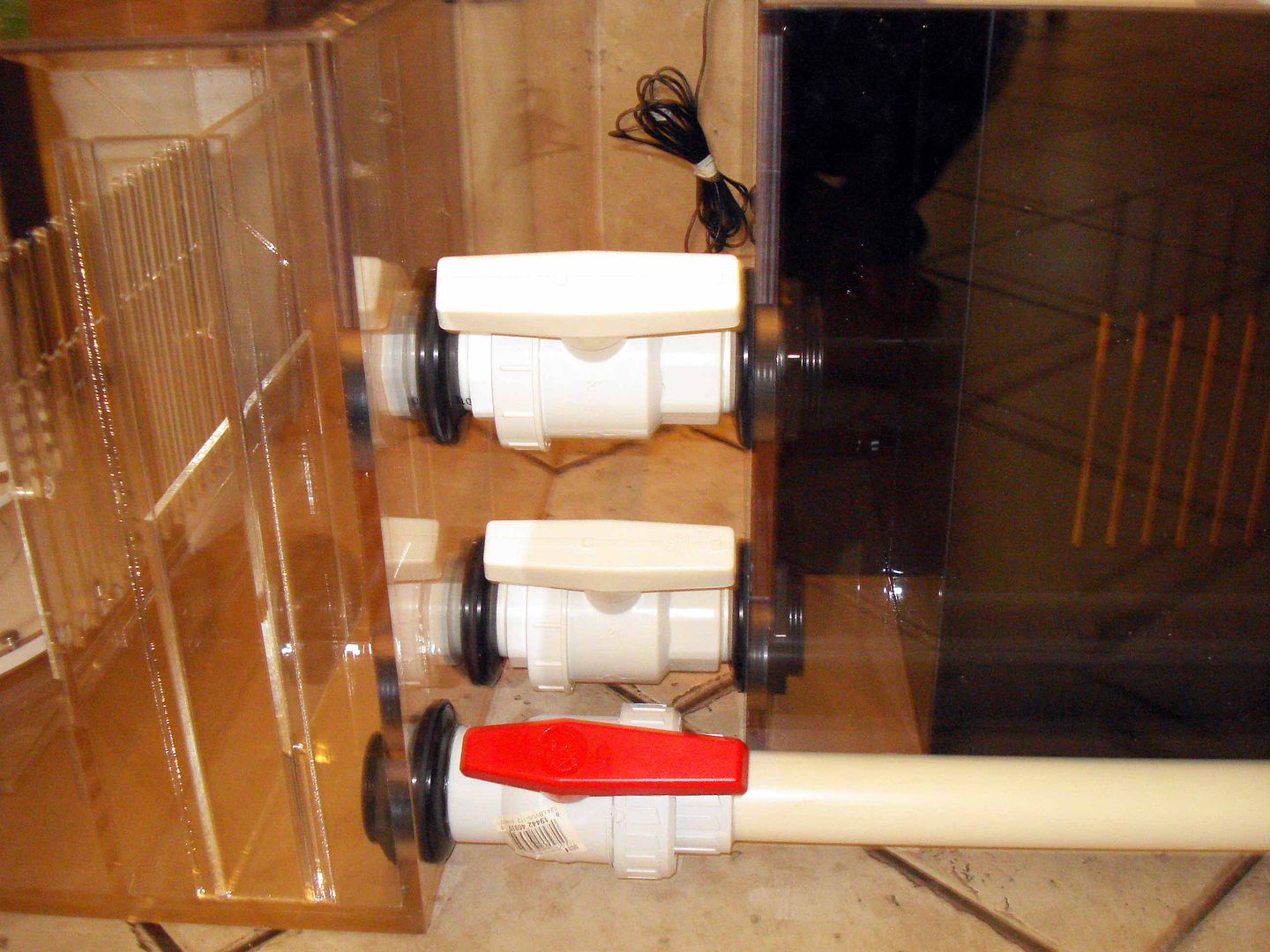
Am i crazy for trying this?

fragbox

New member
DIY Acrylic Sump

10 feet long
16'' wide
14'' high

Would it be crazy if I went with 1/4'' acrylic?

I figure it will only be about half full and have quite a few baffles
Could add top braces for supports as well

Worried about bowing but hoping the baffles will add support to negate it.
What do you think?
Please chime in.
 
With just 14" height, I'd think 1/4" would be fine.

My question is: How would you move this without breaking it? At 10' long, wouldn't 1/4" flex like crazy unless you brace/box it?
 
Haven't thought about that
Would I need to brace/box in order to move it and then take it off afterwards?
 
I think you are crazy, and I've worked as an amatuer with acrylic for years.

Do not take this the wrong way (and I mean no disrespect at all), but since you A) asked if this was a good idea, and B) did not think about how to move it, it seems (to me at least) you might be out of your league on this one. I'd either get someone to build it for you (if you've never done this then a 10 foot sump is not a good starter project), or change your design.

If you don't need drilling or anything you can get a tank that is 100 gallons (about the capacity of your hoped-for sump...110 gallons actually) for less than this will likely cost you in parts alone. It won't be 10 feet long, but it will hold water.

Or, you could find someone to built it for you. In most large metro areas there is a plastics shop that sells cell cast acrylic (what you want to use), and for a fee they will build whatever you want. I'd go with 3/8" (I doubt they would built it with 1/4")...I've built much smaller boxes than what you are looking at with 3/8" and I like to upsize the thickness just to be sure.

But 10 feet is really pushing things...which begs the question of...why?
 
Iv done a nano tank, a 40 gallon sump and 60 gallon sump, a 9 gallon frag tank and 30 gallon frag tank. Iv only every worked with 3/8'' and 1/2''. My tanks usually come out looking pretty crappy and DIY but hold water.

I was going to do 8 feet but found out today that 1/4'' comes in 10 feet and thought might as well go as big as possible. Would only cost about $160 in acrylic.

Do you think 1/4'' for 8 foot long would be ok or still a dumb idea?
 
Okay, you've worked with this before so you know the hazards.

I'd still do 3/8...it will just not give you any issues, and if for some reason the sump needs to hold more water (overflow or something) it would hold it. 8 feet or 10 feet would not matter.

Why is 10 (or 8) feet necessary?
 
I was also wondering why such a large sump and then thought. If this is going in a fish room/basement, it may be pretty cool to also include a frag tank into the sump, you you have some good cross flow and a ton of room to grow out corals. You could have it set up with a refugium at one end with the skimmer and tank return in the middle. Then also run a pump running to the far end where the frags are circulating water back toward the center to be returned to the tank. By pumping water to the frag tank would allow you to adjust the current across the corals.
 
As its not really a display, being one solid piece i don't think is critical... I would instead make 2 tanks half as long. Either 4 or 5 footers would be pretty easy to deal with.

Plumbing them together will be more challenging obviously, but there are ways to do it or just do the more sensible thing and plumb them to a common true sump below.
 
The total length is not as critical as the section lengths assuming the section separations will be solid joints (not flimsy baffle joints).

So the question is: what are the section lengths? 2', 4', 6'?
 
You can get away with 1/4" acrylic by encasing it in wood. You could even leave the front exposed and simply run wood supports every few feet to keep from bowing.

The running water level might not be a problem for 1/4" acrylic but when the power goes out, you may have much more water than that.
 
1/4" acrylic will absolutely bow out on the top edges unless you are going to have a top on it. Even then, you would likely see bowing before long in the middle of the side wall.

With a span that long, I would go with 1/2". As Karimwassef said, what will play a critical role in this would be the length of the sections between the dividers. Anything over 24" will likely bow out if the water level exceeds 7-8". Either way, if this were my sump, I would absolutely go with 1/2". I would also make the dividers go all the way to the top of the sump to provide as much structure as possible. This may mean cutting slots to allow water to pass through but that's the way I would do it. Given then expense of the acrylic, with a sump that size, you want to build or have it built right. That said, unless you have a fair amount of experience working with acrylic, this would be a foolish thing to build on your own as there is too much risk involved should a seam fail. Those a giant spans and without a perfectly level and smooth 10' * bench to work on along with lots of the correct clamps, getting reliable bubble free seams will be next to impossible. IMO
 
Those a giant spans and without a perfectly level and smooth 10' * bench to work on along with lots of the correct clamps, getting reliable bubble free seams will be next to impossible. IMO

That's actually my concern here. Without a PERFECTLY flat surface there will be issues. That said, I'm 100% sure I could build a box that would hold water of that length if I build it on my granite kitchen countertop out of 3/8" or 1/2" with dividers/baffles (or cross supports if the dividers/baffles were too far apart).

I still go back to the [unanswered] question of "why" to the OP. I think it would be better to go with 2 or 3 smaller sumps and tie them together with couplings (like the below) which allow for a bit of "wiggle room" if necessary, and will handle non-level situations better.

611918018263lg.jpg

4-in x 4-in Dia Flexible PVC Coupling
 
I still go back to the [unanswered] question of "why" to the OP. I think it would be better to go with 2 or 3 smaller sumps and tie them together with couplings (like the below) which allow for a bit of "wiggle room" if necessary, and will handle non-level situations better.

611918018263lg.jpg

4-in x 4-in Dia Flexible PVC Coupling

That would certainly make more sense. When I designed my new sump and refugium, I designed them as both separate tanks and connected them via union ball valves. I also designed in a bypass line that allows me to bypass the refugium and draw water from the main sump directly to the return pump just by closing one valve and opening another. In my case, I designed it this way because I was replacing an existing sump and needed to get the new ones under the tank through existing door openings. The only way to accomplish my goal was to build them as two separate units. In the end, it worked out better this was because I was able to add some unique design features to my refugium to handle the high flow but distribute that flow evenly across the entire width of the refugium while also insure that only the refugium was lit with no light leaking into the sump.

This is a shot of the sump/fuge combo. Perhaps it will give the OP some ideas for his design. This setup has served me very well for the last few plus years. It has about 180 gallons of capacity and is fed with a Reeflo Hammerhead Gold pump. That said, they're made from 3/8" acrylic and I still get some deflection along the top edges.

sump-and-fuge_WEB-1.jpg


Sump-and-fuge2.jpg


This shows the refugium bypass setup.
Pump.jpg


This shows the connection between the sump and the refugium along with the bypass line coming out of the sump.
Unions.jpg
 
Last edited:
Its for a store plumbed into 2 frags tanks (16' long, 2 ' wide, 9'' high)

Currently it has a 5 foot sump that is crammed.

When pumps go off it rises an 1'' from the top.

We want to plumb in a 200+ g display = need a larger sump and room for another skimmer. Total water volume in the system will come to about 600 gallons

IMG_3470_zpsa9e9b476.jpg


IMG_3471_zps1291d33d.jpg


final plan
sump_zps43c07609.jpg


Thanks for the advice everyone!
never even thought about making 2 and connecting them
I have an 8' work bench to make it on
if I end up going single 8' sump would 1/4'' be ok just for the bottom pane? Shouldn't be a problem right?

Trying to save $ where we can to pay for the starfire penisula tank! : )
 
Don't save the money...do it right and never have to worry...go with 3/8” all around, including the bottom panel.

You need to do some geometry here and see if you can even get an 8-foot long tank into the space.

Personally, in this situation (now that I see what the need is), I'd make two separate 4-foot tanks, install large bulkheads (see if you can get 4-inch ones), PVC some 4-inch tubes, and use the PVC coupling I outlined above. That will isolate any stresses you would get from a single honkin' long sump. Would still use 3/8”.
 
Excellent!!! Be sure to post some pix when this is done.

By the way, you can have the supplier of the acrylic to all the cuts for you (that's what I do...nice and straight and perfect), and they can even punch the bulkhead holes (be sure to actually have bulkheads in-hand before you do this!!!). This way it's THEIR fault (and cost) if they screw up a hole, etc. I would suggest putting the bulkheads about 2 inches from the bottom...might as well keep them as low as possible.
 
Back
Top