Bacterial Diversity Methods

been reading this thread with interest. My completely uninformed theory is that for lots of various bacterial and other life that should help keep a tank stable is to have multiple enviroments for them to colonize.
In my tank I have a cryptic zone, fuge, low flow LR area, DSB (and interducing critters that utilize it) and lots of LR in the tank. I also believe that spray foam insulation in fact functions better than LR for denitrafing bacteria due to its even more pourus nature. The only proof behind that is that there are constanly bubbles forming on it in my extremely neglected tank and I obviously haven't tested its content.

Granted this tank hasn't been up very long yet, and if my circumstances don't change it will never get to be a decades old tank, but its my theory and I'm running with it.
 
and any potential small amount of copper released should be easily dealt with via some carbon.
There is only stainles steel and graphite contacting water.

I also believe that spray foam insulation in fact functions better than LR for denitrafing bacteria due to its even more pourus nature.

The foam may be better, much of my rock is homemade with hollow PVC skeletons that offer much more surface area than real rock
 
My completely uninformed theory is that for lots of various bacterial and other life that should help keep a tank stable is to have multiple enviroments for them to colonize.

An "uninformed" idea is often better than in "informed" one: once you learn too much it's easy to fall into dogma. The beauty of a newbie is the ability to say "why the hell not?" and just try things :)

About marine biologists and aquarists: clearly not the same thing. I'm in graduate school now and I am just flabbergasted at how many people DON'T dive and DON'T keep tanks. If you love it enough to invest your life in it, why wouldn't you? That said, our school is "Marine Science", so it includes marine biologists, geologists, chemists, etc. A shameful thing is our building has a nice 120 in the lobby, which I affectionately call the "Philippines Post-dynamite Fishing Biotope." The thing has about 40lbs of rock, and about 50 lbs of hair algae (and is maintained by a geologist). You know it's bad when your algae-grazing urchins have algae growing on them :eek1:

Back to bacteria... :)
 
Sprack -No disrespect intended, but- my experience has been that the vast majority of formally educated chemists, marine biologists, engineers and others often are poor aquarists. Not sure why, ( and I fall into more than one of the groups I took a swipe at - so.....) other than I have seen a bit of educated arrogance often replace the very helpful personality traits of humility and wonder.:D

Khaosinc- Just a thought...
I have personally used thousand of gallons of all current forms of isocyanate driven foams, as well as isocyanurate, and other polyurethane derivitives.
I can tell you that I would NEVER want them in my tank. There are many reasons, and I don't want to detract further from the thread - but you can PM me if I can be of some help to you.
I realize it is quick, and the "cool" stuff to use, but it is not long term a great product - and was never designed for the purpose.:beer:

And you are right...back to bacteria!

T
 
Great topic....I have been in this hobby for over 4o years and I think we are always tweaking our closed systems without totally understanding the dynamics of bacterial changes. Fortunately I have different large systems I can experiment with and monitor the results simply by water chemistry and observing the reef and health of animals.
Case in point;
I set-up a 1200 gal tank August 08 and started using Prodibio on the onset. I replaced a 600 gal with the larger tank and kept many of the same corals and rock. Never any algae problems but some diverse sponge life like I have never had before. I started dosing vodka about a year later. (simply an experiment as nitrates and phosphates were never a problem) I was still dosing weekly Prodibio with the vodka.
The tank still loo0ked great but I noticed some color changes in the SPS. Everything else was the same. Some of the SPS were brighter and more growth rates were unbelievable.
About 6 months ago I stopped the Prodibio and kept the vodka dosing.After 3 months the tank still looked great but I noticed some of the exotic spong growth I had was beginning to receed. I ran out of Prodibio and thought I would save the money and not reorder. I started using the prodibio again about a month ago and noticed recently the sponge is coming back.
As I said I am always tweaking with-out understanding exactly what is happening with the bacteria changes. For me, the look of my tank seems to lead me in the direction I need to take .

I have a 550 that I set-up the month of 911. Had a deeper sand bed , and I was never happy with the total filtration of the tank Tank always did well but never the color or sponge growth of the 1200. I never used Prodibio in the 550. After about 4 years the tank started showing signs of OTS. I nursed it along for a couple of years and thought about tearing it down and changing the sand bed debth and filtration. Always had a little nitrate and phosphate problem but no real algae problems.
I decided to try to keep the tank-up, change my bateria dynamics, and slowly remove the sand bed. This was a year and a half ago and I started dosing vodka and every month I would remove a little of the sand bed with a 10% water change. I had some unbelievable algae blooms on the sand bed but decided to keep-up the vodka dosing and slow sand bed removal. I still did not use Prodibio in this tank.
My goal was to get rid of the OTS, make the tank look alive again, totally reduce nitrates and phosphates, remove some of the sand to a 2" depth and take-out 30% of the rock with -out tearing the tank apart.
After 6 months the algae on the sand bed began to disappear and the nitrates were dropping. I slowily removed some of the rock each month and was amazed that the older rock had fused together with sponge growth and created shapes I could not have developed with even a peg rock method
Again the visual results were my overwhelming guide. Chemically the tank was responding and the bacterial growth was increasing even though I had removed almost half the sand bed and 30% of the live rock.
Today I still only dose vodka in this tank (never any Prodibio) and I started using the Vodka pellets about 3 months ago in the filtration system. This tank now looks great but does not have the sponge diversity of the 1200 gallon system even though I tried to introduce some of the sponge in the 550 from the 1200.
IMO we are always playing with bacterial diversity without understanding what is actually happening. I believe the Prodibio that I add to the 1200 gallon system introduces a bacterial source that the sponges feed on that I can not get in the 550 without Prodibio. The bio pellets in the 550 create a bacterial diversity that I do not have or can create in the 1200.
I feed the 1200 gal about three times a day which certainly affects the bacterial diversity.
I am now changing the GFO and Activated Carbon every two weeks in the 1200 gallon system to see what happens. I am getting less algae on the glass but a little less coraline color.
Hopes this helps with reefers that are fighting cyno,algae blooms, diatom outbreaks. I think we can strip the bacteria down to levels that work and maintain our systems or add bacterial stains that feed the reef and maintain life forms that years ago were impossible. Thanks

Welcome S. Hurlock! (if you guys want to push for pics,this is the guy you want to push. He has amazing systems.)

After absorbing all of the thoughts and theories from these posts, I still haven't been able to get past my original thought in my original post of "Assuming bacterial diversity is a good thing..." outside of the fact that I have see-sawed on that original assumption.....

I realize that Prodibio was simply a transient bacterial addition that would remain in the water column, feed, grow and die to be skimmed out.
I now realize that a new bacterial addition may, at least in the short term with each dose, also provide nutrition to some of the organisms in my tank.

I have always strived, for the 20 years I have had tanks, to keep an influx of new organisms, rock, sand etc. (even small amounts) to keep the bacterial populations 'freshened up'.

I have come to the personal conclusion (at least as of this evening) that a bacterial diversity regimen results in the addition of transitory bacterial populations that may: provide food for some of the organisms in my system, may consume some organics prior to being outcompeted, dying and being skimmed out and may introduce some detrimental organisms to the system resulting in a 'disruption'.
 

Attachments

  • IMG_2029.jpg
    IMG_2029.jpg
    59.1 KB · Views: 20
Sprack -No disrespect intended, but- my experience has been that the vast majority of formally educated chemists, marine biologists, engineers and others often are poor aquarists. Not sure why, ( and I fall into more than one of the groups I took a swipe at - so.....) other than I have seen a bit of educated arrogance often replace the very helpful personality traits of humility and wonder.:D

None taken, I agree with you :beer:
 
I do find it erksome that we have many "experts" in this hobby that can espouse theory, and science - but cannot produce pictures of their own tank that is exemplary of the results they claim will follow if one adheres to their advice.

I would love to see pics of your tanks. I am sure they will not dissapoint!

T

Well....... As far as being an "expert", I'll just refer you to Paul's post. I think he covered that about as well as it can be covered. Actually, I think it should be on the home page of RC for everyone to see.

What if someone didn't have a tank at all? Would it make what they're saying any more or less true?

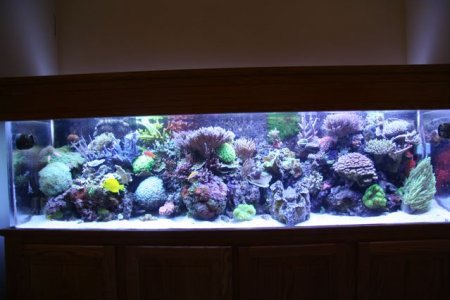
As far as pictures go, I usually don't keep a large display in my living room. I have my own little "man cave" were I set up different smaller systems with different critters and do experiments to learn what makes them tick. Cosmetics usually isn't my goal. I do have photos though. Mostly of critters I've kept over the years, but here are a couple of a tank I set up for the wife.


sn851738editedpu4.jpg


sn851210editedkw9.jpg


editedi.jpg
 
I will be collecting bacteria this week when I work on my boat. However I will not let them read this thread as I believe they are doing some type of good.
I hope so anyway or else I have been hauling mud home for three decades for nothing. :D

Besides the mud I also get an added bonus in all of the copepods, worms and amphipods present in the mud. I also don't know if any of that is beneficial but that is for another thread. :wavehand:
 
Well....... As far as being an "expert", I'll just refer you to Paul's post. I think he covered that about as well as it can be covered. Actually, I think it should be on the home page of RC for everyone to see.

Elegance- let me be clear - I was NOT referring to Paul.:thumbsup: or anyone specific. If you have seen my posts - you will notice I have an over-abundant tendency to speak directly...too directly sometimes:eek1:
What if someone didn't have a tank at all? Would it make what they're saying any more or less true?
It would certainly call into question the validity of EXPERIENCE from which they make the comment...Would it not? Would you take the advice of a physician who could not - for some reason/excuse - practice medicine legally?
Or, could you trust the advice of an attorney that was not currently able to practice law...?
Or - would you climb into an aircraft with an instructor that did not have his current liscence to teach?


Too serious? - maybe...but I don't like to waste time, money or frustration on things that can be eliminated. That includes - sometimes - advice:D

As far as pictures go, I usually don't keep a large display in my living room. I have my own little "man cave" were I set up different smaller systems with different critters and do experiments to learn what makes them tick. Cosmetics usually isn't my goal. I do have photos though. Mostly of critters I've kept over the years, but here are a couple of a tank I set up for the wife.
Looks nice to me! You obviously have demonstrated that you have great experience in the hobby.
We live in an era rife with the availabilty of information. Anyone that can read well, and has good comprehension skills can "claim" anything they want. I just like to see "the body of work" that some of us that have been in the hobby a while have accrued. it is just fun, and interesting to me.


sn851738editedpu4.jpg


sn851210editedkw9.jpg


editedi.jpg
 
After reading through the great input here, I am still of the opinion that a coral reef is constantly washed with a multitude of organisms. Generaly speaking I dont think most of us want our tanks to become a "cave". We want to create a piece of a coral reef. It would seem as much diversity as possible (including pathological) is what we want.
As far as making research in this area profitable, I pointed out that all of us would profit by a better understanding of the oceans because they cover 80% + of the earth surface.
"Driving" a reeftank creates a better understanding of all ecosystems and, in the long run benefits all of us. Some body will, and always has, figured out how to make a buck.
Thanks again to all of you, for sharing your knowlege and, in this forum, commercial free to boot.
 
Wow, this is a high level discussion. I thought this website was just people overcharging each other for zoanthids- I guess I should have joined sooner.

I spent many years in aquarium retail, and I always recommended for people to replenish their sandbeds with wild-harvested sand a few times every year. The idea was that not only would they keep their diversity replenished (thinking more about larger fauna, but bacteria too), they would also replace sand that went into solution over time. If I remember correctly, the Fenner and Calfo invert book suggested swapping out pieces of live rock periodically as well, and I did have some clients who would do that every year or so based on that advice.

As I read through this thread, I wonder how much difference all that effort really made to our bacterial populations, considering that we "cross-contaminate" our tanks so often anyway. I have to imagine, and maybe you guys can confirm, that the act of swapping corals, buying wild organisms like corals or snails, and even frozen foods would almost certainly contribute new and different bacterial matter to people's tanks.

Also, our store sold RO/DI and saltwater, and people would dip the self-serve hose spouts into their buckets that I know a lot of them siphoned "dirty" tank water into. I'm sure there was some microbial cross-contamination from so many people essentially sharing water container germs.
 
I have to imagine, and maybe you guys can confirm, that the act of swapping corals, buying wild organisms like corals or snails, and even frozen foods would almost certainly contribute new and different bacterial matter to people's tanks.

Yes, all this you mention would definitely contribute new and different bacterial species to people's tanks. Every new organism (whether it's a coral, a snail, a fish) is home to it's own particular mix of bacterial species. Introducing this organism to your tank means that you introduce a new mix of bacteria, some novel to your tank, some you already have. But these bacteria will usually not end up colonizing your water surface, your live rock, your filter material, your sand bed, etc. They are usually specialized at colonizing the particular organism that they came with and will stay there. They might colonize other related organisms already present in your tank, though. And if you bring in a new piece of live rock you certainly introduce bacteria that will compete with your existing rock-living bacteria for inhabiting your tank's rocks; and if you bring in a sample of ocean water you introduce free-living bacteria that will compete with the bacteria you already have in your tank's water.

My hypothesis is that -- unless you have done something that would have decimated certain bacterial species from your tank -- recently introduced bacteria will not fair well in competition with those already established. Both because the new bacteria has a low population size (compared to the old-timers) and because the old-timers already have proven themselves adept at thriving in your tank. The newcomers might exist transiently in your tank, and do lots of good while being there, but will eventually, like so many others before them, be out-competed by the old-timers.

If OTS is true, and the tank has many unfulfilled metabolic niches at offer for the newcomers, then adding new bacteria to your tank may be very beneficial.
 
So.... the day I first posed the question concerning methods of adding bacterial biodiversity to a system 10 days ago, I have taken two actions.

1. I have gone from a weekly (RO/DI) water change of 25% to a bi-weekly water change.
The thought being that although I was stripping out some pollution, I was also stripping out some of the built up live bacterial population from the water column.

2. I added a sweet potato sized piece of live base rock to my sump from another system to 'freshen' the bacterial populations.
Although the specific bacterial strains are unknown, I considered the method to be much like adding a Prodibio or other bacterial inoculation.

Anecdotal results are a marked decrease and/or elimination of the cyano on some of the rocks which had been present for months and a marked increase in coral health with much more polyp extension and color.

Coincidence? Maybe, but it begs the question(s):

Can too many water changes actually be detrimental as it replaces some bacterially "หœcharged' water with comparatively sterile water?

Accepting that long-term diversity is difficult to introduce, can an inoculation from a piece of live rock provide a short-term (and relatively inexpensive) transitory benefit much like a Prodibio or MB7?
 
Michael, see I told you this hobby was easy....you give me a piece of your live rock and I will give you a piece of mine.
Again I think diversity of bacteria is just part of the overall success of a good reef system I have tried all different types of water changes over the years, some monthly and sone less frequently. On the 1200 gal I change about 100 gals a month and the 550 I change 40 gals a month.
After feeding the large tank more frequently for a while (I LIKE FAT TANGS) I was getting a little of the dark fuzz algae on the rock surfaces. I began changing the GFO and Carbon every two weeks instead of monthly. In about two months the algae was gone. As I said one of the things I love about this hobby is the visual changes that take place that we can tweek and control to keep the system in some balance. Bacteria is just a part of the equation. As a tank becomes established we can overcome some of our short term mistakes (over feeding,letting cyno get established,letting lights get too old,lack of water changes) by increasing our husbantry when we decide to take action. A friend of mine, Cris Capp (business Aquatic Art) talk on a daily bases. Cris has a theory that he calls the three strike rule. As a reef adapts to even poor conditions you can bring it around but it has to be done in phases. Too many people have lost systems by all of a sudden changing the lights, adding new live rock(bacteria) water change, carbon all at once. The corals can not adapt to that sudden of a change even though you think that is the beat conditions for them. Doing this over a period of a month is great but not all in a weekend.
I will change carbon and GFO at once but never the same time I do a water change.
If I change my lights (Radiums no longer than 7 months) I do nothing else to the system.
I think if you are going to add different bacteria strains (which is great) you let that take action and nothing else until you observe your system for a while. It is great to watch the dynamics of a closed reef system change knowing you had a lot to do with it but without totally understanding WHY. Hurlock
 

Similar threads

Back
Top