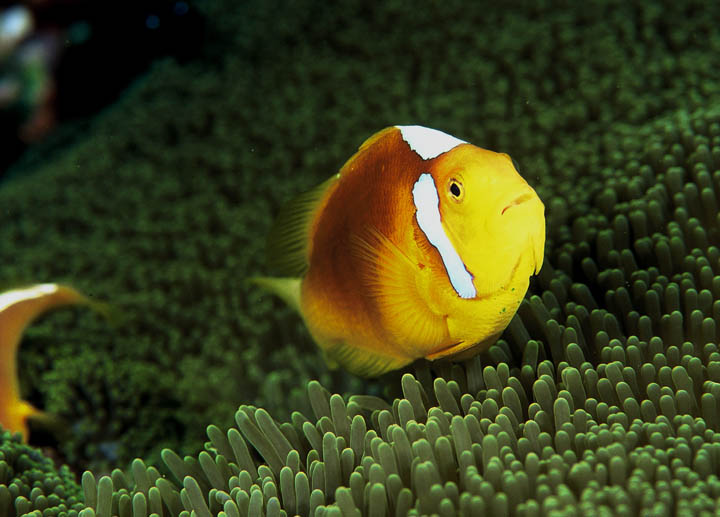
Be on the lookout for a small White Cap

phender

Active member
I went to visit the wholesalers in Los Angeles yesterday (no, I can't get you anything), and noticed a small white cap clown on the "In stock" list. When I asked where it was, I was told that it was already sold when it came it. In the case of this wholesaler, that often means that it is going to LiveAquaria.

If you are looking for a small leukocranos, you might want to subscribe to the Divers Den email updates.
 
DOEP164-024.jpg


I believe its common name is the White Bonnet Clownfish???
 
<a href=showthread.php?s=&postid=11177141#post11177141 target=_blank>Originally posted</a> by reefman13
I believe its common name is the White Bonnet Clownfish???

If you live in Australia. :)

But, that is the trouble with common names. Most dealers, collectors, importers, etc. in the U.S. (at least on the West Coast) refer to them as white cap clowns. If you said white-bonnet, they would know what you meant, but they would look at you funny and figure that you had only read about them in books.


And Gary and I misspelled it. (Gary probably just didn't want to correct me ;) ) I always switch the "c" and the "k".

Its Amphiprion leucokranos, which in itself is probably not correct because it is likely not a species at all, but a naturally occuring hybrid.

FWIW: The species name literally translates to white helmet clownfish.
 
<a href=showthread.php?s=&postid=11177282#post11177282 target=_blank>Originally posted</a> by phender
And Gary and I misspelled it. (Gary probably just didn't want to correct me ;) ) I always switch the "c" and the "k".

Its Amphiprion leucokranos
I sensed something was up with that spelling but I just cut and pasted what you put up, Phil.

Uh oh, I hear the sirens coming... :D
 
"A. Leucokranos, White-bonnet Clownfish

Amphiprion leucokranos is another skunk clown kindrid species. It rarely appears in the aquarium trade and is not hardy by clownfish standards. Although their "classic" design features a teardrop-shaped white dorsal splash near the head (the"bonnet") and matching white splashes of color and striping can be highly variable. They range in color from tan to brown to orange to pink. Siblings may have no whitbe dorsal stripe, a full length dorsal stripe, or anything in between. The head stripe can be wide or narrow, partial or complete, white or blue.

These are the precious "mutts" of the clownfish family and are almost certainly hybrid offspring crosses between A. chrysopterus and one of the skunk clowns, probably A. sandaracinos Maximum length for this fish is 3 1/2 inches (90 millimeters).

If you happen to see this fish and want it, you need to make arrangements to buy it at once, as they are seldom available. Being rare, they should fetch a hefty sum for those who can supply the aquarium market, but remember that the offspring may not all look like their parents. Regardless, it should be fascinating to see what sort of variations you get from a pair of White-bonnets."


This is quoted out of Wilkersons book Clownfishes just so people know what we're talking about here!

 
Last edited:
Ms. Wilkerson takes most of her common names in her book from Gerald Allen writings. This makes sense since he is the world's foremost authority on damselfish. He is also the person who wrote the first description of A. leucokranos and uses the common name White-bonnet clown. Mr. Allen also lives in......(wait for it).......Australia.

Common names are not prescribed. They are the name commonly in use. The Wilkerson book also lists the common name of A. melanopus as the Red and Black clown. She does give cinnamon in parentheses, but no one in the U.S. uses Red and Black as a common name. She lists the common name for chrysopterus as Orange-fin clown. Any chrysopterus I have ever seen went by the common name Blue-Stripe clown. This is why we try to use the scientific name as much as possible in this forum to avoid confusion. I normally try to work in both the common and scientific name.

The reason I used white-cap instead of white-bonnet is because I have never heard anyone who has had these clowns or has dealt extensively with these clowns in the U.S., call them anything but white-caps.

Don't get me started on common names or I will have to tell you the story about being invited to go shoot gophers in Montana. :D
 
<a href=showthread.php?s=&postid=11179173#post11179173 target=_blank>Originally posted</a> by phender

Don't get me started on common names or I will have to tell you the story about being invited to go shoot gophers in Montana. :D

Now you have to tell us!!:)
 
Sorry, the only reason i looked it up is because me myself have only heard of these guys through her book. And i've NEVER saw one.

Phender do you recommend a Gerald Allen book?
 
<a href=showthread.php?s=&postid=11180646#post11180646 target=_blank>Originally posted</a> by cartman5579
Sorry, the only reason i looked it up is because me myself have only heard of these guys through her book. And i've NEVER saw one.

Phender do you recommend a Gerald Allen book?

Besides the book he wrote with Daphne Fautin, "Anemonefish and their Host Sea Anemones", he has written a couple other specifically on clowns.

"The Anemonefishes: Their Classification and Biology-2nd Edition", is an interesting one that is based on a study done on the Marshall Islands. It includes fin ray counts, stomach contents, growth charts and other real science type stuff. It also includes individual info on all the known clown species at that time. A description of leucokranos is only in the 2nd edition.

Since you asked the question I found another book that appears in many bibliographies, "The Anemonefishes of the World: Species, Care, and Breeding" that I just ordered, so I haven't seen it yet.

The last two books are out of print, but you can find them on Amazon.
 
Back
Top