Best husbandry questions

pommie

Member
I've been running my tank for over a year now and whilst it's fairly stable I still have some doubts in what m doing...

The tank is 600 litres
Mainly LPs with a couple of Acro
Tank parameters are

Kh- 8.4
Ca- 450
Mg- 1360

Phosphates and nitrates are undedectable.

I siphon approx 15% from the sand bed every week.
The siphoned water is always dirty
The top of the sand layer is always starting to discolour by the end of the week.
I'm feeding 1 cube every 2 -3 days

Q. Should siphoned water always be dirty?
Q. Does siphoning sand remove pods and other good critters?
Q. Is it normal for the sand bed to get visible detritus within a week?
Q. Is it good practice to move the corals, rocks when siphoning the sand bed?
Q. Is it benificial to brush any of the rocks (with a toothbrush) to remove any algea or detritus?


Thanks
 
Last edited:
I siphon approx 15% from the sand bed every week.
The siphoned water is always dirty
The top of the sand layer is always starting to discolour by the end of the week.
I'm feeding 1 cube every 2 -3 days

Q. Should siphoned water always be dirty?
Q. Does siphoning sand remove pods and other good critters?
Q. Is it normal for the sand bed to get visible detritus within a week?

Thanks

When you say that you siphon 15% of the sand bed every week, do you mean you siphon 15% of the surface area of the sand bed or 15% of the water volume of the tank while vacuuming the sand bed?

I only vacuum the sand bed if it develops something I feel needs to be removed, like a bit of cyano every once and awhile. Otherwise I leave it alone or gently just disturb the sand surface to bring 'clean' sand to the surface... and that is a rare event. But then I don't have that much sand surface and I do have a lot of CUC.

If you are siphoning water at the surface of the sand, yes, I think it will likely always look dirty.

Odds are you will probably catch a few pods when you vacuum the sand surface, but IMHO most pods tend to be near protected places like rocks or corals.

Are you sure it's visible detritus? I'd say no, it's not normal, especially if you have a good CUC and only feed 1 cube of frozen food every 2 or 3 days (but you didn't say how many fish that is feeding). Any chance it's some diatoms similar to the film that develops on the glass? That kind of a brown film on the sand is quite common.
 
Thanks for your reply, i think for the tank size my bio load is normal.

Pair of ocellaris clowns
Pair of adult Banggai Carindals (and a couple of babies).
Foxface
Yellow Watchman
Royal Gramma
Lawnmower Blenny
Yellow tang
Blue Tang
Flame Angel

Yes i siphon 15% of water weekly.
Am i sure its detritus? Not really, i just assumed that any kind of build up on the sand bed would be classed as detritus.
 
Its not good to move the corals to siphon the sand because they grow towards the light.If you moove the corals ,you will not be able to place them exactly in the position they were sitting and somme parts of the corals will become shaded.Depends on the coral thogh,if its a small frag that the light falls directly on it from every direction then is not a worry but if its an sps coral with manny branches then the shadowed parts wont be the same after you moved it.Also ,i wouldnt brush the rocks too hard because there is a surface layer of calcium that deposits on the rock surface and that layer prevents the rock from melting and leaching phosphates.Its similar to, when you add a new dry rock to the aquarium that will leach phosphates and get covered in cyano until it will get sealed by that layer of calcium.To get rid of the detritus in the sand i wanted to build for my aquarium a RUGF.Basically a sand filter that will push the detritus out.PaulB on here has one.For the RUGF i wasnt inspired by PaulB thogh and i designed my own RUGF with a powerfull pump and a timer that is able to stir the sand a few time a day(not continuous ,litle flow like PaulB RUGF).
 
Its not good to move the corals to siphon the sand because they grow towards the light.If you moove the corals ,you will not be able to place them exactly in the position they were sitting and somme parts of the corals will become shaded.Depends on the coral thogh,if its a small frag that the light falls directly on it from every direction then is not a worry but if its an sps coral with manny branches then the shadowed parts wont be the same after you moved it.Also ,i wouldnt brush the rocks too hard because there is a surface layer of calcium that deposits on the rock surface and that layer prevents the rock from melting and leaching phosphates.Its similar to, when you add a new dry rock to the aquarium that will leach phosphates and get covered in cyano until it will get sealed by that layer of calcium.To get rid of the detritus in the sand i wanted to build for my aquarium a RUGF.Basically a sand filter that will push the detritus out.PaulB on here has one.For the RUGF i wasnt inspired by PaulB thogh and i designed my own RUGF with a powerfull pump and a timer that is able to stir the sand a few time a day(not continuous ,litle flow like PaulB RUGF).

Thanks for the tips.
 
Diatoms or cyano would not be classified as detritus. They are growing because of an imbalance somewhere. Either too high of a bioload for your filtration, or too little flow for example. You could try increasing the flow around your sand bed, and also add some sand stirrers like nassarius snails. Also, in my experience, fighting conch snails do an excellent job at keeping the top layer of sand white. For that size tank, you could get a couple. They are fun to watch too.
 
Diatoms or cyano would not be classified as detritus. They are growing because of an imbalance somewhere. Either too high of a bioload for your filtration, or too little flow for example. You could try increasing the flow around your sand bed, and also add some sand stirrers like nassarius snails. Also, in my experience, fighting conch snails do an excellent job at keeping the top layer of sand white. For that size tank, you could get a couple. They are fun to watch too.

Thanks. Ive no Cyno or Diatoms and im pretty certain i have enough flow (2 x Tunze 6095 + Gyre XF150).

Ive tried positioning the powerheads to stir up sand but it always ends up in a sandstorm. Is this just trial an error with the flow then?

CUC i have plenty of snails mainly Turbo and Trochus, my nassarius didnt seem to last that long for some reason?
 
Hmm i think ive found the answer to my problem. Being a newbie when i setup the tank 1 year ago i used Argonite sand and what im reading now is that it can trap detritus due to the size of the size of the grains.
 
If the top layer of sand is starting to discolor, then that is most likely diatoms. For sourcing nassarius, try the vibex variety from reef cleaners. They are smaller, so get 2-3 for every one of the larger ones. Some of the snails sold as nassarius are actually a cold water variety that don't do well in reef tanks.

And aragonite sand doesn't say anything about the particle size. Most people use aragonite. There are different grades. Larger sizes tend to trap detritus more then smaller, but you need to strike a balance between small grain size and flow without blowing it around. Since you say you create sandstorms when you try to increase flow, im guess you have a smaller grain size.

Try a couple conch snails. I think they will help to keep the surface clean.

How deep is your sand?
 
Sorry I thought diatoms were caused by excess silica during the initial cycling and didnt think i would have them now (my sand bed is not brown, its kind of dusty).

Note: I use NSW and topup with RODI.

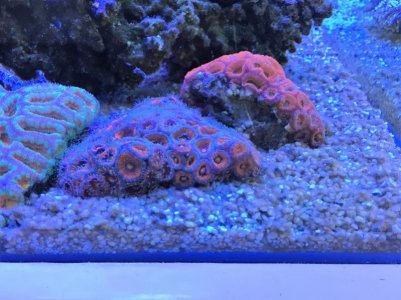
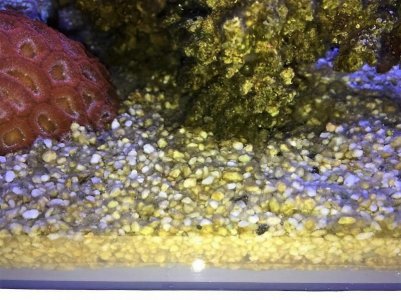
My sand grains look very large compared to my local fish shop. Ive attached the a picture (its not the best).

My sand bed is about 1 inch.

My power heads are running up to 50% because they will either stress the corals too much or start blowing the sand grains around.
 

Attachments

  • Sandbed.jpg
    Sandbed.jpg
    85.6 KB · Views: 2
  • unnamed.jpg
    unnamed.jpg
    93.1 KB · Views: 3
Last edited:
Yes that is on the large side in my opinion. Try to change it out for caribsea seafloor special grade. Has a good balance in large particle size, while not trapping detritus, but not small enough to be easily blown around. If you decide to try different sand, change no more than 30 percent of the sand bed, and no closer then 2 weeks apart. So siphon out the right 1/3 of the sand bed as an example, add your new (rinsed) sand there. Wait two weeks, do the middle 1/3, and the final 1/3 two weeks following that. You can use a section of 2" pvc with a funnel to get the sand where you want it without making a complete mess of your water. It will be a little cloudy after, but should clear up quickly.
 
Yes that is on the large side in my opinion. Try to change it out for caribsea seafloor special grade. Has a good balance in large particle size, while not trapping detritus, but not small enough to be easily blown around. If you decide to try different sand, change no more than 30 percent of the sand bed, and no closer then 2 weeks apart. So siphon out the right 1/3 of the sand bed as an example, add your new (rinsed) sand there. Wait two weeks, do the middle 1/3, and the final 1/3 two weeks following that. You can use a section of 2" pvc with a funnel to get the sand where you want it without making a complete mess of your water. It will be a little cloudy after, but should clear up quickly.

Thank you
 
Back
Top