Best of both worlds: DSB covered with smooth surface 'open bottom' partition (the DT)

MadReefist

New member
What if one filled their bottom with x" of sand bottom, but then laid a flat piece of plexi/glass partition across the bottom covering it?

Might the plexi be cut real snug limiting transfer? Or let in in loose around the edges?

Maybe snug around the dges but 'port' holes drilled in in various spot(s)?

Once this ball is rolling, might we assume the deeper the better that makes sense for the tank dimensions?

Might there be some sweet spot sand depth that would render it about all the filter it'd ever need? I suppose a skimmer would still be essential in such pursuit.

If this is a new technique, I'll name it the "Dual Bed" Method.

I'm really liking this idea, but although my new little tank build experiment is in a primordial state, its bent on diverse (preferably higher order) plant experimentation (plants with roots).

Sucks is I dumped off a unique tank perfect for this not a year ago. The thing was super tall with extra thick glass: It was about 42" tall by about 38" wide and maybe 16" thick. Just didnt have the space outside even.
 
Seeing the open/empty bottom tanks touring the LFS's recently (I had been out of the scene for a few years) did sell me on this idea of having a 'clean' glass bottom. In my other tanks builds I had so many pump heads that water movement was a plenty, so I never went and got a standalone internal powerhead (my logic I guess was for the energy ought to run a filter element).
But now that I'm running a smaller simpler design it's now clear to me just how effective these PH's are.

It seems a properly tuned setup, especially across an smooth open bottom, that the tank could be damn near self cleaning.
Whereas with that large sand surface interface being 'all up in those guts' there's all sorts of detritus bomb potential outcomes.
Yet the natural filtration function of a sand battery offers perhaps unparalleled natural bio-filtration so in most cases we'd have to be crazy to not have it in the loop.
Despite that, short of there being proper plant roots throughout a sand volume: with it being the primary surface where most all the detritus goes it seems to me as being about as big a 'sane' gamble we might ever embark on.

Now I have been mostly out of the game a good long while, so there may be some angles & insights I'm missing here?

I've gathered there are different 'zones' within a DSB. Perhaps this method, with a snug fit and minor interface holes, might quickly establish the battery as the 'deeper zones' whereas normally in a full interface it might only ever amount to a 'upper level' zone?
 
Last edited:
I'd either put holes in it or elevate the 'floor' a bit off the sand bed. How are you planning to put flow over the sand bed?

Is there a specific dynamic you'd be seeking in having that 'empty space' beneath the partition layer?


The total design would go something like:
-The Partitioned Sandbed. [for handling mainly dissolved solids]
-The Live Rocks. [for handling detritus + dissolved solids]
-The Protein Skimmer. [for handling mainly detritus]
-The 'polishers' (low tech plants like macroalgae's or terrestrials [mangrove, sea purslane]; or those fancy pance high tech go-go-gadgets). [for handling mainly dissolved solids]

The sand bed level might ought to have say Fiji Mud at the very bottom, then stack up with gradients of different mesh crushed coral / lava sand.

It seems that assuming this is all sound concept, a hypothetical is that if one had a internal protein skimmer they could damn near have an inclusive tank with but a couple mere power cords running into / hanging upon it.

Of course the big questions are how best to go about the 'vents' in the partition, and this concept you've raised of how to design the ceiling of the bed chamber...
 
Last edited:
I'm absolutely speaking through what I've read on the internet and some intuition that may or may not be correct.

I am assuming 3 things.
1) You want your plate for the clean look, not to change the dynamic of the sand bed.
2) For a sand bed to be effective it has to have some nutrient exchange with the water. I'm assuming this is surface area based, so a sand bed with more surface exposed to the water has a higher capacity.
3) Sand in the bed beyond some depth (say X inches) aren't doing much. There has to be a point of diminishing returns. If a 6" sand bed works (just an example number) then a 12 inch sand bed will be only marginally better if any and an 18 inch sand bed when compared to the 12 will have no significant benefit.


Having said all that that: Say you put a sand bed of X depth in a 120 gallon tank (24x48 inch footprint). If you leave say a 1/4 inch open space around your plate then the sand at the center of the tank is effectively 12 inches 'deep' and has very little opportunity to exchange anything with the 'surface' where it is exposed at the edge. Raise it up a bit and move some water through there then you still have lots of area for exchange.
 
I see. Hey I edited in a big section to my response to you while you were responding^^

This concept pushes the possible in-tank extremes of a totally zero oxygen hypoxic zone to best harness the anaerobic bacteria/microbeasties.

Another advantage I was motivated by was if it could be pinned down pretty snug, if one had to they might be able to move such a device without it being the end of that world (especially if this method results in a very clean tank system wide). I've yet to drain/move any tank and it not be total holocaust conditions down low no matter the device or the methods.
 
What advantage would this method have over putting the sand in the sump?

This isn't to say the good old sump is lacking...

Yet what I'm hoping this concept would achieve is the lack of need for a sump. Reduced need for sump pumps, or much of anything at all hanging off of the tank. Assuming massive effectiveness could be achieved via this method.

Sleek, slick, simple, efficient, inexpensive, all natural, and even portable (if needed) is what I'm reaching for here.

Minimal moving parts. Minimal external potential leak/electrocution sources. Coupled with LED lighting: minimal power needed (like less than 100W total in many cases).

A partitioned sand bed, the critterscape, an internal protein skimmer, as many powerheads as needed, an internal refugium partition 'box' maybe, would be taking this sleek simple concept to the extreme, in this thought experiment. And thats it? (Oh, and an LED light and heater)

In this method the refugium 'box' would merely have to be big enough to hold the amount of plants and maybe a bit of rock needed to support the tank. Mere vent slots in this faculty would be needed. Powerheads are already moving the water around in the tank, so there doesnt have to be a pump dedicated to this feature?
 
Last edited:
Having said all that that: Say you put a sand bed of X depth in a 120 gallon tank (24x48 inch footprint). If you leave say a 1/4 inch open space around your plate then the sand at the center of the tank is effectively 12 inches 'deep' and has very little opportunity to exchange anything with the 'surface' where it is exposed at the edge. Raise it up a bit and move some water through there then you still have lots of area for exchange.

Adding on:
One of the insights I followed was in coil denitrator dynamics. It's about having such a slow rate that its basically dripping out of the outlet into the tank. Slooooow.

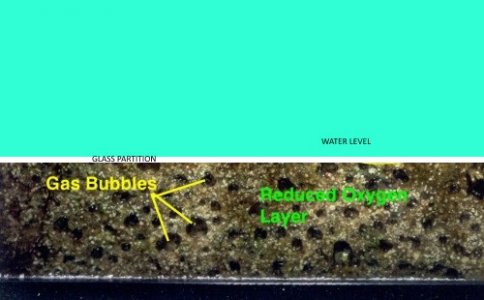
So following this logic it seems to me that a snug partition could cut the top layer off this concept:
Bubbles.jpg

Which in the goal of minimalism/simplicity only even half the sand might be needed. If this is true there's the issue of what the ideal (yet minimal) thickness would be?

Skimmer foams out the solid gunk. Plants handle the rest.

Although I'm now thinking it important for a sort of 'snorkel' tube function say up a back corner to increase gas exchange potential from the under chamber with the water surface (this 'tube' would rise above the actual water level)...
 
These only work until they crash... This has been done before and its not will it crash its when will it crash...


I lost everything in a 8 year old DSB SETUP Just as you are explaining... IT WORKS Great until it becomes over loaded. Then you end up with a HUGE PILE OF GREENISH BLACK STAGNATED SUBSTRATE AND DEAD TANK......
 
^^ Mmm, can't say I agree w/ that, Paul B's tank just hit 44 years going now.
I've had DSB's in different tanks for 30 years now w/out issues.
Having creatures in your sand bed that clean it I think is key, that and maintaining or setting up properly.
There's more than one way to set up a tank, and it should be based on the animals you plan to keep, if they need a sand bed, that should be provided.
Of course this topic will be beat to death over and over again.
 
Bubbles.jpg

Into:
Partitioned Sand Bed.jpg

Has this been tried before (in a public manner of speaking)?

Perhaps a substrate of fine crushed seashell would provide a better medium in terms of minimized ability to decay (into greenish black goo)? Fine crushed lava seems a good fit likewise?

44 year old tank I'd like to see & study that!

Are the critters as needed assuming a lack of the grungy top oxygen layer normally being relevant for detritus 'filtration'? Whether it works or not, having a scratchy layer at the bottom catching the detritus just doesn't seem a most ideal method for dealing with the gunk and the goo. Go stir one up and it should scream.
 
Last edited:
The 44 year old tank:
http://www.thereeftank.com/forums/f6/tank-birthday-40-years-162151.html

Interesting! He's talking about still using an undergravel filter. It hadn't occurred to me the parallels my concept has with UG filters.

Hmmm...
That's right I forgot about "Plenum's":

"In a marine aquarium, a plenum is just an open area of water underneath a sandbed that has been separated from the sand above by a grate and a fine mesh screen. The main point of a plenum is to create a near-anaerobic (low oxygen) area beneath a deep (4 to 5 inch) sandbed where specific bacteria that break nitrates down into nitrogen gas can thrive.
...
The main concern is that some areas of the plenum will develop true anaerobic conditions without any oxygen. In this case, excess organic waste may be converted to hydrogen sulfide, which is toxic and has the potential to “tank” the tank, so to speak.
The other concern has to do with the idea that eventually, the system’s efficiency will be compromised in the long term as excess detritus accumulates, but this hasn’t been conclusively proven yet. Also, there are various design considerations that may play a role in a marine plenum’s long-term viability.
This is a very simplified description of a marine plenum system."[/i}
http://www.fishchannel.com/fish-blogs/into-the-aquascape/2009/09/plenum.aspx

...
 
Last edited:
I don't believe his is typical, I recall seeing something of him calling it a reverse UG or plenum or something, been a long time, can't remember.
But either way, I don't think there is any gauranteed success nor failure between BB SSB or DSB.
I keep sand dwelling sea anemones, and there are many that keep animals that need to burrow.
The animals that I keep make the call on what they need and I just do my best to provide.
If I did a straight sps dominant I would maybe do BB...actually since I don't like the looks of BB I'd probably make something manmade that at least looked ok, but still allowed me to do very heavy flow and keep pristine params as needed.
 
Why not just do a RDSB and replace it whenever it's super-saturated with crud? Seems like it would be a lot quicker and easier than removing your rockwork, to remove the plexi, to mess with the sand.


If I did a straight sps dominant I would maybe do BB...actually since I don't like the looks of BB I'd probably make something manmade that at least looked ok, but still allowed me to do very heavy flow and keep pristine params as needed.

Say a faux sand bed made of a paper-thin layer of sand glued to the bottom?
 
Why not just do a RDSB and replace it whenever it's super-saturated with crud? Seems like it would be a lot quicker and easier than removing your rockwork, to remove the plexi, to mess with the sand.


Say a faux sand bed made of a paper-thin layer of sand glued to the bottom?

Exactly, that has been done in many different ways from what I have seen on here.
 
Back
Top