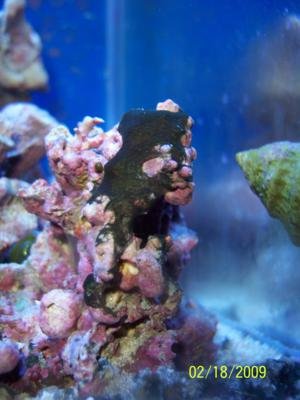
Black algae??

karimwassef

Active member
Ok. I've tried to ID this several times without success. Please take a look

<iframe width="560" height="315" src="https://www.youtube.com/embed/h2kI5u65AQ4" frameborder="0" allowfullscreen></iframe>

When thin, it has a jelly consistency.
When thick, it has a fleshy consistency.
It's attached quite well and prefers very high flow and high light, but it comes off in sections or mats with no roots or fibers into the rock.

Could it be a complex structure with more than one organism? Maybe a bacteria base with algae growing on top and then a protozoan top?
 
I 'd take it under a full spectrum light to reveal it's true color and then a microscope before and after some beating to break it up into it's components.

My bet is on Cyanobacteria on top of something else.
 
The chicken liver sponge usually has openings (like little round mouths) but this doesn't. It also doesn't get very thick. The thickest piece may be ~2mm?

The fact that it is encrusting is strange though
 
My bet is on Cyanobacteria on top of something else.

I bet cyanobacteria as well.
My sump has grown cyano of 4 different colors: neon pink, light green, brown, dark green - virtually black. That's not counting the typical red slime cyano I've had in my tank also.

bacterial mats in my sump have developed the textures and thickness you talk about as well, and have that rough edge appearance when torn, and pull off in patches similar to what you saw.

On the other hand...
I scraped some black patches from my live rock and looked at the fragments under the scope and saw clear rectangular cell walls with pigmented areas inside (chloroplasts) - all arranged in strands that were packed tightly together.
In other words I would have guessed bacterial mat, but it was algae. (it didn't peel up in patches though)

I know many would never touch it, but I've become an increasingly big fan of spot treating H2O2 on trouble areas.
a half a ml here and there can take care of quite a lot of cyano/algae issues, and cyano is especially sensitive.
 
This stuff is right up against the coral tissue and rock interface. I've used peroxide before. It's one of the safer options. But the proximity means that it won't have much distance to dissipate before impacting coral tissue.
 
I would suspect Terpios hoshinota, a black encrusting sponge that gets it's color form a simbiotic cyanobacteria.
 
It sounds right but the pictures don't really match up. This cyanosponge (didn't know that such a thing existed) looks to be very aggressive and invasive on coral tissue. My "growth" is very slow in comparison. Maybe I'm just seeing it in the early stages.
 
help...

<iframe width="560" height="315" src="https://www.youtube.com/embed/sn3mUXQKZtQ" frameborder="0" allowfullscreen></iframe>
 
Try this.Cyano

bluegreencyano

Forms a slimy mat of green goop for lack of a better term. Usually dark green despite name.

While it should be treated like regular cyano, this stuff is generally more difficult to get rid of because most clean up crew species are uninterested in it. Chitons, limpets, and nerites can eat it, but dont expect them to do the whole job for you.

Manual Removal: Wipe glass with mag float, light toothbrush hardier corals and the rocks. Cyano on the sand can sometimes be pulled off as a mat and discarded. You should use a net or a siphon to remove the cyano dislodged by the toothbrush. Don't be discouraged if it comes right back, cyano grows fast and is extremely efficient at consuming nutrients. To make matters worse, species under this heading seem better at handling nutrient lulls than other forms of nuisance algae.

Starving it out : Use a phosban reactor, or granulated ferric oxide to remove excess phosphates in the system. Check to make sure you are not feeding any foods that are particularly phosphate rich. Almost all foods when converted by animals will add to the tank's phosphates levels, but prepared foods like seasoned nori and low quality fish meals tend to be higher in phosphates than other foods. Liquefied foods tend to have more waste than others, plankton cultures that haven't matured can lead to blooms as well. Such feedings should be suspended or stopped if possible until the outbreak is under control.

Chaeto and other macroalgae will help maintain parameters to keep cyano from forming, but because cyano is an epiphyte, (can grow on other life forms), it may starve your desirable algae from light. During an outbreak make sure to keep you macro clean so it can receive light and survive the ordeal.Chemical products exist to remove it, make sure to take into account for possible hypoxia issues. This can usually be done by heavy surface agitation to ensure oxygen levels remain adequate.
 

Attachments

  • image.jpeg
    image.jpeg
    39.2 KB · Views: 6
yes. The fleshy look is ok but when you remove it, you can see that it looks like hair algae but with a fleshy base. I wave it around in the water to show the feathery structure.

Also, it digs in between the coral calcium base and the rock. Its attachment is much more solid than cyano. I do have cyano in my sump and that blows away with a little wave.

As far as reducing nutrients, my tank is exposed to the elements and I've reduced the inflow as much as possible.

As far as export, I have a 12ft skimmer that generates 2 quarts of fluid waste a day and about 2 lbs of solid waste a month. I have 5 kinds of scrubbers (3 ATS, chaeto, xenia), a cryptic zone, compartment DSBs, two GFOs and I run bi-weekly (once every two weeks) water changes at 100gal each.

I also have a dozen tangs, snails, crabs, hermits, etc... My sand is always white. My corals grow very quickly, killing each other before I can frag and give away. They consume about 2 lbs of kalkwasser a month.

This "algae" must have a major predator. The only one I can find is urchins. My urchins do love it, but they are too big to get in the cracks and they're a disaster ripping up my reefscape.

If I could get tiny black urchins (like I see at the beach), that may help.
 
Just chemi-clean your tank. Make sure to turn off the skimmer while treating or it won't be effective. It'll remove that stuff if it's cyano. Starving it doesn't work in my experience. Once it's in the tank, it's hard to get rid of without the chemical treatment. And you should see no ill effects on your corals or other tank inhabitants.
 
Actually... I did the the chemiclean but I overdrove my aeration (no skimming) in my skimmer by dropping the water level in it.

The tank turned into a massive bubble bath with a thick layer of suds that was about 4" thick on top. The black algae became dislodged but it stayed cohesive and fleshy. Then the crabs came out and ate the fibrous parts underneath and that got it off the rocks.

So cyano was part of it, but it wasn't cyano only.

Nothing died. In fact my coral polyps we're opening up like crazy while the "soap effect" from the chemiclean was active.

I've never heard of anyone else experiencing this effect but I strongly recommend using excessive aeration (no skimming) with CC. The result was spectacular and my biofauna exploded afterwards.
 
Here's my sump a day later

<a href="http://s1062.photobucket.com/user/karimwassef/media/C5A2FA12-B435-4FA7-A1D2-A7D7718F1AF1_zpsoba8kvsn.jpg.html" target="_blank"><img src="http://i1062.photobucket.com/albums/t496/karimwassef/C5A2FA12-B435-4FA7-A1D2-A7D7718F1AF1_zpsoba8kvsn.jpg" border="0" alt=" photo C5A2FA12-B435-4FA7-A1D2-A7D7718F1AF1_zpsoba8kvsn.jpg"/></a>

<a href="http://s1062.photobucket.com/user/karimwassef/media/62159C78-0222-4394-A17E-0AF315E6C7D6_zpsoj8rl8lw.jpg.html" target="_blank"><img src="http://i1062.photobucket.com/albums/t496/karimwassef/62159C78-0222-4394-A17E-0AF315E6C7D6_zpsoj8rl8lw.jpg" border="0" alt=" photo 62159C78-0222-4394-A17E-0AF315E6C7D6_zpsoj8rl8lw.jpg"/></a>

<a href="http://s1062.photobucket.com/user/karimwassef/media/EA6E615A-1B57-46B7-8C10-1C3537FB77FF_zpsrbh2jbnc.jpg.html" target="_blank"><img src="http://i1062.photobucket.com/albums/t496/karimwassef/EA6E615A-1B57-46B7-8C10-1C3537FB77FF_zpsrbh2jbnc.jpg" border="0" alt=" photo EA6E615A-1B57-46B7-8C10-1C3537FB77FF_zpsrbh2jbnc.jpg"/></a>
 
I did my usual 100gal water change and it slowly cleared up. My skimmer helped too, of course.

I have to say that the foam didn't hurt anything though. In fact, my tank loved it.
 
Back
Top