calling all Alluminum heatsink expert

Isayso

New member
hi all I need some input /help

I was given 2 pieces of Aluminum plates
their measure is
L 48" x W 4 1/4 x 1/4 thick and around 4-5 pounds in weight
the question is....
can I use this as heat sink for a DIY Led Project?

thanks.

45323169492_4948d994c7_z.jpg
[/url]Aluminum plates

45373988981_c7da2e1854_z.jpg
[/url]Aluminum plates

45373988311_d5cdff6b88_z.jpg
[/url]Aluminum plates
 
Short answer? Yes, maybe, and no.

Longer answer is it depends. How much heat you are pumping into it, for how long, in what sort of conditions, etc...

It won't be good at getting rid of heat (relatively speaking low surface area, and its thick) but it will soak some up for a while. That while could be enough, or it could be lots too little...

How much heat are you planning on making?
 
^ yep..

Of course it can be a heatsink...
Most black box LEDs just use an aluminum plate that has no fins at all..
If its sufficient or not for your build depends on the specifics of your build..
It will easily handle all of those LEDs in the back of picture 1...

Being a "good" heatsink is about surface area.. A flat plate by itself doesn't have nearly the surface area of one with tons of fins/pins or whatever...
 
no expert and thermal management is sort of part art,science, and trial ..BUT this is a bit of a "rule of thumb" approach..

If you want the LEDs to run a long time and be the most efficient, then 12 sq in per watt is a good "conservative" place to work. This will work for pretty much any LEd.

The other end of the thermal area needed - about 1 in sq per watt - is on the aggressive side, and will result in higher die temperatures, somewhat shorter life, and slightly less efficient.
http://www.candlepowerforums.com/vb/showthread.php?272979-Calculating-heat-sink-for-power-leds
you have approx 408 sq inches...thickness is really of lesser importance and adds little, at about "2W" of heat dissipation w/ the conservative approach..


So one "rule" says you can do like 430W another one says 35W... ;)

Pick one or in-between...;)

Now that also assumes you are actually going to RUN them at 10W which, if cheap chips, wouldn't be recommended anyways..
 
Wow didn't know
All these rules
And yes they are two
Opposite data's
12 sqi x watt ??
Wondering what the
Companies are using
For the black box
 
12in^2 per watt? ha ha ha ha...
Black box LEDs are doing WAY more wattage than that...


first off I want to say 12 sq inches per watt IS extreme but ssumes passive cooling..

BB's use 2 fans....and run about 2W at the diodes..
100W-ish is probably a more realistic "guess"..
180 sq " boards..Lets just say 2 sq " per watt w/ active cooling..


Reefbreeders use finned heatsinks and fans on some of their boxes..

Actually surface area "could be" is much larger.. based on this:
It's a Mars Aqua hort light. much bigger than a black box though.
20160621_163011-jpg.589023


CORRECTIONS:
suspect smaller bb's have no finned heat sink
Many use 3 fans for cooling..

@12square inches per real watt. for 100w flat plate would be around 34"x17" plate passive.. w a large margin of error (not really subtracting any diode footprints.)
 
Last edited:
So if I install 24 leds of 10 watts each, and run them at 900 MA
or 850 ma instead of 1000 and also installing 3 fan on the top should be ok? Not the best but ok?
Thanks
 
Personally, I dislike fans but a lot depends on where you put the lights.. You encoded? Open top ect..

I really don't think you will have an issue w/out the fans and lower currents...900-ish might push each to it's 10W depends on the chip..

to be honest, it's going to be a bit of trial and error..

What drivers are you planning on using?
 
There are dozen of models of HLG120's.. ;)


anyways I guess you are planning on running the 10W chips in parallel to divide the driver output current..

Since most common 10W chips run around 34V V(f) and 120 drivers capable of that voltage have 4A or less available..

Soo @ 6 per driver your max current to each is 600mA to 300mA
 
Hi there the leds are in Serial,
The driver puts out
120V at 1a
Right now on my old rail I'm running 11 leds
The leds can be run at 10 to 12 volts
120 /11 = 10.9 volts @1000 mA
 
I suggest you run some tests if you already have the LEDs and drivers. Take some readings and see where the temp starts to level out. Surface area is the key but a small fan can make a big difference.

Typically, LED intensity starts to diminish above 105 deg f and if you run them long over 135, they won't last.

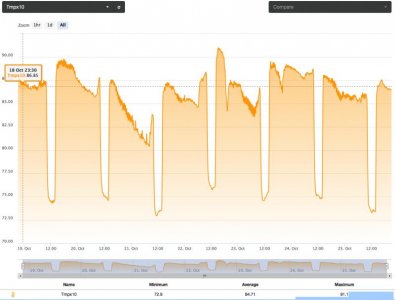
I've been using these 3.5 inch pucks that you can find on eBay. They have less than 10 sq in on each but there are (15) one watt LEDs on them, so.. far greater than the amount recommended above. There are no fins but i do have a small fan blowing on four of them. Without the fan they would burn up in a day or two.

I put a temp probe on one of them and monitor it with the Apex. These are my refugium lights. If the temp goes above 110, I shut them off.

I've attached the temp graph.
 

Attachments

  • screenshot_109.jpg
    screenshot_109.jpg
    45.3 KB · Views: 9
I can't see that alloy plate being useful much at all. The life of the LEDs will be diminished greatly if they are not cooled efficiently.

Basically, an LED produces a lot of heat behind the chip & this heat needs to be sucked, or absorbed away from the chip to keep the chip at a reasonable operating temperature.
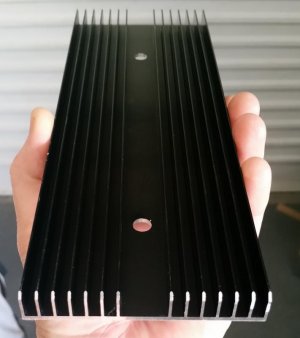
A heatsink absorbs this heat. But the heatsink must be able to cool quickly & efficiently itself so it doesn't over heat. If it can't cool rapidly enough its temperature gets closer to the temperature produced at the chip & its ability to absorb enough heat away from the chip is drastically diminished. So the heatsink cannot be made from a material (normally aluminum) that is too thick because it will hold the heat. As already pointed out fins greatly increase the surface area of a heatsink and that enables it to radiate heat - loose heat, much more quickly/efficiently.

This is a heatsink I use. The base is only 2mm thick, & the fins 1mm thick.
 

Attachments

  • heatsink.jpg
    heatsink.jpg
    40.6 KB · Views: 7
Thanks ozla
I need to check the temp
I think tha is above the 100 f

Thanks for the suggestion Twinfallz
Did you buy that heatsink locally?
 
Thanks ozla
I need to check the temp
I think tha is above the 100 f

Thanks for the suggestion Twinfallz
Did you buy that heatsink locally?

FIRST I'm not arguing against "proper heatsinks" but this isn't exactly what you asked about.
This is enough to passive cool 10W chips (at least for me for a few years b4 abandoning the build). Granted a lot of surface area and a lot of convection air movement arounfd the sink but not really very big.
Temps would easily go over 120F..
heatsm.jpg

SECOND there is a large difference between cheap chips and quality modern chips:
The XB-D LED, among many other new
Cree XLamp LEDs, is binned at 85 °C, so the relative flux data is based on 100% light output at an 85 °C junction temperature.

That's 185F "at the core"...cheaper chips should probably be kept below 158f..
NOTE: That is at the core not the sink.


Easiest "fix" if you think the chips are heating too much is just tweak the drive current down a bit..
Less current less heat but oddly the LED's become more efficient..

Oh and yes black anodizing.. and even black paint radiates heat off the sink better than a raw or polished surface. Not needed for fan cooled though.

I've seen plenty of things that shouldn't work, work just fine..

Would it be my choice? No. But it's free, large and, if needed, can be enhanced w/ thermal pasting some fins on top..

Cheap 10W chips are like $2.50 each...

Again, heat sinking is complicated and even manf need to do Real world tests over any calcs and guessing..

 
Last edited:
Back
Top