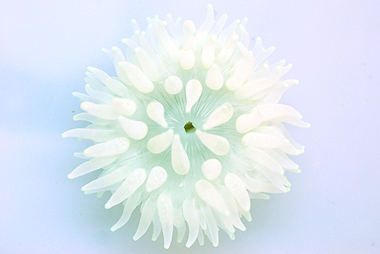
can a anemone be truly white?

auem

New member
is it possible ?
see this...it's appeared in BZA....
LTA2_101202_PS.jpg
 
There are anemones that have white pigments on their tentacles like the one pictured. There are even solid white, deep water anemones that don't rely on photosynthesis. All of the anemones typically kept in captivity do rely on photosynthesis. They contain zooxanthellae that are different shades of brown. This gives the anemones we keep a brownish color. In anemones like the one above, there may be white tentacles and white lines on the oral disk, but the underlying color should be brownish.
 
There are anemones that have white pigments on their tentacles like the one pictured. There are even solid white, deep water anemones that don't rely on photosynthesis. All of the anemones typically kept in captivity do rely on photosynthesis. They contain zooxanthellae that are different shades of brown. This gives the anemones we keep a brownish color. In anemones like the one above, there may be white tentacles and white lines on the oral disk, but the underlying color should be brownish.

^^^

A perfect description. Elegance needs to write a reference book!

Think about it this way: if the pigment in an anemone was strong enough to block all light (and thus appear white to our eyes), it would block the light necessary for the zooxanthellae to survive.
 
What about the Merten's Carpet Anemone?

http://www.advancedaquarist.com/2010/2/inverts

Stichodactyla mertensii

Range: Malasia, Indonesia, Southern Japan, East African Cost to Australia

S. mertensii, or Merten's carpet anemone, is the rarest of the carpet anemones, and is seldom seen in the ornamental aquatics trade. Merten's carpet anemone is the only species of the large carpet anemones that is naturally found attached to rocky substrates, usually in deeper water than S. haddoni and S. gigantea, and can be identified by it's flattened, 'rock-hugging' appearance, short tentacles, verrucae (small finger like projections) on its small pedal disc, and is the only species that has a naturally occurring white (non-bleached) color variation. Merten's carpet anemone occurs in the aforementioned white color morph, as well as green, tan, and purple.

 
What about the Merten's Carpet Anemone?

A picture is worth a thousand words :)

There are factual inaccuracies in that article (that I KNOW of), so I immediately question other items that are presented without a source. Perhaps the author is referring to an anemone with white-tip tentacles? Without a source, it is impossible to determine.
 
A picture is worth a thousand words :)

There are factual inaccuracies in that article (that I KNOW of), so I immediately question other items that are presented without a source. Perhaps the author is referring to an anemone with white-tip tentacles? Without a source, it is impossible to determine.

Yeah, I would love to see a picture of that.

I also agree, that article has bothered me too.


The only time I have seen white in a healthy hosting anemone is the stripes in some S. Haddonis, similar to one of mine,

SIPerc3-1.jpg
 
Bonsai

Bonsai

Mertens is the only carpet anemone that has white in it when it healthy.
Here are some pictures. Mertens have like feeder tentacles that are a different color then the rest and longer. Edit( Thank you todd i forgot haddoni too)


IMG_1795.jpg

good2.jpg

IMG_2171.jpg

IMG_2155.jpg

IMG_2166.jpg

VXBkYXRlUGhvdG8uanBn.jpg

MertensCarpet1.jpg
 
Mertens is the only carpet anemone that has white in it when it healthy. ( Thank you todd i forgot haddoni too)

...and C. adhaesivum.

adhe1.JPG


adhe2.JPG


I have seen very light mottled tentacles on S. helianthus, but I would not call them white.

But back to the subject of the thread - can an anemone be truly white? I guess you could say (when speaking of clownfish anemones) that parts of an anemone - i.e. tentacle tips or individual tentacles - may have white pigment, but no anemone (that we are aware of) will be predominantly white for the reasons we posted above.

I think the poster may be specifically referring to completely bleached individuals being sold as a "white anemone". Certainly the M. doreensis in his first photo is bleached to the point of appearing white...
 
Last edited:
Back
Top