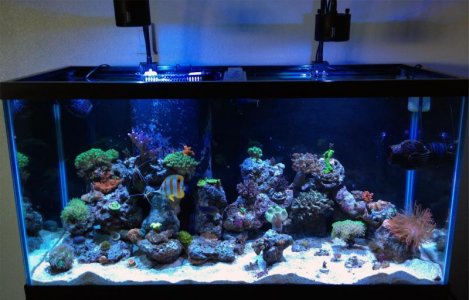
Carbon or no Carbon?

A bucket is not as long a path length as looking through the length of a biggish aquarium.

Here's the difference I saw when initiating ozone (was already using carbon), looking through 4 feet:

Ozone and the Reef Aquarium, Part 3: Changes in a Reef Aquarium upon Initiating Ozone
http://reefkeeping.com/issues/2006-05/rhf/index.php

from it:

Figure 1. Two digital photographs of a plastic bar taken through four feet of aquarium water. The bar on the left was taken before using ozone, and the bar on the right was taken after two weeks on ozone. The numbers were written onto the bar with marking pens. All camera settings were identical.

tn_Figure1_jpg.jpg


and looking straight on:

Figure 2. Overall photographs of my 120-gallon reef aquarium. The top one was taken before adding any ozone, and the bottom one was taken after two weeks on ozone. All camera settings were identical.

tn_Figure2_jpg.jpg
 
A bucket is not as long a path length as looking through the length of a biggish aquarium.

You've never seen the size of my buckets :dance:

Seriously. I use the old IO buckets that are quite tall and I've done a similar test. I used Profoto strobes which measure 5500K with my Minolta color meter and shot from the top down. I used a Phase One camera tethered and read the white values in Capture One. There was a 300K difference in the worst case. Typically a lot less.

I guess I should have mentioned that after 30+ years as a professional photographer I know what white looks like and how to verify it.

I'm not disputing the use of Ozone for a moment. I thought the thread was about running a successful reef tank without carbon.
 
I'm not disputing the use of Ozone for a moment. I thought the thread was about running a successful reef tank without carbon.

Quite true. I was just challenging the assumption that one can tell whether the water is yellowed just by looking at it in the tank. :)
 
Quite true. I was just challenging the assumption that one can tell whether the water is yellowed just by looking at it in the tank. :)

I don't doubt that's true but I only referred to judging the water color against white in comparison to a 'clean' sample of fresh water. I never suggested anyone could judge yellowing in a tank, particularly under the very blue/white 10K/14K/20K light sources we use.
 
I like the discussion in this thread so far. :)

Randy (or anyone)... Do you think that throwing carbon in my tank for a week or so can throw things off/negatively affect my tank?
 
Quite true. I was just challenging the assumption that one can tell whether the water is yellowed just by looking at it in the tank. :)

I don't doubt that's true but I only referred to judging the water color against white in comparison to a 'clean' sample of fresh water. I never suggested anyone could judge yellowing in a tank, particularly under the very blue/white 10K/14K/20K light sources we use.

Excuse my ignorance. I am still somewhat of a beginner in this hobby... So I am a little confused here. Isn't yellowing mostly a visual thing. I can see how it would be hard to tell if it is yellow when there is nothing to compare but if compared to a clean water sample, isn't that enough? What is "yellowing" then? is it more than just color?
 
Yellowing is an indicator of organic compounds in the water which inhibit light.

I would think a visual comparison would be the most the typical reef keeper would be need and/or have the resources for.
 
I started out running carbon, then stopped because I thought I was over-cleaning my water and starving out my corals. Recently I put it back in my reactor - mixed with the GFO, super low flow - because I'm in a horrible battle with cyano. Is it indeed the case that cyano can dump toxins into the water as it dies or just in general?
 
I started out running carbon, then stopped because I thought I was over-cleaning my water and starving out my corals. Recently I put it back in my reactor - mixed with the GFO, super low flow - because I'm in a horrible battle with cyano. Is it indeed the case that cyano can dump toxins into the water as it dies or just in general?

Hey Jedimaster, you might want to look into setting up a DIY algae scrubber. I was battling cyano as well so I decided to build one. Now my display tank has no cyano at all or GHA. Nitrates are at zero as well now and before I was struggling to keep it below 5ppm. Below is a pic of my tank I just took, if you look at the rockwork closely there is zero cyano and everything is super clean. (I did not clean the tank either before taking the pic :) )

attachment.php


I probably wont run another tank without a scrubber. Just something to possibly try on your tank as well! When the cyano dies off just keep the skimmer running strong! I did not use carbon during the process of removing the cyano but I'm sure it would have helped!
 

Attachments

  • photo-42.jpg
    photo-42.jpg
    65 KB · Views: 19
Isn't yellowing mostly a visual thing.

Yes, and that's the context here, but yellowing from organics also extends into the UV (and is much more pronounced in the UV), and many people think that the near UV impacts coral coloration. :)

That's a potential reason that folks are cautioned to start GAC slowly. The sudden increase in visible and UV light hitting corals after carbon has reduced organics in the water can damage them. Some folks have, unfortunately, experienced this first hand.
 
Isn't yellowing mostly a visual thing.

Yes, and that's the context here, but yellowing from organics also extends into the UV (and is much more pronounced in the UV), and many people think that the near UV impacts coral coloration. :)

That's a potential reason that folks are cautioned to start GAC slowly. The sudden increase in visible and UV light hitting corals after carbon has reduced organics in the water can damage them. Some folks have, unfortunately, experienced this first hand.

Gotcha! That is very interesting about the UV/light actually negatively affecting the corals due to clearer water. Thanks for all your help good sir! :beer:
 
Since the title of the thread is "carbon or no carbon" not just tanks that don't use it I have a few thoughts:

Turf scrubbers add organics ; they don't reduce them.

Yellowing of the water is only one effect of certain types of excess organic material,which does decrease light intensity and can be measured optically; "gelbstoff", ,typically humic andd fulvic acids .
Granulated activated carbon(gac) removes organics ,primarily those that are hydrophobic ,repelled by water. Gelbstoff is readily removed by gac as are other organics. There are hundreds of thousands of organic compounds or more usually formed by decaying material ,exuded by living organisms in the tank or brought in with foods. In excess they can be harmfull to corals and other organisms; not all of them yellow the water. The organic materials often contain organically bound phosphate and nitrogen and heavy metals;so removing them to prevent excess limits the amounts of these elements that can be released as the organics degrade in the aqaurium.

There are many good reasons to use gac judiciously, imo and experience.


Algae turf scrubbers add organics ; they don't reduce them,btw.
 
Algae turf scrubbers add organics ; they don't reduce them,btw.

True. And Ozone doesn't remove them either. It just breaks them down to smaller components which may or may not allow your skimmer to remove them.
 
The algae scrubber was a side comment not related to yellowing and using carbon. Just a way of nutrient export. Guess I should have said that.... Thanks for all the help/advice guys!

Still don't know yet, can adding carbon to the tank without use for over a year have a negative affect? I plan on just throwing a bag of Chemi-pure in the sump in a high flow area.
 
I've heard reports of carbon causing coral problems, possibly by increasing light penetration, but adding a small amount and building up should be safe, assuming the Carbon isn't being ground up by the flow.
 
Back
Top