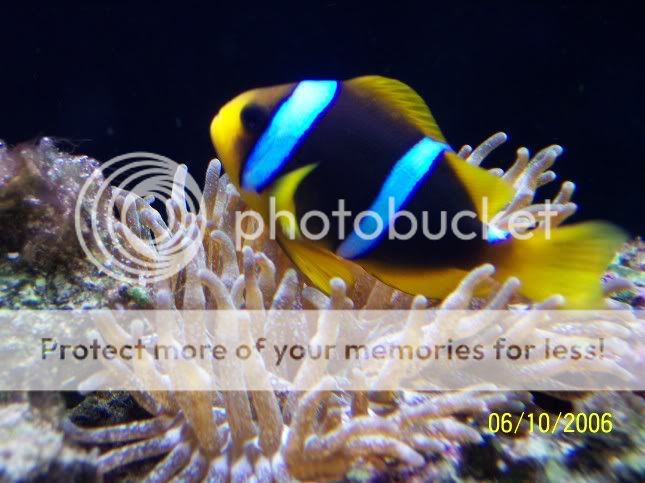
chrysopterus color change.

Ron Popeil

Love them clownfish.
my question today is on the topic of color change.

first up is a pair i acquired several months ago, collected from the solomon islands. brightly colored with a bold yellow and black pattern. they looked just as good as this:

achrysop.jpg


but then, within a matter of a few months, the fish are now completely black. both of them. as seen in this terrific photograph:

DSCF0861.jpg


now, with my most recent vanuatu pair, the female is starting to change her colors. originally her colors were essentially indistinguishble from the males (except for size) and looked like this:

DSCF0881.jpg


but in the month or so i have had the fish, the female appears to be changing into this:

Amphiprion_chrysopterus.jpg


the dorsal fin has lost the intense yellow. but the peculiar thing is the male is maintaining his bright colors.

in my first example of color changing fish, since it occurred in both specimens, one would think that perhaps diet was factor that caused the change. but in my second example, since both fish consume the exact same types of food, this suddenly negates that idea. i try and feed my fish the widest range of foods i can (several brands of frozen, flake, pellet) using mixtures of brine, mysis, spirulina, cyclopeeze, silversides, krill, etc.

what are some other factors of color change? why would the female suddenly change color, but not the male? why would both solomon island fish suddenly change all black?

any ideas?
 
I have had a tough time with my white tailed chrysopterus losing their colors as well. Both of mine (not kept in the same tank) have done a "brown out". The dark colors fad to brown and the yellow darkens to brown. If you figure it out let me know.
 
Re: chrysopterus color change.

<a href=showthread.php?s=&postid=8138471#post8138471 target=_blank>Originally posted</a> by Ron Popeil
in my first example of color changing fish, since it occurred in both specimens, one would think that perhaps diet was factor that caused the change. but in my second example, since both fish consume the exact same types of food, this suddenly negates that idea. i try and feed my fish the widest range of foods i can (several brands of frozen, flake, pellet) using mixtures of brine, mysis, spirulina, cyclopeeze, silversides, krill, etc.
No answers, but diet is not eliminated since a female clown utilizes quite a different assortment of sustaining materials for specific hormones, egg production, etc.
 
Same here, Ron. My Vanuatu pair both lost their bright colors (photos would look just like yours). One of them (female I think) seems to be getting some back, but not to where it was. I was feeding predominantly Formula I (80%), with some mysis and VHP mixed in. That always did well for my fish as far as color went. But these Vanuatu chrys have me trying more foods. Now they get a pretty even assortment of Spirulina, Formula I, VHP, cyclopeeze, silverside chunks, mysis, prawn, and plankton. Since it only took 2 months to lose their bright colors, figure it will take a while to see any improvement. Going to load up the mysis and plankton with some vitamin supplements as well (never liked doing that, but hey). They are obviously missing something that they were getting in the wild. We need to find out what that is. My last pair of white tailed chry (origin unknown) maintained their bright colors for the 2 years I had them on the Formula I diet. I do believe it is a diet issue, since they do not appear stressed (anymore), and they have the same anemone they had in the wild (supposedly). Keep us posted if anyone can figure out the missing ingredient.

Dan
 
This is the reason why I have always stayed away from the White tail variety. I have a orange fin pair that still has great color. The male has lost some color but is coloring back up great. I've noticed that White tails usually turn drab compared to their first few months in captivity.

My theories:
1 I think the nutrition is not the key in this situation

2 I think host anenome is the key element. Yes we know what they host in nature but they're are several anenome's they host in so we should do comparsion amongst color and anenome's.

3 Lighting, if these fish are collected at a deeper water perhaps our lights are just fading them out.

just some theories
Phender and Dan please post some pics

100_1418.jpg


100_1381.jpg


as you can see my male needs a little coloring but he is still very small, about 1 1/2 -2"
 
Host anemone species are usually implicated whenever melanistic variations of A. chrysopterus are discussed.
Has everyone here ruled out the possibility?
 
My pair was purchased as a group. Fish and anemone were collected together, so the anemone species should not be an issue since they were together in the wild (again, supposedly).

Dan
 
Gary, thats exactly what I was thinking, but I thought that mostly carpets were responsible for darkening clowns, what do ya think.

maybe it would help if everyone listed the Anenome they keep with their chrys'

Pair of Orange fin Chrysopterus hosting in BTA (soon to be H.Crispa)
 
my solomon island chrysopterus were not collected with an anemone, were paired by me, and placed in a tank housing mainly brownish green BTAs

the vanuatu pair came in collected as a pair and with their original anemone, a purplish violet h. crispa. as of right now, its too soon to see what will become of their color, but it will be interesting to see how and if they change. but as stated earlier, its just the female undergoing the change right now.
 
well, i wanted to see if i could challenge your statement eric, so i went back and looked at my very first pair of chrysopterus. this was a pair i had for well over a year and a half.

8415chry_1.jpg


this was the female in QT and this was what she developed into:

P1010010_1.jpg


you can see she developed to be quite dark on her body, which seems pretty standard for YT. marinas breeding pair seemed to be almost black on their bodies. however, there is still a fair amount of bright yellow to the finnage. ill add this following picture because it shows the male in the background, who appears to still maintain fairly brighter yellows on his fins, in contrast to the slightly duller female.

P1010017.jpg
 
seems like they didn't go as dark as the white tails but still darkened with time. I guess we should expect this as every other clownfish seems to darken with time.
 
I think my WT chrys and Ron's were imported at the same time (June 2006), as they were also with a large, purple crispa from Vanuatu. Still convinced it is a diet issue, but only time will tell.

Dan
 
<a href=showthread.php?s=&postid=8146381#post8146381 target=_blank>Originally posted</a> by Dan
I think my WT chrys and Ron's were imported at the same time (June 2006), as they were also with a large, purple crispa from Vanuatu. Still convinced it is a diet issue, but only time will tell.

Dan
If diet is the cause of melanistic variations, how are observations in the field explained?
I'm not saying that diet in captivity has nothing to do with coloration, but there are color variations of this species (in the ocean) that seem to coincide with the age of the fish and it's host anemone choice.
 
Melanism is a different phenomenon than the color fading discussed here. Melanism is the production of darker pigments (usually in response to sunlight). The variety in Ron's top photo has those black pelvic fins, which have been attributed to "melanism" caused by anemone species. But the fins remain black, even after the fish have lost their orange (second photo). What I see here is that the bright orange is what is fading. This is not a "melanism" issue, which is why I emphasize diet. Diet is indeed highly responsible for color in animals, or should I say the "intensity" of color. Our chrys still have the pigments of orange, just not as intense. To me that has "diet" written all over it. I hope we can figure this out 'cause they sure were pretty.

Dan
 
<a href=showthread.php?s=&postid=8147621#post8147621 target=_blank>Originally posted</a> by Dan
The variety in Ron's top photo has those black pelvic fins, which have been attributed to "melanism" caused by anemone species.
I thought that black pelvic and anal fins in chrysopterus indicated a geographical variation.
FWIW: I've seen bright orange finned chrysops living in Merten's carpet anemone.
 
gary, im with you on the geographically variation of specific features (ie the black pelvic and anal fins) but what happened in my fish was all the orange from the dorsal, pelvic and anal fins, as well as the color surrounding the face faded completely. the whole fish just turned black within a matter of months.

and i think this is where dan and i are suggesting diet may be repsonsible.

ive also seen dozens of images of chrys in mertens with wonderful colors. but, now this is a ridiculous stretch, perhaps we arent seeing more drab, darkened chrys in wild photographs due to their unattractiveness in comparison to more brightly colored specimens? perhaps they are more common out there, and/or it is an age related issue (in which case its highly coincidental the above hobbyists all noticed a sudden "aging" within a few months.)

just a thought.
 
I did notice a slight darkening of the tail of my male Orange fin


BTW, I've never seen a wild photo of a pair in anything but a carpet, just assuming a merten's.
 

Similar threads

Back
Top